
The questions that come before the phone call.
Plain, clinically reviewed answers to the decisions families and professionals face before treatment begins. No sales language, no scare tactics, just the information you need to decide well.
Authored by the MLJ Clinical Team. Reviewed under board-certified psychiatric oversight. Last updated September 2026.
How This Library WorksMost people do not arrive at treatment with one question. They arrive with a tangle: is this bad enough, what would it involve, how long, what about work, what if it does not hold. We have organized this library around the order those questions tend to come in, from the first flicker of "is it time" through the day-to-day reality of being inside a program. Read the stage you are in. Skip the rest until you need it.
Every guide here is written by the same clinical team that treats clients in our six-bed home in Encino, reviewed under psychiatric oversight, and updated as guidance changes. Where we make a clinical or legal claim, we cite the source. Where the honest answer is "it depends," we say so and explain on what.
On This Page
Is it time for residential treatment?
For the moment when you are still asking whether this is serious enough, and what stopping safely actually requires. These guides are for the person at the kitchen table at midnight, and for the partner or parent sitting across from them.
- Do I Need Residential Treatment?. An honest self-assessment guide for a hard question.
- Medical Detox vs. Quitting at Home. Which withdrawals are dangerous, and what stopping safely involves.
- Detox Timelines by Substance. Alcohol, benzodiazepines, opioids, fentanyl, and stimulants on the same ten-day clock, and when supervision is a necessity.
- What Happens on the Admissions Call. Who answers, what we ask and why, and what you do not have to decide before you hang up.
Understanding the levels of care.
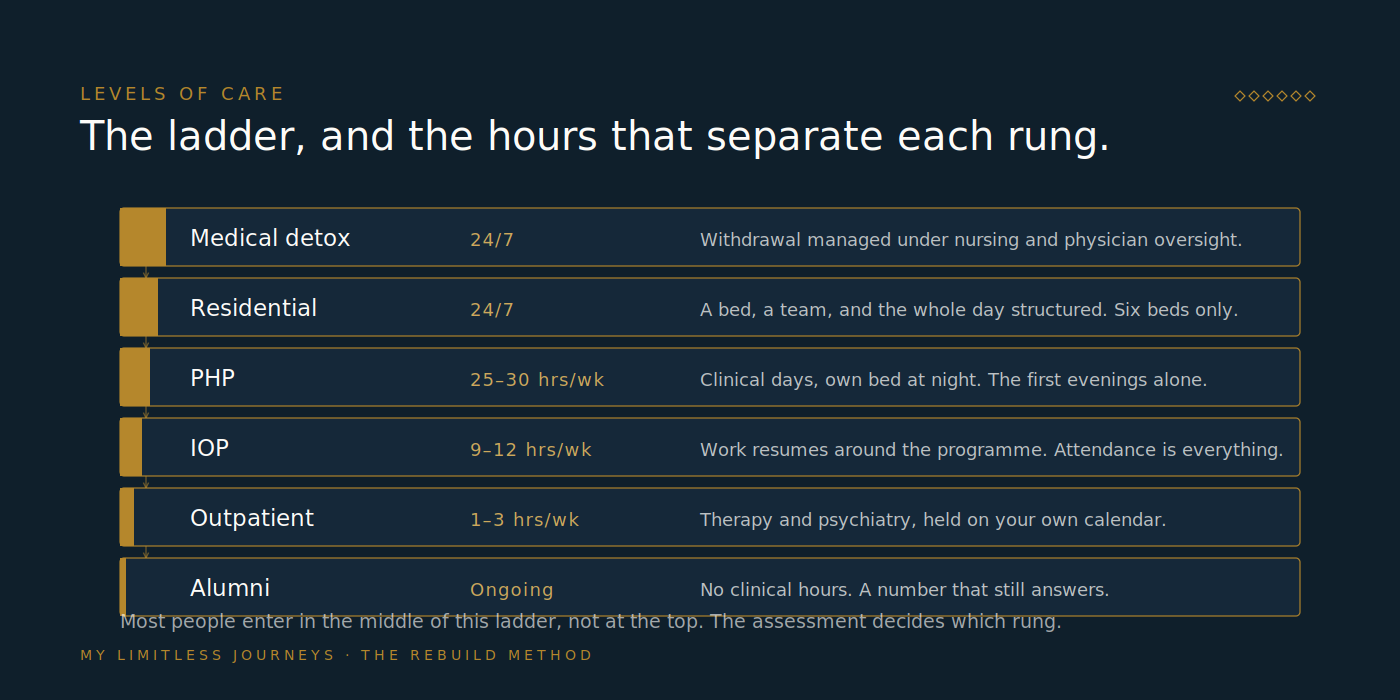
Detox, residential, PHP, IOP, aftercare: what each level actually is, how they differ, and how long treatment realistically takes. Also here: how to compare programs against one another, and what changes when a psychiatric diagnosis is part of the picture.
- Levels of Care Explained. The full continuum from detox to aftercare, compared side by side.
- IOP vs. PHP. Which outpatient intensity fits, and when neither is enough.
- 30, 60, and 90 Day Programs. What length actually changes, and how insurance decides.
- How to Choose a Rehab. Twelve questions to ask any program on the phone, with the answers we give to each.
- Levels of Care for Co-Occurring Disorders. Why psychiatric contact frequency, not just substance use, drives the decision.
- Transitional Living vs. Sober Living. Two terms used interchangeably that describe very different amounts of care.
How the right care gets chosen.
How clinicians match intensity to need, and what it means when a previous plan did not hold. These guides open up the assessment process so you can see the reasoning rather than just the recommendation.
- How the Right Level of Care Is Determined. The assessment process, explained without jargon.
- The ASAM Criteria in Plain Language. The six dimensions behind every level-of-care decision, and what the clinician is listening for.
- What a 1:1 Clinical Ratio Means. Individual sessions per week, nursing coverage, psychiatric contact, and why six beds makes it possible.
- Why Relapse Happens. What a setback actually means, and what to do in the first 24 hours.
What treatment is actually like.
The day-to-day reality: schedules, therapy, the difficult first week, and the role your family plays in all of it. Also the questions people are often embarrassed to ask, about laptops, about wanting to leave, about what the nurses are actually doing.
- What Treatment Actually Looks Like. A day-by-day picture of residential care.
- The First Week in Residential Treatment. What to expect when everything is new.
- What Medically Supervised Means. Nursing coverage, physician oversight, vitals cadence, and when a hospital transfer happens.
- Can I Work During Treatment?. Phones, laptops, and clinical boundaries, level by level.
- Leaving Treatment Early. Why the urge arrives around day four, what AMA means, and how to talk about it.
- The Family's Role in Recovery. For the people who love someone in treatment.
One clinical team, writing what it practices.
My Limitless Journeys is a six-bed residential program in Encino, in the hills above the San Fernando Valley, licensed by the California Department of Health Care Services and accredited by The Joint Commission. We provide a full continuum, from medically supervised detox through residential, PHP, IOP, transitional living, and an alumni program, with one clinical team throughout. The guides in this library describe how we actually work, which is why they say things a marketing department might not, such as when a lower level of care is the right answer, or when the honest response to a question is that no one knows yet.
beds, never more
clinical ratio, hour by hour
confidential admissions line
Our approach, the Rebuild Method, treats recovery as reconstruction across four domains, body, mind, life, and self, inside a perimeter of discretion. You will see that framework referenced throughout these pages. Our editorial policy explains how content is reviewed and when it is updated.
Six more libraries, for the questions that follow.
Treatment Guidance covers the decisions about care itself. The questions around it, who will know, what happens to your work, how detox actually goes, what your family should do, how it gets paid for, what happens after, each have a library of their own.
- Privacy in Treatment. What federal law protects, what your employer can and cannot learn, and how six beds changes anonymity.
- For Professionals. Treatment for people whose work, reputation, and calendar cannot simply be set aside, from on-camera talent to physicians and attorneys.
- Medical Detox. Substance-by-substance withdrawal timelines, tapering, medications, and sleep in early recovery.
- For Families. What to do when someone refuses help, how to support a partner through detox, and how family therapy works here.
- Paying for Treatment. In-network and out-of-network benefits, single-case agreements, private pay, and what happens after you submit a verification.
- After Treatment. The first 24 hours after a relapse, going home versus transitional living, and the first ninety days back at work.
- Our Programs. The full continuum of care at MLJ, from detox to alumni.
- The Rebuild Method. The four-domain framework behind everything we do.
- Frequently Asked Questions. Shorter answers to the practical questions about admission and daily life.
- Encino. Where we are, and why a private hillside home matters.
- What Is Residential Treatment?. A blog post on what to expect at an inpatient program.
This library is educational and is not a substitute for medical advice. If someone is in immediate danger, call 911.