
Sometimes the best treatment isn't in your zip code.
We do not have a facility in Orange County. Our six-bed residence is in Encino, roughly an hour north of Newport Beach, Irvine, and Anaheim when the 405 is moving. This page explains why a meaningful number of Orange County families make that drive on purpose, which levels of care travel well and which do not, and what the practical side looks like for the people who love you.
Authored by the MLJ Clinical Team. Reviewed under board-certified psychiatric oversight. Last updated September 2026.
Key Takeaways- My Limitless Journeys has no Orange County location; every level of care happens at or around a private six-bed home in Encino, in the San Fernando Valley.
- From most of Orange County the drive is 50 to 70 miles and about an hour off-peak, closer to two in rush hour; we plan admissions and family visits around that reality rather than pretending it away.
- Detox and residential treatment are the levels of care where distance from home is a clinical asset; day programs are not, and we say so plainly on the PHP and IOP pages.
- Orange County has one of the densest concentrations of treatment programs in the country, and for many professionals that density is exactly the problem: the odds of being recognized in a waiting room are real.
- We work with Aetna, Anthem, Cigna, Kaiser Southern California, and UnitedHealthcare, and we verify benefits before anyone drives north.
Why leave a county full of treatment centers.
If you live in Orange County and have started searching, you already know the paradox. There are more licensed treatment programs within twenty minutes of Costa Mesa than most states have in total. Supply is not your problem.
The problem is that the county is small in the ways that matter. The corridor from Huntington Beach through Newport to Laguna is, socially, a series of overlapping villages. The person at the next table at a fundraiser is a client of your firm. Your daughter's coach is a patient of your practice. When a treatment program's morning group has forty people in it and the program itself sits in a business park you drive past on the way to work, the probability that someone in that room knows someone you know is not small. For an attorney, a physician, a founder, or someone whose face is part of their business, that probability changes whether they go at all.
There is a second, quieter reason. The people, places, and routines that held your use in place are local. The parking lot where the drop happened, the harbor bar, the friend who always has more, the pharmacy on the way home. Cue-triggered craving is not a character flaw; it is how a conditioned brain works, and the National Institute on Drug Abuse describes environmental cues as one of the most reliable drivers of relapse. Sixty miles does not erase those cues. It does put a freeway and a full tank of gas between you and them during the weeks when your judgment is least reliable, and that is worth more than it sounds.
Our residence holds six people. No lobby, no van with a logo, no morning group in a strip-mall suite: a house on a hillside in Encino, address shared only at intake. Our privacy guide explains why headcount is the variable that matters most.
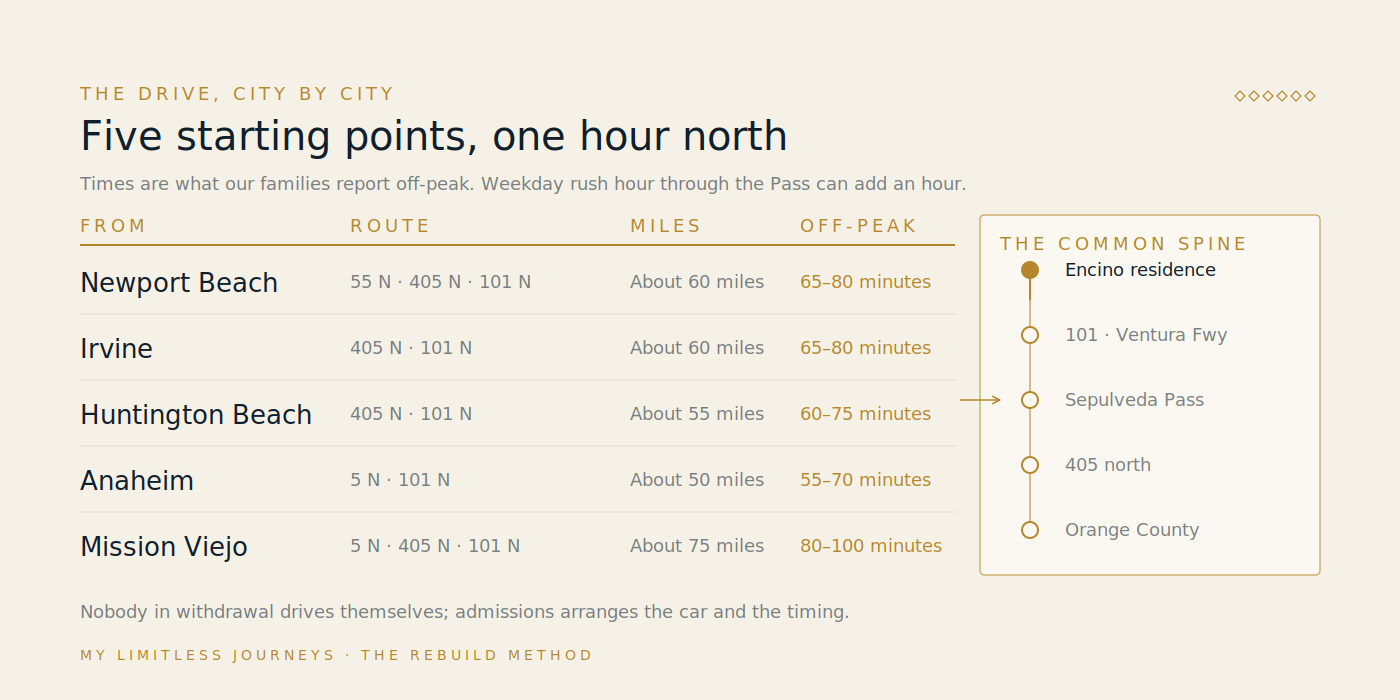
The drive, city by city.
We would rather you plan around real numbers than be surprised. Encino sits along the 101 (the Ventura Freeway) just west of where the 405 comes over the Sepulveda Pass. From nearly all of Orange County the route is some combination of the 5 or the 55 to the 405 north, over the hill, and a few minutes west on the 101. The times below are what our families report for a Saturday morning or a late evening. Weekday rush hour on the 405 through the Westside and the Pass can add an hour on its own.
| From | Typical route | Distance | Off-peak |
|---|---|---|---|
| Newport Beach | 55 north, 405 north, 101 north | About 60 miles | 65–80 minutes |
| Irvine | 405 north, 101 north | About 60 miles | 65–80 minutes |
| Huntington Beach | 405 north, 101 north | About 55 miles | 60–75 minutes |
| Anaheim | 5 north, 101 north (or 5 to 405) | About 50 miles | 55–70 minutes |
| Mission Viejo | 5 north, 405 north, 101 north | About 75 miles | 80–100 minutes |
Two notes. Nobody in withdrawal should drive themselves; the Orange County detox page explains how arrival day is arranged. And the drive is a one-time event for the client but a periodic one for the family, which is the key to the next section.
Which levels of care travel well.
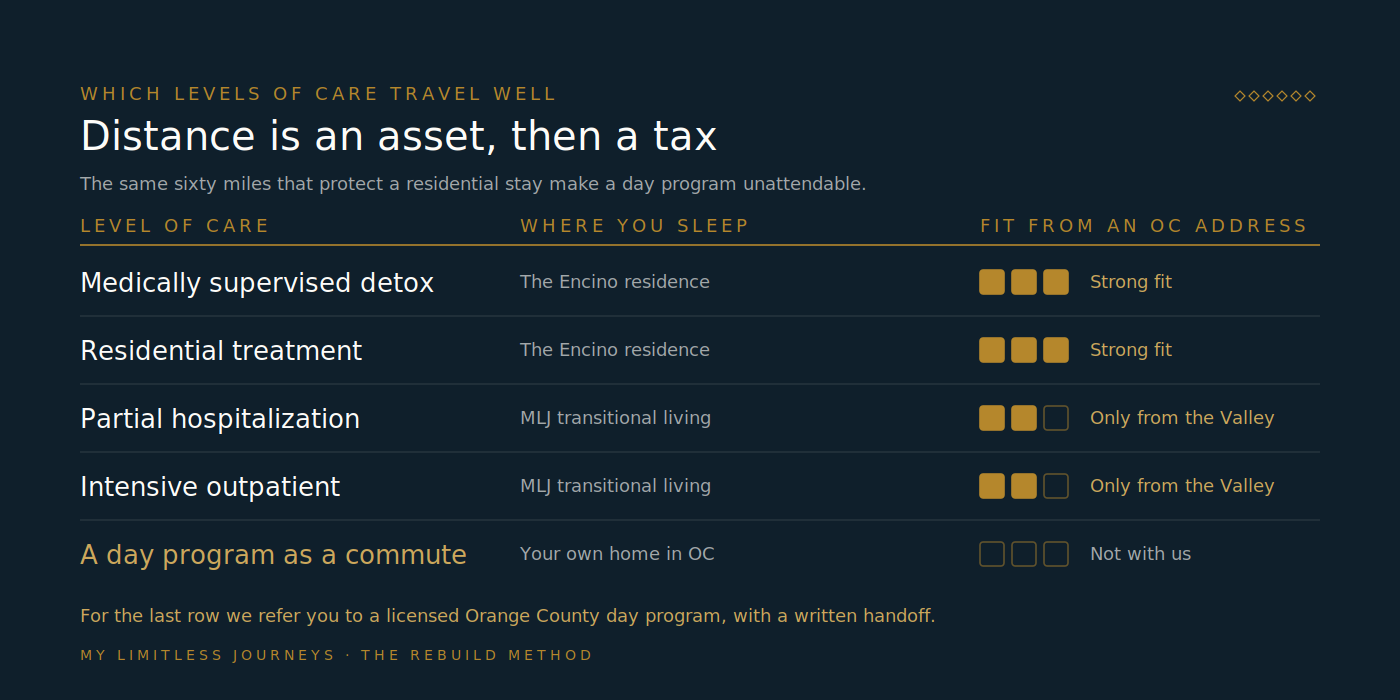
Distance is a clinical variable, and it cuts both ways depending on the level of care. For detox and residential treatment, you live at the residence. You make the drive once, on the way in, and once on the way out. Everything in between happens inside the house or with the clinical team, and the sixty miles behind you function as insulation. This is the level of care where an hour away is a feature, and we have written a dedicated Orange County residential treatment page about it.
Partial hospitalization and intensive outpatient are different animals. They are day programs. PHP typically runs five or six hours a day, most days of the week; IOP runs three hours a day, three to five days a week. Nobody should be commuting from Newport Beach to Encino for a three-hour session and then driving home in the dark on the 405. When Orange County clients step down into our PHP or IOP, they do it while living in our transitional housing in the Valley, a few minutes from the residence, with the same team that ran their detox. When that arrangement does not fit, an Orange County day program near your home is the right answer, and we will help you find one. Both the PHP page and the IOP page are written with that honesty.
If you are unsure which level you need at all, see how the right level of care is determined.
One team from the first night to the last call.
The most common complaint we hear from Orange County families who have done this before is not about quality. It is about handoffs: a detox in one city, a residential program in another, an IOP referral to a third, each with a new intake and a new history to retell. At MLJ the continuum is one staircase in one place, medically supervised detox, residential (thirty to ninety days), PHP, IOP, transitional living, and an alumni program, all run by the same clinicians under the same board-certified psychiatric oversight. The therapist who sat with you on night two helps you plan your first week back in Irvine.
The work follows The Rebuild Method: four domains, Body, Mind, Life, and Self, inside a perimeter of discretion. For an Orange County professional, the Life domain is where the distance question gets solved. Return-to-work planning starts at intake and is built around the fact that your job and your home are an hour south.
beds, never more
clinical team, detox through alumni
miles between you and the pattern
Families across sixty miles.
The first question a spouse asks is usually some version of "how often can I come." The honest answer is that in the first week, during detox, the answer is rarely, and that is clinical rather than logistical. After that, family therapy at MLJ is scheduled around the drive rather than around our convenience. Sessions are clustered so that a Saturday trip north can hold a family session, a meal, and unstructured time, rather than asking someone to make the 405 round trip for fifty minutes on a Tuesday afternoon.
Some of the work happens without the drive at all: secure video sessions, and early phone work with spouses and parents preparing them for the coming weeks. See the family's role in recovery and the For Families hub.
Distance also gives the household a break from daily proximity to the crisis. Parents who have been checking a bedroom door at 3 a.m. get to sleep. That is not abandonment; it is the start of the family's own recovery.
Insurance, employers, and referrals.
Crossing a county line changes nothing about insurance; your behavioral-health benefit follows you to Los Angeles County as it would to Costa Mesa. We work with Aetna, Anthem, Cigna, Kaiser Southern California, and UnitedHealthcare and verify benefits before anyone commits; the verification form takes minutes, and the Paying for Treatment hub explains what follows. Private pay is accepted, and some clients choose it for privacy reasons we describe openly.
On employers: federal FMLA leave, where it applies, requires certification of a "serious health condition," not a diagnosis, and the Department of Labor is the primary source on how that works. Our page on whether an employer can find out goes into the details.
Many Orange County admissions arrive through a referral: a therapist in Newport, a psychiatrist in Irvine, an interventionist, a physician who has watched a patient's labs drift. We coordinate with referring clinicians throughout the stay and hand the client back at discharge with a written plan, as described for referring professionals.
Every Orange County page, by question.
This hub is deliberately general. Each page below takes one question and answers it in depth for someone starting from an Orange County address.
- Addiction treatment. The full continuum explained for OC clients, and how each stage sits relative to home.
- Drug rehab. Opioids, fentanyl, stimulants, benzodiazepines, and why leaving the supply network matters.
- Alcohol rehab. High-functioning drinking in a county built around the harbor, the club, and the wine list.
- Detox. Medically supervised withdrawal, and how to get to Encino safely when you are not well.
- Residential treatment. The level of care where an hour away is the point.
- Partial hospitalization. For OC clients living in our transitional housing during step-down.
- Intensive outpatient. An honest account of when our IOP fits and when a local one is better.
- Newport Beach. The private-pay, discretion-first conversation.
- Irvine. The insurance-first, return-to-work conversation.
- South Orange County. Laguna, Dana Point, San Clemente, Mission Viejo, and small-town visibility.
- Recovery support groups in Orange County. What you come home to.
- All locations. Where this page sits in the larger picture.
- Orange County residential treatment. The level of care built for distance.
- Orange County detox. The first days, and getting here safely.
- The Encino residence. The neighborhood you would actually be living in.
- Residential treatment program. What the thirty to ninety days contain.
- Recovery support groups in Orange County. The network waiting for you at home.
This guide is educational and is not a substitute for medical advice. If someone is in immediate danger, call 911.