
Private pay: what it includes, and why some clients with good insurance choose it anyway.
Paying privately is not a consolation prize for people whose insurance fell through. For a meaningful share of our clients it is a deliberate decision about privacy, about who controls the length of stay, and about keeping one clinical team from the first day of detox to the last alumni call.
Authored by the MLJ Clinical Team. Reviewed under board-certified psychiatric oversight. Last updated September 2026.
Key Takeaways- Private pay means no claim is filed, so no insurer record, no explanation of benefits mailed to a policyholder, and no utilization reviewer with a say in your length of stay.
- A private-pay stay at MLJ is priced per level of care and includes clinical, medical, and residential services; we tell you in writing what is and is not inside that figure.
- Length of stay is decided by your clinical team and you, against documented goals, not against an authorization block.
- Some clients pay privately for residential and use insurance for step-down care, or the reverse; the two are not mutually exclusive.
- You can request an itemized statement afterward to seek out-of-network reimbursement yourself, though doing so recreates the insurer record you may have wanted to avoid.
Three kinds of people who pay privately.
The first group is the one everybody expects: people whose coverage will not reach. An HMO with no out-of-network benefit, a plan that excludes residential care, a lapse between jobs, a deductible so high that insurance is a technicality. For them, private pay is simply how treatment happens, and the questions are about structure and value.
The second group has excellent insurance and does not want to use it. They are attorneys who will one day fill out a bar renewal, physicians with a medical board, pilots, people in finance with licensing questionnaires, and people in the entertainment industry whose work depends on being perceived as reliable. What they want is for the fact of treatment to exist in as few databases as possible. A claim is a disclosure to an insurer, and while the law that governs that disclosure is strong, it is still a disclosure. We take that concern seriously enough to have written a whole section on privacy in treatment.
The third group has been through treatment before, usually with insurance, and remembers the phone call on day nineteen announcing that the plan had approved "through Friday." They watched a clinical decision get made by someone who had never met them, and they do not want that again. For this group, private pay is a way of buying back the clinical judgment they felt they lost. All three groups end up in the same six-bed house doing the same work; they arrived by different doors.
What a private-pay stay includes.
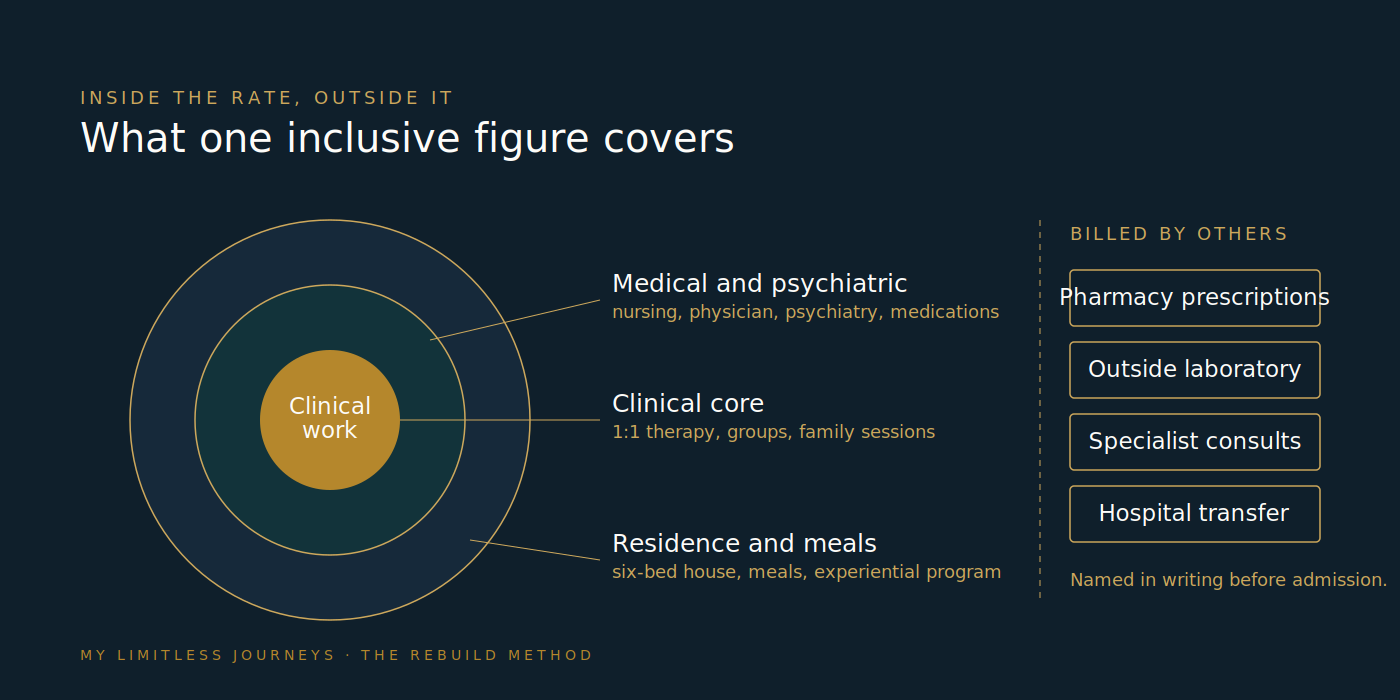
Private-pay pricing at MLJ is set per level of care, and the figure for each level is inclusive rather than à la carte. For medically supervised detox that means twenty-four-hour nursing, daily physician contact, medication management, psychiatric evaluation, meals, and the room. For residential it means individual therapy at a true one-to-one ratio, group work, psychiatry, family sessions, the experiential and somatic program, the Rebuild Method curriculum across Body, Mind, Life, and Self, meals prepared on site, and the residence itself. For PHP and IOP it means the clinical programming; housing during those phases is a separate arrangement through transitional living.
What is not inside the figure is also specific, and we say it out loud before admission: prescription medications dispensed through a pharmacy, laboratory work sent to an outside lab, imaging, specialist consultations we arrange on your behalf, and any hospital transfer. These are billed by the entity that provides them. If you have a pharmacy benefit and choose to use it for medications, that creates a pharmacy claim; if you would rather pay the pharmacy directly to avoid the record, tell us and we will arrange it. The point of an inclusive rate is not that nothing else can ever cost money; it is that you should never be surprised by what does.
What a claim creates that a private payment does not.
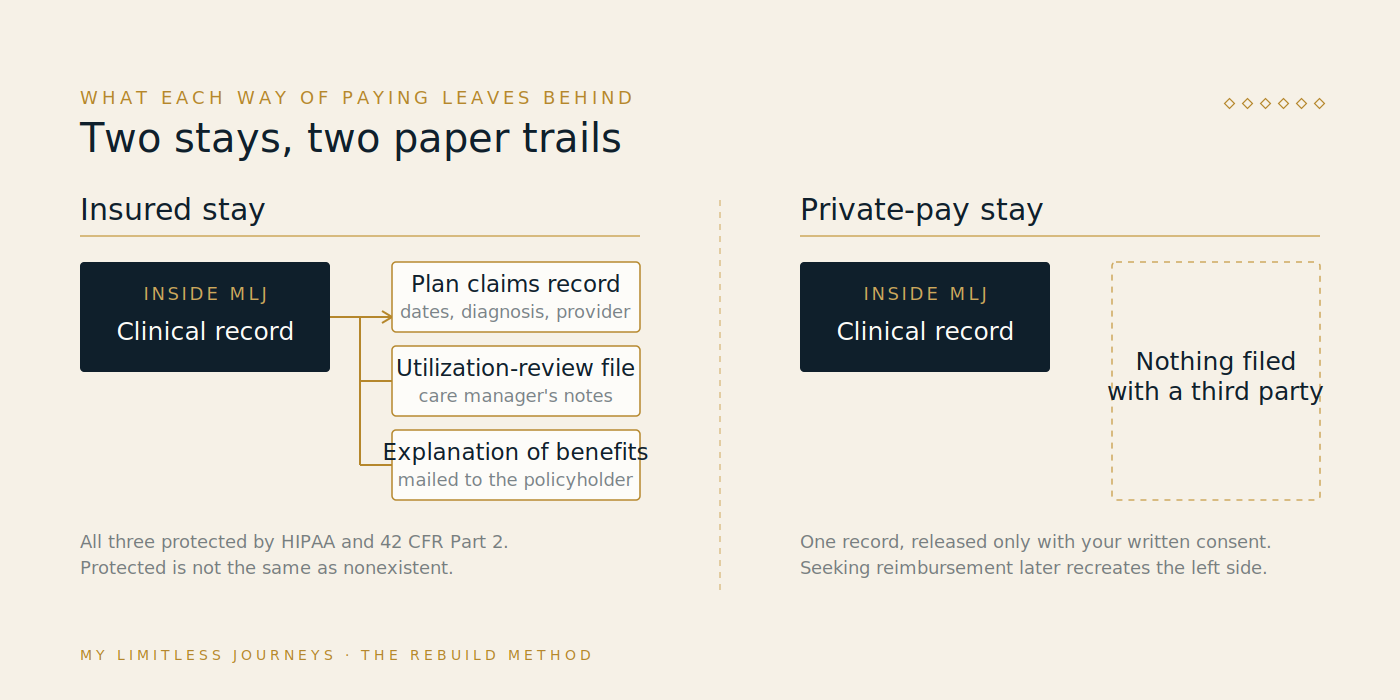
Be precise about what a claim does, because the fear is often vaguer than the fact. When a program bills your insurer, three things come into existence outside the program's walls. The first is a record in the plan's claims system that you received substance-use treatment, with dates, a diagnosis code, and a provider name. The second is a utilization-review file, the notes a care manager kept while deciding whether to authorize each block of days. The third is the explanation of benefits, a document the plan sends to the policyholder describing what was billed and paid.
All three are protected. HIPAA limits how the plan may use and disclose them, and the federal confidentiality rule at 42 CFR Part 2 adds further restrictions on records that originate with a substance-use program. Plans may not share them with your employer, and an employer-sponsored plan is walled off from the employer's human-resources function by law. But protected is not the same as nonexistent. The explanation of benefits in particular goes to the policyholder, which is a problem if you are covered under a spouse's or parent's plan and have not told them. Both federal law and California law give you the right to ask a plan to send communications to a different address or in a confidential manner; the request has to be made, and it has to be honored before the first EOB is generated. Private pay removes the question. The only record is our clinical record, which is governed by Part 2 and released only with your written consent. Our page comparing insurance and private pay for privacy walks through each of these documents in more detail.
Who decides how long you stay.
In an insured stay, length of stay is negotiated in blocks. The plan authorizes a span of days; the program documents progress; the plan authorizes another span or declines. Your clinical team's opinion carries weight in that negotiation, but it is one voice among two. In a private-pay stay, there is no second voice. The length of stay is set by you and your clinicians against the goals written in your treatment plan and revisited every week.
This is not a blank check, and it should not be. A program that keeps private-pay clients longer than it keeps insured clients with the same clinical picture is selling days, not treatment. Our discharge planning starts on the first day for everyone, and the criteria for stepping down from residential to PHP are the same regardless of who is paying: stable withdrawal, a psychiatric picture that no longer needs daily contact, a working relapse-prevention plan, and a living situation that can hold the gains. What private pay changes is the pressure. When the plan has approved through Friday and the clinician believes you need another ten days, someone has to make a decision under time pressure with imperfect information. When there is no Friday, the decision can be made on Tuesday, calmly, for the right reasons. Our guide to 30-, 60-, and 90-day programs explains what those reasons usually are.
One team, start to finish.
Insurance shapes treatment in a way that is rarely discussed: it fragments it. A plan may authorize detox at one facility, residential at a second that is in-network, and outpatient care at a third close to home. Each transfer means a new intake, a new history, a new set of clinicians who have to earn trust from zero, and a gap of days in which the most common thing that happens is nothing. Some of the relapses we see after "successful" treatment happened in those gaps.
MLJ was built as a single continuum with one clinical team, and private pay makes it easy to use it that way. The therapist who sat with you in detox is the one who runs your family session in week three and the one who calls you in month four from the alumni program. The psychiatrist who adjusted your sleep medication in the first week is the one who reviews it before you go back to work. Insured clients can have this too, and many do; it just requires more negotiation with the plan at each step. Private-pay clients have it by default.
How payment is structured.
The mechanics are straightforward and are put in writing before you arrive. Payment is arranged per level of care, with the terms for the initial phase settled at admission and each subsequent phase agreed before it begins, so that a step-down is a conversation rather than a surprise invoice. You receive an itemized statement at the end of each phase. Health savings account and flexible spending account funds can generally be applied, because treatment for a diagnosed substance-use disorder is ordinarily a qualified medical expense; your account administrator has the final say, and our statements are prepared to meet their documentation requirements.
Some clients pay privately and then, months later, submit our itemized statement to their plan for out-of-network reimbursement. That is your right, and we will provide what you need. Understand what it does: it creates the claim record you may have chosen private pay to avoid. It is a reasonable choice for the first group described above and usually the wrong one for the second. Families also frequently split the cost across sources: a parent covers residential privately while the client's own plan covers IOP, or an employer's assistance program funds a portion. We help you map that out on the first call. Our paying for treatment hub covers the broader landscape, including state disability wage replacement during a residential stay.
Deciding whether it is right for you.
Four questions usually settle it. Is there a professional license, security clearance, or contract in your life for which the existence of an insurance record would be a genuine problem, not a vague worry? Are you covered under someone else's policy, and have you told them? Have you been in treatment before and had a stay cut short by a reviewer? And can the cost be met without creating a financial crisis that will itself become a relapse risk in month two? If the first three point toward private pay and the fourth does not forbid it, the decision is usually clear. If the fourth is the obstacle, tell us; we would rather help you use your insurance well than have you not come.
- Paying for treatment. The hub: cost drivers, insurance mechanics, other resources.
- Insurance vs. private pay for privacy. Every document a claim creates, examined.
- Network status and single-case agreements. If you decide to use insurance after all.
- How six beds changes anonymity. The other half of the privacy equation.
- Residential treatment. What the inclusive rate actually buys.
- Executive and professional treatment in Los Angeles. For the second group described above.
This guide is educational and is not a substitute for medical advice. If someone is in immediate danger, call 911.