
How six beds changes anonymity: privacy as a headcount problem.
Laws protect your records. They do not control how many strangers see your face at breakfast. The number of people in a building is the privacy variable most programs never mention, and it is the one we designed around.
Authored by the MLJ Clinical Team. Reviewed under board-certified psychiatric oversight. Last updated September 2026.
Key Takeaways- HIPAA and 42 CFR Part 2 govern paper and data; they say nothing about how many other clients, visitors, and staff physically encounter you during a stay.
- In a sixty-bed program, a thirty-day stay can put you in front of well over a hundred people who now know you were there. In a six-bed home, that number stays in the low dozens.
- Anonymity is also about infrastructure: no lobby, no branded vans, no forty-person group room, no parking lot with a sign on it.
- Small does not mean isolated. Six people is enough for real group work and too few for anyone to disappear into a crowd, which is clinically useful.
- Six beds does not make you invisible; it makes the circle of people who know small, named, and accountable.

Why anonymity is a headcount problem.
When people worry about privacy in treatment, they usually picture a record: a diagnosis in a database, a claim on an insurance statement, a chart someone could subpoena. Those worries are legitimate, and federal law addresses them directly. The HIPAA Privacy Rule limits how your health information can be used and shared, and 42 CFR Part 2 adds a stricter layer for substance use treatment records specifically. We take both seriously, and we explain them elsewhere in this library.
But the record is rarely how people find out. In practice, the way someone learns that you went to treatment is that another human being saw you there and later said so. A fellow client recognizes you from a screening. A visitor's brother-in-law works at your firm. A night-shift tech from a large facility mentions a name at a party. None of that involves a data breach. It involves a room with too many people in it.
No statute regulates that room. Every one of the 150 people in a large program has a right to be there and no legal duty to forget your face. Which means the single most powerful privacy tool a treatment provider has is not a policy. It is a number. How many people will be inside the building with you, and how many of them will you have to see every day for a month?
We chose six. Not as a marketing figure but as a clinical and architectural constraint we hold ourselves to: six beds, never more, in a private hillside home in Encino. This page walks through what that number does and, just as honestly, what it does not.
The math of a thirty-day stay.
Consider a facility with sixty residential beds and an average stay of about three weeks, which is common in the industry. Beds turn over. Over your thirty days, you will overlap not only with the fifty-nine people present when you arrive but with the wave who replace them as they discharge. A reasonable estimate is that you share a dining room, a group circle, or a smoking patio with somewhere between ninety and a hundred and twenty other clients before you leave.
Add the staff a sixty-bed operation requires: nursing across three shifts, a group therapy roster, case managers, behavioral health technicians, kitchen and housekeeping, drivers, admissions, and administration. Sixty to a hundred employees is not unusual. Add family visitors on weekends. Add outside speakers for evening meetings. The total number of people who could, in principle, say "I saw you there" comfortably clears two hundred.
Now run the same thirty days at MLJ. Five other clients when you arrive. Perhaps three to five more who admit during your stay as others step down to PHP or transitional living. One clinical team, the same faces throughout, small enough that you will know every one by name within the first week. No outside speakers cycling through a lecture hall, because there is no lecture hall. The circle of people who know you were here stays under thirty, and every one of them is someone you can identify.
beds, never more
other clients you might overlap with across a full month
clinical team from detox through alumni
What a large facility cannot avoid.
Scale creates infrastructure, and infrastructure is visible. A sixty-bed campus needs a reception desk and a lobby, because dozens of people arrive and depart every week. It needs vans to move clients to outside appointments and meetings, and vans need to be parked somewhere, often with a logo on the door. It needs a large group room, because the economics of a big program depend on one clinician addressing twenty or forty people at once. It needs signage so that new arrivals, delivery drivers, and visiting families can find it.
A branded van outside a Ventura Boulevard coffee shop announces the identities of everyone who steps out of it. A lobby means you sit across from people you do not know while a stranger at a desk says your name aloud. A forty-person group means forty people hear your story, and a program that size can rarely screen for who already knows whom.
A six-bed home in a residential neighborhood needs none of it. There is no lobby, because there is a front door. There is no signage, because it is a house on a hillside and we do not release the street address until intake. Transportation is a staff member driving a personal-looking vehicle, not a fleet. Group therapy is six chairs in a living room. The absence of infrastructure is not a lack of resources. It is the resource.
| Exposure point | Sixty-bed facility | Six-bed residence |
|---|---|---|
| Arrival | Lobby, sign-in desk, waiting area | A front door, met by a clinician who knows you are coming |
| Group therapy | 20 to 40 people, rotating membership | Six at most, the same people all week |
| Transport | Branded vans, scheduled runs | Unmarked vehicle, staff driver |
| Location | Signed campus, public address | Unsigned home, address shared at intake |
| Staff you encounter | Sixty to a hundred, across departments | One team, known by name |
Who actually knows you were here.
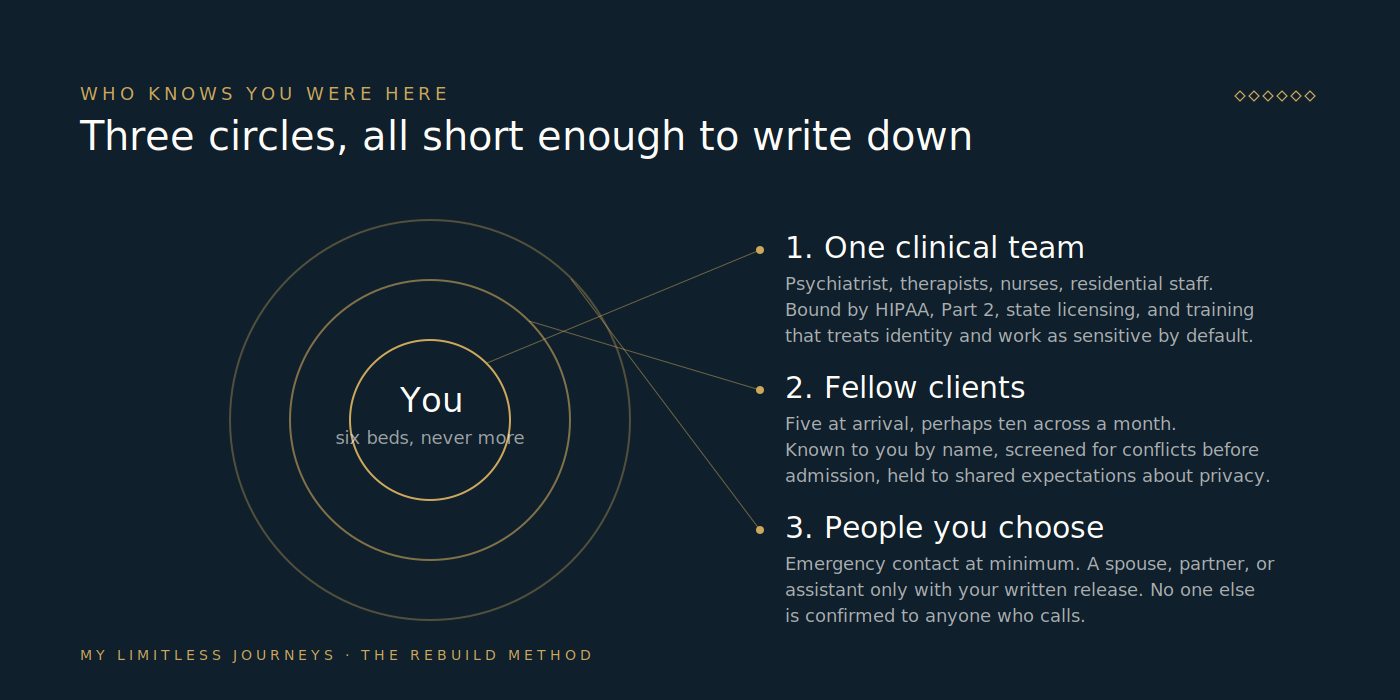
It helps to be concrete. At MLJ, the people who will know you are in treatment fall into three groups, and you have some control over each.
The first is our clinical team: the psychiatrist providing oversight, the licensed therapists, the nurses, and the residential staff. They are bound by HIPAA, by Part 2, by California licensing law, and by our own training, which treats identity, work, and reputation as sensitive by default. That last part matters more than it sounds.
The second group is the other clients. Here the small number does something the law cannot. Six adults sharing a home for weeks become known to one another in a way forty people in a rotating group never do. Someone who knows your name, your story, and your children's names is far less likely to trade your presence as gossip than a stranger who spent one session across a circle from you. And we screen intentionally: if an incoming client has a professional or personal connection to someone already in residence, we address it before admission rather than after.
The third group is whoever you choose to tell. That might be no one beyond an emergency contact. It might be a spouse, a business partner, or an assistant who needs to manage your calendar. We have a separate guide on what to tell your team and another on how family confidentiality works. The point for this page is simpler: at six beds, the list of people who know is short enough to write down. In most programs, it is not.
The clinical side of a small room.
None of this is an argument for isolation; recovery is relational work, and six turns out to be a useful number for it. It is enough people for group therapy to function, for a client to hear a version of their own story from someone else's mouth, for the ordinary friction of shared living to surface the patterns that DBT and family work are built to address. It is also too few people for anyone to hide. In a forty-person group, a skilled professional can attend for weeks without saying anything true. In a room of six, silence is noticed by the second day, kindly, by people who are in the same position.
The same scale is what makes our clinical ratios possible. When the census is six, individual sessions happen several times a week rather than once, psychiatric contact is regular rather than a monthly medication check, and the person adjusting your detox protocol at night is the same person who reviews it in the morning. We describe this in more detail in what a 1:1 clinical ratio means operationally. For the purposes of privacy, the summary is that the intimacy which protects your anonymity is the same intimacy that drives the treatment.
What six beds does not do.
We would rather you hear the limits from us than discover them. A small residence reduces exposure; it does not eliminate it. Five other adults will know you are here, and while we screen for conflicts and cultivate a culture of discretion, we cannot legally bind another client to silence any more than a large program can. Staff are bound by law and by training, but staff are also human beings who live in Los Angeles.
Six beds also does nothing about the paper trail. If you use insurance, an explanation of benefits will be generated regardless of where you are treated, and we explain the implications in insurance versus private pay. If you take leave from work, your employer will know you are on leave, even if they never learn why; this page covers what FMLA certification does and does not reveal. And a thirty-day absence from your normal life is itself a signal that people who know you well may read.
What six beds does is change the odds and change the character of the risk. Instead of two hundred people whose names you will never learn, you are known by a small group whose names you will. That is the honest promise. We think it is a meaningful one, and we would rather make it precisely than make a larger one we cannot keep.
- Privacy in Treatment. The hub: what the law protects, and what we add on top of it.
- Treatment without telling anyone. What is realistic, and where the honest limits are.
- What to tell your team. Scripts for assistants, agents, managers, and partners.
- Phones and social media in treatment. The fear that another client posts, and how we handle it.
- Our facility. The Encino residence itself, and why it is a home rather than a campus.
- Executive and professional addiction treatment in Los Angeles. Why discretion is a clinical need for some clients, not a luxury.
This guide is educational and is not a substitute for medical advice. If someone is in immediate danger, call 911.