
What treatment costs, and how people actually pay for it.
Cost is the question most people are afraid to ask first, so we will answer it plainly: what drives the price of care, what your insurance is likely to do with a claim, and what private pay buys that insurance does not.
Authored by the MLJ Clinical Team. Reviewed under board-certified psychiatric oversight. Last updated September 2026.
Key Takeaways- The price of treatment is mostly a function of medical staffing, clinical ratio, and time; detox and residential cost the most per day, IOP the least.
- Federal parity law requires most plans to cover substance-use treatment on terms no more restrictive than medical or surgical care, but "covered" is not the same as "free."
- Your share of the bill is governed by four numbers: deductible, copay or coinsurance, out-of-pocket maximum, and whether the program is in-network for your plan.
- A claim moves through verification, prior authorization, concurrent review, and payment; knowing where you are in that sequence removes most of the anxiety.
- Private pay is not only for people without insurance; some clients choose it for privacy and to keep clinical decisions out of a utilization reviewer's hands.
Why no honest program quotes a single number.
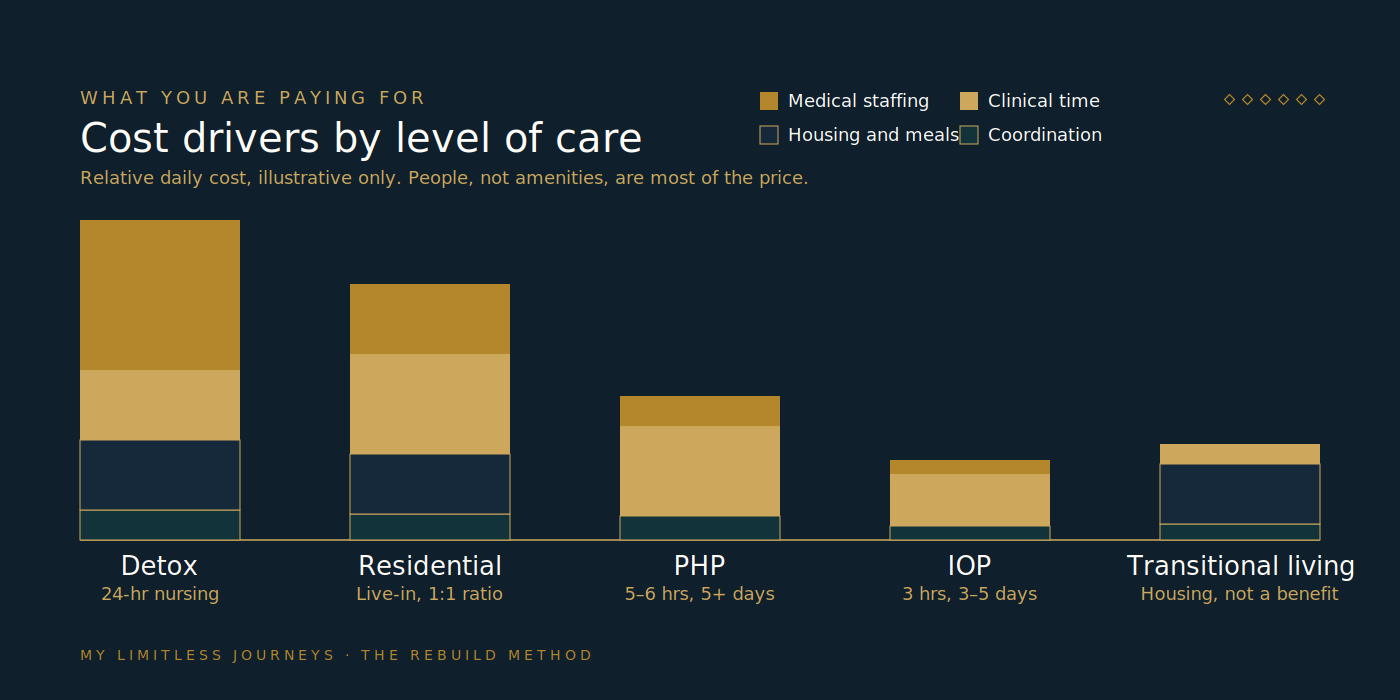
If you have already searched, you have seen the pattern: a page that promises to talk about cost and then asks for your phone number. That is frustrating, and it is also partly unavoidable, because the cost of treatment depends on three things a website cannot know about you. The first is which level of care you need. A medically supervised detox with nursing coverage around the clock costs more per day than a residential stay, which costs more than a partial hospitalization day, which costs more than an intensive outpatient evening. The second is how long you need it. A thirty-day stay and a ninety-day stay at the same program are different purchases, and the right length is a clinical decision, not a pricing tier. We explain how that decision is made in our guide to 30-, 60-, and 90-day programs.
The third is what your insurance will do. Two people can sit in the same program for the same number of days and owe wildly different amounts, because one has met a deductible and one has not. So a program that will not quote a number is sometimes evasive and sometimes honest; the tell is whether it will explain the mechanism. What you can know in advance is what drives the price. Medical staffing is the biggest factor: a program with a physician, nurses, and psychiatric oversight on site costs more to run than a "social model" house with a manager and a van. Clinical ratio is next. A true one-to-one ratio in a six-bed residence spreads the payroll across six people instead of sixty. Amenities matter less than people assume; the kitchen and the view are a small fraction of what a day costs. The people are most of it.
What is included at each level of care.
"Included" is where estimates go wrong. A quoted daily rate at one program may include psychiatry, medications, and lab work; at another, each of those arrives as a separate bill weeks later. When you compare programs, ask what a day includes, not what a day costs. The table below shows what each level of care at MLJ contains, so you can ask the same question of anyone else.
| Level of care | Typical intensity | What the day includes | Usually billed separately |
|---|---|---|---|
| Medically supervised detox | 24-hour nursing, daily physician contact, 3–10 days | Room and board, nursing, medication management, psychiatric evaluation, meals | Outside laboratory work, any hospital transfer |
| Residential | Live-in, structured seven days a week, 30–90 days | Individual and group therapy, psychiatry, family sessions, experiential work, meals, housing | Prescription medications filled through your pharmacy benefit |
| PHP | Five to six hours a day, five or more days a week | Programming and psychiatry; housing only if paired with transitional living | Housing, medications |
| IOP | Three hours a day, three to five days a week | Group and individual sessions, medication follow-up | Housing, medications |
| Transitional living | Supported housing during step-down | Housing, structure, recovery support | Clinical programming is billed as PHP or IOP; housing is generally not an insurance benefit |
Two patterns in that table deserve a sentence each. Insurance plans pay for treatment, not housing, which is why transitional living is almost always a private expense even when the PHP or IOP alongside it is covered. And the pharmacy benefit is a separate track from the medical benefit, so medications started in detox may show up on your pharmacy statement rather than the program's claim. Neither is a trick; both surprise people who were not told.
The four numbers that decide your share.
Insurance vocabulary is designed by actuaries, and it shows. Only four terms matter for treatment, and they are worth learning before the admissions call so that the person verifying your benefits can speak to you as a partner rather than translate.
Your deductible is the amount you pay before the plan pays anything for most services. It resets every plan year, which for most people means January. If your deductible is high and you have used little care this year, the first days of treatment may be entirely yours; if you have already had surgery or a hospitalization, you may have met it, and the plan starts paying immediately. Once the deductible is met, coinsurance or a copay applies: coinsurance is a percentage of the allowed charge, a copay is a flat amount per day or per visit. Then there is the out-of-pocket maximum, the ceiling on what you can be asked to pay in a plan year for covered, in-network care. Federal rules cap this figure annually, and the HealthCare.gov glossary publishes the current limit. For many families, the practical cost of a residential stay is simply the distance between what they have already paid this year and that maximum.
The fourth number is not a dollar figure. It is whether the program is in-network for your plan. In-network means the program has a contract with the insurer that sets the rate and generally bars the program from billing you for the difference. Out-of-network means no contract, a separate and usually higher deductible and coinsurance, and in some plans no coverage at all. The middle path is a single-case agreement, which we explain on our page about network status and single-case agreements. It is the single most consequential detail in your benefits, and it is the first thing our admissions team checks when you submit your insurance for verification.
How a claim actually moves.
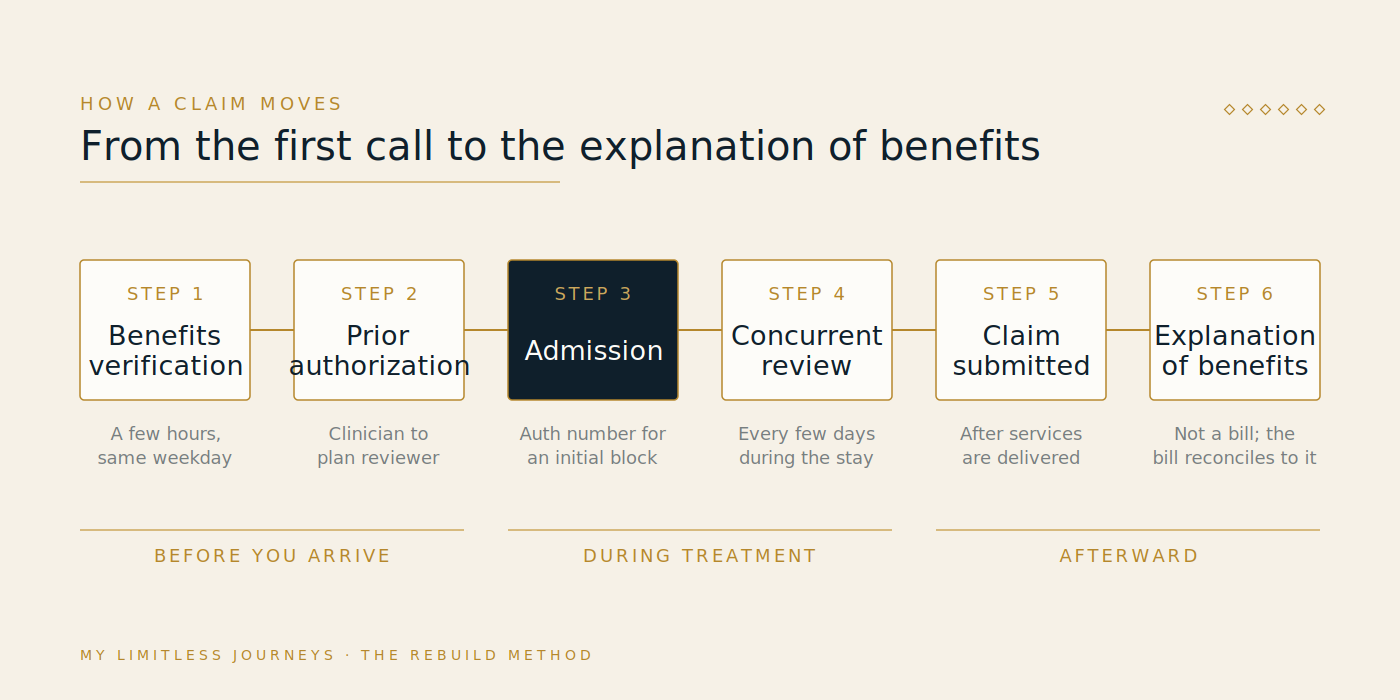
Most of the fear around paying for treatment comes from not knowing where you are in a process nobody explained. The process has six steps, and they happen in the same order at every legitimate program.
First, benefits verification. With your member ID, our admissions team contacts the plan and confirms that substance-use and mental-health benefits exist, what the deductible and out-of-pocket status are today, and whether we are in-network. This usually takes a few hours on a weekday. Second, prior authorization. For detox and residential care, most plans require the program to demonstrate medical necessity before admission, using criteria such as the ASAM criteria. A clinician on our side speaks to a reviewer on theirs. Third, admission, with an authorization number that covers an initial block of days.
Fourth, concurrent review. Every few days the plan asks whether you still meet criteria for the level of care you are in, and our clinical team documents why you do, or recommends a step-down when you no longer do. Fifth, claim submission, after services are delivered. Sixth, the explanation of benefits arrives in your mail or portal, showing what was billed, what the plan allowed, what it paid, and what remains yours. An EOB is not a bill, though it looks like one. The bill, if any, comes from the program, and it should reconcile to the EOB line by line. We walk through what to expect in the first days of this sequence on our page about what happens after you submit verification.
What parity law does, and does not, guarantee.
The Mental Health Parity and Addiction Equity Act requires most group health plans and insurers that cover mental health or substance-use treatment to do so on terms no more restrictive than the terms they apply to medical and surgical care. That covers dollar limits, visit limits, and the harder-to-see "non-quantitative" limits such as prior authorization and concurrent review. The law is enforced jointly; the Centers for Medicare & Medicaid Services oversee individual-market and non-federal governmental plans, and the Department of Labor oversees most employer plans. Since the Affordable Care Act, individual and small-group plans must also include mental-health and substance-use services as essential health benefits.
What parity does not do is guarantee that any particular stay will be approved, that a program will be in-network, or that your deductible will be waived. It guarantees equivalence of rules, not generosity. In practice, parity is most useful as leverage when a plan denies or cuts short a stay on grounds it would never apply to a cardiac admission. That is when a clinical appeal, and sometimes a complaint to the state regulator, is appropriate. Our team handles those appeals as part of treatment, because a reviewer's calendar should not decide your clinical course.
When private pay is the better decision.
Some of our clients have excellent insurance and choose not to use it. The reasons are practical rather than ideological. Every claim creates a record with the insurer, and while federal confidentiality rules tightly limit what happens to that record, a claim is still a disclosure to a third party that a private payment is not. Every authorized stay is subject to concurrent review, which means someone outside your clinical team has a say in how long you stay. And when a plan approves twenty-one days for a person whose clinicians believe needs forty-five, the family faces a choice in the middle of treatment that nobody wants to make.
Private pay removes those variables by moving the decision entirely inside the treatment relationship. We lay out what a private-pay stay includes on our private pay page and compare the privacy implications in insurance versus private pay for privacy. Many families do something in between: insurance for what it covers well, private payment for what it does not, such as transitional living.
Other places the money comes from.
Insurance and savings are not the only two columns. Health savings accounts and flexible spending accounts can be used for qualified medical expenses, and residential treatment for a diagnosed substance-use disorder is generally a qualified expense; confirm with your plan administrator. Many employers offer an employee assistance program that funds a short course of counseling and can help coordinate a leave. In California, State Disability Insurance administered by the Employment Development Department can provide partial wage replacement during a physician-certified stay in a licensed residential facility, which changes the arithmetic for many working adults. And job protection under FMLA, described on our employer privacy page, is separate from pay but often matters more.
Families sometimes ask whether to wait for a new plan year or a bonus. Our post on deductible resets and treatment timing takes that question seriously; the short answer is that the calendar is a financial variable and the illness is a medical one, and when they conflict, the medical one usually wins.
- In-network, out-of-network, and single-case agreements. The plans we work with and what "work with" means.
- Private pay. What it includes and why some clients with good insurance choose it.
- After you submit insurance verification. The next 24 to 48 hours, step by step.
- Our programs. The full continuum, from detox to alumni.
- Does insurance cover addiction treatment?. A longer look at benefits and common denials.
This guide is educational and is not a substitute for medical advice. If someone is in immediate danger, call 911.