
Medical detox at MLJ: what it is, who needs it, and what the first week looks like.
Detox is the medically supervised management of withdrawal so that your body can clear a substance safely. At MLJ it happens in a bedroom in a six-bed Encino home, under board-certified psychiatric oversight, with the same clinical team that will still be with you in week six.
Authored by the MLJ Clinical Team. Reviewed under board-certified psychiatric oversight. Last updated September 2026.
Key Takeaways- Medical detox is necessary when withdrawal itself can be dangerous, which is the case for alcohol, benzodiazepines, and often for opioids and polysubstance use.
- Detox is not treatment. It is the medical work that makes treatment possible, and it should hand off directly into residential care without a change of team or building.
- Withdrawal is managed with substance-specific protocols and structured monitoring tools such as CIWA-Ar and COWS, not with guesswork or willpower.
- At MLJ, detox happens in a private bedroom with nursing coverage around the clock and one-to-one clinical attention through the hardest nights.
- Most acute withdrawal is over within three to ten days; sleep, mood, and energy take longer, and that longer arc is the reason residential care follows detox.

What medical detox actually is.
When you use a substance every day, your nervous system adapts to it. It turns some systems down and others up so that, with the substance on board, you feel roughly normal. Take the substance away and those adaptations are suddenly unopposed. That is withdrawal. For alcohol and benzodiazepines, the unopposed system is excitatory, which is why withdrawal can produce seizures. For opioids, it is the stress and pain systems that surge. For stimulants, the brain's reward circuitry simply goes quiet.
Medical detox is the supervised management of that period. SAMHSA's Treatment Improvement Protocol 45 describes it as three linked tasks: evaluation, stabilization, and fostering entry into treatment. Evaluation means a physician and nursing team measure what is in your system, what your vital signs are doing, and what medical or psychiatric conditions are riding alongside. Stabilization means using medication and monitoring to keep withdrawal within a safe range while your body clears the drug. The third task is the one most detox programs neglect, and the one we care most about: making sure detox leads somewhere.
Detox is not, on its own, treatment for addiction. A person can be fully detoxed and have learned nothing about why they drink. That is why we do not offer detox as a stand-alone service. It is the first stage of the detox-and-residential program, and the first stage of the Body domain of the Rebuild Method.
Who needs medical detox, and who does not.
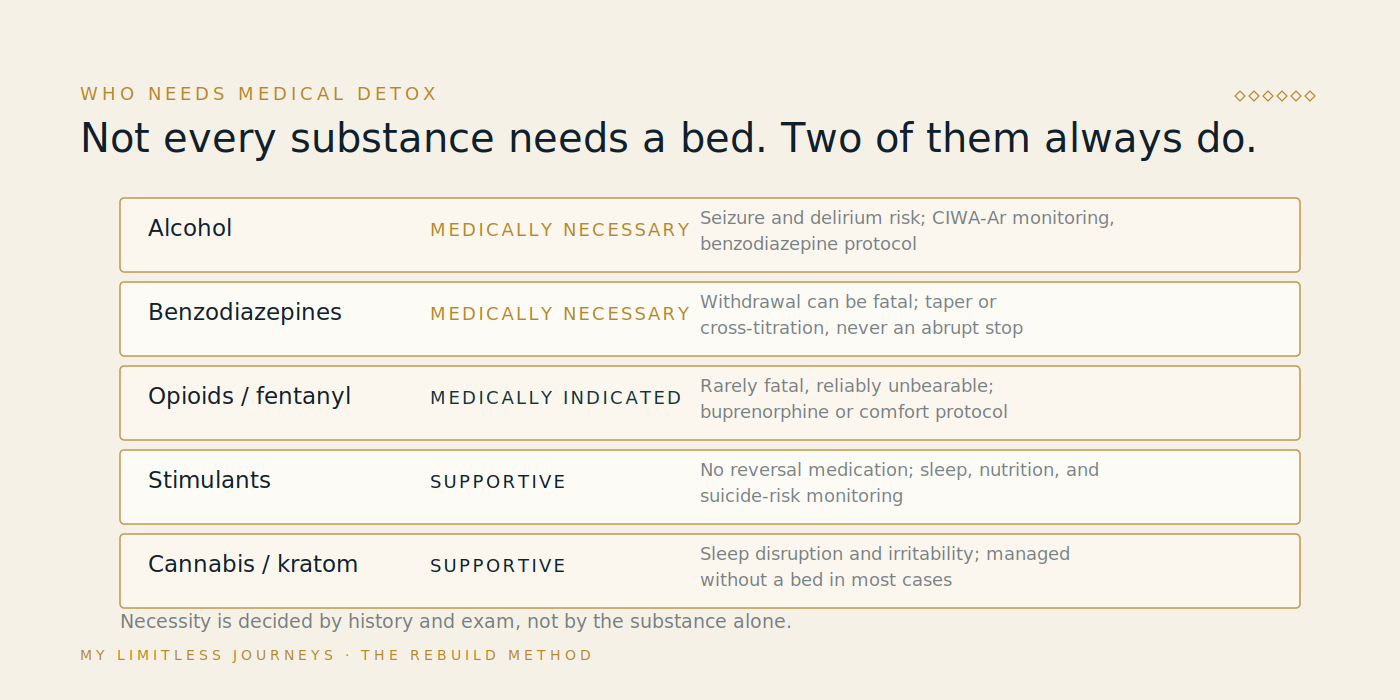
The question is not how much you use. It is whether stopping could hurt you. Alcohol withdrawal can cause seizures and delirium tremens, and both can be fatal without treatment. Benzodiazepine withdrawal carries the same seizure risk and needs a slow, physician-managed taper rather than an abrupt stop. Opioid withdrawal is rarely fatal by itself, but it is miserable enough that people return to use, and with fentanyl the loss of tolerance during even a few days off makes that return dangerous. When more than one of these is on board, the picture gets harder to predict, and supervision matters more, not less.
The signs that point toward medical detox rather than stopping at home are consistent across guidelines. You drink or use daily and have done so for months. You have had withdrawal symptoms before, especially shakes, sweats, racing heart, or a seizure. You use to stop symptoms rather than to feel good. You take more than one substance. You have a heart, liver, or seizure condition, or a psychiatric diagnosis that destabilizes under stress. If several of those describe you, please read medical detox versus quitting at home before you try to stop on your own, and call us if you want to talk it through with a clinician.
Some substances do not have a formal medical withdrawal protocol. Cocaine, methamphetamine, and cannabis produce a real and often severe withdrawal, but it is psychiatric rather than physiological in its dangers: exhaustion, depression, and in some cases suicidal thinking. Those clients still admit through detox at MLJ, because what they need in the first week is psychiatric oversight, sleep, and nutrition, and that is what the first week here is built to provide. Our guide to stimulant withdrawal explains what that looks like.
A bedroom, not a ward.
Most people picture detox as a hospital corridor: a shared room, fluorescent light, a nurse checking on twenty patients. There are settings where that is exactly right, and if your medical picture calls for hospital-level care we will say so and help you get there. But for most adults whose withdrawal can be safely managed outside a hospital, the environment itself is part of the medicine. Withdrawal is a state of nervous-system alarm. A quiet room, a door that closes, food you can face, and a nurse who knows your name calm that alarm in ways that matter clinically.
At MLJ, detox happens in your own room in a private hillside home. Nursing is present around the clock. Vital signs and withdrawal scores are taken on a schedule set by your physician, and adjusted as your symptoms move. The psychiatrist who oversees your medication protocol is the same psychiatrist who will manage your care in residential treatment. There are six clients in the house at most, which is what makes a true one-to-one clinical ratio possible. On the hardest night, usually somewhere between the second and fourth, someone is with you.
beds, never more
nursing coverage during detox
clinical team from detox through alumni
The first seven days, honestly.
Day one is assessment. You arrive, you meet the nurse and the physician, and we take a careful history: what you use, how much, when you last used, what happened the last time you stopped, what else you take, and what your body has been through. Labs are drawn. A withdrawal score is taken as a baseline. Medication is started according to the protocol for your substance. You are shown your room and left to rest, with someone checking in on a schedule rather than hovering.
Days two through four are usually the peak. For alcohol this is when the risk of seizures and delirium is highest and monitoring is most frequent. For short-acting opioids and heroin it is when muscle pain, sweating, and gut symptoms crest. For fentanyl the peak may arrive a day or two later than you expect. For benzodiazepines, there is no peak in this sense, because a taper is designed not to have one. Sleep is poor. Appetite is poor. This is the stretch where people leave programs, and it is the stretch where being in a home with a clinician a few steps away changes the outcome.
Days five through seven are the turn. Vital signs settle, the withdrawal score falls, medications begin to come down. You start to eat. You may start joining a meal in the kitchen, a walk, a first individual session. The mood is often flat, and that flatness is expected; the brain's reward system takes weeks to recalibrate, which is part of why the first week in residential is designed the way it is. By the end of the week, most clients are medically stable. They are not yet well, and no one here will pretend otherwise.
Detox by substance: the guides.
Withdrawal is not one thing. The timing, the risks, the medications, and the monitoring tools differ by substance, and a guide that blurs them is not much use to someone trying to decide what to do tonight. Each of the pages below is written for one situation.
| Substance | Main medical risk | Typical acute course | Guide |
|---|---|---|---|
| Alcohol | Seizures, delirium tremens | Onset within hours; peak 24–72 hours; settles by day five to seven | Alcohol withdrawal timeline |
| Benzodiazepines | Seizures with abrupt stop | Managed as a slow taper over weeks to months, not a short detox | Benzodiazepine tapering |
| Opioids and fentanyl | Return to use after lost tolerance; precipitated withdrawal | Heroin peaks at two to three days; fentanyl's onset is delayed and its course longer | Opioid and fentanyl detox |
| Stimulants | Depression, suicidal thinking | Crash over one to three days; low mood and energy for two weeks or more | Stimulant withdrawal |
| More than one substance | Masked or overlapping withdrawal | Sequenced by risk; the most dangerous withdrawal is managed first | Polysubstance detox |
Two further guides cut across all of these. Detox medications is a plain-language reference to what each medication does and does not do. Sleep in early recovery explains why sleep is the last thing to return and how we treat it as clinical work rather than a side issue.
What happens on day eight.
In many systems, detox ends with a discharge. You are handed a list of programs and a phone number, and the gap between the detox unit and the treatment program is where a great many people are lost. The ASAM Criteria, which most insurers and clinicians use to decide the right level of care, treat withdrawal management as one dimension of a larger assessment, not as a destination. We agree.
At MLJ there is no discharge on day eight. You stay in the same room, with the same psychiatrist, nurse, and primary therapist, and the work shifts from stabilizing your body to understanding your life. Medication started in detox, including any medication for alcohol or opioid use disorder, continues without interruption. Residential treatment runs thirty to ninety days, then steps down to PHP, IOP, and transitional living as you are ready, all with the same team. If you are coming from the Valley or the Westside, our Encino detox page covers the practical questions about arriving. If you are coming from farther away, admissions will help you plan the trip.
- Alcohol withdrawal timeline. Hour by hour, including when seizures and delirium tremens occur.
- Benzodiazepine tapering. Why it is slow, and what daily life looks like during a taper.
- Opioid and fentanyl detox. Fentanyl's timing problem and how buprenorphine is started safely.
- Detox and residential program. The program detox opens into.
- Detox timelines by substance. A one-page overview across all substances.
- Nutrition in alcohol withdrawal. Why thiamine matters from the first day.
This guide is educational and is not a substitute for medical advice. If someone is in immediate danger, call 911.