
Addiction treatment for people whose work, reputation, and privacy can't be set aside.
Most treatment assumes you can disappear for a month and that nobody will notice. If that has never been true of your life, this part of the library is written for you, and for the people who look after you.
Authored by the MLJ Clinical Team. Reviewed under board-certified psychiatric oversight. Last updated September 2026.
Key Takeaways- My Limitless Journeys is a six-bed residence in Encino, not a campus, and that headcount is the single biggest structural difference for anyone whose face or name is known.
- One clinical team carries you from medically supervised detox through residential, PHP, IOP, and transitional living, so your story is told once.
- Discretion is a trained staff practice here, not a brochure word: identity, work, and reputation are treated as sensitive by default.
- Return-to-work planning sits inside the Life domain of the Rebuild Method and starts in the first week, not the last.
- This hub routes to pages for actors, crews, writers and producers, musicians, licensed professionals, and production-calendar timing.

Why most treatment was not built for you.
The standard residential program in Southern California is designed around volume: forty to a hundred beds, a shuttle van with the program's name on the door, a morning process group where thirty strangers learn your first name and your line of work in the same breath. None of that is malicious. It is how a program pays for itself when its clients' main constraint is getting sober.
Your constraints are different. A production that resumes on a date someone else chose. A licensing board, a caseload, a room full of writers waiting on pages, a public that recognizes you at the grocery store. A small circle, a manager, a spouse, an attorney, who need to know something and must not know everything. When the fear of being seen is larger than the fear of continuing, people continue. We built this residence to make that trade unnecessary.
The clinical care itself is not exotic: medically supervised detox, trauma-focused therapy, DBT, CBT, EMDR, psychiatric oversight, family work. What is different is the container, designed for people who cannot afford to be careless with their name. The Rebuild Method page explains the program; this hub is about why the shape of the place matters.
Six structural differences, none of them cosmetic.
Six beds, never more. Anonymity is largely a headcount problem. With six clients in the house, the number of people who could ever say they were in treatment with you is five, and each of them is protected by the same federal confidentiality rules you are. Our page on how six beds changes anonymity works through the arithmetic honestly.
A house, not a campus. MLJ is a private hillside home in Encino. There is no lobby, no signage, no branded vehicle, and the street address is withheld until admissions intake. Arriving looks like arriving at a friend's house, because that is what the neighbors see.
One team, the whole way. The clinicians who meet you in detox run your IOP and your alumni check-ins. Your history is told once, and the details of your professional life do not travel across three organizations.
The Valley, not the Westside circuit. Encino is twenty to thirty minutes from the Burbank and Universal lots, Studio City, and the Ventura Boulevard post corridor, and off the well-photographed Malibu and Westside treatment circuit. Close enough to step down near where you work; far from where people go looking.
Discretion as training, not a promise. Every member of staff is trained to treat a client's identity, work, and reputation as sensitive by default. Nobody asks what you do in front of anyone else. The legal protections and operational commitments are laid out in Privacy in Treatment.
Return-to-work planning inside the treatment plan. Going back is not handled in a discharge meeting. It lives in the Life domain from the first week, because how you re-enter the work is a relapse-prevention question.
beds, never more
clinical team across every level of care
minutes from the Burbank and Universal lots
Find the page written for your work.
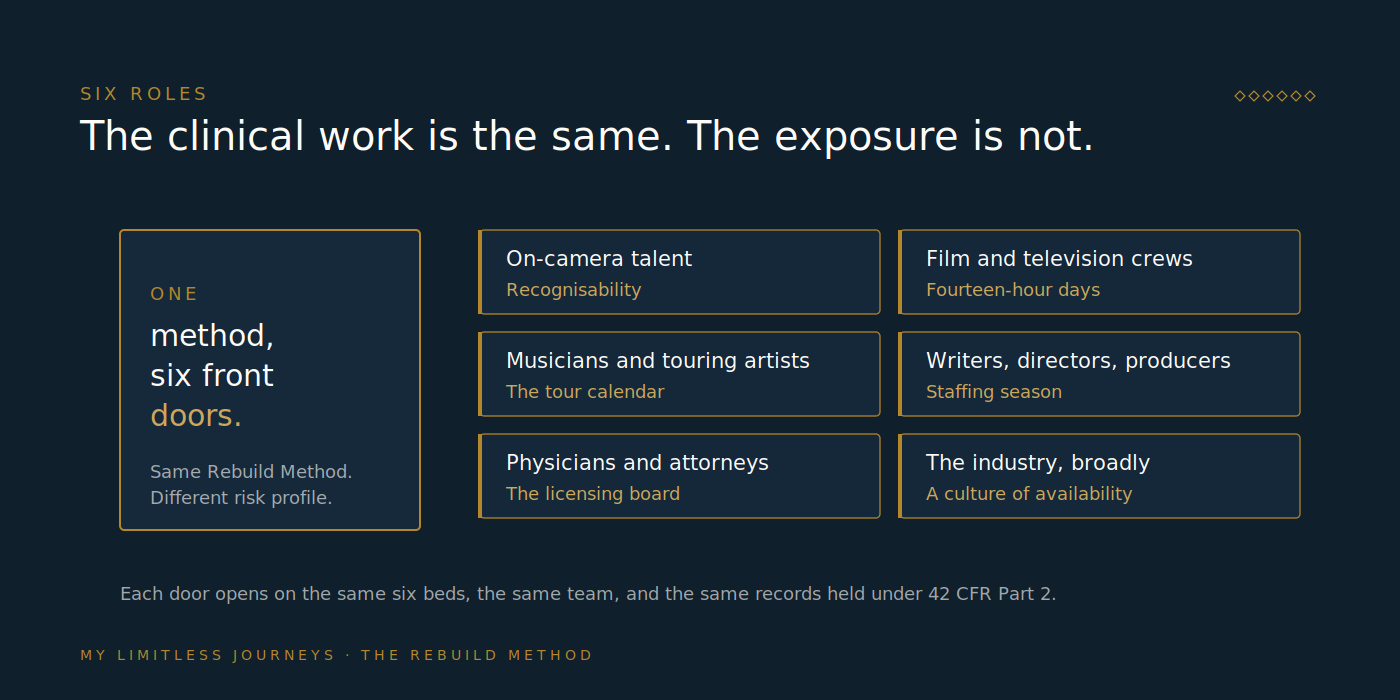
The pressures on a series regular are not the pressures on a gaffer, and neither resembles a surgeon with a medical board watching. We wrote separate pages because the honest answers differ.
Actors and on-camera talent: what "unavailable" can carry, a thirty-day stay inside a hiatus, physical health as clinical work, and what happens if a set needs you sooner. Film and television crews: fourteen-hour days, stimulants and sleep, hiatus and strike calendars as windows, PHP and IOP around a shooting schedule. Writers, directors, and producers: isolation and deadline cycles, room dynamics, remote work from transitional living, and the Self domain when identity is the work.
Musicians and touring artists takes on tour cycles and relapse prevention for a job inside bars. Physicians, attorneys, and licensed professionals deals with board reporting, physician health and lawyer assistance programs, and monitoring agreements.
Two pages serve everyone: timing treatment around a production calendar, a candid guide to what can and cannot be compressed, and substance use in the entertainment industry, which gathers what research and industry surveys actually say. Two earlier pieces remain useful: executive and professional addiction treatment in Los Angeles and addiction treatment for high-functioning professionals.
What the Rebuild Method does with a career.
The Rebuild Method works across four domains, Body, Mind, Life, and Self, inside a perimeter of Discretion. For most clients the Life domain is where the professional questions get answered: which commitments survive the stay, which are delegated, who holds the calendar, what the first week back looks like hour by hour, and what the early signs are that the old pattern is reassembling itself around the new schedule. Our guide to the first ninety days back at work shows what that planning produces.
The Self domain matters more here than people expect. When work has been the whole identity, sobriety can feel like a demotion. Values, purpose, and spiritual exploration are how we help someone find a reason to stay well that does not depend on the next job. "Recovery isn't retreat. It's reconstruction." You are not asked to abandon the career that got you here, only to rebuild the way you carry it.
Fitting a stay to a real calendar.
We will not tell you that thirty days always works. Detox takes as long as your body takes; residential runs thirty to ninety days by clinical need; the step-down through PHP, IOP, and transitional living is where most people re-enter work. What we can do is be honest early about which parts of that arc are flexible, and plan so the immovable parts of your calendar land in the flexible parts of ours. Our page on working during treatment explains phone and laptop access at each level: residential limited and scheduled, PHP rarely, IOP designed for it, transitional living built for a working life with a safety net.
If you are the manager, spouse, or attorney reading this.
Many first calls to (866) 209-4246 come from someone other than the person who needs care. You can call without giving a name. We will explain the assessment, a realistic admission window, benefits verification with Aetna, Anthem, Cigna, Kaiser Southern California, and UnitedHealthcare, and private pay if that is the more discreet route. If a production or firm has its own plan, ask admissions to verify rather than assuming either way.
We will also tell you what we cannot do: admit someone who does not consent, share clinical information without a signed release (see family confidentiality), or promise a discharge date to match a call sheet. What we can promise is a clinical team that understands why you are calling at midnight and treats the call as confidential from the first word.
- Actors and on-camera talent. For the actor, the manager, and the spouse, in that order.
- Film and television crews. Treatment built around a shooting schedule.
- Privacy in Treatment. What the law protects and what we add on top of it.
- Residential treatment. What thirty to ninety days in the house involves.
- When your using network is your professional network. A blog post on the hardest version of this problem.
This guide is educational and is not a substitute for medical advice. If someone is in immediate danger, call 911.