
When it's someone you love.
You are probably here for one of three reasons: they will not go, they just went, or they are about to come home. Each of those is a different problem with a different set of moves. This page sorts them out and points you to the right guide.
Authored by the MLJ Clinical Team. Reviewed under board-certified psychiatric oversight. Last updated September 2026.
Key Takeaways- Families usually arrive at one of three moments: before treatment (refusal), during treatment (the first weeks apart), or after treatment (the return home). Each has its own guide below.
- You did not cause this, you cannot control it, and you still have more influence than you think, especially over how the conversation goes and what happens at home.
- At MLJ, family work is built into the Life domain of the Rebuild Method rather than bolted on, and it starts during detox, not after discharge.
- What we can share with you about a client is governed by HIPAA and 42 CFR Part 2; we will tell you plainly where those lines are before your loved one arrives.
- Your own exhaustion is a clinical variable. The guides here treat it as one.

Three moments, three different problems.
Families call us at very different points, and the advice that fits one point is often wrong for another. A spouse whose husband has refused treatment for the fourth time needs a strategy for a conversation that has already failed three times. A mother whose daughter checked into detox yesterday needs to know why the phone has gone quiet and whether that is normal. A partner whose wife is discharging next Friday needs a plan for the kitchen cabinet, the first dinner party, and the first bad Tuesday.
So this hub is organized by moment rather than by topic. Find the section that matches where you are today, read the short summary, and follow the link to the full guide. If you are not sure which moment you are in, that ambiguity is itself information: it often means your loved one is oscillating between willingness and refusal, which is common and workable. Our admissions team at (866) 209-4246 talks with families in exactly that position every day, and calling on someone else's behalf is welcome. We will tell you what we can and cannot do without the person's own consent.
If they will not go.
This is the most painful moment and the one where families most often act on bad instincts, because the good instincts are counterintuitive. Ultimatums delivered in anger rarely work. Neither does silence. What tends to work is a patient, structured approach that reduces the person's need to defend themselves while making the consequences of continued use clearer and the path into treatment easier. The evidence for that approach, sometimes called CRAFT, comes from randomized trials in which family members who learned these skills got treatment-refusing loved ones into care at rates several times higher than traditional confrontation. One of those trials is indexed on PubMed if you want to read the numbers.
Our guide When they refuse treatment walks through what a professional intervention actually involves, the main models and how they differ, how an interventionist hands off to a facility like ours, and what you can do on your own if an intervention is not the right fit. If the person you love keeps saying they can handle it alone, read He says he can stop on his own, which is about the exact sentence you are hearing. And for the conversation itself, the words to use and the ones to avoid, start with How to talk to a loved one about getting help.
If they just went.
The relief lasts about a day. Then the house is quiet in a way it has not been for years, and you discover that you have been organizing your entire nervous system around another person's drinking or using. The phone does not ring when you expected. When it does, the person on the other end sounds flat, or irritable, or unnervingly cheerful. You wonder whether you should visit, whether you said the wrong thing, whether they are going to walk out.
All of that is predictable, and most of it has a clinical explanation. Supporting a partner through detox lays out the first ten days from the spouse's side: what withdrawal does to mood and memory, why we limit calls early, when visits make sense, and what to do with your own evenings. The first week in residential treatment describes the same days from inside the house, which many families find steadying to read. If your loved one starts talking about leaving, Leaving treatment early explains why the day-three-to-five window is so hard and how to respond without either caving or threatening.
You will also want to know what we can tell you. The honest answer is: less than you want, and exactly as much as the law and your loved one allow. Family confidentiality explains how HIPAA and 42 CFR Part 2 shape what a treatment program may disclose, how a signed release changes that, and why we ask clients to sign one early. It is not a wall; it is a set of doors your loved one holds the keys to.
If they are coming home.
Discharge is a beginning that looks like an ending, and families are often less prepared for it than the client is. The client has spent thirty to ninety days rehearsing this. You have spent that time catching your breath. The first two weeks home carry real risk, and they carry it for reasons that have nothing to do with willpower: tolerance has dropped, old cues are everywhere, and the structure that held the days together is suddenly gone.
Our After Treatment hub is the map for the first year. Within it, Going home vs. transitional living helps you and your loved one decide honestly whether the house is ready, and whether a few months in transitional living would make the return safer. Relapse: the first 24 hours is the page you hope never to need and should read anyway, because what a family does in the first day after a slip changes what happens in the following week.
What your role is, and what it is not.
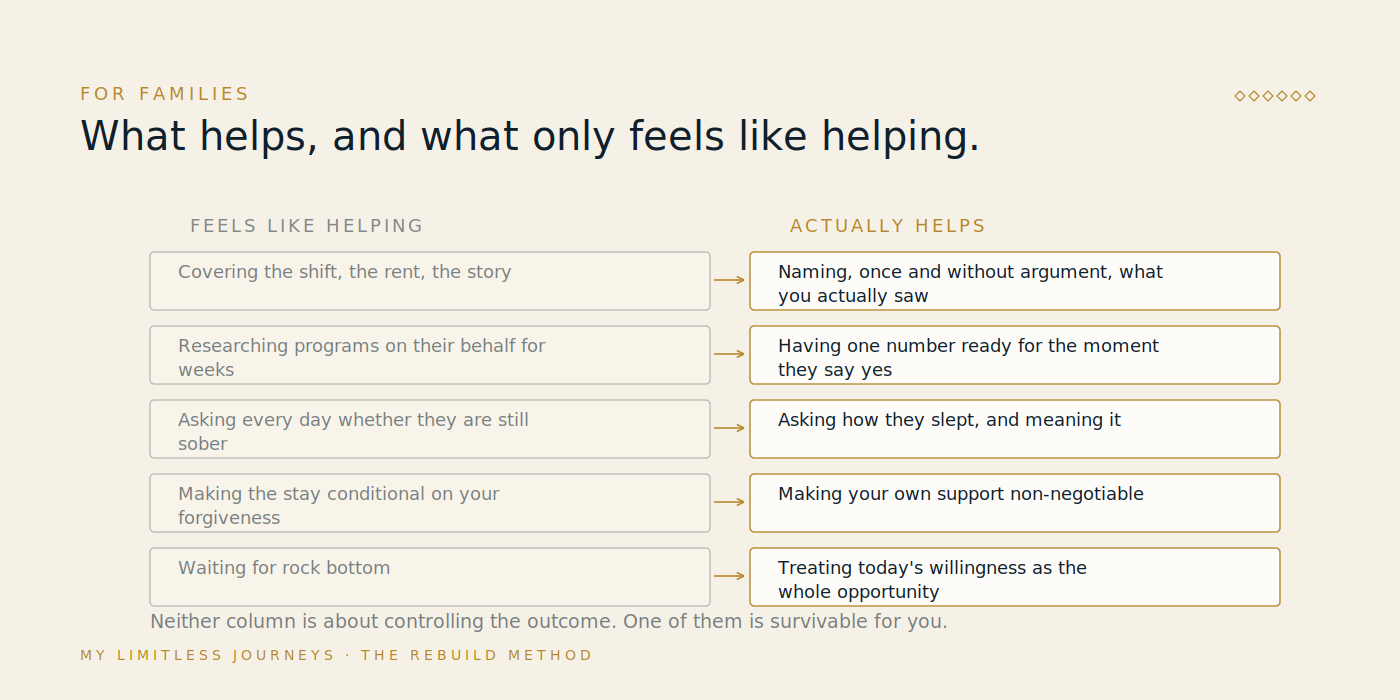
Your role is not to be the treatment. You cannot monitor someone into recovery, and trying tends to produce a household in which one adult is a parole officer and the other is a suspect. Your role is also not to disappear. The research on family involvement is fairly consistent: when families participate in treatment, people stay longer and do better afterward. SAMHSA maintains a plain-language collection of resources for families that we recommend as a starting point.
The role that actually helps sits between those extremes. Learn how the illness works so you stop taking its symptoms personally. Hold boundaries that protect you and the household without turning every boundary into a punishment. Repair what needs repairing on your side of the relationship, because there is almost always something. And get your own support, whether that is a family group, a therapist of your own, or the kind of mutual-aid meetings that exist specifically for the relatives of people with addiction. The family's role in recovery develops each of those in detail, and our family support services page describes how we build them into a stay.
If you are the referring clinician.
Therapists, psychiatrists, and interventionists refer to us often, and they have their own version of the family's questions: what happens to my client, what will I hear and when, and how does the client come back to me. For referring clinicians lays out our coordination model week by week, how releases are handled, what our reports contain, and how the handback works at each step-down. The shorter overview lives at Referring Professionals.
- When they refuse treatment. Interventions, the main models, and what to do without one.
- Supporting a partner through detox. The first ten days from the spouse's side.
- Family therapy at MLJ. Format, cadence, and what it asks of you.
- For referring clinicians. How we coordinate, report, and hand back.
- Residential treatment. What the 30 to 90 days your loved one is entering actually contain.
- How to talk to a loved one about getting help. The conversation itself, word by word.
This guide is educational and is not a substitute for medical advice. If someone is in immediate danger, call 911.