
The first year after residential treatment.
Discharge is the midpoint, not the finish. This is the map of the twelve months that follow: step-down, transitional living, the return to work, the alumni year, and the specific weeks where people tend to wobble, with the guide for each.
Authored by the MLJ Clinical Team. Reviewed under board-certified psychiatric oversight. Last updated September 2026.
Key Takeaways- Addiction behaves like other chronic medical conditions: the year after intensive treatment is where relapse risk is highest, and it falls steadily the longer a person stays in care and in recovery.
- At MLJ, the same team that ran detox runs step-down, transitional living, and the alumni program, so the first year is a continuation rather than a series of handoffs.
- The predictable hard points are the first two weeks home, the return to work, roughly month three when the novelty wears off, and the first anniversary season of whatever used to drive the using.
- A slip is a medical event with a protocol, not a moral verdict; what happens in the first 24 hours afterward largely determines whether it becomes a relapse.
- Recovery becomes durable somewhere between years one and five, and the point of year one is to get there with the relationships, the job, and the self intact.

Why the first year is the year that matters.
A well-known analysis in JAMA compared addiction with type 2 diabetes, hypertension, and asthma and found relapse rates after treatment to be broadly similar across the four conditions, in the range of forty to sixty percent for addiction. The authors' point was not despair; it was that addiction is a chronic condition and should be managed like one, with ongoing care rather than a single episode and a handshake. That paper is a quarter-century old and the field has largely come around to it. Nobody discharges a diabetic from the hospital and considers them finished.
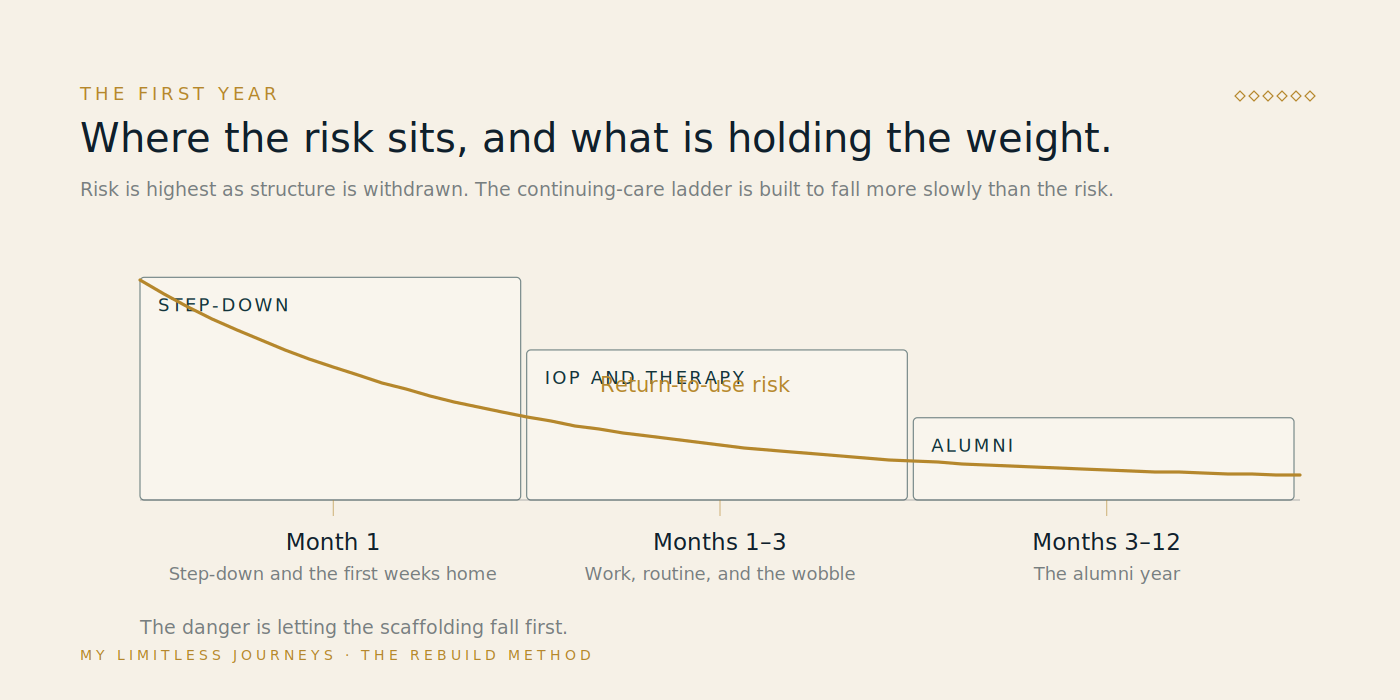
What the longitudinal research adds is that risk is not evenly spread. It is heaviest in the months immediately after a person leaves structured care, and it declines with each year of sustained recovery until, somewhere past the fourth or fifth year, the likelihood of a return to use approaches that of the general population. The first year is therefore both the most dangerous and the most consequential. Get through it with the job, the marriage, and the self-respect intact, and the odds shift substantially in your favor. This hub exists because we think people deserve to know the shape of that year before they are in it.
At MLJ, the year is designed rather than left to chance. The clinical team that ran your detox runs your PHP, your IOP, your transitional living, and your alumni program. There is no discharge to a stranger. The therapist who knows your history is the one who picks up the phone in month four. That continuity is the single structural feature most responsible for how our first years tend to go, and it is only possible because we have six beds.
Month one: step-down and the first weeks home.
Leaving residential care is a change in dose, not a discontinuation. Most clients move into PHP, which is five or six hours of clinical programming most days, then into IOP, which is roughly nine hours a week in the evenings or mornings around a work schedule. Our guide to IOP vs. PHP explains the difference and who needs which. The step-down is decided at your mid-stay treatment-plan review, not at the door, and it is decided by clinical criteria rather than by an insurance calendar.
The first question of month one is where you sleep. For some people, home is ready: alcohol is out of the house, the family has done its own work, and the routine is waiting. For others, home is the place where the using happened, or a place with a partner who is also using, or simply too quiet. Going home vs. transitional living is an honest guide to that decision. Transitional living at MLJ is a bridge, not a warehouse: a structured residence with clinical involvement, from which people attend PHP or IOP and begin returning to work. Our comparison of transitional living and sober living explains what distinguishes it from the unregulated houses that give the category a bad name.
Months one to three: work, routine, and the wobble.
For most of our clients, this is when work resumes, and work is where the old life is waiting most intact. The dinner meetings, the wrap parties, the colleague who does not know, the stress that the substance used to metabolize. The first ninety days back at work is our guide to that re-entry: what to say and to whom, how to handle the first professional event with a bar in it, and how the return-to-work plan built in the Life domain during treatment actually gets used. For people whose professional world overlaps with their using world, this post addresses the harder version of the problem.
Somewhere around month three, many people hit a wobble that has little to do with craving. The acute gratitude of early recovery fades. The structure of IOP has tapered. Life is, frankly, a bit ordinary, and the brain's reward system, still recalibrating after years of chemical shortcuts, does not yet find ordinary very rewarding. This is the point at which people quietly stop going to meetings, skip a session, decide they have this handled. It is also the point at which the alumni check-in at ninety days is scheduled, not by coincidence. Our explainer on why relapse happens describes the psychology of this stretch, and it is worth reading before you reach it rather than after.
Months three to twelve: the alumni year.
The alumni program is not a newsletter. It is the clinical team staying in your life at a lower intensity: scheduled check-ins at 30, 90, 180, and 365 days; a therapist who will take your call between them; access to groups with people who were in the house when you were, or who were in it before you; and an open door back to a higher level of care if you need it, without a new intake process. Because we are six beds, the alumni community is small enough that people actually know each other, and discreet enough that our professional clients participate.
When there is a slip.
Some people will use again during the first year. The chronic-disease framing says so, and pretending otherwise leaves people without a plan for the one moment they most need one. The distinction that matters clinically is between a slip, a single use or a short episode that is interrupted, and a relapse, a return to the pattern. What determines which one a given event becomes is mostly what happens in the next twenty-four hours: whether the person tells someone, whether they reach the team, whether the family responds with the plan or with the old script, and whether shame is allowed to do the thing shame does, which is to make the next drink feel inevitable.
Relapse: the first 24 hours is the protocol, written for the person and for the family, and every client leaves with a version of it that they wrote themselves. The short form: call. The team you know answers. A slip may mean a few extra sessions, a brief return to IOP, or in some cases a short stay back in the house; it does not mean starting over, and it does not mean the year was wasted. People who slip and re-engage quickly do not have worse long-term outcomes than people who never slip. People who slip and disappear do. The plan is also a family document: family therapy continues into the alumni year, and the For Families hub has a section written for the return home.
- Relapse: the first 24 hours. The protocol, for the person and the family.
- Going home vs. transitional living. The first decision of month one.
- The first ninety days back at work. Re-entry for professionals.
- The alumni program. What staying connected actually involves.
- Relapse prevention. The program built for months one to twelve.
- Building a continuing care plan. The long-form guide to the plan you leave with.
This guide is educational and is not a substitute for medical advice. If someone is in immediate danger, call 911.