
What a 1:1 clinical ratio means, hour by hour.
"Individualized care" appears on every treatment website. A true one-to-one ratio is something more specific: a number of clinicians relative to a number of clients, and a weekly schedule that reflects it. Here is what the phrase means when we use it, and how to tell whether a program's math holds up.
Authored by the MLJ Clinical Team. Reviewed under board-certified psychiatric oversight. Last updated September 2026.
Key Takeaways- A clinical ratio is the number of licensed clinicians on shift relative to the number of clients in care; at MLJ that ratio is one to one across our six beds.
- Operationally, 1:1 means multiple individual therapy sessions a week, daily contact with your primary therapist, psychiatric follow-up as often as clinically needed, and nursing coverage around the clock.
- Six beds is what makes the ratio possible; the same staffing model cannot be sustained at forty or sixty beds without becoming group-heavy.
- Group therapy remains part of the week, but it supplements individual work rather than substituting for it.
- When you call any program, ask for the ratio as a number, ask how many individual sessions a week are scheduled, and ask who the psychiatrist is and how often they are on-site.
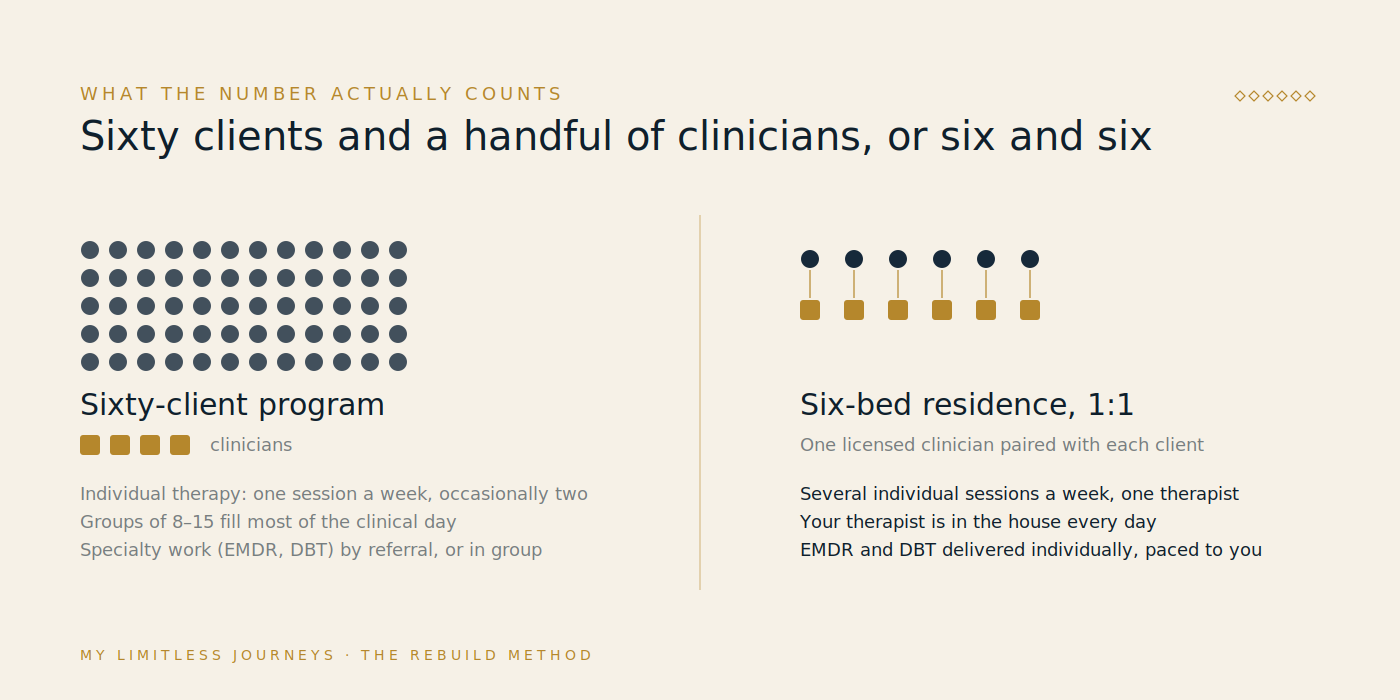
What the number actually counts.
A staff-to-client ratio can be calculated several ways, and programs that advertise a favorable one are not always counting the same thing. Some count every employee, including cooks, drivers, and administrative staff. Some count only staff on the day shift. Some count the total clinical roster across a week, which produces an impressive figure even when only one therapist is in the building at any given moment.
When we say six beds and a true 1:1 clinical ratio, we mean something narrower. We count licensed clinicians, the therapists, nurses, and psychiatric staff who deliver care, against the number of clients in residence at the time. With six clients, that means six people whose job is your treatment, present and available, not spread across a campus. No licensing rule requires a ratio like this; we hold ourselves to it because it changes what the treatment can be.
The ratio is the input. The output is time: how many minutes a week a clinician who knows you is working directly with you, and how quickly someone notices when something changes. Everything else on this page follows from that.
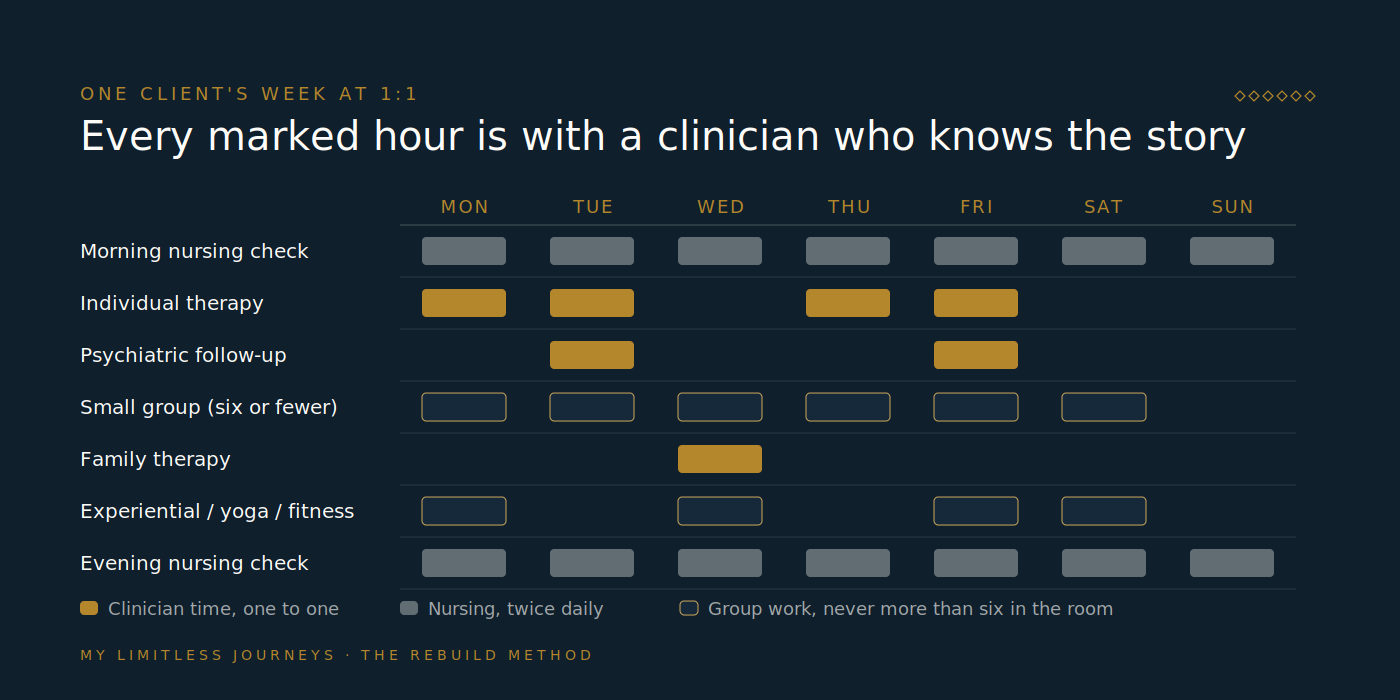
What 1:1 looks like in a client's week.
The clearest way to understand the ratio is to look at a schedule. In most residential programs, a client can expect one individual therapy session per week, sometimes two, with the remainder of the clinical day spent in groups of eight to fifteen. That is not a criticism of those programs so much as arithmetic: if two therapists carry a caseload of thirty, there are only so many fifty-minute hours available.
| Clinical contact | Typical residential program | MLJ at 1:1 |
|---|---|---|
| Individual therapy | One session a week, occasionally two | Multiple scheduled sessions a week with your primary therapist, plus unscheduled time as needed |
| Primary therapist contact | At the scheduled session; otherwise via a case manager | Daily; the therapist is in the house and knows what kind of night you had |
| Specialty modalities (EMDR, DBT skills) | Delivered in group format, or by referral after discharge | Delivered individually by the treating clinician, paced to you |
| Group therapy | Most of the clinical day; groups of 8–15 | Daily, with no more than six people in the room |
The middle row deserves attention. At MLJ, individual therapy is not an appointment you wait for. Your primary therapist sees you in the kitchen, in the garden, at the start of the day and the end of it. A session can be moved forward because you woke up in a bad place. An DBT skill can be coached in the moment it is needed rather than reviewed in retrospect. This is what clinicians mean by "milieu" treatment, and it only works when the people providing it are actually present.
Nursing coverage and psychiatric contact.
Therapy is half the ratio. The other half is medical. Nursing coverage at MLJ is continuous: a nurse is on-site or on immediate call every hour of the day, including overnight, which is when withdrawal symptoms tend to surface and when a person with a co-occurring condition is most likely to have a hard night. With six clients, the nurse taking your vitals at 6 a.m. is the same nurse who noticed your tremor yesterday afternoon, and can tell whether it is better or worse. Our page on what medically supervised means goes into the vitals cadence and protocols in detail.
Psychiatric contact is where large and small programs diverge most sharply. In many residential settings, a psychiatrist visits the facility on a fixed day, sees a long list of clients in brief medication checks, and is otherwise reachable only through nursing. At MLJ, our board-certified psychiatrist evaluates every client on admission, reviews nursing notes daily, and sees clients as often as the clinical picture requires, daily during a difficult stretch, weekly once stable. Medication changes are observed by staff who know what you were like before the change. For clients with co-occurring psychiatric conditions, this frequency is often the single biggest difference between a stay that works and one that does not.
Why six beds is the condition, not the slogan.
It is tempting to read "six beds, never more" as a luxury positioning statement. It is more accurate to read it as a staffing constraint we chose on purpose. A one-to-one ratio at six beds requires six clinicians. At sixty beds it would require sixty, which no program sustains. So programs at that scale make a rational decision: they shift the clinical day toward groups, where one therapist can serve twelve clients an hour, and they reserve individual time for one session a week. The ratio degrades not because anyone is cutting corners but because the building is full.
Small scale also changes what staff can perceive. In a six-bed home, everyone knows when someone has gone quiet, stopped eating breakfast, or started pacing at night. There is no shift report in which a client is one line among forty. The signal that a person is struggling arrives as an observation from someone who has spent the whole day with them, not as a box checked on a rounding sheet. This is the same reason six beds changes what privacy means: fewer people in the building means fewer people who know you are there, and more attention from the ones who do.
There is a cost to this model, and it would be dishonest not to name it. We treat fewer people. We cannot admit someone the day they call if all six beds are full. We do not offer a dozen tracks or a campus. What we offer instead is that every person here receives the attention a larger program can only promise to a few.
How this differs from group-heavy programs.
Group therapy is genuinely useful. Hearing your own story in someone else's mouth, being challenged by a peer rather than a professional, practicing honesty in front of others: these are things individual therapy cannot replicate, and group work remains part of every MLJ week. The question is not whether groups belong in treatment. It is whether they can carry the whole load.
For many clients, they cannot. Trauma work requires safety and pacing that a room of twelve does not provide. A person whose drinking is tangled up with a reputation, a professional license, or a public role will often say very little in a large group and a great deal in a private one. Someone with social anxiety may spend a whole group managing the room rather than working on anything. And a psychiatric medication question cannot be answered in a process group at all.
Research on treatment intensity supports the intuition. NIDA's principles of effective treatment emphasize that no single approach fits everyone, that treatment must attend to the whole person rather than only the substance use, and that individual counseling alongside other modalities improves outcomes (NIDA, Principles of Effective Treatment). A program built on groups can honor those principles in the brochure. A program built on a 1:1 ratio can honor them in the schedule.
How to check any program's math.
You do not have to take any facility's ratio on faith, including ours. On the phone, ask for the ratio as a number and ask exactly who is being counted. Ask how many clients are in residence right now and how many licensed clinicians are on shift right now. Ask how many individual therapy sessions are scheduled per client per week, and whether "individual" includes case-management check-ins or only therapy. Ask who the psychiatrist is by name, how often they are on-site, and how a medication question gets to them on a Saturday.
Then ask about the nights. Who is awake at 3 a.m., and are they a nurse? If a program hesitates on any of these, that tells you something. If they answer readily, you have what you need to compare. Our guide to choosing a rehab lists these among twelve questions worth asking, and our team page names the people who will answer them here.
- Treatment Guidance. The full library of decisions before, during, and after treatment.
- How to Choose a Rehab. Twelve questions to ask on the phone, including the ratio.
- What Treatment Actually Looks Like. A day-by-day picture of residential care.
- What Medically Supervised Means. Nursing and physician oversight, explained.
- Our Facility. The six-bed Encino home where the ratio lives.
- Executive and Professional Addiction Treatment in Los Angeles. A blog post on why professionals need individual work.
This guide is educational and is not a substitute for medical advice. If someone is in immediate danger, call 911.