
Addiction treatment for physicians, attorneys, and licensed professionals with a license to protect.
You are weighing two fears at once: what the substance is doing to you, and what a treatment record could do to the license you spent a decade earning. This page separates what boards actually require from what people assume they require, and explains how treatment fits inside that reality.
Authored by the MLJ Clinical Team. Reviewed under board-certified psychiatric oversight. Last updated September 2026.
Key Takeaways- Seeking treatment voluntarily is not, by itself, a reportable event to most licensing boards; a substance-related patient-safety incident, arrest, or malpractice claim usually is.
- Most states run confidential physician health programs and lawyer assistance programs that provide an alternative to discipline; California's structures differ by profession, and we help you understand the current landscape before you decide anything.
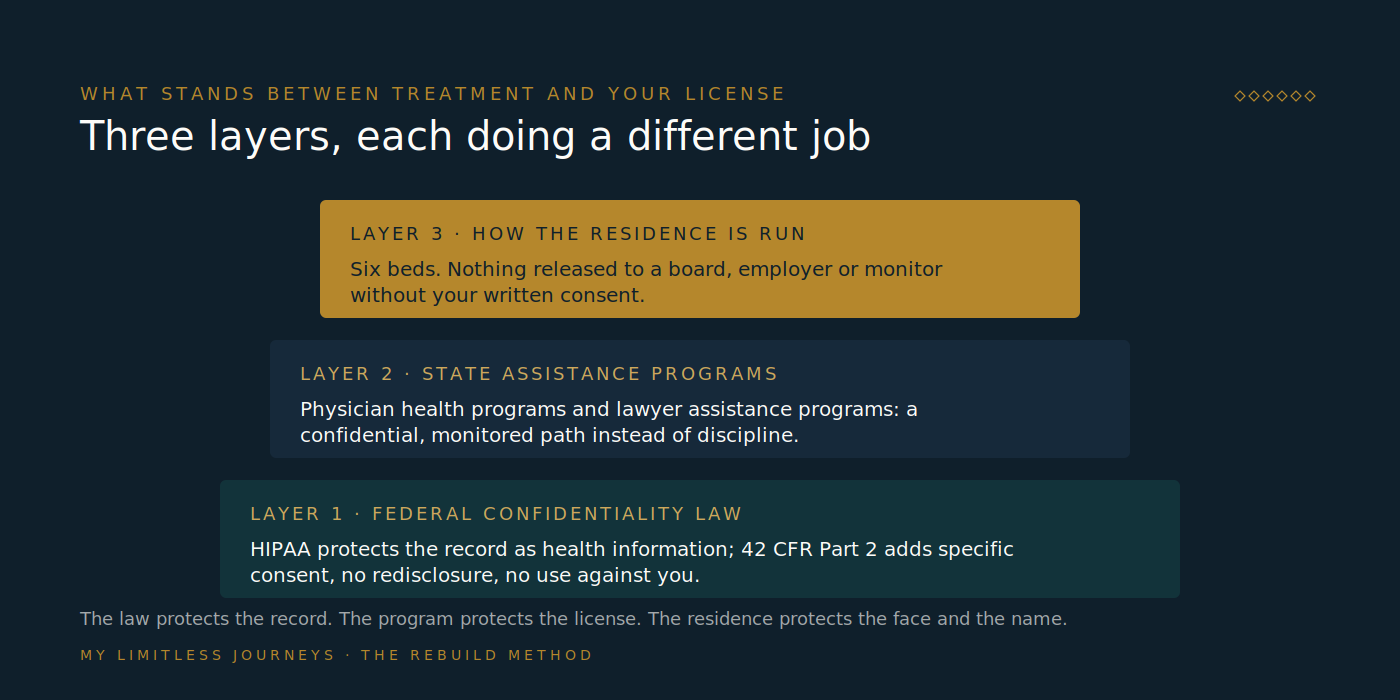
- Your treatment records are protected by HIPAA and, more strictly, by 42 CFR Part 2, and we release nothing to a board, employer, or monitoring program without your written consent.
- Monitoring agreements typically last several years and involve toxicology testing, workplace reporting, and documented treatment; our team writes the reports monitors need, when you ask us to.
- Six beds, one clinical team, and a private residence in Encino mean you are not in a group with a colleague, a patient, or a client.
- What licensing boards actually require you to report
- Physician health programs and lawyer assistance programs, explained
- What stays confidential, and where the boundaries are
- Monitoring agreements: what five years of accountability looks like
- The clinical picture we see in licensed professionals
- How treatment is arranged around a practice
What licensing boards actually require you to report.
The fear is usually vaguer than the rule. Most professionals we speak with believe entering treatment triggers an automatic report to their board. In the great majority of cases it does not; boards regulate conduct, not diagnoses. The events that generally create a reporting obligation are a criminal conviction, a substance-related incident involving a patient or client, a malpractice settlement above a threshold, a hospital action against your privileges, or a positive drug test taken under an employer's or board's authority. Checking into a private residential program on your own initiative is not on that list in most jurisdictions.
The exception that catches people is the renewal application. Many boards ask, in some form, whether you have a condition that currently impairs your ability to practice safely. The wording varies by state and profession, and it has been narrowed considerably over the past decade under pressure from the Americans with Disabilities Act; the Equal Employment Opportunity Commission's guidance on the ADA and people who use drugs or alcohol is a useful orientation to how "current use" and "in recovery" are treated differently under federal law. How you answer a renewal question after treatment is a question for a licensing attorney, not for us, and we will tell you so directly. What we can do is make sure that by the time you face it, the honest answer is that you sought care and are not impaired.
The most important point is sequence. Professionals who end up in disciplinary proceedings are rarely the ones who got treatment early; they waited until the incident that made a report unavoidable. If you are reading this before that incident, you are in the strongest position you will ever be in, and our admissions call commits you to nothing.
Physician health programs and lawyer assistance programs, explained.
Most states have created a formal alternative to discipline for health professionals and lawyers with substance use or mental health conditions. For physicians these are generally called physician health programs, or PHPs, and they are coordinated nationally through a federation of state programs. For lawyers they are usually called lawyer assistance programs, or LAPs, and they are typically run by or alongside the state bar. The design is similar: a confidential evaluation, a referral to treatment, and then a period of structured monitoring in exchange for the board or bar agreeing not to pursue discipline, or to hold it in abeyance, as long as you comply.
California is a special case. The state's lawyer assistance program operates through the State Bar and offers confidential support and, where relevant, a monitored path that can be considered in disciplinary matters. The structure for physicians in California has changed over the years and differs from the classic model in many other states, and nurses, pharmacists, dentists, and other health professionals each fall under their own board with its own program or diversion track. We will not summarize rules here that change. Our clinical team will help you identify the right program for your license and, if you wish, coordinate with it, and we will always recommend speaking with a professional-licensing attorney before you self-report to anyone.
Two things are worth saying plainly. First, participation in these programs is often voluntary and confidential when you enter before a complaint exists, and the programs generally report favorably on physicians and lawyers who complete them. Second, they typically require treatment from a provider who can document a clinical assessment, an individualized plan, and progress, which is exactly what a program with true 1:1 clinical ratios and board-certified psychiatric oversight is built to produce.
What stays confidential, and where the boundaries are.
Your records at MLJ are protected twice. HIPAA governs them as health information. The federal rule at 42 CFR Part 2 governs them as substance use disorder treatment records, which is a stricter standard: it generally requires your specific written consent before we disclose anything, prohibits the recipient from redisclosing it, and, with narrow exceptions, prevents the records from being used against you in criminal proceedings. Our plain-language explainer on Part 2 walks through the details. In practice, no board, bar, hospital, firm, or monitoring program hears from us unless you sign a release naming them and specifying what they may receive.
The honest boundaries are these. If you are in a monitoring agreement and you ask us to report to your monitor, we will report accurately, including a positive test or a missed appointment; we will not shade a report to protect you, because a program that does that is worthless to you when you need its credibility. If we learn of an imminent danger to an identifiable person, we have duties that override confidentiality. And a court order can compel disclosure under Part 2's deliberately demanding procedures. Beyond that, our staff treat your identity, profession, and reputation as sensitive by default; that you are a surgeon or a partner at a firm is not something anyone in the house needs to know unless you decide to say it.
Monitoring agreements: what five years of accountability looks like.
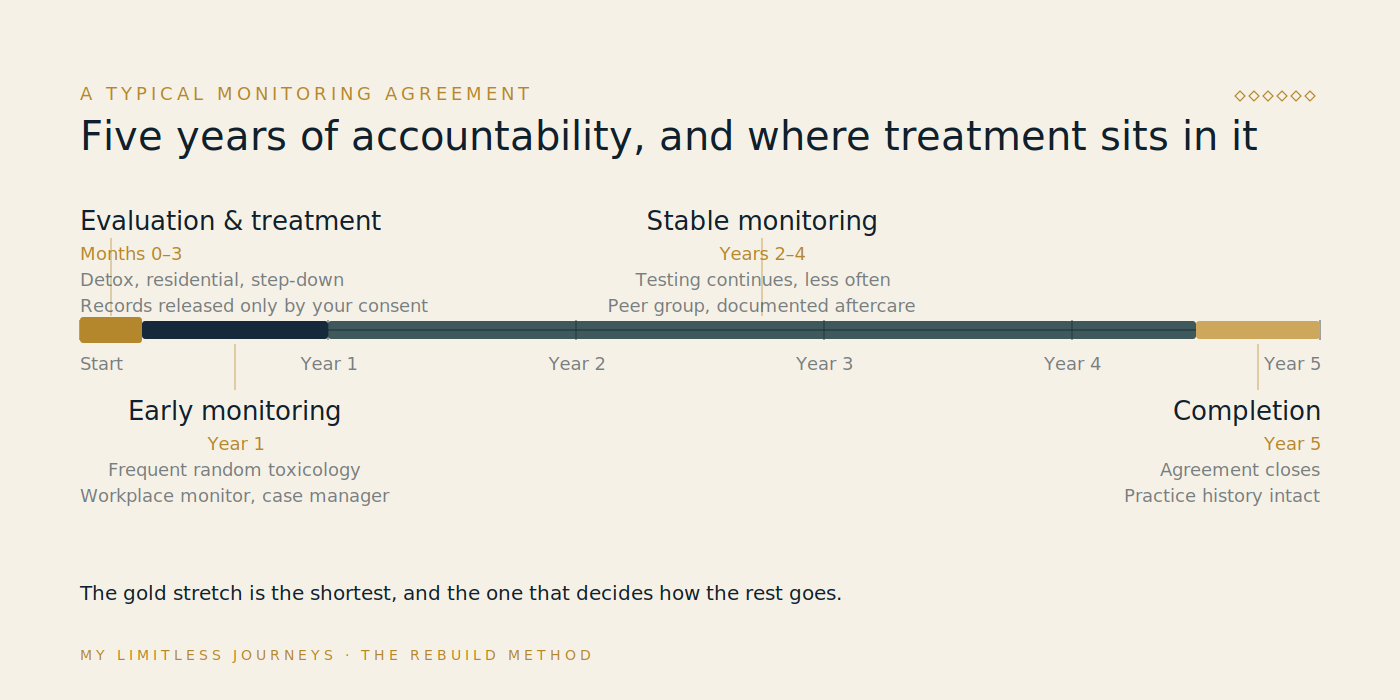
If you enter a formal program, expect a contract. Terms vary, but a typical agreement runs several years, often five for physicians and more variable for attorneys, and includes random toxicology testing, a workplace monitor, regular contact with a case manager, a peer support group, and documented treatment and aftercare. Some restrict access to controlled substances or certain practice settings early on. The structure is demanding, and that demand is why boards trust it.
Where MLJ fits: the initial treatment episode, the transition to outpatient care, and the documentation that anchors everything after. Our continuum, from detox and residential through IOP and alumni support, is delivered by one clinical team, so a monitor receives a coherent record rather than a folder of discharge summaries from four providers who never spoke to each other. When you ask us to, we write the discharge summary, fitness-for-duty input, and continuing-care plan in the form monitors expect. When you do not ask, we write nothing to anyone.
A word on the emotional side, because nobody warns you about it. Being tested at random for years after you feel well provokes resentment in almost everyone, and resentment is a relapse risk. We treat it as one in individual therapy and in your relapse-prevention plan. The professionals who do best with monitoring decided early to treat it as a structure they chose rather than a sentence they received, and that reframe starts during residential care, not after.
The clinical picture we see in licensed professionals.
The pattern is recognizable. High-functioning use that stayed invisible for years because performance never visibly dropped. Alcohol most commonly, often paired with a sleep medication or a benzodiazepine prescribed by a colleague or self-prescribed. Among clinicians with access, opioids and anesthetic agents; among attorneys, stimulants layered onto alcohol to sustain billable hours. Underneath, more often than not, an untreated co-occurring condition: anxiety that predates medical school, depression managed by working harder, trauma from the job itself. Our post on high-functioning anxiety and silent alcoholism describes this arc.
Two clinical features matter. First, intellectualization is a formidable defense, and group confrontation tends to bounce off it. Our model is individual-heavy by design, with CBT, DBT, EMDR where trauma is present, and psychiatric care that treats the co-occurring condition as seriously as the substance. Second, shame runs unusually deep in people whose identity is competence. The Self domain of the Rebuild Method exists for exactly this: separating who you are from what you can do, so that recovery does not feel like an admission of being the one thing you were never allowed to be.
How treatment is arranged around a practice.
A practice does not pause cleanly. Patients need coverage, cases have deadlines, partners need an explanation. Our admissions team has helped arrange this many times, and the pattern is usually a medical leave under the Family and Medical Leave Act for employed professionals, where the certification states only that you have a serious health condition, not a diagnosis; the Department of Labor's FMLA resources spell out what an employer may and may not ask. For solo practitioners and partners, it is a locum, a covering attorney, or a frank conversation with one trusted colleague. Our page on what an employer can find out covers the mechanics.
Inside the program, the Life domain includes return-to-practice planning from the first week: how you will handle the first prescription pad, the first client dinner, the first Friday after a loss in court. If your license involves access to controlled substances, we address that directly rather than hoping you figure it out alone. Length of stay is clinical, not scheduled around your calendar, but the continuum gives you options; many professionals complete residential care and step down to PHP or IOP while resuming limited, supervised work. Read working during treatment for what is realistic at each level, and call (866) 209-4246 when you are ready to talk it through.
- Treatment for professionals. The hub for people whose work, reputation, and privacy cannot be set aside.
- Can my employer find out?. FMLA certification, ADA protections, and what HR actually receives.
- 42 CFR Part 2 in plain language. The federal rule that protects your treatment record.
- Working during treatment. What is realistic at each level of care.
- Residential treatment. How the core program is structured.
- Executive and professional addiction treatment in Los Angeles. A clinical-team note on the high-functioning pattern.
This guide is educational and is not a substitute for medical or legal advice. If someone is in immediate danger, call 911.