
Can I work during treatment? Phones, laptops, and clinical boundaries.
It depends on the level of care, and the honest answer is different at each one. In residential, work is limited and scheduled. In PHP, it is rare. In IOP and transitional living, the program is built so you can.
Authored by the MLJ Clinical Team. Reviewed under board-certified psychiatric oversight. Last updated September 2026.
Key Takeaways- Device and work access follows your level of care: almost none during detox, scheduled windows in residential, progressively more in PHP, IOP, and transitional living.
- The early restriction is a clinical intervention. A brain in withdrawal cannot do its job and your job at the same time.
- We plan your work constraints on the admissions call, so the people who depend on you are covered before you arrive.
- IOP is designed around a working schedule. Most of our IOP clients are back at their desks while still in treatment.
- Federal law gives most employees a protected way to take the time. You do not have to choose between your recovery and your position.
- The honest answer, level by level
- Residential: why the phone goes away first, and how it comes back
- PHP and IOP: where work re-enters
- Transitional living: working from the bridge
- Why the boundaries are clinical, not punitive
- How we plan your work before you arrive
- What the law does for your job while you are here
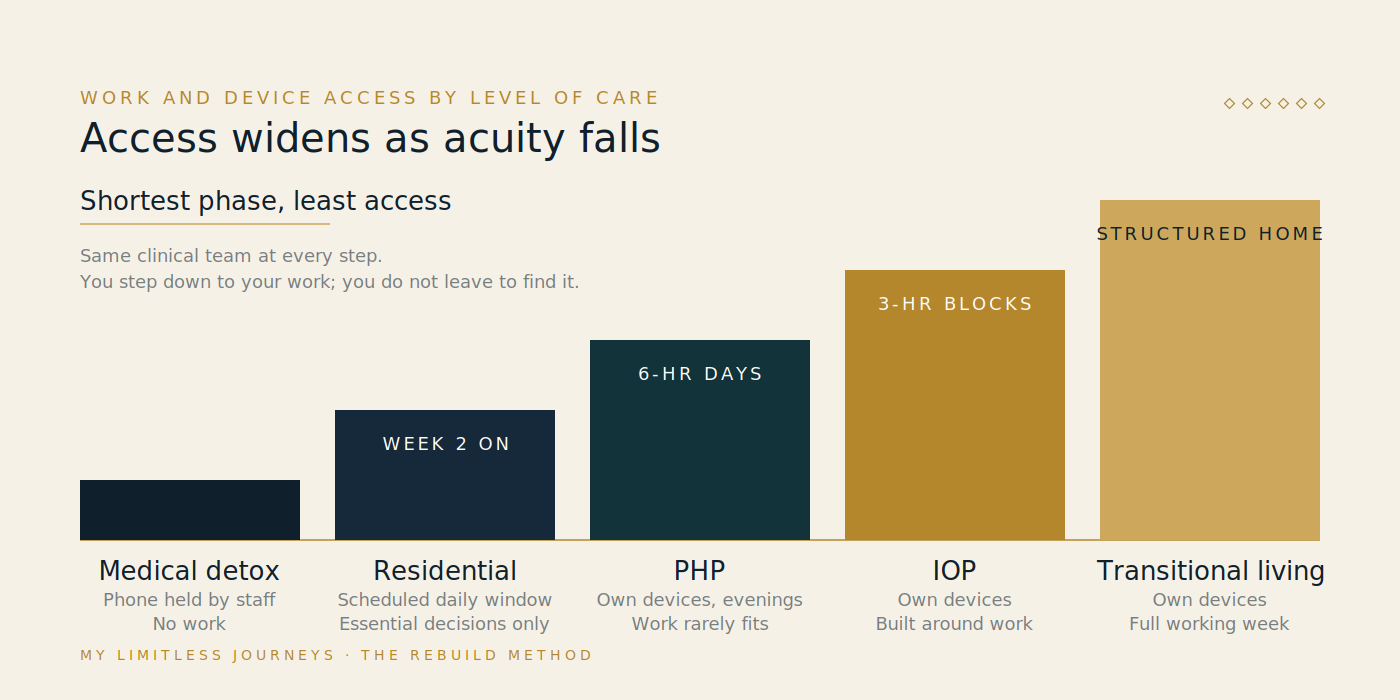
The honest answer, level by level.
Most programs answer this question with a policy. We would rather answer it with a table, because the same person has a very different relationship with a laptop on day three of detox than on day forty of IOP. If a program tells you that you can work normally during residential treatment, ask what "normally" means and where the clinical hours fit.
| Level of care | Phone and laptop | Work, honestly |
|---|---|---|
| Medical detox | Held by staff; brief supervised calls to family or a designated contact | None. You are a patient, not an employee, for these days. |
| Residential | Scheduled windows, usually beginning in week two, expanding with clinical progress | Limited and scheduled: a daily window for essential decisions, not a working day |
| PHP | Your own, outside program hours | Rarely. Programming runs most of the day, five or six days a week. |
| IOP | Your own | Designed for it. Three-hour blocks, morning or evening, around a working schedule. |
| Transitional living | Your own | Expected. A structured home base while you return to full work. |
Notice that the restriction is front-loaded: the level with the least access is also the shortest. And because MLJ runs the full continuum, you do not leave treatment to get your work back. You step down to it, with the same clinical team, on a planned schedule. Our page on levels of care defines each stage; this page is about what each asks of your working life.
Residential: why the phone goes away first, and how it comes back.
During detox and the opening days of residential, your phone is held by staff. You can make brief supervised calls to a spouse, a parent, or one designated contact. You cannot take a client call or clear your inbox. For someone who has run their life from that device for twenty years, this produces the most anxiety before admission and, in our experience, the most gratitude afterward.
The reason is physiological before it is philosophical. Withdrawal disrupts sleep, concentration, and emotional regulation for days to weeks, and the National Institute on Drug Abuse describes early recovery as a period when the brain's stress and reward systems are still recalibrating. You would not want to sign a term sheet on the second day of alcohol withdrawal. Neither would your board. Taking the device out of reach removes a category of decisions you should not be making yet.
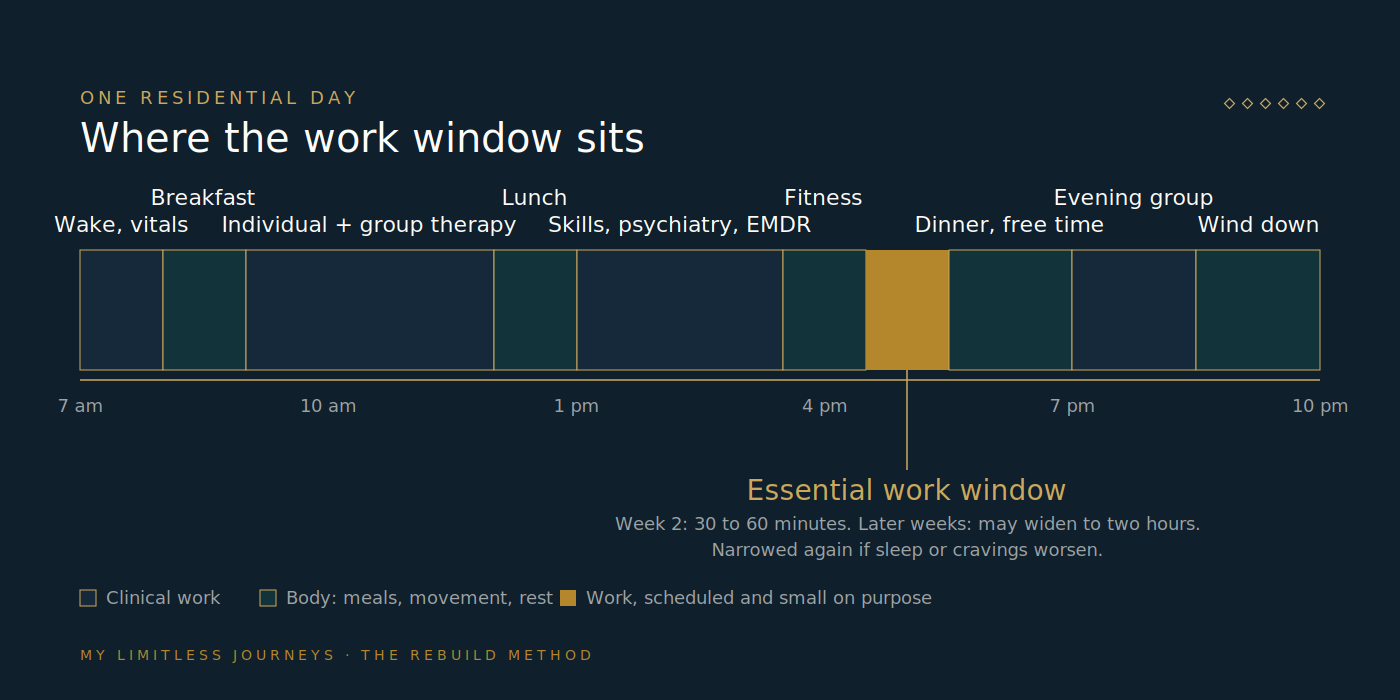
Access comes back gradually, as a clinical decision rather than a reward. Typically in the second week, once you are medically stable and sleeping, your primary therapist agrees a daily window with you, often thirty to sixty minutes in the late afternoon. It is for essential decisions: the two emails only you can answer, a ten-minute call with the person holding your desk. It is not a working shift. Someone in the sixth week of a ninety-day stay may have a two-hour block and a laptop in their room. Someone struggling with sleep or cravings may have it narrowed again, for the same reason a physician adjusts a medication.
Residential at MLJ is six clients and a full clinical team, so this is negotiated person to person rather than announced on a laminated sheet. If the "essential decisions" hour is quietly becoming an afternoon of anxious refreshing, your therapist will notice, and that becomes material for the work.
PHP and IOP: where work re-enters.
Partial hospitalization is the level people most often misjudge. Because you are no longer sleeping at the residence, it feels like it should be compatible with a job. In practice, PHP runs roughly six clinically dense hours a day, five or six days a week. Your phone and your evenings are your own, but a full workday on top of a full clinical day is not something we can recommend, and most people who try it find within a week that one of the two is being done badly. If your work cannot wait but your clinical need is still high, that conversation usually leads to a shorter PHP phase and an earlier move to IOP.
IOP is where work genuinely comes back. It runs in three-hour blocks, three to five days a week, scheduled morning or evening so that a working professional can attend. This is the level designed for the attorney back at the firm, the producer back on set, the physician back in clinic: recovery treated like any serious medical condition with a standing appointment that is on the calendar and not negotiable. Our comparison of IOP and PHP covers the clinical differences; from a working-life perspective, IOP simply assumes you have somewhere else to be.
One caution. The step-down is when people most want to prove they are fine by taking on everything at once. Returning to work in IOP is healthy. Returning to eighty-hour weeks in IOP is the old pattern in a new outfit. Our page on the first ninety days back at work lays out how we sequence the return.
Transitional living: working from the bridge.
Transitional living is a structured, substance-free residence with clinical involvement, and for many professionals it is where they return to a full working week. You have your devices, you leave in the morning, and you come back to a house with expectations: curfew, testing, house meetings, continued contact with the clinical team. The structure is not there to supervise your work. It is there so the hours outside work are not a vacuum.
An executive who lives in Newport Beach and works in Century City can hold the job from Encino while family therapy does its work. A writer on deadline can finish the draft somewhere other than the apartment where the drinking happened. Our page on going home versus transitional living walks through the decision, and this comparison explains how our model differs from a standard sober-living house.
Why the boundaries are clinical, not punitive.
Some people arrive having been in treatment before, at programs where the phone policy felt like a rule for children. We understand the resentment, and a boundary you understand is a boundary you can use.
The first purpose is protection during impaired judgment, covered above. The second is diagnostic. For many professionals, work is not only a stressor; it is the primary regulating behavior, keeping feelings at bay as reliably as the drink did. When the laptop is closed for ten days, what surfaces is often the material treatment needs to reach: the panic at four o'clock, the grief the schedule never allowed, the discovery that an identity built on being indispensable does not know what to do with a quiet afternoon. In the Rebuild Method this is the Self domain, and it is very hard to do while answering Slack.
The third purpose is the other five people in the house. One person taking calls in the living room changes the room for everyone. Our policy on phones and social media in treatment protects your anonymity as much as your recovery: no photographs of other clients, no posting from the residence.
Finally, the boundary is temporary. Nobody at MLJ believes ambitious work is the enemy of recovery; most of our clients return to careers they love. The question is not whether you should work but whether work has been doing a job it was never meant to do.
How we plan your work before you arrive.
The most useful thing you can do about work happens on the admissions call. We ask about your constraints directly: what cannot be delegated, what is time-sensitive in the next thirty days, who needs to be told what, and whether a deal, a production, a trial, or a filing depends on you. This is the beginning of your return-to-work plan, and it lets us design the first two weeks around real obligations rather than a policy.
Several things come out of it. One is a designated work contact, often an assistant, a partner, or a manager, who holds the desk and can reach the residence in a genuine emergency. Another is a short list of decisions that truly require you, which becomes the content of your first phone window. A third is timing; clients in production work with us on where treatment fits a schedule that is not theirs to move. We also help with what to tell your team.
The people who struggle most with the phone boundary almost always arrived without this planning done. The people who find it a relief know the desk is covered.
What the law does for your job while you are here.
The Family and Medical Leave Act provides eligible employees up to twelve weeks of job-protected, unpaid leave in a twelve-month period for a serious health condition, and treatment for a substance use disorder qualifies when provided by a health care provider. The U.S. Department of Labor publishes the eligibility rules. Your employer may ask for medical certification; it does not get your diagnosis or your records.
The Americans with Disabilities Act, enforced by the EEOC, protects people in recovery from discrimination and can require reasonable accommodation, such as a schedule that permits IOP attendance. It does not protect current illegal drug use. Physicians, attorneys, and other licensees also have profession-specific programs, discussed on our page for licensed professionals.
Your records are protected by HIPAA and, for substance use treatment, by the stricter federal rule 42 CFR Part 2: we cannot confirm to your employer that you are here without your written consent. This page answers whether an employer can find out at all. None of this is legal advice; it is offered so you know the law is on the side of your getting well.
- Treatment Guidance. The hub for every question about how treatment actually works.
- Your first week in residential treatment. What the days look like when the phone is away.
- 30-, 60-, and 90-day programs. How length of stay is decided, and what it means for your calendar.
- What to tell your team. Scripts for the assistant, the partner, and the manager.
- Intensive outpatient program. The level of care built around a working week.
This guide is educational and is not a substitute for medical advice. If someone is in immediate danger, call 911.