
Treatment for writers, directors, and producers, when the work is who you are.
Months alone with a draft, then weeks in a room where everyone is watching you. Deadlines that reward the substance and punish the sleep. Here is how treatment works when identity and output have become the same thing, and how you can keep writing while you get well.
Authored by the MLJ Clinical Team. Reviewed under board-certified psychiatric oversight. Last updated September 2026.
Key Takeaways- Creative work alternates between isolation and intense exposure, and both phases have their own substance logic; treatment has to address each.
- Writers' rooms, sets, and production offices carry culture as well as pressure, and a showrunner or producer often holds everyone's stress.
- Remote work from transitional living during IOP is realistic at My Limitless Journeys; laptops and deadlines are managed by clinical stage, not banned.
- The Self domain of the Rebuild Method exists for people who fear that sobriety will cost them the voice that made the work possible.
- A stay between projects, thirty days residential followed by outpatient care, is the most common arc, and it can be planned around a delivery date.
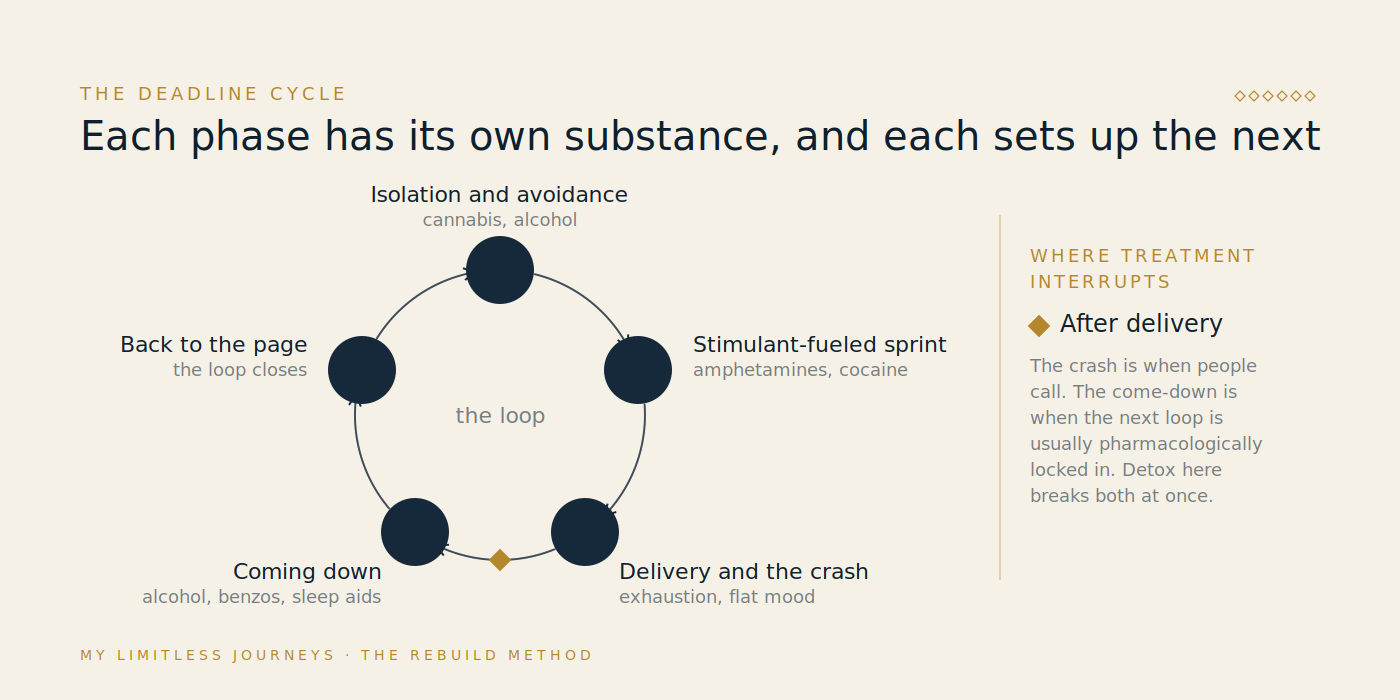
The two phases of creative work.
Almost every writer, director, or producer we have treated describes the same shape. The alone phase: the draft, the outline, the edit, the development period where nothing is happening and everything depends on you. Then the exposed phase: the room, the set, the network call, the notes meeting, the test screening. Isolation with no structure, then exposure with no privacy. Neither is sustainable, and the switch between them is brutal.
Each phase has its own substance logic. In isolation, alcohol or cannabis fills the shape of the day and quiets the voice that says the pages are bad; stimulants, prescribed or not, manufacture the focus that used to come naturally. In exposure, alcohol manages the social dread, benzodiazepines the panic before a pitch, and cocaine the fact that the day started at seven and the dinner runs until midnight. When the exposed phase ends, isolation resumes with the new habits in place.
Treatment has to understand both. A program that only addresses social drinking misses the writer who has not been sober alone in a room in six years; one that only addresses solitary use misses the producer who is fine at home and cannot walk onto a stage without a drink. The Rebuild Method is built around the whole life, with a Life domain for daily structure and a Mind domain for the anxiety and trauma underneath. For the rest of this part of the library, start at the For Professionals hub.
Deadline physiology.
The deadline sprint is the most reliable relapse trigger in creative work, and it is worth understanding why. A draft is due Monday. It is Thursday. The pattern says: stimulant to start, alcohol to stop, repeat until delivered. The stimulant is not only about wakefulness; it produces a certainty about the work that a sober writer at two in the morning does not have. The alcohol is not only about sleep; it turns off the review process that would otherwise run all night.
Then the draft is delivered and the crash arrives, physiological and emotional at once. The National Institute on Drug Abuse describes the depression, fatigue, and sleep disturbance that follow heavy stimulant use; anyone who has delivered a script on a bender knows the three days after are often worse than the three before. Alcohol compounds it. The National Institute on Alcohol Abuse and Alcoholism has long documented that alcohol shortens sleep onset and then fragments the second half of the night, which is why the writer who drank to sleep wakes at four and cannot face the pages.
The deadline cycle is why we take co-occurring conditions so seriously here. Untreated ADHD often sits under the stimulant use; untreated anxiety or a trauma history under the drinking. Board-certified psychiatric oversight means those are evaluated in the first week rather than discovered in the fourth. Our page on co-occurring disorder treatment explains how both are treated together, by one team.
The room, the set, and the production office.
A writers' room is a workplace, a friend group, a pressure cooker, and sometimes a bar. Its culture is set from the top: a showrunner who drinks at the table at six sets the temperature for a dozen people who depend on them for their next job. That cuts both ways. A staff writer who wants to stop cannot easily be the one person who skips drinks. A showrunner who wants to stop is watched by a room that has organized itself around the existing rhythm.
Directors face a different version. On set you are the calm the crew borrows, the answer to two hundred questions a day, the person whose mood decides whether the day is survivable. Many directors describe using not to feel good but to keep the surface flat. Producers describe something similar with a longer horizon: holding the financing, the schedule, the talent's crisis, and the studio's notes, with no one to whom they can say they are not all right.
We name these dynamics because relapse prevention has to be designed for the actual environment. Avoiding people and places associated with use would mean leaving the industry, and we do not ask that. Instead the Life domain work is specific: what you say in the room, which colleague knows, how you leave a dinner at ten without explanation, what happens when an executive orders a bottle for the table. The post on when your using network is your professional network goes further, and our relapse-prevention program is where the rehearsal happens.
When identity is the work.
The fear that stops many writers from getting help is not being seen at a facility. It is that sobriety will take the voice. The drink that quiets the inner critic, the stimulant that makes the words come, the mythology of the writer who wrote drunk: all of it points to the same terror, that whoever you are without the substance cannot make the work. Directors and producers carry a related fear, that the appetite that built the career is the appetite that drinks, and you cannot turn one off without losing the other.
This is why the Rebuild Method has a Self domain, and why it matters more for this population than any other. Values, purpose, and spiritual exploration are how we help someone whose whole identity has been output find a self that can survive a fallow season. It is not about caring less about the work. It is about not needing the work to be the only reason to stay alive; a life with one load-bearing wall collapses when that wall is under renovation.
We will say honestly that early recovery is often flat. Anhedonia in the first several weeks, the inability to feel pleasure in things that used to produce it, is common and well described, and for a writer it can feel like confirmation of the fear. It is not; it is the brain recalibrating, and it lifts. Our post on anhedonia in week three is worth reading before it arrives. Individual therapy and acceptance and commitment therapy are where the identity work happens, and people who do it tend to report the writing comes back changed and, eventually, better.
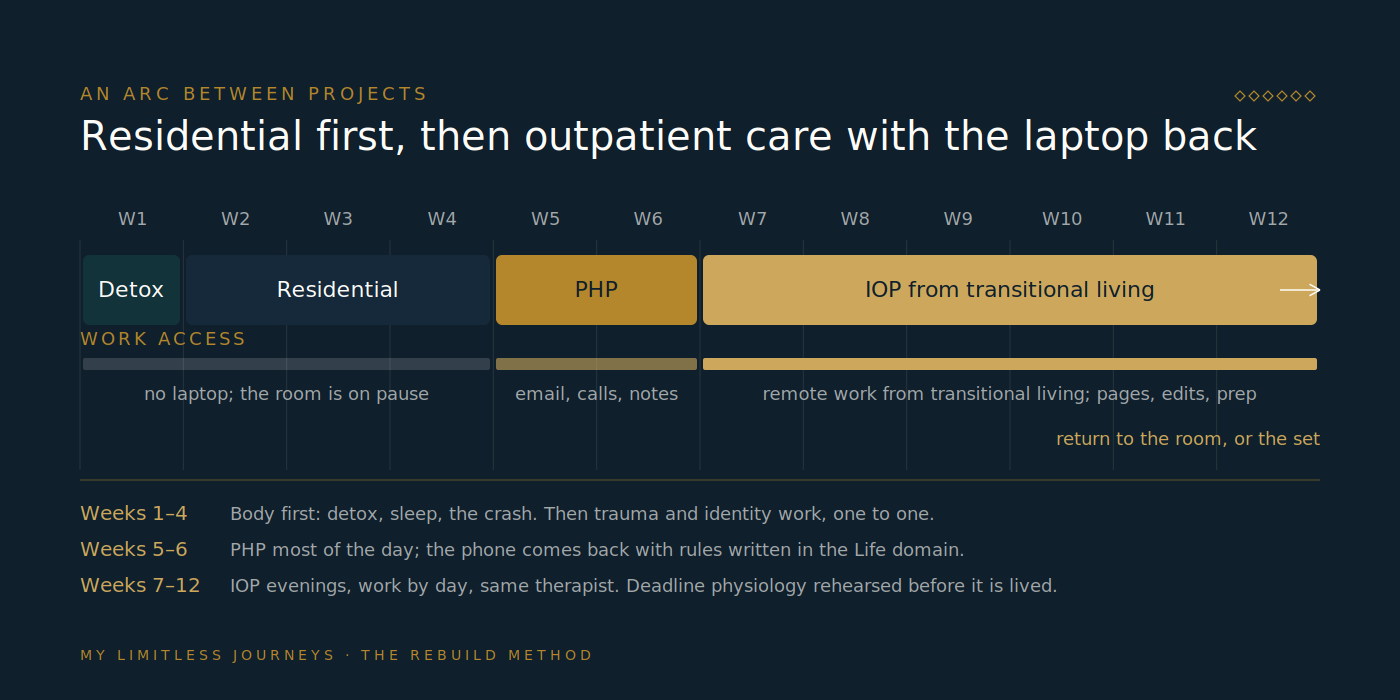
Working remotely from transitional living.
The question every writer asks on the admissions call is whether they can keep working. It depends on the level of care. In detox and residential, no, and not because we are doctrinaire: the early weeks are when outside pressure does the most damage, and a producer taking a financier's call on day four of alcohol detox is a clinical risk we will not take. Phone access is limited and scheduled after stabilization. Our page on working during treatment explains what changes at each stage and why the limits are clinical rather than punitive.
In IOP, the answer changes. IOP is built for a working life, and for a writer that life is largely a laptop. Clients in transitional living during IOP routinely write in the mornings, attend sessions in the afternoon or evening, and deliver pages on schedule. Directors in post have cut with an editor twenty minutes away. Producers have run a development slate from a desk in the house. What makes it work is the structure: a sober household, a clinician who knows what a delivery date does to you, and a daily plan that puts sleep and meals ahead of the sprint.
Two boundaries hold even in IOP. Sessions are not skipped for a call, any more than a psychiatric appointment would be skipped for a notes meeting. And the deadline sprint is planned with your clinician in advance rather than survived in secret, which for many people is the first time a deadline has been approached with a plan rather than a supply.
The arc of a stay between projects.
The most common shape is a stay that begins after a delivery or a wrap and ends before the next commitment. Weeks one through four are residential, with medically supervised detox absorbed into the first days; the same team runs both, in the same six-bed house. Weeks five and six, for many clients, are PHP, with daytime programming and the phone back on a schedule. From week seven, IOP with remote work, and the laptop returns in earnest.
That arc fits a twelve-week gap comfortably and a ten-week gap with care. If your window is shorter, thirty days residential followed by IOP is the honest minimum for most people; our guide to thirty, sixty, and ninety-day programs explains why we sometimes recommend more. If there is no window and the using is escalating mid-season, the calendar stops being the deciding factor. A development deal survives a medical leave. Some things do not survive waiting for the right gap.
For the agent, partner, or spouse.
If you represent this person, you have probably covered for a missed delivery and fielded a studio call about late pages. You can call (866) 209-4246 without naming your client, learn how assessment and the admission window work, and find out what you can and cannot do without their consent. We cannot admit anyone against their will. We can help you think about how to raise it; our Families pillar has a page on when they refuse treatment.
If you are the spouse or partner, you have lived the isolation phase up close: the closed office door, the drinking that starts when the draft is bad, the promise that it will stop when the script is delivered. Family therapy is part of the clinical program, not an add-on, and what you can be told during the stay is governed by a release your partner controls; our page on family confidentiality explains how that is set up on day one and how it usually widens. You should not have to decide whether it is bad enough. If you are reading this at midnight, it is bad enough to call.
- For Professionals. The hub, and the six structural differences that make this possible.
- Actors and on-camera talent. The exposed phase, full time.
- Working during treatment. Phones, laptops, and clinical boundaries by level of care.
- Transitional living. Where remote work and recovery share a roof.
- Anhedonia in early recovery. The flat weeks, and why they end.
This guide is educational and is not a substitute for medical advice. If someone is in immediate danger, call 911.