
What to tell your team: who needs to know what, and when.
Your assistant needs your calendar. Your agent needs a date. Your business partner needs to know the deal will close. None of them needs a diagnosis. This is a working guide to saying enough, and no more, to the people who keep your professional life running.
Authored by the MLJ Clinical Team. Reviewed under board-certified psychiatric oversight. Last updated September 2026.
Key Takeaways- Disclosure is not binary. Each person in your working life needs a different amount of information, and most need far less than you fear.
- "Unavailable for personal reasons" is a complete sentence. In most professional settings it is also a normal one, and it does not invite follow-up.
- Decide the story before you leave, tell it consistently, and give one trusted person the authority to repeat it so you do not have to.
- Sometimes fuller disclosure helps: when someone must cover clinical constraints on your schedule, when a contract has a health clause, or when the rumor would be worse than the truth.
- Whatever you tell people, you decide. No one at MLJ will confirm your presence without your written release.
One principle: need to know, not right to know.
People who run companies, sets, practices, and careers tend to over-disclose when they are frightened, because telling the whole truth feels like the only honest option. It is not. Honesty means not lying. It does not mean volunteering your medical history to everyone whose week you are about to disrupt.
A more useful frame comes from how organizations already handle sensitive information: each person gets what they need to do their job, and nothing more. Your assistant needs to know you are unreachable and for how long. Your agent needs to know what you can and cannot commit to. Your partner at the firm needs to know who is covering your matters. Not one of those jobs requires the word "treatment."
There is also a legal backdrop worth knowing. If your absence is structured as medical leave, the Family and Medical Leave Act certification your employer receives describes a "serious health condition" without a diagnosis, and the Americans with Disabilities Act limits what an employer may ask. We cover this in Can my employer find out? This page assumes you have read that and want to know what to actually say.
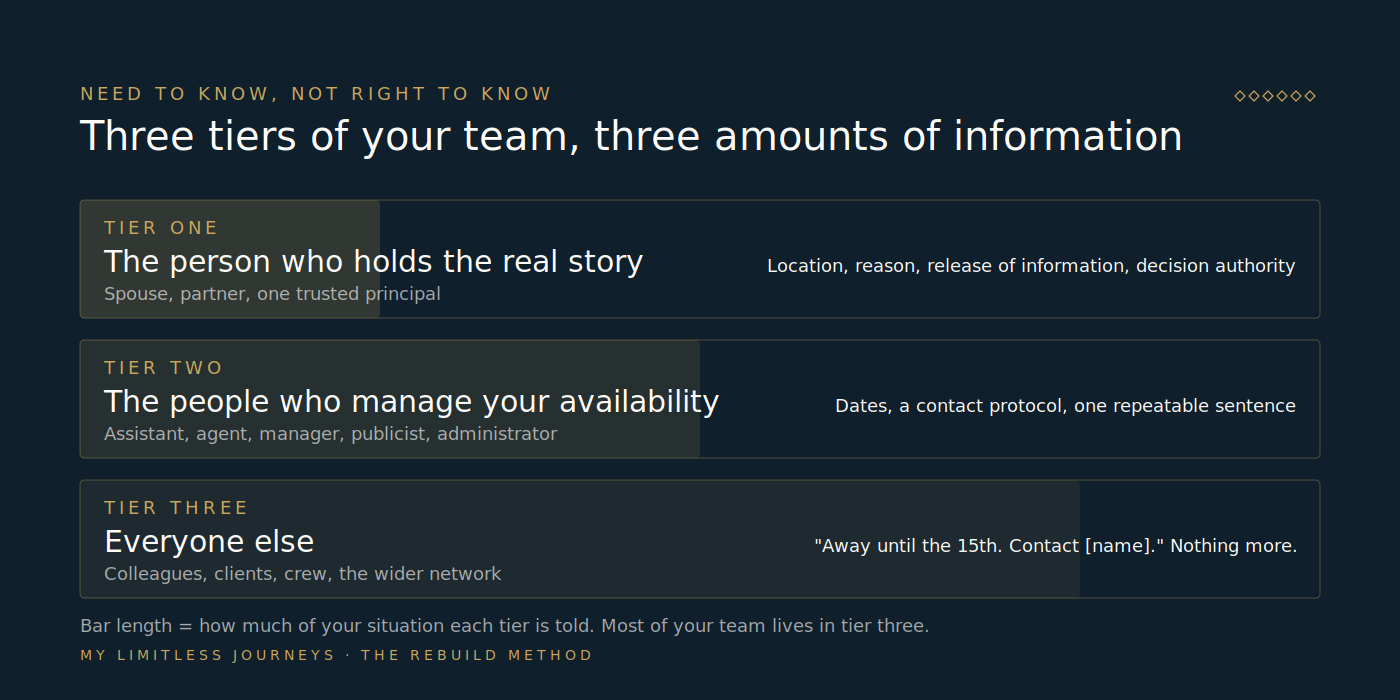
The three tiers of your team.
Before you write a single message, sort the people in your working life into three groups. The sorting is the hard part; the scripts follow from it.
Tier one: the person who holds the real story. One person, occasionally two. Usually a spouse or partner, sometimes a long-standing business partner, manager, or attorney. This person knows where you are and why, has your permission to be named on a release of information, and can make decisions on your behalf if something in your professional life cannot wait. Choosing this person carefully is the single most protective thing you will do. Everyone else can be routed through them.
Tier two: the people who manage your availability. Assistants, agents, managers, publicists, a chief of staff, a practice administrator. They need dates, a contact protocol, and a sentence they can repeat. They do not need the reason, and a good one will not ask. If they do, the answer is that it is personal and handled.
Tier three: everyone else. Colleagues, clients, collaborators, crew, staff, the wider network. They need to know you are away and who to talk to instead. That is all. In most professional cultures, a senior person being unavailable for several weeks with a designated point of contact reads as ordinary. It only reads as strange if you make it strange.
| Tier | Who | What they get | What they do not get |
|---|---|---|---|
| One | Spouse, partner, one trusted principal | Location, reason, release of information, decision authority | Clinical detail you choose to keep private |
| Two | Assistant, agent, manager, publicist, administrator | Dates, contact protocol, a repeatable sentence | The reason, the location |
| Three | Colleagues, clients, crew, network | "Away until [date]; contact [name]" | Anything else |
Scripts, by role.
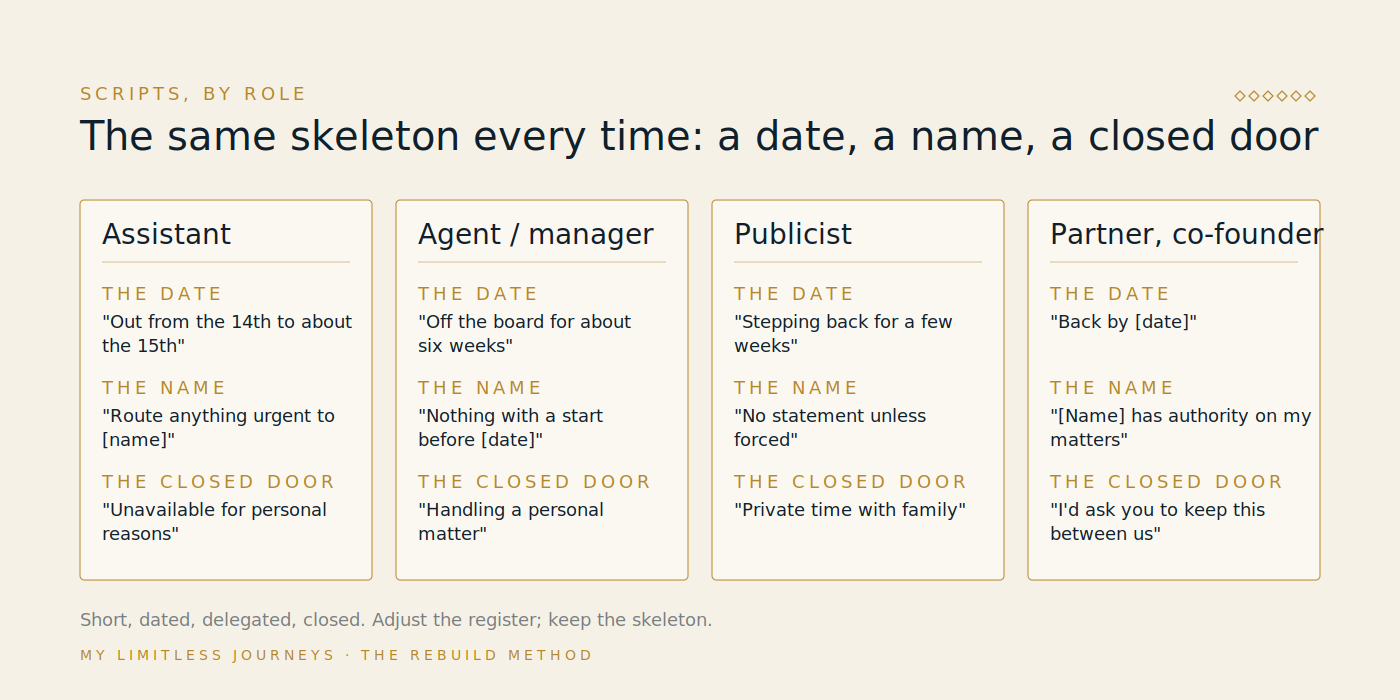
These are starting points, written the way our clients actually talk. Adjust the register to your relationships. The common thread is that each one is short, gives a date, names a point of contact, and closes the door gently on follow-up questions.
To an executive assistant or chief of staff. "I'm going to be out and mostly unreachable from the 14th through roughly the 15th of next month for a personal matter. Please clear my calendar, decline anything that can't move, and route anything urgent to [tier-one person]. If anyone asks, I'm unavailable for personal reasons and will follow up when I'm back. I'll check in with you on a schedule once I have one."
To an agent or manager. "I need to take myself off the board for about six weeks starting the 14th. Nothing I can't move, please. Don't pitch me for anything with a start date before [date]. If a producer or a partner asks, I'm handling a personal matter and I'll be back at full speed by [date]. I'll have more clarity on what I can commit to after the first couple of weeks." If you are mid-production, our guide on timing treatment around a production calendar goes deeper on the sequencing.
To a publicist. "I'm stepping back for a few weeks for personal reasons. If anything comes up, the line is 'taking some private time with family' and nothing further. I don't want a statement unless something forces one, and if something does, I want to see it first."
To a partner at the firm or a co-founder. This is where more disclosure is sometimes warranted, because this person may need to make decisions in your absence and may carry fiduciary duties. A middle path: "I'm dealing with a health issue that needs my full attention for the next several weeks. It's being handled and I expect to be back by [date]. [Name] has authority on my open matters. I'd rather not go into detail right now, and I'd ask you to keep this between us." You have told the truth. You have not told them which health issue.
When to tell them.
Sequence matters almost as much as content. Tell tier one first, before anything is scheduled, because that person may help you decide the rest. Tell tier two once you have an admission date, ideally two to five days before you leave, which is long enough to reorganize a calendar and short enough that the story does not have time to drift. Tell tier three last, and let tier two do most of it.
Resist the impulse to tell people the night before you admit, or worse, from the car. Rushed disclosure is where over-disclosure happens. If your admissions call results in a window of 24 to 72 hours, use the first of those hours to make a list and the second to make the calls.
Set expectations about contact at the same time. In residential treatment, phone access is limited and scheduled, particularly in the first days. Tell your tier-two people that work contact will happen on a set cadence, perhaps twice a week, through one channel, and that silence in between is expected and not a cause for alarm. This single sentence prevents a great deal of anxious texting.
When telling more actually helps.
The first is when someone has to enforce clinical constraints. If you step down to IOP and return to work while attending programming several evenings a week, the person who builds your schedule may need to know those blocks are non-negotiable medical appointments. They still do not need to know what kind.
The second is when a contract or a license is involved. Some employment agreements, production insurance policies, and professional licensing boards have health or fitness-for-duty provisions. If you hold a medical, legal, or aviation license, or if your work is bonded, talk to an attorney before you admit. Our guide for physicians, attorneys, and licensed professionals walks through the common situations, and we can coordinate with counsel on your behalf if you authorize it.
The third is when the rumor would be worse than the truth. If your behavior before treatment was visible to colleagues, a vague absence may feed speculation that is more damaging than a controlled, partial disclosure to a few key people. Clients in this position often choose to tell one or two more people than they would otherwise, with a script that acknowledges a health issue and a plan without naming either. Judgment here is personal, and it is a good subject for early sessions with your therapist.
If someone asks directly.
Occasionally someone will push past the closed door. A colleague will say, "Is everything okay? You're not sick, are you?" or, more pointedly, "Are you in rehab?" You are allowed to decline to answer, and you should have a sentence ready so that you do not improvise one under pressure.
Something like: "I appreciate you asking. It's a personal matter and I'm handling it. I'll be back on the 15th." Then change the subject or end the conversation. Repeating the same sentence a second time, in the same tone, is more effective than finding a new one. People stop asking when the answer does not change.
You do not owe anyone a denial, and we would gently discourage one. A denial creates a fact that has to be defended later. "I'd rather not discuss it" is unimpeachable in a way "no, of course not" never will be.
What we do on our side.
Everything above concerns what you say. Here is what we do to make sure nothing else is said for you. MLJ does not confirm or deny that any person is a client to anyone who calls, writes, or arrives, regardless of who they claim to be, unless you have signed a release naming that person. This is required by 42 CFR Part 2, and we would do it anyway. If your assistant calls the residence looking for you and is not on your release, they will be told, courteously, that we cannot help them.
Our staff are trained to treat identity, work, and reputation as sensitive by default, which in practice means that the details of your professional life stay inside the clinical relationship. We do not release our street address until intake. We do not use branded vehicles. And with six beds, the number of people who could recognize you is small enough that we can screen for conflicts before you arrive. Your story, told carefully, is one layer of protection. The building and the people in it are another.
- Privacy in Treatment. The hub for what the law protects and what we add.
- Can my employer find out?. FMLA, ADA, and what HR actually receives.
- Family confidentiality. How releases of information work for a spouse or parent.
- Phones and social media in treatment. How contact with your team actually works day to day.
- For Professionals. Treatment for people whose work, reputation, and privacy cannot be set aside.
- When your using network is your professional network. Why some conversations with colleagues are harder than others.
This guide is educational and is not a substitute for medical advice. If someone is in immediate danger, call 911.