
One nervous system. One treatment plan.
Most addiction is self-medication for something underneath. Treating the substance and ignoring the condition is how the industry built its relapse statistics. This page explains what integrated treatment means in practice, and how we do it.
Authored by the MLJ Clinical Team. Reviewed under board-certified psychiatric oversight. Last updated September 2026.
Key Takeaways- Co-occurring disorder means a psychiatric condition and a substance use disorder in the same person at the same time. It is the norm in treatment, not the exception.
- SAMHSA counted 20.4 million American adults with both in a single year, and more than a third of them received no treatment of either kind.
- Sequential care, getting sober first and treating the psychiatry later, is the model most likely to fail. Integrated care treats both from day one.
- Some psychiatric symptoms are caused by the substance and resolve with time. Telling the difference takes weeks of observation, not one intake appointment.
- One psychiatrist, one clinical team and one plan across detox, residential and step-down is the structural difference that makes integration real.
What co-occurring actually means.
A co-occurring disorder, sometimes called dual diagnosis, is a diagnosable psychiatric condition and a substance use disorder present in the same person at the same time. SAMHSA counted 20.4 million American adults in that position in a single year, and more than a third of them received no treatment of any kind. Among those who did get care, most received help for only one of the two conditions.
The relationship runs in more than one direction, which is why the question of blame goes nowhere. The National Institute on Drug Abuse describes three overlapping explanations: shared risk factors such as genetics, temperament and early adversity; psychiatric illness driving substance use as self-medication; and substance use itself changing brain circuitry in ways that produce or worsen psychiatric illness. In most of the adults we treat, all three are visible in the same history.
That last number is the whole problem in one line. It describes a person who spends six weeks getting sober in a program that never treats the depression that has been there since they were nineteen, then goes home and finds the depression exactly where they left it, with the one thing that used to touch it now forbidden. Nobody should be surprised by what happens next.
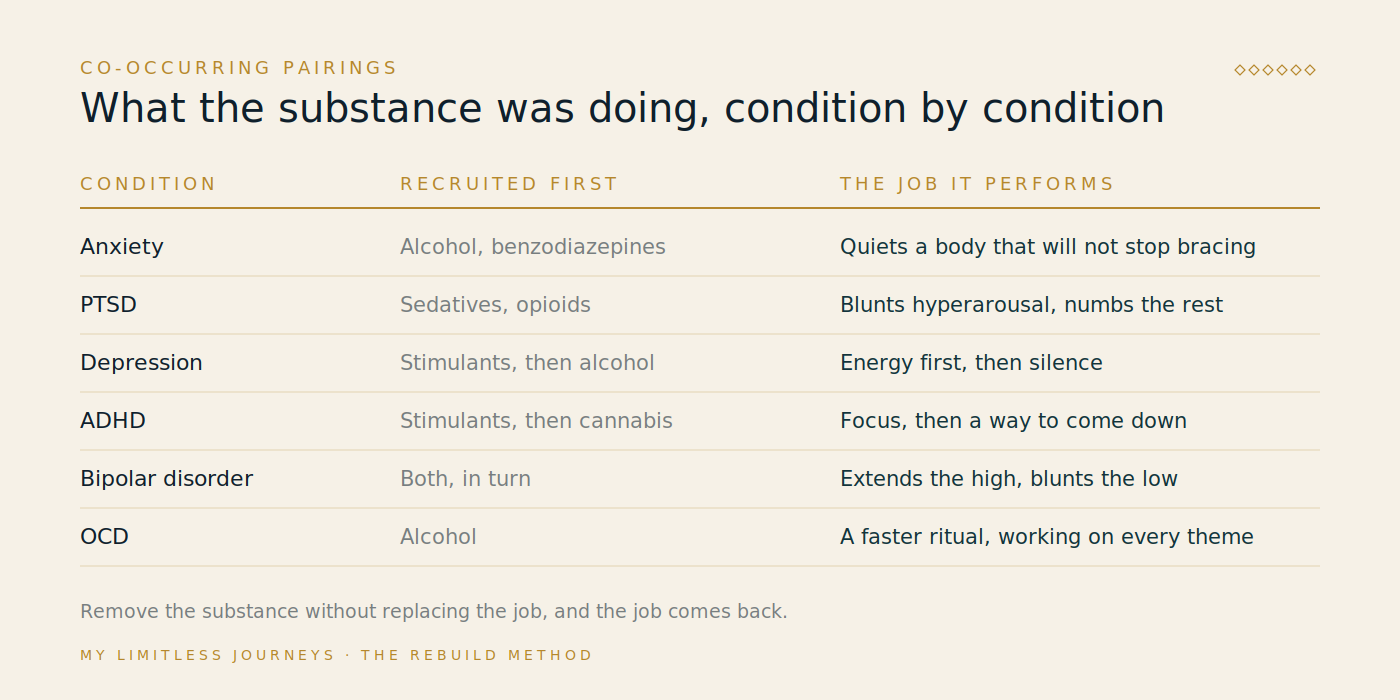
The substance was doing a job.
The pairings are consistent enough to be predictive. Anxiety recruits alcohol and benzodiazepines, because both quiet a body that will not stop bracing. PTSD recruits whatever sedates, and opioids for the numbing. Depression often starts with stimulants for energy and ends with alcohol for the noise. ADHD recruits stimulants because they work, and then cannabis to come down.
In bipolar disorder the pattern runs in both directions, extending a hypomania or blunting a depression. In OCD the drink becomes another compulsion. In borderline personality disorder it is used against emotional intensity that arrives faster than any skill can meet it.
This matters clinically rather than philosophically. If you remove a substance without replacing the function it served, you have taken away a coping mechanism and left the problem it was managing. Every one of our condition pages describes what replaces the job, and that is what integrated treatment is actually for.
Why sequential care fails.
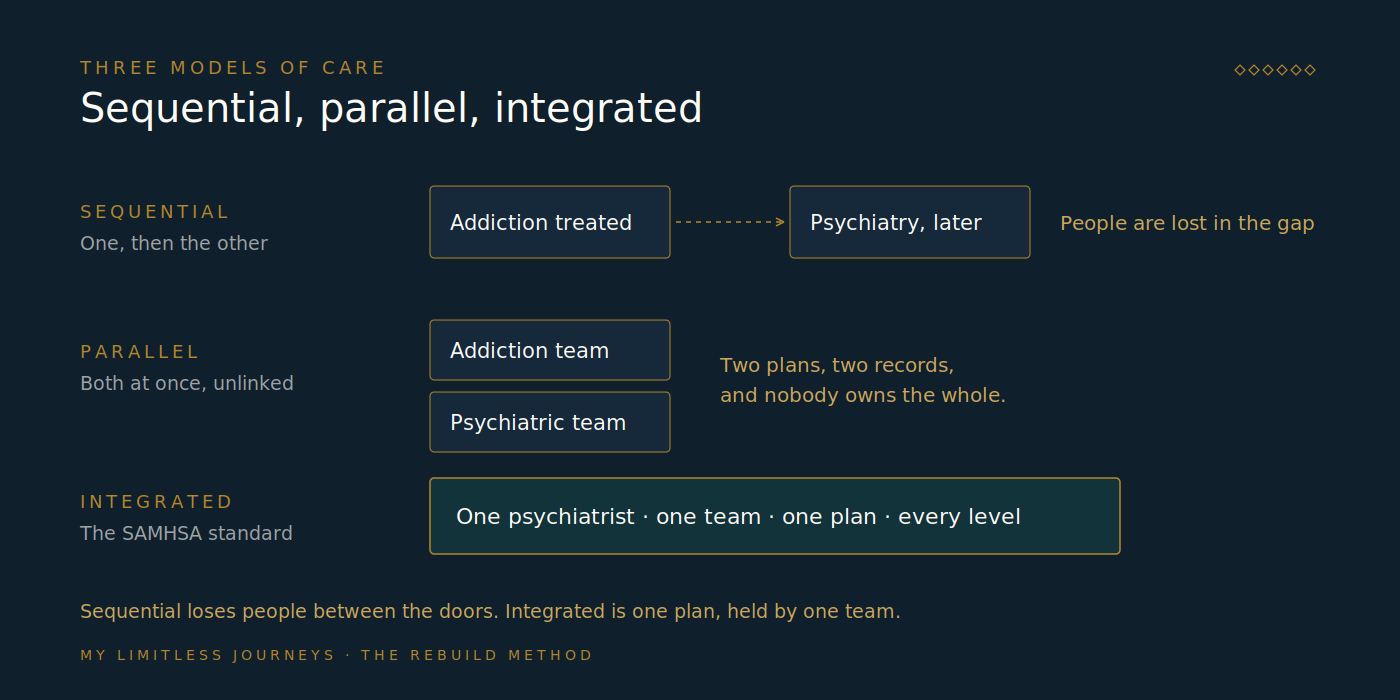
There are three ways a system can respond to a person with both conditions. Sequential care treats one and then the other: get clean, then come back for the depression. Parallel care treats both at once through two separate services that rarely speak. Integrated care treats both at the same time, by the same team, under one plan. SAMHSA's TIP 42, the standard clinical guidance in this field, has favored the third for two decades.
Sequential care fails for an unglamorous reason: people fall through the gap between the two appointments. Many of our clients have lived that loop, told by a psychiatrist to sort out the drinking first and by a treatment program that they could not be assessed while medicated. Parallel care fails more quietly, when one prescriber does not know what the other changed, and nobody owns the plan.
Integration is not a philosophy statement, it is a staffing decision. It requires a psychiatrist with authority over both diagnoses, therapists trained in addiction and in psychiatric care, and one record. We keep the same team across detox, residential and step-down for that reason.
Substance-induced or independent?
Heavy drinking produces depression. Stimulant withdrawal produces something that looks exactly like it. Cannabis withdrawal produces anxiety and insomnia; alcohol withdrawal produces panic. So a psychiatric assessment carried out in week one measures the withdrawal as much as the person, and a diagnosis made there is often wrong in a way that leads to years of the wrong medication.
The distinction is drawn over time. We look for symptoms that clearly predate the substance use, symptoms that persist well beyond the expected withdrawal window, family history, and the shape of previous periods of abstinence. Where the picture is genuinely unclear, we say so and keep watching rather than committing to a label. Treatment does not have to wait for that answer, but the prescription pad often should.
Detox and medication with both in the room.
Withdrawal amplifies almost every psychiatric symptom a person has. Anxiety climbs, mood drops, sleep breaks, and in the first two weeks suicidal thinking is more common than most families are warned about. That is the argument for supervised detox in a setting where a psychiatrist is already involved rather than called in later. Existing psychiatric medications are generally continued through detox rather than stopped, unless there is a specific interaction reason, and stopping an antidepressant on admission is a mistake we see often.
On the other side, addiction medications belong in the plan. Naltrexone and acamprosate for alcohol use disorder, and buprenorphine for opioid use disorder, are compatible with most psychiatric treatment and are not a lesser form of sobriety. Benzodiazepines are the recurring problem: useful in managed alcohol withdrawal, poorly suited to long-term anxiety in someone with a substance history. Where a client arrives on one, we build a taper instead of an argument. Our page on detox medications covers the pharmacology in more depth.
What changes most in a co-occurring detox is not the protocol but the frequency of psychiatric contact. Mood, sleep, appetite and suicidal thinking are reviewed daily rather than at a weekly medication check, and staff are briefed on what your particular condition tends to do in withdrawal, so that a spike in symptoms is read as expected rather than as a reason to conclude the psychiatric diagnosis was wrong.
Both conditions through the four domains.
The Rebuild Method was designed for people carrying two diagnoses, because a single-diagnosis structure always ends up prioritizing one of them.
Body. Detox, sleep, nutrition, movement and medication management sit together because they are the shared foundation. Nearly every psychiatric symptom improves when sleep is restored, and nothing else in the plan works reliably until it is.
Mind. Trauma processing, DBT and CBT are delivered as one course of therapy rather than as an addiction track plus a mental health track. The same clinician holds both threads, so the craving and the panic get discussed in the same hour.
Life. Structure, family systems work and return-to-work planning that accounts for both conditions, including the honest question of which parts of your working life were fueling which diagnosis.
Self. People arriving with two diagnoses often carry a double shame: one for the illness, one for the drinking. Values and meaning work is where that gets set down.
What a stay looks like.
Admission begins with a full psychiatric and medical assessment rather than a substance intake with a psychiatric footnote. Detox runs with psychiatric oversight from day one. Weeks two and three are where the diagnostic picture usually clarifies, medication is adjusted, and therapy moves from stabilization into the actual work. From there the plan is built around both conditions at once, with family sessions, and a step-down into PHP or IOP that keeps the same psychiatrist and the same therapist. Six beds is what makes that continuity affordable in clinician hours rather than aspirational.
Choosing a level of care.
With two conditions, the level of care is usually driven by how often you need psychiatric contact and how unstable the psychiatric side is, not by the substance alone. Residential is indicated when detox is required, when psychiatric symptoms are severe or unstable, when there is any current suicidal thinking, or when repeated outpatient attempts have not held. PHP and IOP work when the psychiatry is stable enough for weekly contact and home is safe. Our guide to levels of care for co-occurring disorders walks through the decision in detail.
One caution worth stating plainly. Programs that describe themselves as dual-diagnosis capable sometimes mean a psychiatrist visits fortnightly and prescribes. That is not integration, and it is worth asking any program you are considering how often you will see a psychiatrist, who holds the treatment plan, and whether that same clinician follows you into outpatient care.
For families.
Families of people with two diagnoses have usually spent years arguing about which one is the real problem, and that argument is unwinnable because the answer is both. What helps is understanding that early sobriety may temporarily make the psychiatric symptoms more visible, not less, and that this is progress rather than deterioration. Family sessions cover what to expect month by month, and our families hub is where to begin.
- Mental health treatment at MLJ. The hub for every condition.
- Depression. The most common psychiatric half of the pair.
- PTSD and trauma. The pairing that most often hides underneath.
- Levels of care for co-occurring disorders. How the decision is made.
- Residential treatment. What a stay involves.
- Co-occurring disorders explained. A longer read from our clinical team.
This guide is educational and is not a substitute for medical advice. If someone is in immediate danger, call 911.