
Going home or transitional living: a four-factor decision.
The right answer depends on four things you can actually evaluate: the home you would return to, the timing of your work, how ready your family is, and how close your old using network sits to your front door. This page walks through each one.
Authored by the MLJ Clinical Team. Reviewed under board-certified psychiatric oversight. Last updated September 2026.
Key Takeaways- This is not a question of strength. It is a question of environment, and environments can be assessed.
- Four factors decide most cases: home environment, work timing, family readiness, and proximity to the using network.
- Transitional living is a bridge, not a demotion. Most clients who choose it are home within two to three months, with a plan that held.
- Going home well is possible, and it has requirements: a cleared house, a scheduled week, and people who know what they are looking at.
- The decision is made with your clinical team in the final weeks of residential, not on the last day.
The question underneath the question.
Around week three of residential, most people feel well enough to want their life back, and the question of where to live after discharge becomes urgent. It usually arrives disguised as a question about strength: am I strong enough to go home? We would like to retire that framing. Nobody is strong enough to go home to a stocked bar, a spouse who has not spoken to them in a month, and a dealer two blocks away. Nobody needs to be especially strong to go home to a cleared house, a scheduled week, and people who know what to watch for.
The question is environmental, and environments can be assessed. The Substance Abuse and Mental Health Services Administration names a stable and safe place to live as one of the four dimensions that support recovery, alongside health, purpose, and community. Transitional living exists because for some people, for a period, the home they left cannot yet provide that, and pretending otherwise is how the first month after discharge becomes the month the work unravels.
In the Rebuild Method, this sits in the Life domain: daily structure, family systems, return-to-work planning. It is worked out with your therapist over the final weeks of residential, with input from family sessions. Four factors carry most of the weight.
Factor one: the home you would return to.
Start with the building. Is there alcohol in it, and will it be gone before you arrive, permanently, without your having to ask twice? Does anyone else there drink or use, even moderately? A partner who enjoys wine with dinner is not a villain, but an open bottle in the refrigerator is a daily decision you did not have to make in Encino. Are there prescriptions that were part of the problem? Is there a room, a chair, or an hour of the evening so bound up with using that walking into it feels like walking into a memory?
Then consider who is home. Living alone after residential is its own risk: the evenings are long, nobody notices a missed meeting, and the phone is the only witness. Living with someone hostile to your recovery, or themselves unwell, is a different risk with the same shape. The best home has at least one person in it who is sober, steady, informed, and around in the hours that were hardest before.
If the honest answer is that the house can be cleared and someone steady lives in it, going home is on the table. If the answer is that you would be alone, or that the person you live with cannot or will not change the house, that is the first strong signal toward transitional living, at least for the first weeks.
Factor two: work timing.
Work cuts both ways. A structured job you return to gradually, with a clinical schedule protected around it, is one of the strongest supports early recovery has. A job you return to at full intensity on the Monday after discharge, with travel in week two and a client dinner in week three, is one of the most reliable ways to lose the plot.
Ask what your first thirty days back actually contain. If they contain a production wrap, a trial, a quarterly close, or a tour, the question is not whether you can handle it but where you will sleep while you do. For many professionals, transitional living is the answer precisely because work is heavy: they leave for a demanding job in the morning and return to a structure that does not depend on their having energy left to build one. Our page on the first ninety days back at work covers the sequencing itself.
Geography matters too. If your work is in Los Angeles and your home is in Orange County, a stretch in Encino keeps you close to both your job and your clinical team while the family situation matures. If work is remote or flexible and home is otherwise sound, the argument for going home strengthens, provided the days have a shape. Unstructured time at home is not rest; it is the condition most of our clients were using in.
Factor three: family readiness.
Your family has been in recovery too, on their own timeline. A spouse who spent the last year managing your drinking may be exhausted, angry, and frightened of your return in ways they have not said aloud. Children may have adapted to your absence with a competence that is hard to hand back. Parents may hover, or retreat. None of this makes anyone a bad family. It makes them people who have also been through something.
Readiness is specific. Have they participated in family therapy during your stay? Do they know what a craving looks like from the outside, and what to do when they see one? Have the resentments been spoken, or are they waiting in the kitchen? Is there agreement about alcohol in the house, about who you will see, about what happens if you slip? A family that has done this work is a formidable ally. A family that has not been given the chance is being asked to improvise something they do not understand, with everything at stake.
When the family is not yet ready, transitional living is not a rejection of them. It is time. Family sessions continue while you are in the residence, and a partner who visits on a Saturday and returns to a quiet house has room to process what they could not process with you in the next room. Our page on the family's role in recovery goes deeper on what that work involves.
Factor four: the using network.
This is the factor people most want to skip, and the one that most often decides the outcome. Who did you use with, and how far are they from your front door? For some the answer is a dealer's number that can be deleted. For others, especially in entertainment and high-pressure professional cultures, the using network is the professional network: the agent who orders the second bottle, the crew that decompresses in the parking lot, the partners whose Thursday dinners run to 2 a.m. We have written about this directly in when your using network is your professional network.
The question is not whether you will ever see these people again. It is whether you can go home and not see them for the first sixty to ninety days, during the period when your response to a cue is fastest and your new habits are slowest. If they live on your street, drink in your building, or expect you at the same bar on Friday, the honest answer is often no. Distance is a clinical tool. Encino is far enough from most of Los Angeles and all of Orange County that an old friend cannot simply drop by, and close enough that your work and your family can.
A related question: who is your new network? If you leave residential with a home group, a sponsor, a therapist, and two or three sober people you actually like, going home is more survivable. If you have none of those yet, transitional living gives you a house full of people doing the same thing, and time to build the rest.
Putting the four together.
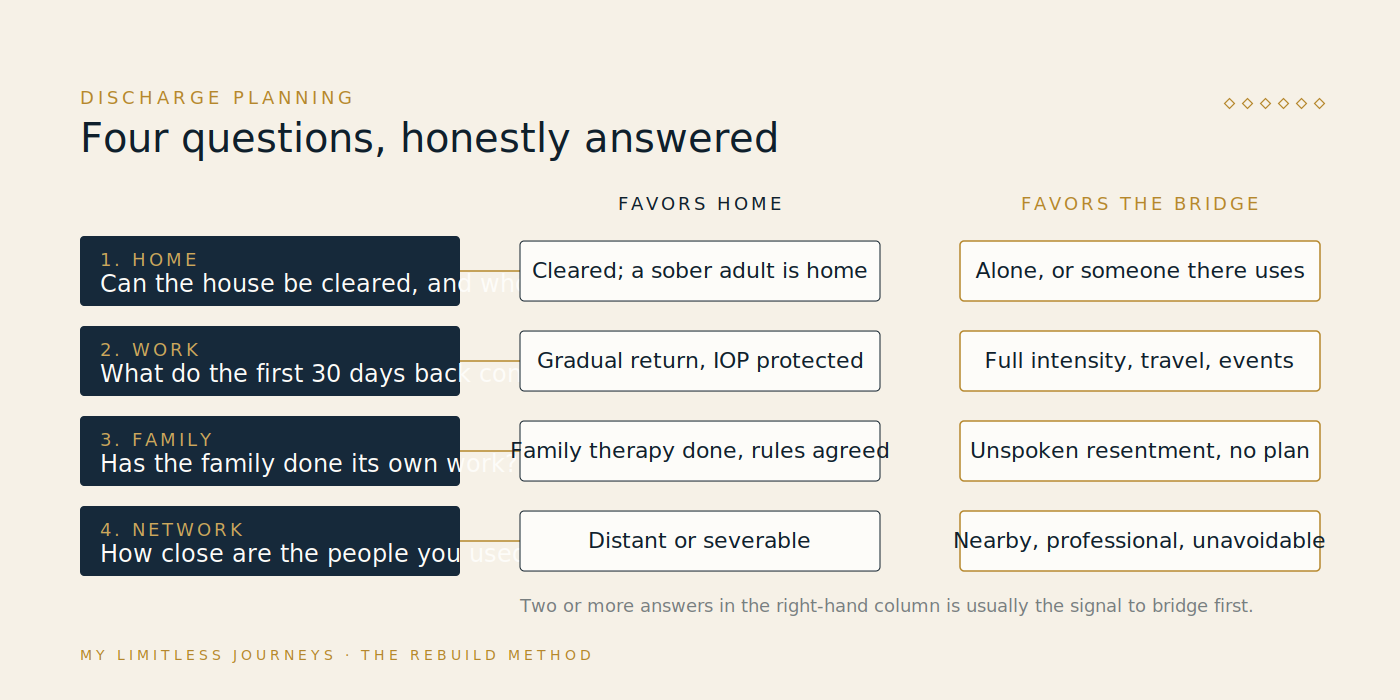
No single factor decides it. Someone with a difficult family but a clear house, flexible work, and no using network nearby may do well at home with intensive outpatient support. Someone with a loving, prepared family but a job that puts them in a bar three nights a week may need the bridge. The table below is the shorthand our clinicians use in discharge planning.
| Factor | Favors going home | Favors transitional living |
|---|---|---|
| Home environment | Cleared house; a sober, steady person lives there | Living alone, or with someone who drinks or uses |
| Work timing | Gradual return; IOP protected on the calendar | Full intensity from day one; travel or events in month one |
| Family readiness | Family therapy done; house rules agreed | Unspoken resentment; no shared plan |
| Using network | Distant or severable; new sober network forming | Nearby, professional, or unavoidable |
Two or more rows in the right-hand column is usually the signal to bridge. One row in the right-hand column is usually workable at home, if the plan addresses it directly. Four in the left-hand column is rare and fortunate, and even then we would want IOP and alumni contact on the calendar before you leave.
What each path looks like when it is done well.
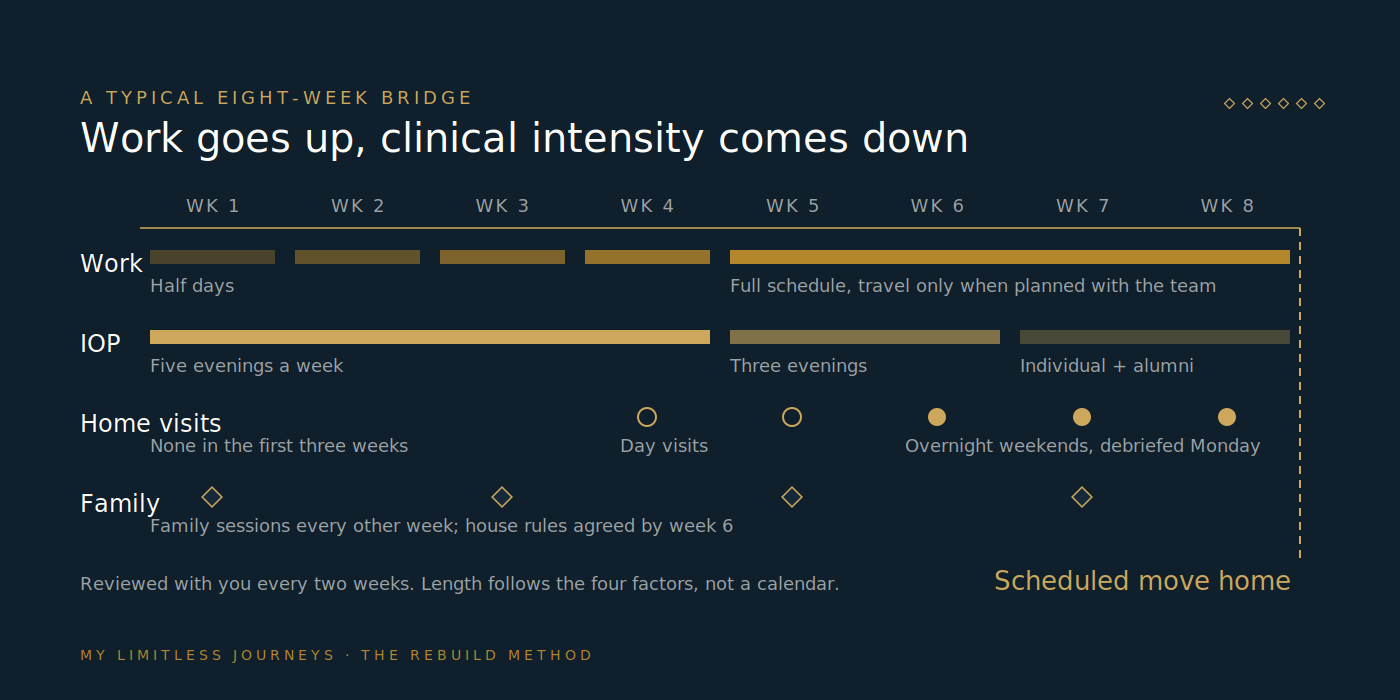
Transitional living at MLJ is a structured, substance-free residence with the same clinical team you have had since detox. You attend IOP or individual sessions from the house, you go to work, you come back to a curfew, testing, and other adults doing the same thing. Most clients stay four to twelve weeks. During that time the family work continues, the home is prepared, and the return is scheduled rather than sprung. Our comparison of transitional living and sober living explains how this differs from a standard sober house.
Going home well has its own requirements, and they are not optional. The house is cleared before you arrive. IOP is on the calendar for the first six to twelve weeks, and it is treated like a court date. There is a home group and a sponsor or equivalent, identified before discharge, not after. The family has a plan for the first slip that does not involve panic or silence. And you have an appointment with your MLJ therapist in the first week home, because the first week home is when the gap between the residence and real life is widest. Done that way, going home is not the riskier choice. It is simply the choice that asks more of the people around you.
- After Treatment. The first year after residential, in one timeline.
- The first ninety days back at work. The work-timing factor in full.
- Relapse: the first 24 hours. What to do if the environment fails.
- Transitional living vs. sober living. How the two models differ.
- Transitional living at MLJ. The program itself.
- Building a continuing care plan. The wider plan this decision sits inside.
This guide is educational and is not a substitute for medical advice. If someone is in immediate danger, call 911.