
Published by the Clinical Team at My Limitless Journeys. Reviewed under board-certified psychiatric oversight.
The problem discharge plans keep skipping
A client finishes thirty days, leaves with a solid relapse-prevention plan, and returns to a job in which the actual work of getting hired happens at dinners, wrap parties, festivals, industry mixers, client entertainment and long nights in a mixing room. The plan says avoid high-risk environments. His calendar says those environments are the job.
This is not confined to entertainment, though Los Angeles concentrates it. Sales runs on it. Law and finance run on it. Restaurants and music run on it almost totally. In every one of these worlds, a person in early recovery is being asked to choose between their sobriety and their livelihood by anyone who tells them simply to stay away. That is a false choice, and it is worth refusing.
Start with an audit, not a purge
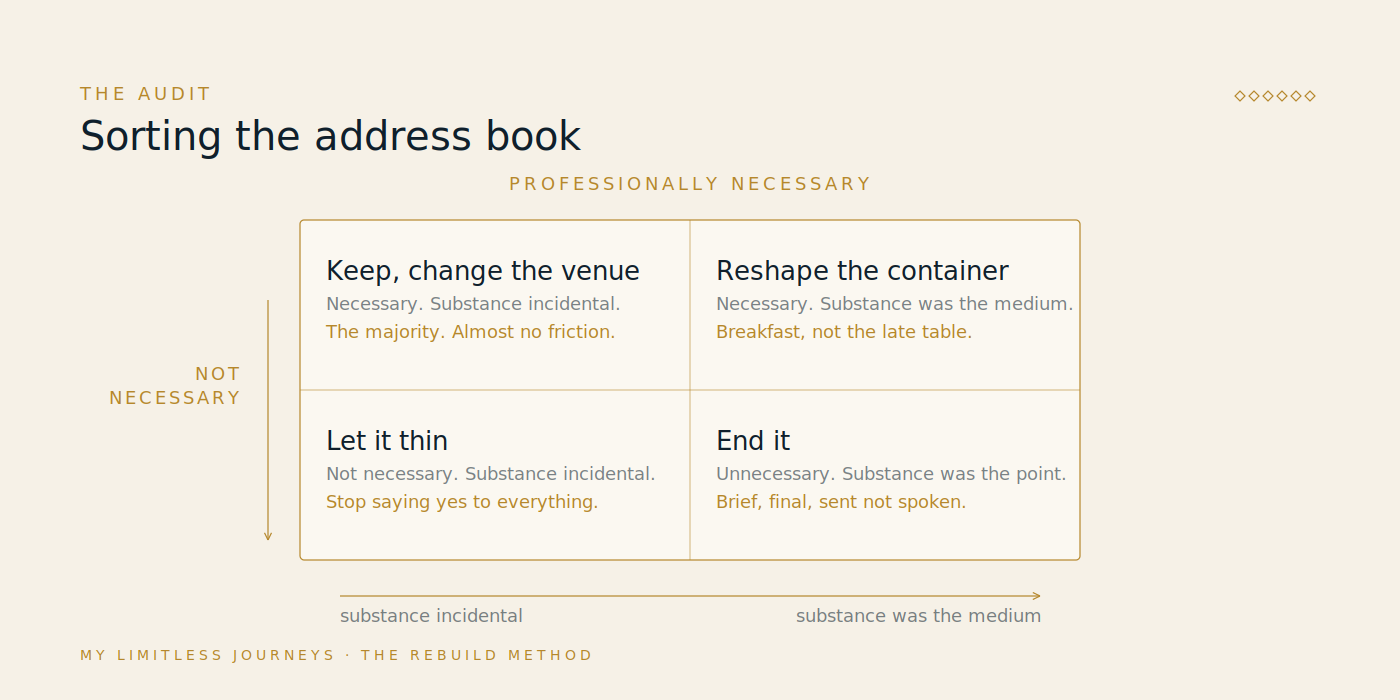
Open your contacts and sort the people who matter professionally along two axes: how necessary the relationship is to your work, and how central substance use was to it. Four groups fall out, and each gets a different strategy.
Necessary, and substance use was incidental. These are the majority, and they are safe. You drank around them because everyone drank; the relationship was never about it. Keep them, change the venue, and expect almost no friction.
Necessary, and substance use was the medium. The producer you only ever met after ten at night. The client whose entire ritual is a bottle. These are the hard ones, and the answer is reshaping the container rather than dropping the person.
Not necessary, substance use incidental. Let these thin naturally. You do not owe anyone a declaration; you simply stop being the person who says yes to everything.
Not necessary, and substance use was the point. This is the group that includes whoever supplied you, and the friend whose friendship is a delivery mechanism. These relationships end. Not coldly, not with a speech, but they end, and pretending otherwise is the single most common reason a good first ninety days comes apart in month four.
Change the container, keep the relationship
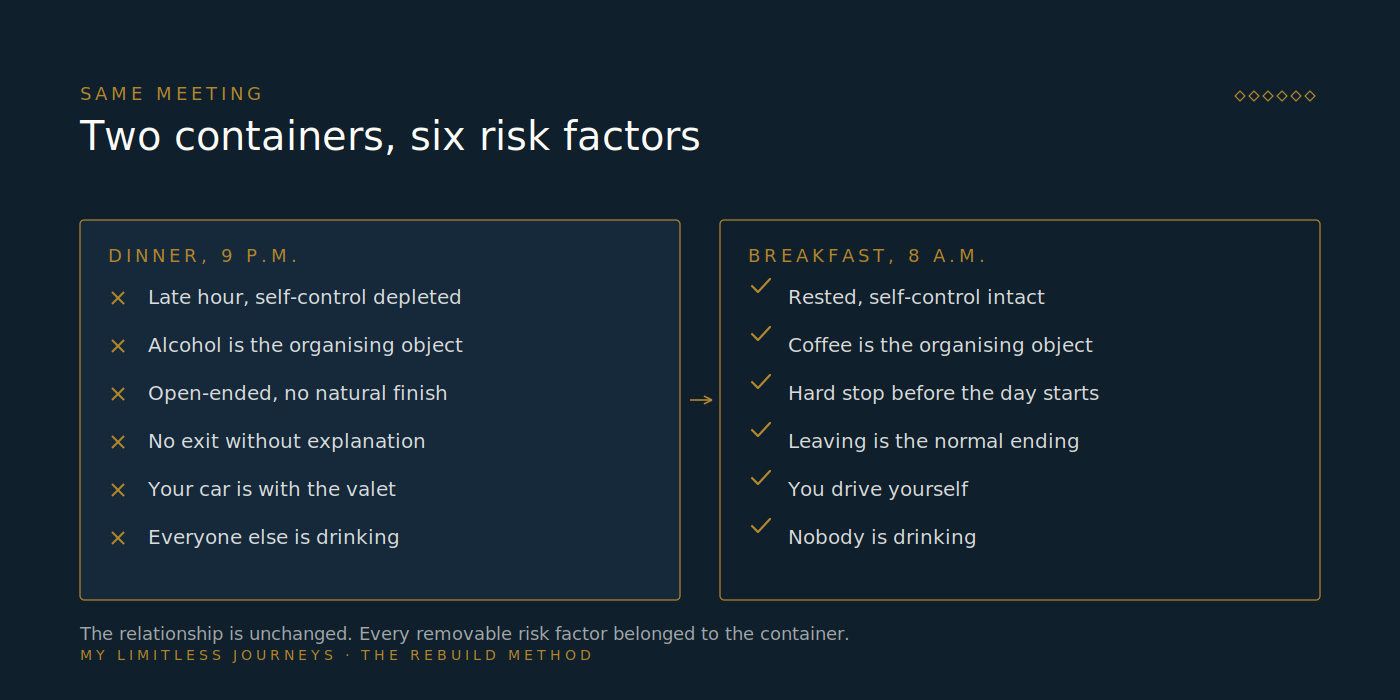
Almost every risk factor in an industry dinner is a property of the container rather than of the company. Late start. Alcohol as the organising object. Open-ended duration. No exit. Depleted willpower at the end of a long day. Your own car left at the valet, which quietly removes the option of leaving early.
Move the same conversation to breakfast, coffee, a walk, a screening, a lunch with a hard stop before a real meeting, and every one of those factors disappears without the relationship losing anything. In practice this reads as decisive rather than evasive: people who propose a specific time and place are read as people who are busy and organised. You are also, incidentally, more likely to be remembered, because you will be the only meeting that day the other person could recall clearly.
When the evening event is genuinely unavoidable, treat it as an operation. Arrive after the meal has started and leave before the last round. Drive yourself. Hold a drink so no one hands you one. Have one person present who knows. Book a call with your therapist or your sponsor for the following morning, before you go, so the debrief already exists. Our guidance on the first ninety days back at work sets out the wider structure this fits into.
Lines that hold under pressure
The best decline is short, unexplained and identical every time. “I’m not drinking.” That is a complete sentence. Reasons invite negotiation; a flat statement does not. If a follow-up comes, “just taking a break” or “early start” closes it without disclosure. Almost nobody pushes twice, and the person who does is telling you something about themselves rather than about you.
For the venue, propose rather than refuse: “I can’t do Thursday night, but I can do Wednesday at eight in the morning, and I’ll come to you.” For the person who always had something, the message is brief and final, and it is sent rather than delivered in person: “I’m making some changes. I’m not going to be around for a while.” Then mute the thread. For the colleague who says you seem different, “I’m sleeping better” is true, deflects nothing important, and ends the conversation.
Deciding how much to say, and to whom, is a separate and genuinely strategic question. We work through it with clients in detail, and have written it up in what to tell your team. The short version: disclosure is a one-way door, and there is no clinical reason to walk through it in your first month back.
Why the room you sit in is a clinical variable
This is not folk wisdom dressed up. Social network composition is one of the more robust findings in the treatment literature. The Network Support Project, a randomised trial by Litt and colleagues published in the Journal of Consulting and Clinical Psychology, tested a treatment aimed specifically at changing whom people spend time with, and found that shifting the balance of a drinker’s social network toward people who support abstinence improved drinking outcomes, with the effect persisting at two-year follow-up.
The same mechanism sits underneath the mutual-aid evidence. The 2020 Cochrane review by Kelly, Humphreys and Ferri found that manualised twelve-step facilitation usually produced higher rates of continuous abstinence than other established treatments, with a risk ratio of 1.21 at twelve months in the highest-certainty comparison — and part of what such an intervention does is hand a person an entire second network that costs nothing and meets nightly. You can read our take on that in twelve-step facilitation therapy. If the fellowship model is not for you, the requirement is unchanged: you need people, in the diary, who are not connected to the substance.
The losses, honestly
Some of this will cost you. There are rooms you will hear about afterwards. There is at least one friendship that turns out to have been a logistics arrangement, and losing it is a real grief even when you can see clearly what it was. Clients in their first year often describe a specific loneliness that nobody warned them about: not the absence of the substance, but the absence of the crowd.
Two things are worth saying about that. The first is that the professional cost is almost always smaller than anticipated; careers in these industries are built by people who deliver, and the reputational damage of a slow public unravelling is far larger than the cost of skipping a party. The second is that the loneliness is a stage rather than a destination. It resolves as the new network fills in, which takes about six months of showing up to things that feel pointless at the time. Our professionals hub and the specific work in relapse prevention are both built around this stretch of the road.
Frequently asked questions
Do I have to tell clients or colleagues that I am in recovery?
No. There is no professional or legal obligation to disclose, and disclosure cannot be reversed. Most people find that “I’m not drinking” covers ninety-five per cent of situations, and that the remaining five per cent are handled by a change of venue rather than an explanation.
What if my whole industry is the trigger?
Then the plan needs to be built at that scale rather than event by event, and it may include timing your return, restructuring how you take meetings, or changing your role within the same field. We look at this specifically in substance use in the entertainment industry. Leaving the industry altogether is occasionally the right answer, but it should be a considered decision, not a reflex in month two.
How long before I can go back to a normal industry event?
There is no universal number, and anyone who gives you one is guessing. What matters is whether you have a stable routine, a plan for the specific event, someone who knows where you are, and a way to leave. Many people manage a short, structured appearance well before the ninety-day mark and a genuinely relaxed one considerably later.
A key contact only ever meets over drinks. Do I lose the account?
Usually not. Propose a specific alternative rather than declining in the abstract, and be the one who suggests the time and place. In our experience the relationships that genuinely cannot survive a change of venue were transactional to begin with, and were not as valuable as they felt.
What do I do if I run into my former dealer at a work event?
Leave. Not dramatically, but promptly, and call someone from the car. Decide this in advance and rehearse it, because the moment itself is not when you want to be making a judgment call. Then tell your therapist, because that encounter is clinical information, not a confession.
If your work and your using have the same address book, that is a solvable problem and a specific one. We build these plans with people whose reputations cannot be set aside.
Keep reading: Treatment for professionals · Substance use in the entertainment industry · The first ninety days back at work · Relapse prevention · Why relapse happens