
The first ninety days back at work, planned like a project.
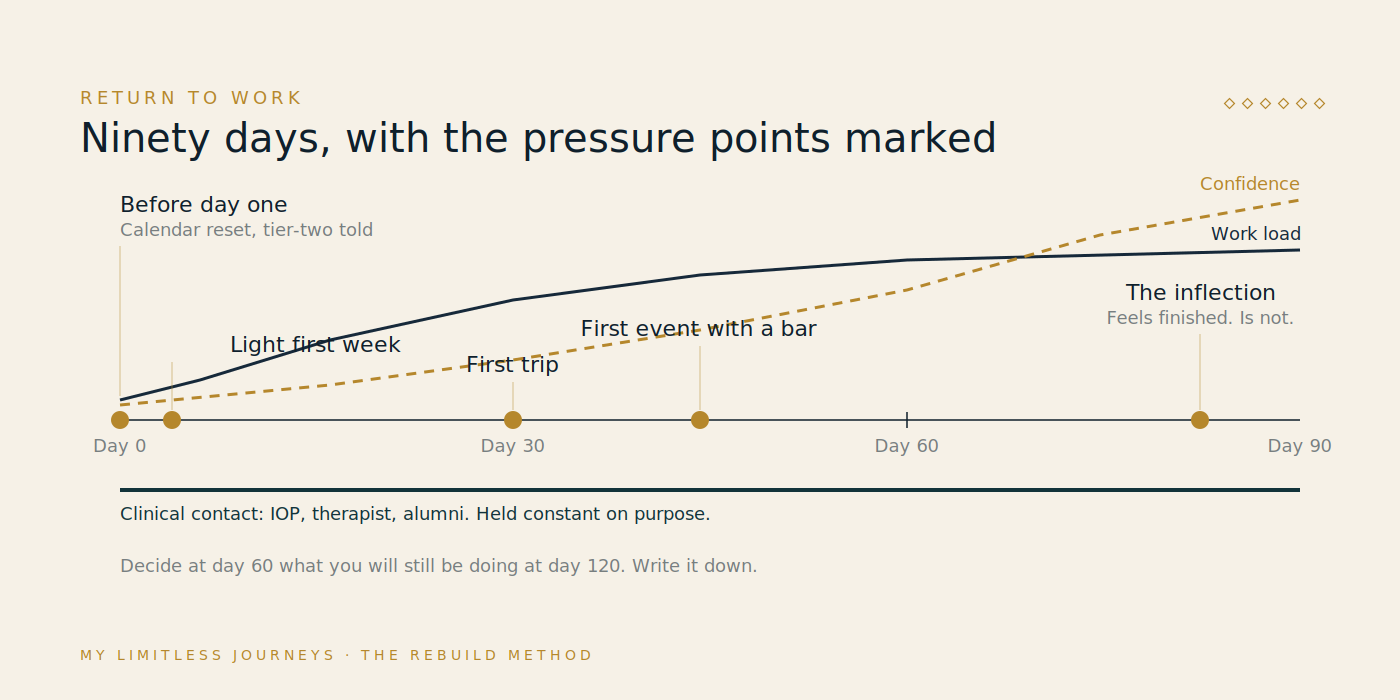
Returning to work after treatment is not a single Monday. It is a ninety-day arc with predictable pressure points: what to disclose, the first week, the first trip, the first event with a bar, and the inflection near day ninety when things feel easy and are not yet.
Authored by the MLJ Clinical Team. Reviewed under board-certified psychiatric oversight. Last updated September 2026.
Key Takeaways- Disclosure is a decision with three tiers, not a yes or no. Most professionals tell almost no one, and the law lets them.
- The first week back is deliberately light. Protect the clinical calendar the way you would protect a board meeting.
- Travel and events with alcohol are the two pressure points that most often undo a good plan. Each has a script.
- Around day ninety, confidence rises faster than stability. That is the inflection to plan for, not the finish line.
- Return-to-work planning is part of the Life domain of the Rebuild Method and begins while you are still in residential.
Why work is a clinical project.
For most of the people we treat, work is not a backdrop to recovery. It is where the drinking was rewarded, where the stimulants were justified, where the schedule made sleep optional and a drink at six o'clock invisible. Going back without a plan is going back to the conditions the condition grew in. That is why return-to-work planning sits inside the Life domain of the Rebuild Method, and why it starts during residential rather than after.
The planning is concrete. In the last two weeks of residential your therapist works through the actual first thirty days with you, meeting by meeting, trip by trip, with clinical appointments placed first and work around them. If you have stepped down to IOP, those sessions are already on the calendar. If you are in transitional living, the house provides the evening structure. Either way, the work is scheduled into a recovery, not the other way round.
The disclosure decision: three tiers.
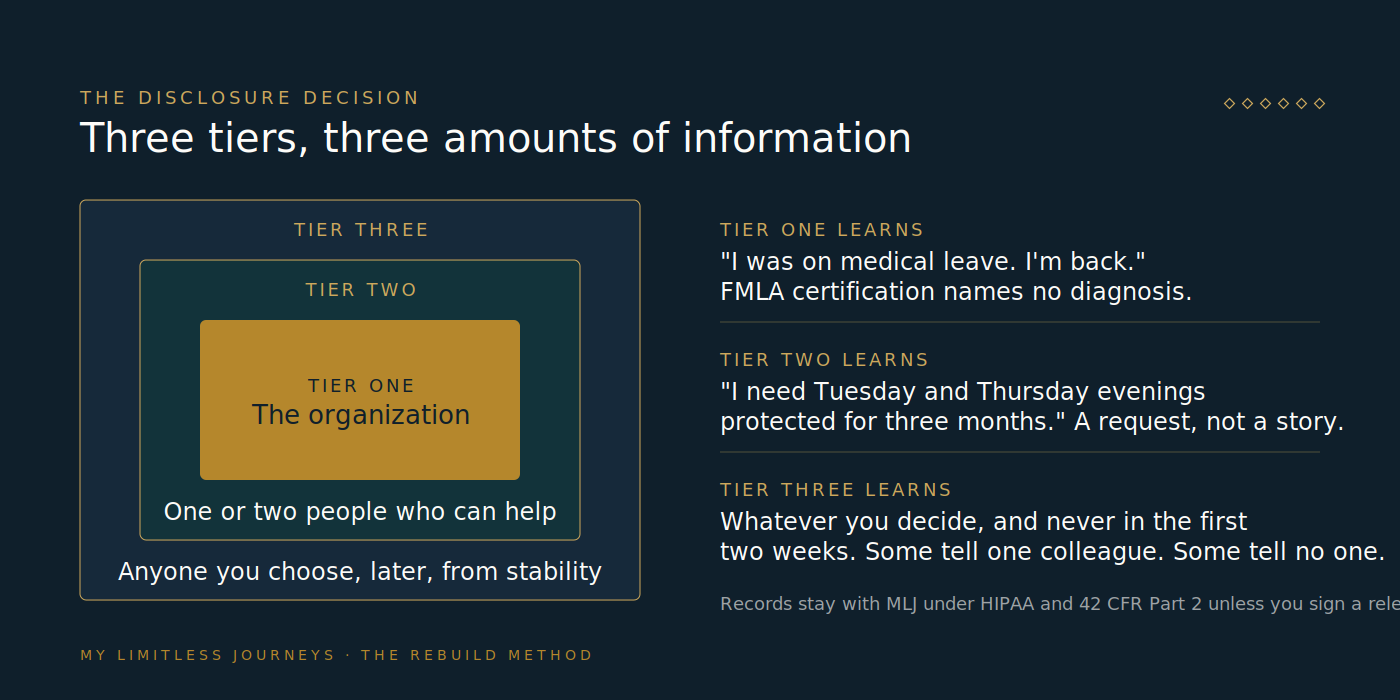
The question people lose the most sleep over is who to tell. It helps to break it into tiers, because the answer is different for each.
Tier one is what the organization needs to know. Usually nothing beyond the fact of a medical leave. If you used leave under the Family and Medical Leave Act, your employer received certification of a serious health condition, not a diagnosis; the Department of Labor is explicit that the certification does not have to name the condition. Your treatment records are protected by HIPAA and by 42 CFR Part 2, and MLJ cannot confirm your stay to anyone without your written consent. "I was on medical leave and I'm back" is a complete sentence. You are allowed to stop there.
Tier two is who needs to know something in order to help you. This is often one person: an assistant who will stop booking the client dinner at the bar, a partner who will take the Vegas conference, a manager who can approve the standing 5 p.m. departure on IOP nights without asking why. These people do not need the diagnosis. They need a request, and a plausible frame: "I'm managing a health condition and I need my Tuesday and Thursday evenings protected for the next three months." Our page on what to tell your team has scripts for each role.
Tier three is who you choose to tell because it helps you. Some people find one trusted colleague who knows the whole story is a relief, someone to text before the holiday party. Others find any disclosure at work feels like a loss of control. Both are legitimate. The one rule: choose this tier slowly, from stability, and never in the first two weeks, when the urge to explain yourself is strongest and your judgment about who deserves the story is weakest.
Physicians, attorneys, and other licensees may also have reporting obligations to a board or monitoring program, separate from the employer question; see our page for licensed professionals.
Before day one, and the first week.
The week before you return is for logistics that remove decisions. Put the clinical appointments in the calendar as recurring, private entries. Tell your tier-two person what you need. Clear the office of anything from the old pattern: the bottle in the credenza, the pills in the drawer. If the commute passed the bar, change the route now, while it is a decision and not a reflex. And decide what you will say in the first ten conversations: "Good to be back. It was a medical thing, all handled. What did I miss?"
The first week should be lighter than you want it to be. Start midweek if you can, so the first stretch is three days. Arrive on time and leave on time; the eleven-hour day is the pattern, not the proof of recovery. Expect to be tired in a way that surprises you; cognitive stamina returns over weeks. Expect too that people will treat you normally, which is both what you wanted and strangely disorienting. Nobody knows what you have just done. That is the privacy working.
Watch for the specific hour that was hardest before. For many professionals it is the transition out of the workday, when the drink used to mark the boundary. Have something in that slot for the first weeks: IOP, a meeting, the gym, a standing call with a sober friend. The slot matters more than what fills it. Our page on working during treatment covers how work and clinical hours fit together at each level of care, if you are still in one.
The first trip.
Travel is where good plans go to die. A business trip removes every structure you have built: the schedule, the sober household, the IOP evening, the route that no longer passes the bar. It replaces them with an airport lounge, a minibar, a dinner where the client orders for the table, and a room where nobody will know. It also arrives with a story attached: I am away, this is different, this does not count.
The first trip should not happen in the first thirty days if it can be avoided, and it usually can. When it comes, it needs a plan as detailed as the itinerary. Have the hotel empty the minibar; it is a routine request. Book the earliest reasonable flight home rather than the one that leaves room for a late night. Schedule a call with your therapist or sponsor for the first evening, at the hour dinner would run late. Know which meeting is near the hotel; there is one near every hotel in every American city. Tell your tier-two person you are traveling so someone is expecting a check-in.
For clients whose work is constant travel, this is a template rather than a one-time plan, and we build it with you in treatment. Our page on musicians and touring artists addresses the extreme version, where the road itself is the workplace.
Events with alcohol.
The client dinner, the wrap party, the firm retreat, the awards season, the closing drinks. In many industries, alcohol is not incidental to work; it is the medium in which work relationships are conducted. You will not avoid every event for ninety days, and you should not try. You will need a way through them.
Decide before you arrive what you are drinking, and order it first. Sparkling water with lime in a highball glass ends most conversations before they begin. Have the sentence ready for the one person who pushes: "I'm not drinking these days" is enough, and "I'm on a medication that doesn't mix with it" is true for many people in early recovery. Arrive a little late and leave early; the first hour is greetings and the last hour is where the trouble is. Drive yourself so you control the exit. Text someone before you walk in and after you walk out.
And notice what the event does to you. Some clients find that a party without drinking is boring, and the boredom is information: the relationships were thinner than the alcohol made them feel. Others find the craving arrives not at the bar but on the drive home, when the old reward never came. Bring both to your therapist. In the first ninety days, every event is data as well as an obstacle. The relapse-prevention program works directly on these situations, with rehearsal, and it is not an admission of weakness to use it.
The ninety-day inflection.
Somewhere between the sixtieth and ninetieth day, something shifts. Sleep is reliable. The work is back to full speed and going well; people have noticed. The clinical appointments start to feel like an inconvenience. The craving that arrived every evening in week one has not come for a fortnight. It is at exactly this point that many people quietly stop doing the things that got them here: the IOP evenings become optional, the meeting attendance thins, the therapist gets rescheduled twice.
The difficulty is that confidence recovers faster than the brain does. The National Institute on Drug Abuse describes addiction as a chronic condition in which the brain changes that drive craving persist well after use has stopped, which is why the field treats the first year, not the first quarter, as the period of highest vulnerability. Feeling fine at day ninety is real. It is also the state in which the first drink at the client dinner starts to seem like an experiment rather than a relapse.
So plan for the inflection the way you planned for the first week. Before you reach it, decide what you will still be doing at day 120: which appointments stay, which meetings stay, who you will still be checking in with. Make that decision at day sixty, while you still feel the need for it, and write it down. The alumni program exists for exactly this stretch, when formal treatment has ended and the structure that replaces it has to be chosen rather than assigned. Our hub on the first year after treatment maps the rest of the arc.
And if the plan fails, there is a page for that too. The first twenty-four hours after a relapse is written for the night it happens, and the number on it reaches the same team that planned your return.
- After Treatment. The full first-year arc this page sits inside.
- Going home vs. transitional living. Where you sleep during these ninety days.
- Relapse: the first 24 hours. For the night the plan fails.
- Can my employer find out?. The law behind the disclosure decision.
- Alumni program. The structure that carries you past day ninety.
- Sunday-night dread and the Monday drink. On the hour of the week that work made hardest.
This guide is educational and is not a substitute for medical advice. If someone is in immediate danger, call 911.