
You used. Here is what to do in the next 24 hours.
First, make sure you are physically safe: your tolerance is lower than it was, and that is the danger right now. Then call one person. Everything else on this page can wait until you have done those two things.
Authored by the MLJ Clinical Team. Reviewed under board-certified psychiatric oversight. Last updated September 2026.
Key Takeaways- If you have used opioids, or you are not sure what was in what you took, do not be alone tonight. Reduced tolerance after a period of abstinence is a leading cause of fatal overdose.
- If you have been drinking heavily for several days, do not stop abruptly without medical advice. Call us or your physician first.
- A slip is a medical event, not a moral verdict. The shame you feel right now is real, and it is also the thing most likely to turn one night into a month.
- Call one person in the next hour: a sponsor, your therapist, a family member who knows, or MLJ. You do not need a plan. You need a witness.
- MLJ alumni can re-engage the same day. The conversation starts with a clinical check-in, not a readmission form.
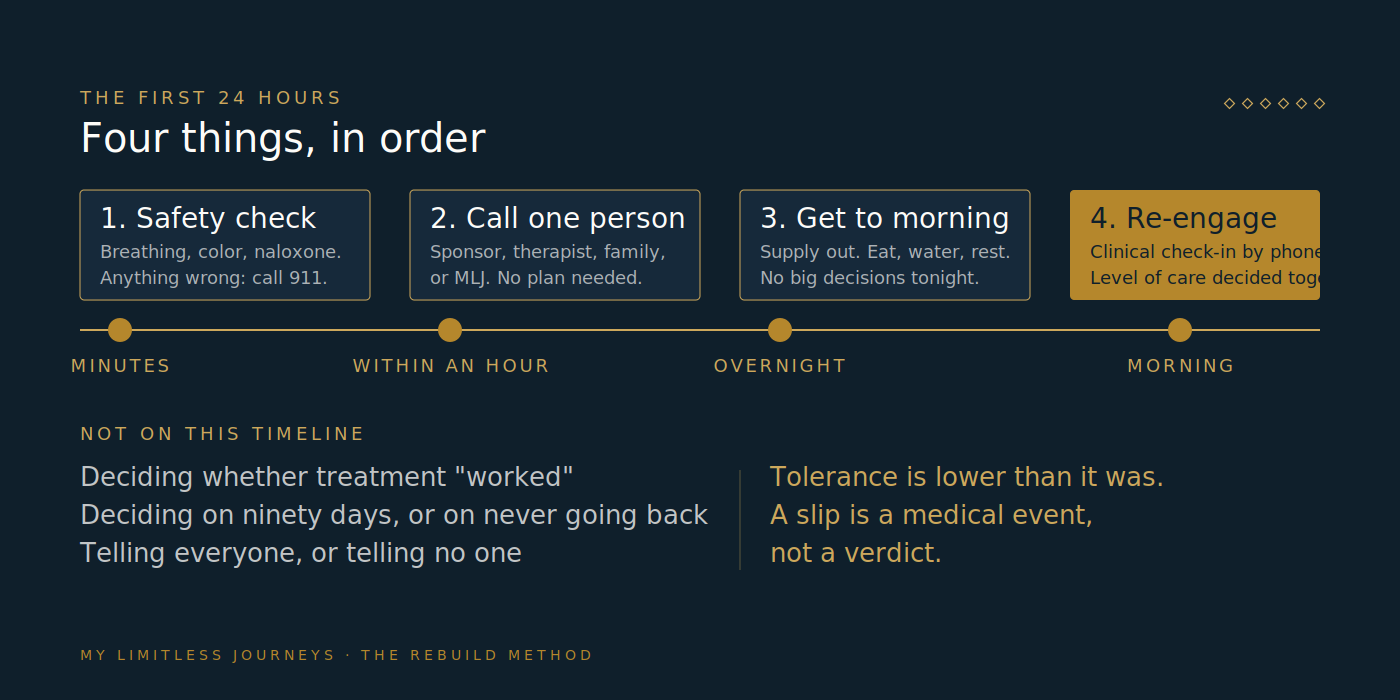
Right now: the safety check.
Before anything else, your body, because the risk tonight is physical and specific. After weeks or months without a substance, your tolerance has fallen. The National Institute on Drug Abuse is direct about this: returning to use after abstinence is especially dangerous because the body no longer tolerates the amount it once did. People who die after a period of sobriety often die of a dose that, six months earlier, would have been ordinary.
If you used opioids, including pills you were told were something else, do not be alone. Fentanyl is common in the counterfeit pill supply, and a person who has stopped breathing cannot call for help. If anyone near you has naloxone, make sure they know where it is. Trouble staying awake, slow breathing, or lips or fingertips turning blue or gray: that is a 911 call, now. California's Good Samaritan law protects people who call for help during an overdose from arrest for simple possession.
If you have been drinking heavily for several days in a row, the danger runs the other way. Stopping abruptly can produce withdrawal, and in a minority of cases seizures or delirium tremens, particularly in people who have withdrawn before. Do not white-knuckle it alone. Call us or your physician and let someone with medical training decide whether you need supervised detox again. The same applies to benzodiazepines.
If you used stimulants, chest pain, an irregular heartbeat, or a severe headache also warrant 911. If you are having thoughts of ending your life, call or text 988 and stay on the line. None of this is meant to frighten you. It is meant to get you to tomorrow, where the rest of this page happens.
The next hour: call one person.
Relapse thrives in secrecy, and the most powerful thing you can do in the first hour is end the secrecy. Not with a confession to everyone. With one call, to one person who already knows you are in recovery and will not be surprised that recovery includes this.
Who that person is matters less than the call. A sponsor. Your outpatient therapist. The alumni coordinator at MLJ. A spouse or sibling who has been part of this from the start. If you left treatment with a relapse-prevention plan, the name is written on it. If you cannot think of anyone, call us at (866) 209-4246; the line is confidential and answered at three in the morning by a person, not a menu.
You do not need a plan, an explanation, or a decision about treatment. You need to say, out loud, to another human being: I used tonight, and I am telling you. That sentence ends the isolation that makes a second dose feel inevitable, and it hands part of the weight to someone whose judgment is not currently impaired. Let them help with the safety check. Let them decide whether to come over.
Tonight: getting to morning.
The hours between the call and sunrise are when a slip either stays a slip or becomes something longer, and there are a few practical things that tilt the odds.
Get whatever is left out of the house, or have the person you called do it. Not tomorrow. The strongest predictor of using again tonight is the substance being within reach. Then eat something and drink water; low blood sugar and dehydration amplify craving. If you can sleep, sleep. If you cannot, do not lie in the dark negotiating with yourself. Put on a light, turn on something dull, and stay upright until you are tired.
Do not make any large decisions tonight. Do not quit your job by text, do not tell your ex, do not announce that treatment was a waste, do not decide you are going back for ninety days, and do not decide you are never going back. Every one of those decisions can be made tomorrow, with a clearer head, and most of them will look different. The one thing to decide tonight is that you will still be here in the morning to decide them.
The DBT skills from treatment are useful here: cold water on the face, paced breathing, naming five things in the room. They are not magic. They are a way to spend ten minutes not using, and ten minutes is what tonight is made of.

What this is, and what it is not.
Clinicians distinguish between a lapse, a single episode of use, and a relapse, a return to the pattern. The distinction is not a technicality. What turns the first into the second is often not the substance but the story you tell yourself about it in the following hours. Researchers call it the abstinence violation effect: the belief that one drink means you have failed, that the streak is broken and therefore worthless, that you are simply a person who cannot do this. That belief is not an observation. It is a symptom, and it is the one this page is written to interrupt.
Substance use disorder is a chronic, relapsing condition. NIDA reports that relapse rates are comparable to those of hypertension and asthma, and that a return to use is a signal to adjust care, not evidence that care failed. Nobody tells a person with diabetes their insulin was pointless because their blood sugar spiked. The months you spent in treatment did not evaporate tonight. The skills, the relationships, the understanding of your own patterns are still there, and they are the reason you are reading this instead of pouring another one.
Nor is a slip random. It has a shape, and the shape is usually visible in hindsight: a stretch of poor sleep, a skipped meeting, a return to the old friend group, a work crisis, a grief anniversary, a slow decision to stop mentioning cravings to anyone. Our page on why relapse happens walks through those mechanisms in detail. Tonight is not the night to analyze them. But tomorrow, with your therapist, the question "what was the week before this like?" will be more useful than "what is wrong with me?"
Tomorrow: how MLJ alumni re-engage.
If you completed treatment with us, you are still ours. The alumni program exists for exactly this morning, and the people who answer already know your history, which means you do not have to start the story from the beginning.
The first step is a clinical check-in, usually by phone the same day, with a clinician who has access to your record. They will ask what you used, how much, over what period, and how you are physically. They will ask about sleep, mood, and whether you are safe. That conversation determines what comes next, and what comes next is not one thing. For a single night of use with a stable home and a functioning support network, the recommendation may be a series of individual sessions and a temporary increase in meeting attendance. For a week of heavy drinking, it may be a brief return to medically supervised detox followed by IOP rather than a full residential stay. For someone whose environment has clearly failed them, transitional living may be the right container while the plan is rebuilt.
Because one clinical team runs every level of care at MLJ, re-entry does not mean a new facility, a new intake, and a new set of strangers. Your psychiatrist is the same psychiatrist. Your therapist knows what you were working on when you left. The relapse-prevention program is built to be re-entered, not just completed. And we do not do shame. You will not be lectured, and you will not be treated as a failed case. You will be treated as a patient with a chronic condition who did the right thing by calling.
If you were treated somewhere else, the same number works. We will assess, coordinate with your prior program if you want us to, and tell you honestly which level of care fits. Benefits verification can happen while you are still on the phone.
If you are the one who found them.
If you are reading this because your partner, your adult child, or your friend used tonight, the safety section at the top applies to you first: check breathing, check color, know where the naloxone is, and call 911 if anything is wrong. If they have been drinking heavily for days, do not let them detox alone on the couch.
Then, if they are safe, resist the two instincts that arrive together: to rage and to rescue. Anger tonight will drive the secrecy deeper. Rescuing, whether by covering for them at work or by immediately booking a bed without their involvement, takes the decision out of their hands at the moment they most need to make one. What helps is quieter. Stay. Say that you are glad they are alive and that this does not undo the last several months. Offer to sit with them while they make the call above, or make it with them. Our families hub and our page on the family's role in recovery have more on what tomorrow looks like for you, and the alumni line is open to families too.
- After Treatment. The first year, month by month, and where slips tend to fall in it.
- Why relapse happens. The mechanisms behind a slip, for when you are ready to look at them.
- Going home vs. transitional living. If tonight showed that the environment is part of the problem.
- Relapse-prevention program. What re-entry into structured care looks like.
- For Families. For the person who found them.
- Why willpower doesn't work for addiction. A useful read for the morning after.
This guide is educational and is not a substitute for medical advice. If someone is in immediate danger, call 911.