
Alcohol withdrawal timeline: what happens hour by hour, and when it becomes dangerous.
For a daily heavy drinker, withdrawal begins within six to twelve hours of the last drink, peaks between 24 and 72 hours, and carries a real risk of seizures and delirium tremens in that window. This page lays out the timeline as clinicians understand it, and explains why the same symptoms that are manageable under supervision can be fatal at home.
Authored by the MLJ Clinical Team. Reviewed under board-certified psychiatric oversight. Last updated September 2026.
Key Takeaways- Early symptoms (tremor, sweating, anxiety, nausea, racing heart) usually start six to twelve hours after the last drink and can begin while alcohol is still in the blood.
- Withdrawal seizures most often occur between 6 and 48 hours; delirium tremens typically begins at 48 to 72 hours and can last several days.
- Clinicians track severity with the CIWA-Ar scale and treat with benzodiazepines, which is the first-line approach in both SAMHSA and ASAM guidance.
- Every untreated withdrawal makes the next one worse, a phenomenon called kindling, which is why "I got through it last time" is not reassurance.
- After the acute phase, weeks of poor sleep, low mood, and anxiety are common; this is post-acute withdrawal, and it is the reason detox hands off directly into residential care.

Why alcohol withdrawal is different.
Alcohol is a depressant. It enhances the brain's main inhibitory signal, GABA, and dampens its main excitatory signal, glutamate. If you drink heavily every day, your brain compensates: it turns down its GABA receptors and turns up its glutamate receptors so that, with alcohol on board, you function. When the alcohol leaves, that compensation is suddenly unopposed. The brain is running with the brakes cut and the accelerator down.
That mechanism is why alcohol belongs in a small group of substances, along with benzodiazepines, whose withdrawal can kill. Opioid withdrawal is agonizing but rarely lethal on its own. Alcohol withdrawal produces seizures, dangerous swings in heart rate and blood pressure, and in its most severe form a confusional state, delirium tremens, that the National Institute on Alcohol Abuse and Alcoholism describes as a medical emergency. This is the reason quitting at home is a decision that deserves a clinician's input, not a resolution made on a bad morning.
Not everyone who drinks heavily will have severe withdrawal. Roughly half of people with alcohol use disorder experience noticeable withdrawal when they stop, and a smaller fraction progress to seizures or delirium. The problem is that you cannot reliably tell in advance which group you are in. The factors that raise the risk are well described: years of daily drinking, a prior withdrawal seizure or episode of delirium, older age, other medical illness, and use of other sedatives. The timeline below describes what happens when withdrawal does progress, so that you or the person watching over you know what you are looking at.
Hours 6 to 12: the first signs.
The first symptoms arrive sooner than most people expect, often before the blood alcohol level has reached zero. For someone who drinks through the evening, that means waking at four or five in the morning with a pounding heart and wet sheets. The hands shake. There is a sense of dread that has no object. Nausea, sometimes vomiting. Headache. Sensitivity to light and sound. The pulse and blood pressure are up. If you have felt this and treated it with a morning drink, you have already experienced alcohol withdrawal and have already learned, correctly, that alcohol stops it.
Clinically, this stage is called minor or early withdrawal. On its own it is unpleasant rather than dangerous, and in a supervised setting this is when treatment starts. A nurse takes a baseline set of vital signs and a first withdrawal score. Bloodwork checks electrolytes, liver function, and blood count. Thiamine and other vitamins are started, because heavy drinkers are frequently deficient and thiamine deficiency can cause permanent brain injury (Wernicke's encephalopathy) that is entirely preventable. The first dose of withdrawal medication is given according to a protocol the physician has set for your history and current symptoms.
The single most important thing to understand about this stage is that it is a prediction. Symptoms at hour eight tell a clinician a good deal about what hours 24 through 72 are likely to bring. Marked tremor, a fast heart rate, and high blood pressure early on are associated with a more severe course. That is why, at MLJ, admission timing is planned around your last drink rather than around the calendar; we want you in the house before this stage, not after it.
Hours 12 to 48: hallucinations and the seizure window.
As the first day wears on, two new phenomena can appear. The first is alcoholic hallucinosis: seeing, hearing, or feeling things that are not there, usually while the person remains oriented and knows the experience is not real. Insects on the skin and voices in another room are common descriptions. This typically begins 12 to 24 hours after the last drink and resolves within a day or two. It is frightening, but by itself it does not indicate delirium, and clinicians distinguish carefully between the two.
The second is the seizure. Alcohol withdrawal seizures are generalized tonic-clonic seizures, the kind with loss of consciousness and rhythmic convulsions. They most often occur between six and 48 hours after the last drink, with the peak around 24 hours. They can happen in someone who has never had a seizure before and who, an hour earlier, looked merely shaky and anxious. About a third of people who have a withdrawal seizure and are not treated will go on to develop delirium tremens. Benzodiazepines, given early and adjusted to symptoms, substantially reduce the risk of both seizures and delirium, which is the reason they remain the first-line treatment in SAMHSA's TIP 45 and in the American Society of Addiction Medicine's alcohol withdrawal management guideline.
In a supervised detox, hours 12 to 48 are the most closely watched. Vital signs and CIWA-Ar scores are repeated on a schedule that tightens as scores rise. Medication is adjusted to the score, not to a fixed clock. Fluids and nutrition are managed. Because MLJ has six beds and nursing on site around the clock, the person monitoring you is not managing a hallway of patients; they are managing you, and they know what your tremor looked like four hours ago. In a home with no one trained to watch, this is the window in which a seizure happens in a bathroom, unobserved.
Hours 48 to 72 and beyond: delirium tremens.
Delirium tremens, or DTs, is the most severe form of alcohol withdrawal. It usually begins 48 to 72 hours after the last drink, though onset up to four or five days out is described, and it can last for several days once established. The defining feature is delirium: profound confusion and disorientation, a clouded and fluctuating level of consciousness, severe agitation, and vivid hallucinations that the person cannot distinguish from reality. Alongside the delirium the autonomic nervous system runs wild: fever, drenching sweats, a racing heart, high blood pressure, and rapid breathing.
DTs is dangerous because of what it does to the heart and to fluid balance, and because a confused, agitated person cannot protect themselves. Before modern treatment the death rate was estimated at up to one in three; with appropriate hospital care it is now low but not zero, with most reviews placing it in the low single-digit percent range. Those who die typically do so from arrhythmia, from complications of aspiration or infection, or from an underlying illness that the withdrawal unmasked. The risk factors mirror those for seizures: a long drinking history, prior DTs or seizures, other acute medical problems, and a delay in starting treatment.
Established delirium tremens is treated in a hospital, and any residential detox that tells you otherwise should worry you. What a residential setting like ours can do is prevent it from developing in the majority of cases by starting treatment early, and recognize the earliest signs, usually a change in orientation or attention on top of rising autonomic signs, so that transfer happens before the picture is fully formed. The threshold for transfer is set in advance by the physician and is not a judgment call made at two in the morning. If you are transferred, our team coordinates with the hospital and you return to the house when you are stable. By days five to seven, in the great majority of people who have been treated, the acute phase is over. Vital signs are normal, sleep is beginning to return, and medication is being tapered off.
How severity is measured: the CIWA-Ar scale.
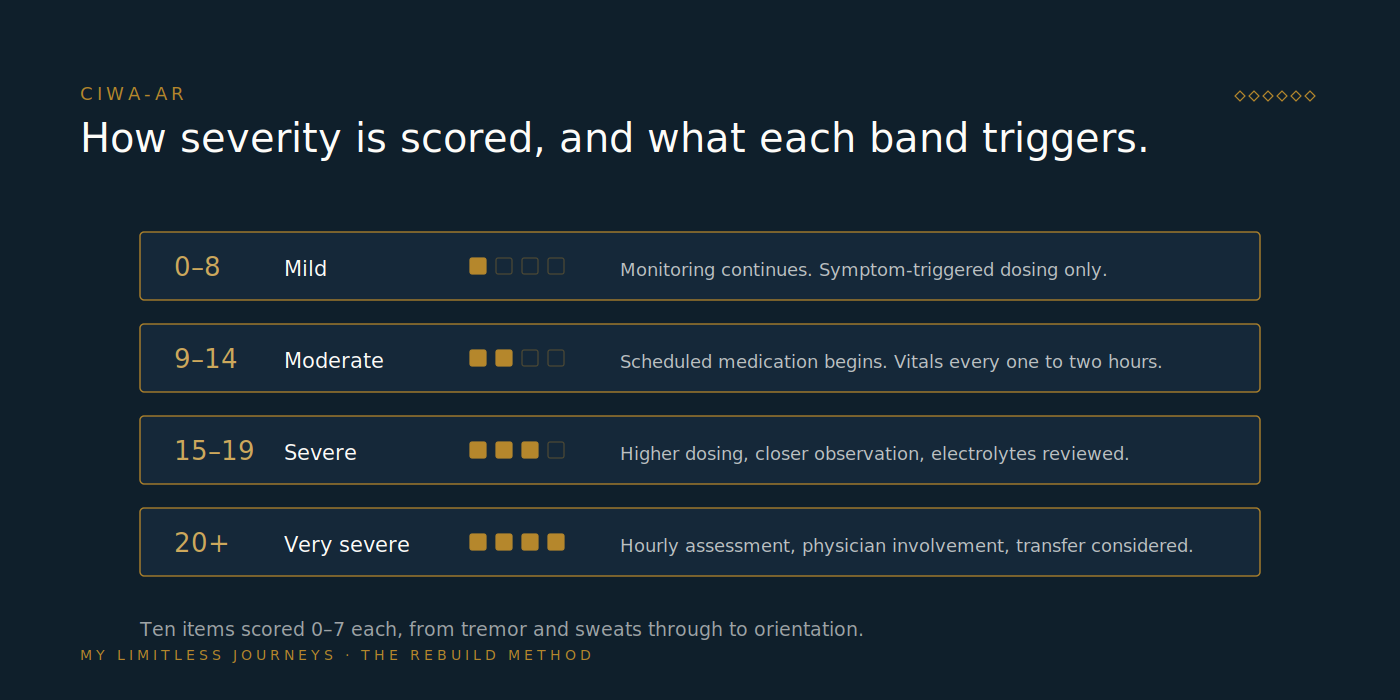
The Clinical Institute Withdrawal Assessment for Alcohol, revised (CIWA-Ar), is the standard tool for measuring how severe withdrawal is at a given moment. A nurse scores ten items: nausea and vomiting, tremor, sweating, anxiety, agitation, tactile disturbances, auditory disturbances, visual disturbances, headache, and orientation. Nine items score from zero to seven and orientation scores from zero to four, giving a maximum of 67. It takes a few minutes to administer and is repeated throughout detox, so that the numbers form a curve rather than a snapshot.
| CIWA-Ar score | What it indicates | What typically happens |
|---|---|---|
| Under 8 to 10 | Minimal or mild withdrawal | Monitoring continues; medication may be withheld or given on a fixed schedule depending on history |
| 8–10 to 15 | Moderate withdrawal | Medication is given and monitoring frequency increases |
| Above 15 to 20 | Severe withdrawal; high risk of seizures and delirium | Intensive medication and monitoring; hospital transfer is considered if scores do not respond |
Two things about the scale are worth knowing as a patient. First, it depends on your answers, so a person who is minimizing or who cannot communicate well can be under-scored, which is why nurses also weigh vital signs and history. Second, it is a tool for guiding medication, not a verdict on you. The protocol at MLJ, in line with TIP 45 and the ASAM guideline, is symptom-triggered: medication follows the score. That approach has been shown to use less total medication and shorten detox compared with fixed schedules, while keeping people just as safe. Our guide to what medically supervised means describes the nursing and physician structure behind this.
Why unsupervised withdrawal is dangerous.
The obvious danger is the one already described: a seizure or delirium arriving with no one present who can recognize it. But there are three subtler dangers that people who have "gotten through it before" tend to underestimate. The first is kindling. Each episode of withdrawal sensitizes the brain, so that subsequent episodes tend to be more severe than the last, even if the drinking in between was no heavier. A person who has stopped and restarted a dozen times is at higher risk on the thirteenth attempt than they were on the first, and previous success is a poor guide.
The second is the relapse that stops the withdrawal. Because alcohol reliably ends the symptoms, unsupervised withdrawal has a built-in exit. Most attempts to quit at home end not in a seizure but in a drink on the second day, followed by a sense of failure that makes the next attempt less likely. The third is what withdrawal unmasks. Dehydration, low potassium and magnesium, a liver that is inflamed, a heart rhythm that alcohol was suppressing, a depression that alcohol was blunting: none of these announce themselves, and all of them are things that bloodwork and a physician's exam on day one are meant to find.
We do not say this to frighten anyone into admission. Some people with mild dependence and no risk factors can stop with outpatient medical support and a family member present, and a clinician can help you decide whether that describes you. The question of whether you need residential care is genuinely open in many cases. The question of whether alcohol withdrawal should be watched by someone who knows what they are watching for is not.
After the acute phase: post-acute withdrawal.
Somewhere around day seven, the medical emergency is over, and a quieter and longer phase begins. Sleep is fragmented and shallow, with vivid dreams. Anxiety comes in waves that have no trigger. Mood is flat or low, concentration is poor, and small frustrations produce outsized irritability. Cravings arrive without warning, often in the late afternoon, at the hour the first drink used to be poured. This cluster is often called post-acute withdrawal syndrome, or PAWS. It is not a formal diagnosis and its boundaries are debated, but the experience it describes is nearly universal in early recovery from alcohol, and it can persist in some form for weeks to months.
The mechanism is the same one that drove acute withdrawal, playing out on a slower clock. The receptor changes that alcohol produced over years do not reverse in a week. The brain's stress system stays over-tuned; its reward system stays under-tuned. Sleep architecture, which alcohol disrupts profoundly, takes weeks to rebuild. We treat all of this as clinical work within the Body domain of the Rebuild Method: sleep is assessed and treated, nutrition is prescribed rather than left to appetite, exercise is scheduled as a pharmacological intervention, and medications that reduce craving, such as naltrexone or acamprosate, are discussed with the psychiatrist as detox ends rather than months later.
This is also the honest answer to the question of why detox at MLJ is not a stand-alone service. The week in which you are medically fragile is the week you are in a bed with a nurse nearby. The months in which you are psychologically fragile are the months that follow, and a detox program that discharges you at day seven has left you at the start of the hardest part with nothing in your hands. Residential treatment, and the step-down through IOP and transitional living, exist for that stretch. If you are trying to decide what to do about your drinking tonight, please call. The conversation is confidential, and the person who answers has had it many times.
- Medical detox at MLJ. The pillar page: what detox is, who needs it, what the first week looks like.
- Benzodiazepine tapering. The other withdrawal that can cause seizures, and why it is managed differently.
- Polysubstance detox. What changes when alcohol is combined with benzodiazepines or cocaine.
- Detox medications. What each medication does and does not do.
- Alcohol addiction treatment. The program that follows detox.
- Signs of a high-functioning alcoholic. If you are reading this at four in the morning and unsure it applies to you.
This guide is educational and is not a substitute for medical advice. If someone is in immediate danger, call 911.