What did Prop 1 change for addiction treatment?
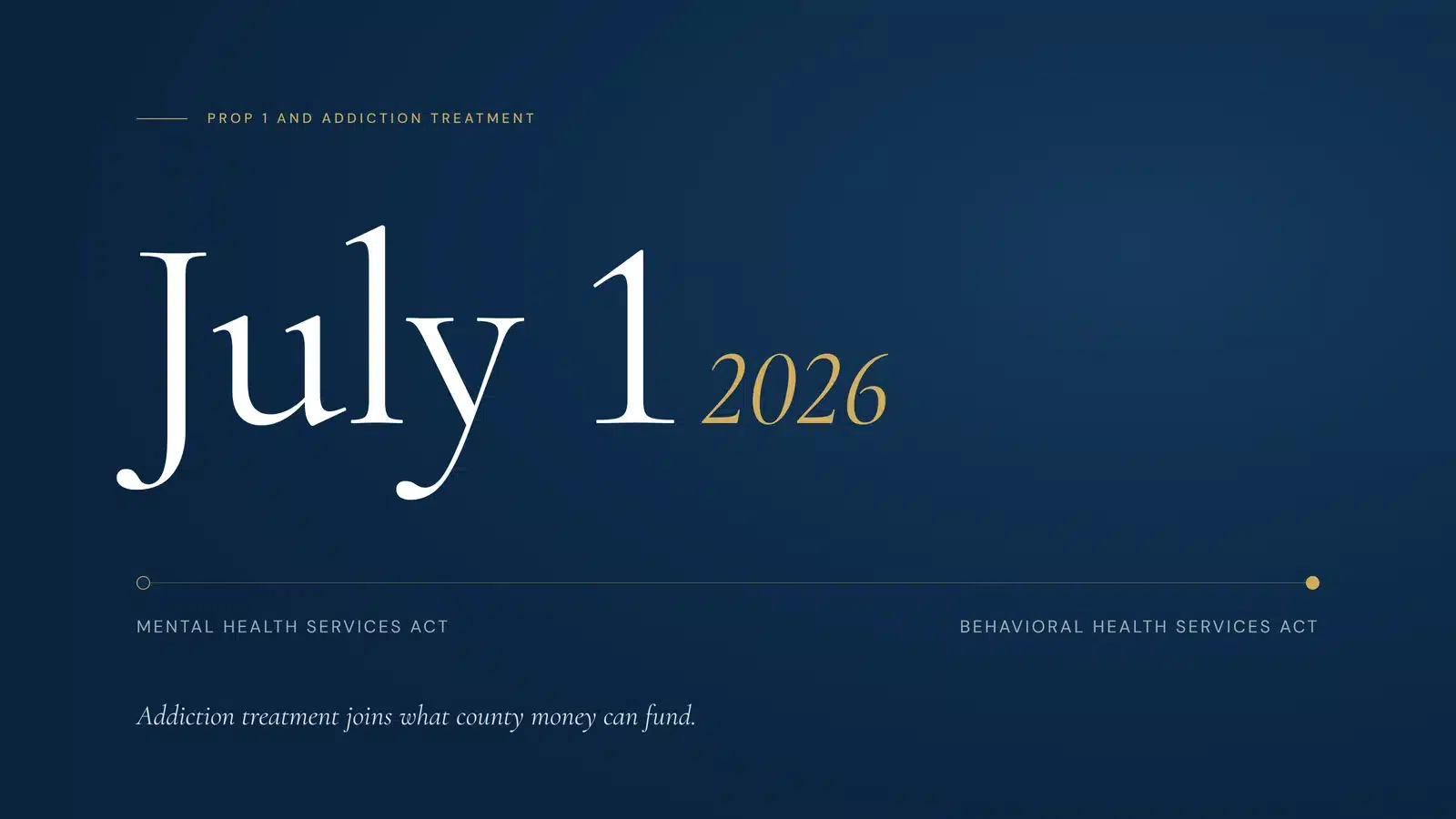
California’s Behavioral Health Services Act, approved by voters as Proposition 1, replaced the Mental Health Services Act on July 1, 2026. It adds substance use disorder treatment to what county behavioral health money may fund, mainly for people with the most serious needs in the public system. Families with private insurance still go through their health plan.
What is the Behavioral Health Services Act?
For two decades, California counties received dedicated mental health money under the Mental Health Services Act. Voters approved Proposition 1 in 2024, and the reworked law, now called the Behavioral Health Services Act, took effect on July 1, 2026, according to the Department of Health Care Services.
The biggest change for families affected by addiction is scope. DHCS describes the act as adding the treatment of substance use disorders to the old mental health framework. Counties may choose whether to spend these funds on substance use disorder services, based on local need, and the act is aimed at eligible adults and children with or at risk of the most serious mental health conditions and substance use disorders, including people experiencing homelessness.
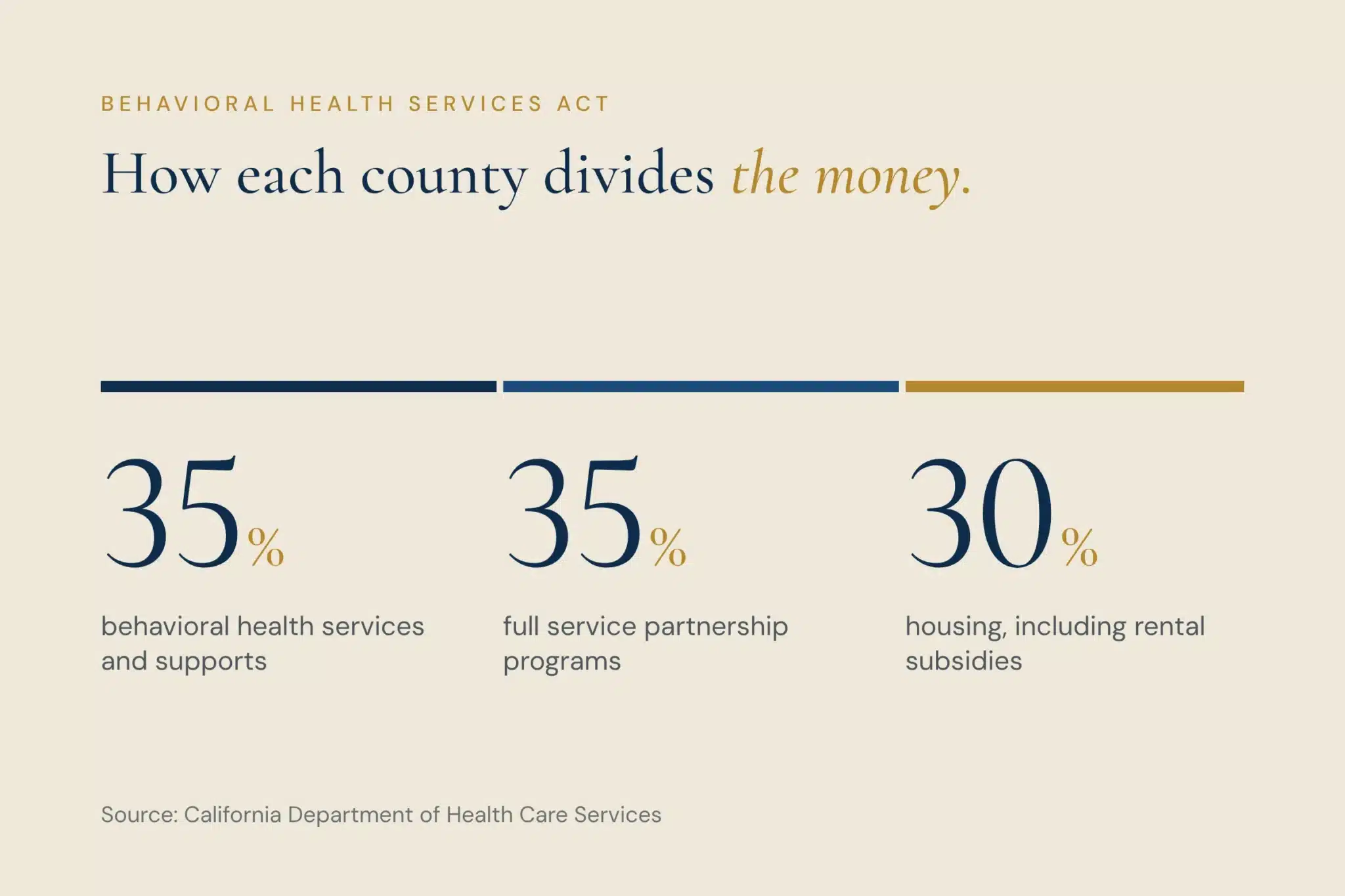
The money is divided in fixed shares. Each county puts 35 percent toward behavioral health services and supports, 35 percent toward full service partnership programs and 30 percent toward housing, including rental subsidies.
What did the state publish on October 1?
On October 1, DHCS released the Behavioral Health Public County Profile, which the department calls the first public, statewide tool that brings county-reported behavioral health data together in one place. It reflects two years of work with counties under Proposition 1.
A family, a reporter or a referring clinician can use it to see, county by county:
- Each county’s three-year integrated plan, including program investments, projected spending and how many people the county expects to serve.
- Utilization rates on a subset of the act’s performance measures.
- Opioid-related overdose indicators: deaths, emergency department visits, hospitalizations and prescribing patterns.
- Statewide reporting on involuntary treatment under the Lanterman-Petris-Short Act, the CARE Act courts and the Medi-Cal BH-CONNECT initiative.
DHCS says more datasets and measures will be added over the coming year. For now it is a planning document more than a bed finder, but it answers a question families rarely get answered: what is my county actually funding?
How do you get addiction treatment in Los Angeles County?
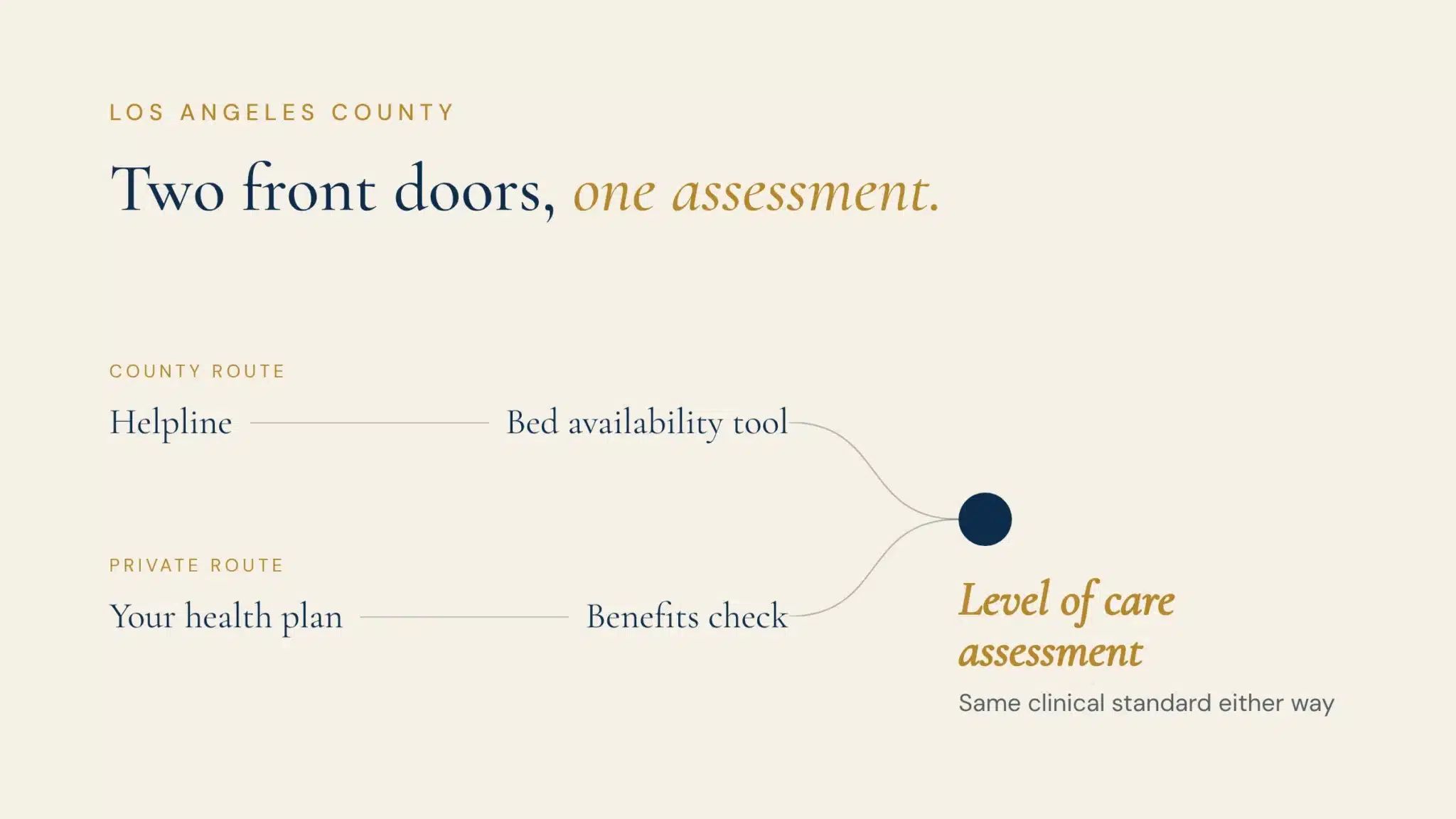
There are two front doors, and which one fits depends mostly on coverage.
The county route
If someone has Medi-Cal, or no coverage, the starting point is the Los Angeles County Department of Public Health’s Substance Abuse Prevention and Control program. Its Substance Abuse Service Helpline is 1-800-854-7771, option 2. The county also runs a Service and Bed Availability Tool, a searchable locator that shows real-time bed availability for substance use treatment. This is the system the new act helps fund.
The private route
If someone has employer or individual insurance, the starting point is the plan. Call the member services number on the card and ask which programs are in network, what the deductible and out-of-pocket maximum are, and whether prior authorization is needed. A licensed program will run the same check for you; ours is a confidential benefits verification that commits you to nothing. Private pay is the third option, and our guide to paying for treatment lays out what each route reveals.
“Before anyone commits, they should know what their plan covers, what they will owe and whether the program is in network. That conversation should take minutes, and it should happen before admission, not after.”
Garrett Braukman, Executive Director, SoCal West Region, Emend Healthcare
Does the route change the treatment someone needs?
It should not. Whichever door a person uses, the level of care should come from a clinical assessment, and the ASAM Criteria are the standard most programs use to match a patient to the right level. That means detox when withdrawal is risky, residential care when home or prior attempts make outpatient care unlikely to hold, and outpatient care when it is enough. Our explainer on the six ASAM dimensions walks through how that decision is made.
“Whichever door someone comes through, the first useful hour is the same: an honest assessment of what they are using, what they have tried and what is waiting at home.”
Brett Cronon, Counselor, My Limitless Journeys
Where the routes do differ is setting, wait and size. Public programs serve many more people. A small private residence can offer a level of attention and privacy that is hard to reproduce at scale. Neither is automatically better. The right one is the one that fits the person and is available when they are ready.
“Families ask whether the county route or the private route is better. The better question is whether the level of care fits the person, and whether the next step is already arranged before this one ends.”
Garrett Braukman, Executive Director, SoCal West Region, Emend Healthcare
Where our Encino residence fits
We are a private, six-bed residence in the hills above Ventura Boulevard, licensed by DHCS (license 191135CP) and accredited by The Joint Commission. Addiction treatment in Encino here runs from medically supervised detox through residential care, partial hospitalization, intensive outpatient, transitional living and alumni support, with one clinical team and no transfers between levels. Every stage is described on our programs page, and the neighborhood and house are on our Encino location page.
We work with commercial health plans and private pay. When the county route is the better fit for someone who calls us, we say so and point them to the helpline above. For families weighing the private option, our overview of what addiction treatment at our Encino residence includes is the place to start. Anywhere in the country, the free, confidential SAMHSA National Helpline at 1-800-662-4357 answers around the clock in English and Spanish.
Frequently asked questions
Does Prop 1 pay for private rehab?
Not directly. Behavioral Health Services Act money flows to counties, which decide how to spend it within the required shares and whether to fund substance use disorder services at all. It supports the public system, so people with private insurance generally still use their plan, and it is not a way to pay a private program’s bill.
Is Medi-Cal the same as the Behavioral Health Services Act?
No. Medi-Cal is the state’s health coverage program and pays for a defined set of substance use disorder services for its members. The Behavioral Health Services Act is a separate county funding stream that can pay for services, housing and programs that coverage alone does not reach.
How do I find an open detox or residential bed in Los Angeles County?
For the county system, call the Substance Abuse Service Helpline at 1-800-854-7771, option 2, or use the county’s Service and Bed Availability Tool, which shows real-time availability. With private insurance, call your plan or ask a licensed program to verify benefits and check its own availability.
Where can I see what my county is spending on behavioral health?
The DHCS Behavioral Health Public County Profile, released October 1, 2026, shows each county’s three-year integrated plan, projected spending, expected numbers served and opioid overdose indicators. DHCS says it will add more data and performance measures over the coming year.
Not sure which door fits? Ask us. We will tell you plainly whether our residence is the right level of care, and where to go if it is not.
Begin a conversation · (866) 209-4246 during business hours · Verify your benefits
This article is general information, not a diagnosis or a substitute for an assessment by a clinician. If someone is in immediate danger, call 911. In a mental health or substance use crisis, call or text 988.
Sources
- California Department of Health Care Services, “New Public County Profile Gives Californians Unprecedented Insight into Local Behavioral Health Services and Investments,” October 1, 2026. dhcs.ca.gov
- California Department of Health Care Services, Behavioral Health Public County Profile. dhcs.ca.gov
- California Department of Health Care Services, Behavioral Health Services Act. dhcs.ca.gov
- Los Angeles County Department of Public Health, Substance Abuse Prevention and Control. publichealth.lacounty.gov
- American Society of Addiction Medicine, “About the ASAM Criteria.” asam.org
- SAMHSA National Helpline. samhsa.gov
Every article on this site is written by our editorial team and reviewed by a licensed clinician. Read how we write and review content.
Keep reading: Addiction treatment in Encino · Paying for addiction treatment · In-network, out-of-network and single-case agreements · Levels of care explained