What is cychlorphine?
Cychlorphine, also called N-propionitrile chlorphine, is an illicit synthetic opioid from a newer drug family called orphines. It is chemically unrelated to fentanyl, so fentanyl test strips do not detect it, and lab data suggest it may be more potent than fentanyl. Naloxone can reverse a cychlorphine overdose, though more than one dose may be needed.
What Los Angeles County reported in October
On October 15, the Los Angeles County Department of Public Health announced the county’s first fatal overdose linked to cychlorphine. The Medical Examiner’s Office identified the drug as a cause of a death that occurred in February. The county did not release where in Los Angeles County the person lived or what else was found. A second California death was reported in the Bay Area in April.
The county’s message was blunt. Health officials said the safest course is to avoid illicit substances altogether, given the possibility that cychlorphine is present, and they flagged two facts that matter to every family with a loved one who uses opioids: fentanyl test strips will not detect it, and an overdose may take more than one dose of naloxone to reverse.
Los Angeles is not an outlier. The Center for Forensic Science Research and Education, which tracks new drugs through its NPS Discovery program, reported in January 2026 that cychlorphine had appeared in 25 fatal overdose blood specimens from the United States and Canada, most submitted in late 2025 and early 2026. In 11 of those 25 deaths it was the only opioid found. A separate commercial lab, NMS Labs, had tentatively identified it in more than 100 toxicology cases.
Why a fentanyl test strip cannot catch it
A fentanyl test strip is an antibody test. It is built to recognize the shape of the fentanyl molecule and many of its close relatives, and nothing more. Cychlorphine belongs to a different chemical family, the benzimidazolone opioids, so the strip simply does not see it. A 2026 editorial in the Journal of Pain Research notes that neither fentanyl nor nitazene strips cross-react with orphines, and that a negative result on a standard hospital drug screen does not rule them out either. The Legislative Analysis and Public Policy Association states it plainly: test strips for orphines do not exist.
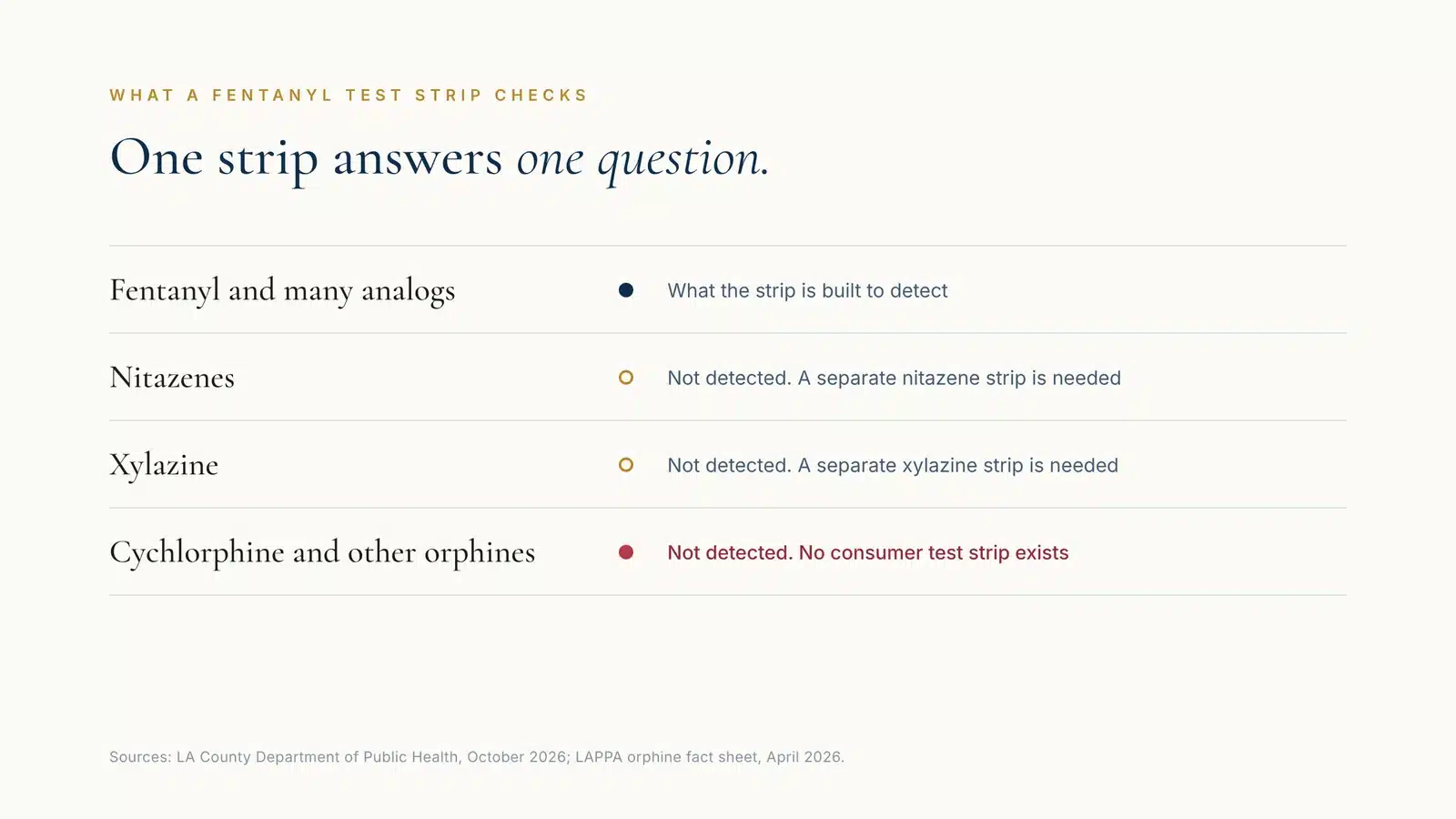
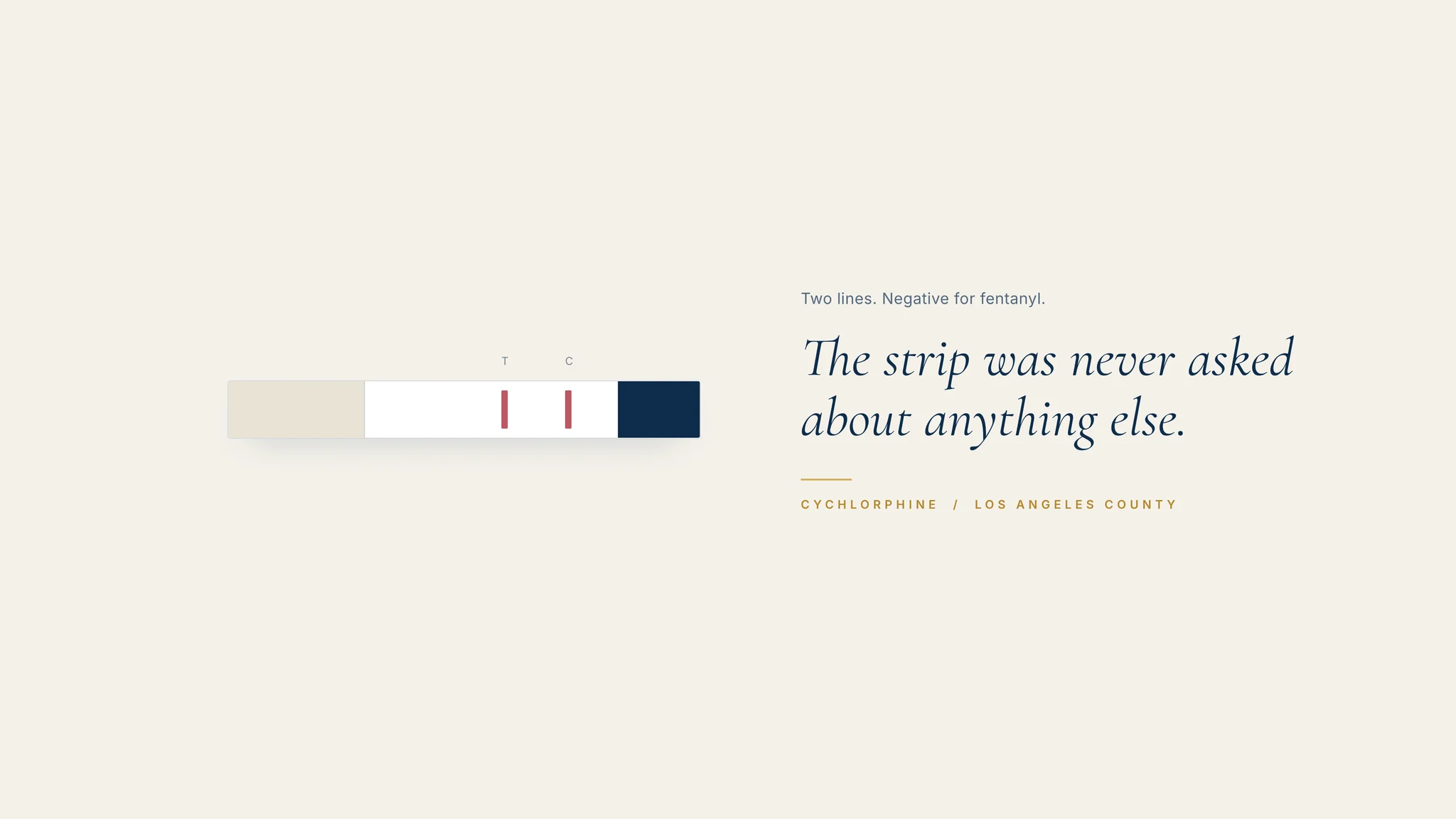
That is the uncomfortable part for families. Test strips have been one of the most useful harm reduction tools of the fentanyl era, and they still are, for fentanyl. The risk is the false comfort of a clean result. Someone who has relied on two lines for years may take a full dose of a pill or powder that contains a drug the strip was never designed to find.
Los Angeles County does offer a better option than a strip: free, confidential drug checking through Drug Checking LA, which the county says can test specifically for cychlorphine, with results in about 15 to 20 minutes.
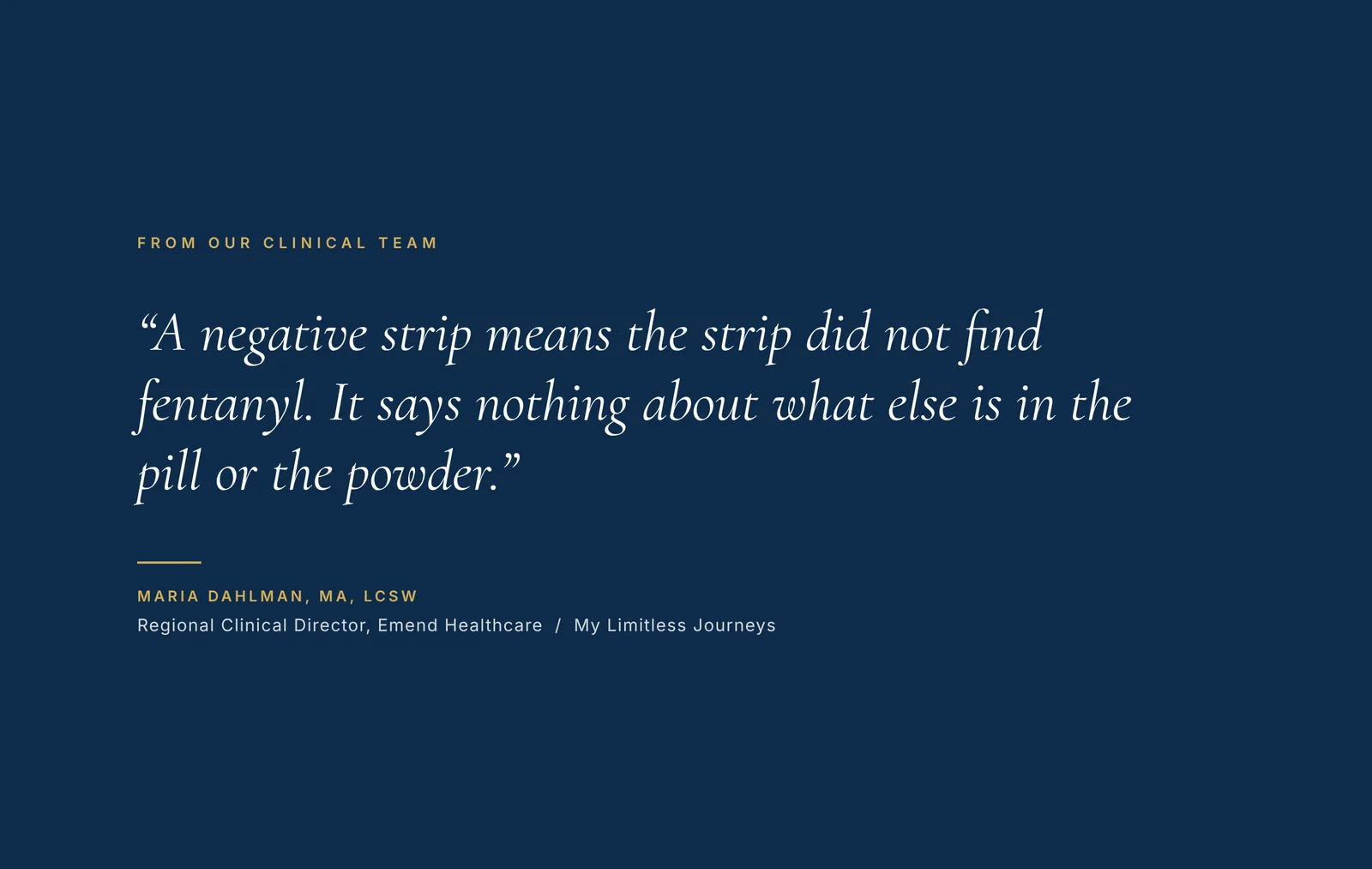
“A negative strip means the strip did not find fentanyl. It says nothing about what else is in the pill or the powder, and with the newer synthetic opioids, that gap is exactly where the danger sits.”
Maria Dahlman, MA, LCSW, Regional Clinical Director, Emend Healthcare
Naloxone still works. Plan for more than one dose.
Cychlorphine acts on the same opioid receptors as fentanyl and heroin, which means naloxone, the overdose reversal medication sold as Narcan and in generic nasal sprays, can reverse it. Los Angeles County and the national fact sheets agree on that point, and they agree on the caveat: because the drug is so potent, multiple doses may be necessary. The Journal of Pain Research authors also note that some overdoses that look resistant to naloxone are better explained by sedatives taken alongside the opioid, such as the street benzodiazepines that keep turning up in these cases. Naloxone does not reverse a benzodiazepine, which is one more reason to call 911 rather than rely on the spray alone.
If you live with or love someone who uses opioids, keep naloxone in more than one place: the house, the car, a bag. In Los Angeles County you can get it without a prescription at retail pharmacies, public health centers and county Community Health Stations. Then learn the sequence.
- Check for response. Shout their name and rub hard on the breastbone. Slow or stopped breathing, blue or gray lips and pinpoint pupils are signs of an opioid overdose.
- Call 911. California’s Good Samaritan law offers limited protection to people who seek help during an overdose.
- Give naloxone. One spray in one nostril.
- Wait two to three minutes. If breathing has not improved, give another dose in the other nostril.
- Stay with them. Turn them on their side and stay until help arrives. Naloxone can wear off before a long-acting opioid does.
Why this matters while overdose deaths are falling
Los Angeles County has real progress to protect. In June, Public Health reported 2,298 accidental overdose and poisoning deaths in 2025, down 6% from 2024 and nearly 30% below the 2022 peak of 3,220. Fentanyl-related deaths fell more than 40% over that span. Adults aged 40 to 64 still accounted for more than half of all deaths, and deaths among adults 65 and older rose 14%.
The pattern of the last decade is that the drug supply changes faster than people’s habits do. Heroin gave way to fentanyl; fentanyl began arriving with xylazine, nitazenes and street benzodiazepines; now orphines. Each shift arrives quietly, often before tests and warnings catch up. For the people we serve, many of them working professionals in their forties and fifties across the San Fernando Valley and greater Los Angeles, the honest conclusion is that there is no longer a reliable way to make illicit opioid use safe. There are only ways to make it less likely to be fatal, and a way out.
If someone you love is using opioids
News like this tempts families toward an ultimatum. In our experience, fear rarely works as an opening line. What tends to help is a calm, specific conversation, repeated more than once: what you have noticed, what you are worried about, and one concrete next step you are prepared to help with. Our guides on what to say when he insists he can stop on his own and what to do when someone refuses treatment walk through those conversations in detail.
“Most people who use opioids trust their own routine more than any headline. The conversations that move someone toward care usually start with worry rather than warnings, and they almost never happen only once.”
Brett Cronon, Counselor, My Limitless Journeys
When someone is ready, stopping opioids alone is the riskiest version of stopping. Withdrawal from fentanyl and other potent synthetics is often delayed and drawn out, and the period after a few days or weeks without use is when tolerance has fallen and an overdose is most likely. Our page on opioid and fentanyl detox explains how withdrawal is managed medically, including when buprenorphine can be started safely, and our guide to the first 24 hours after a relapse covers what to do if use returns.
How My Limitless Journeys approaches opioid treatment
We are a six-bed residence in Encino, licensed by the California Department of Health Care Services and accredited by The Joint Commission. Care for opioid use begins with medically supervised detox on site and continues into residential treatment, with a true one-to-one clinical ratio on every shift. Medication for opioid use disorder is treated as treatment, not a crutch, and it continues past detox when it is the right fit. Every client who leaves after opioid treatment, and every family member who wants it, is offered naloxone and shown how to use it.
If cost is the first question, start with a confidential insurance verification. It takes a few minutes and commits you to nothing.
Frequently asked questions
Do fentanyl test strips detect cychlorphine?
No. Cychlorphine belongs to a different chemical family from fentanyl, and fentanyl test strips do not react to it. No consumer test strip for orphines currently exists. In Los Angeles County, Drug Checking LA offers free, confidential testing that can identify cychlorphine.
Does Narcan work on cychlorphine?
Yes. Naloxone, including Narcan, can reverse a cychlorphine overdose, but because the drug is so potent, more than one dose may be needed. Call 911, give one dose, and if breathing has not improved after two to three minutes, give another.
How strong is cychlorphine compared with fentanyl?
Los Angeles County describes it as more potent than fentanyl. Laboratory data cited by the Center for Forensic Science Research and Education suggest it may be around ten times as potent, but no human studies have confirmed a precise figure, so the safest assumption is that a very small amount can be fatal.
Where can someone in Los Angeles get help for opioid use?
The county’s Substance Abuse Service Helpline, 800-854-7771, is open around the clock. California’s CA Bridge Connect line, (800) 944-1807, offers same-day referrals for opioid treatment on weekdays. Our admissions team can also talk through levels of care and next steps, whether or not My Limitless Journeys is the right fit.
If opioids are part of your family’s life right now, a calm first conversation is worth more than another warning. Talk with our team about detox, residential care and what the weeks after look like.
This article is general information, not a diagnosis or a substitute for an assessment by a clinician. If someone is unresponsive or not breathing normally, call 911. Poison Control is available at 1-800-222-1222. In a mental health or substance use crisis, call or text 988.
Sources
- City News Service, “LA County reports first fatal overdose linked to potent synthetic opioid,” MyNewsLA, October 15, 2026, reporting the Los Angeles County Department of Public Health announcement. mynewsla.com
- Krotulski AJ, Papsun DM, Stang BN, Walton SE, Logan BK. “Increase in Fatal Overdoses Linked to Novel Synthetic Opioid N-Propionitrile Chlorphine (Cychlorphine).” Center for Forensic Science Research and Education, NPS Discovery public alert, January 2026. cadca.org (PDF)
- Raffa RB, Breve F, Pergolizzi JV Jr, Vortsman E, Varrassi G. “Cychlorphine (N-Propionitrile Chlorphine): An Emerging Benzimidazolone Synthetic Opioid and Its Implications for Overdose Recognition and Management.” Journal of Pain Research, 2026;19. dovepress.com
- Legislative Analysis and Public Policy Association, “Orphines: Brorphine, Cychlorphine, and Beyond,” fact sheet, April 2026. legislativeanalysis.org (PDF)
- Los Angeles County, “Drug-Related Overdose Deaths in LA County Continue to Fall,” June 25, 2026. lacounty.gov
- California Department of Health Care Services, “New Helpline Connects Californians to Same-Day Opioid Treatment Support,” August 2026. dhcs.ca.gov
- Drug Checking LA, free and confidential drug checking in Los Angeles County. drugcheckingla.com
Every article on this site is written by our editorial team and reviewed by a licensed clinician. Read how we write and review content.
Keep reading: Fentanyl addiction: warning signs and risks · Fentanyl addiction treatment · Polysubstance detox · Patient brokering in California rehab