
How do you vet a luxury rehab in California?
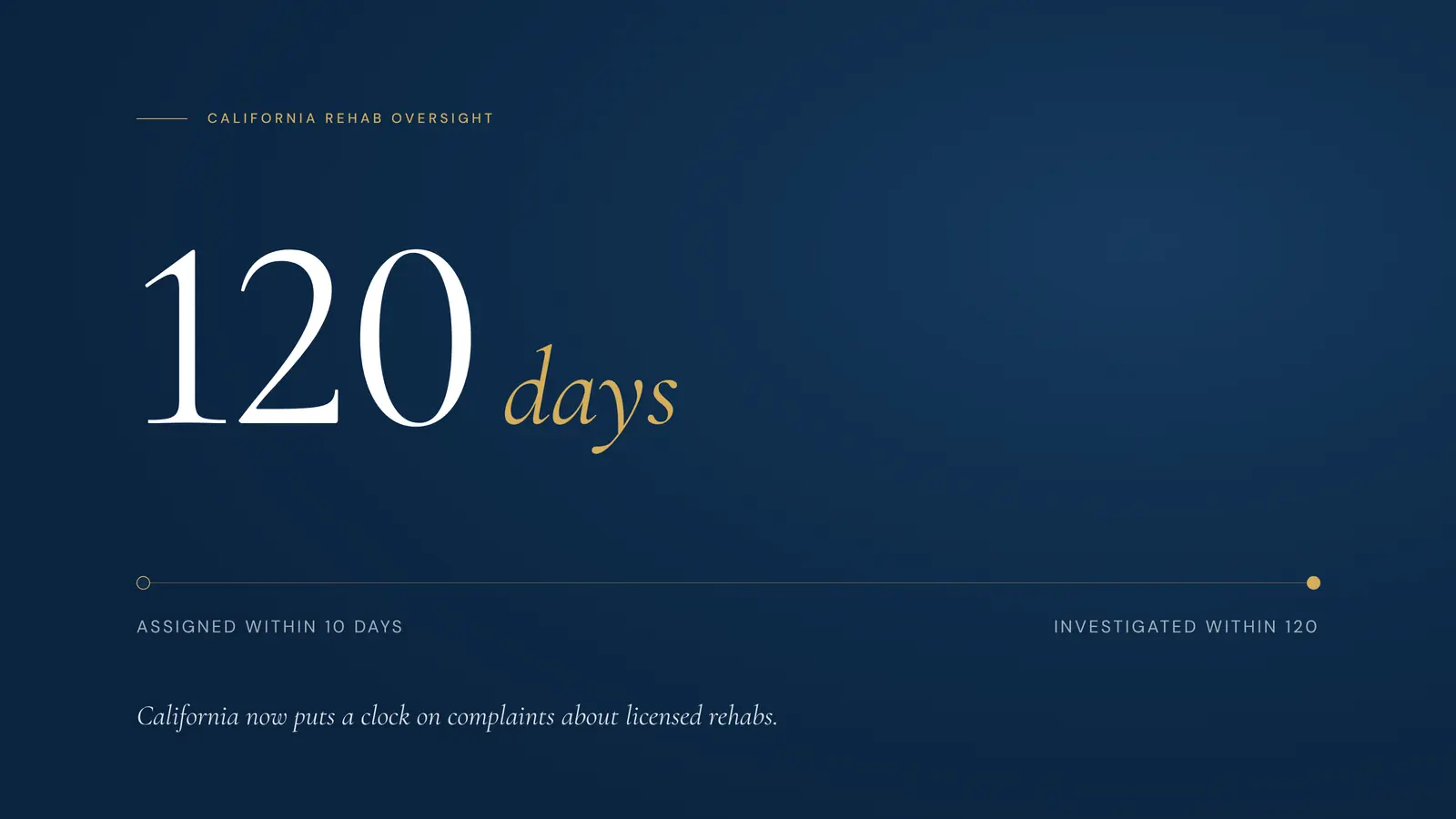
Vetting a luxury rehab in California starts with the state license and the record behind it. Laws approved in September 2026 require the Department of Health Care Services to assign complaints within 10 days, finish investigations within 120, and publish an annual report from July 2027, and they require licensed facilities to adopt a suicide prevention plan.
Families from Beverly Hills, Bel Air and Brentwood tend to shop for treatment the way they would choose a surgeon: by reputation, referral and a feel for the people. That instinct is right, and it is incomplete. California licenses residential addiction treatment through the Department of Health Care Services (DHCS), and two laws chaptered on September 27, 2026, change what that license now carries with it. Both appear in the Steinberg Institute’s October 28 roundup of behavioral health bills signed this year.
What changed in California rehab oversight this fall?
Two things: the state now has deadlines, and facilities now have a new written obligation.
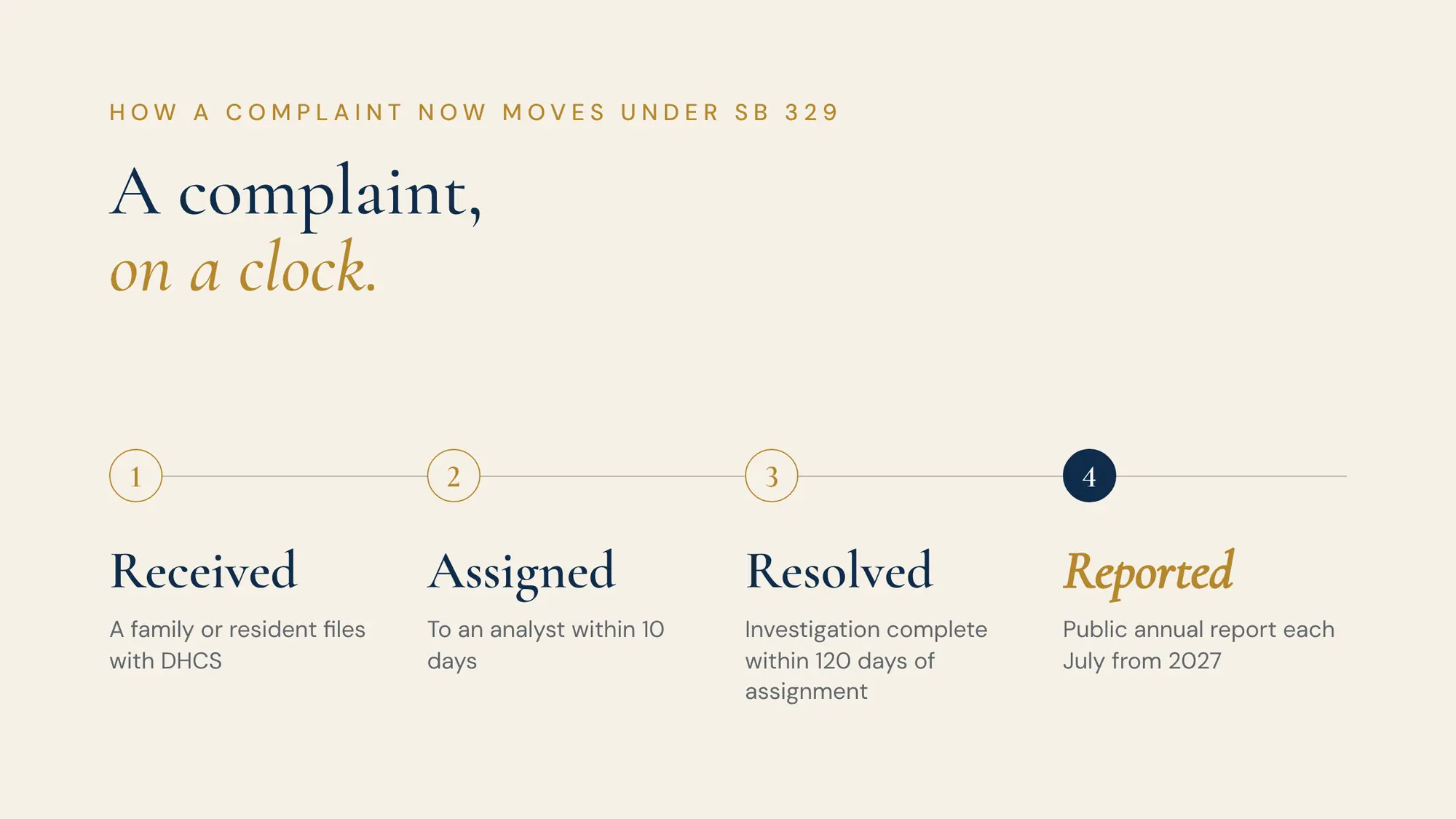
SB 329, by Senators Catherine Blakespear and Thomas Umberg, Chapter 646, requires DHCS to assign a complaint within its jurisdiction to an analyst within 10 days of receiving it and to complete an investigation into a facility within 120 days of assignment, unless it needs additional resources. When a complaint falls outside its jurisdiction, the department must, where feasible, tell the person in writing. Starting July 1, 2027, and every July 1 after that, DHCS must post an annual report of its investigations online. The law also allows a single fee increase for licensure and certification to pay for that reporting.
AB 2562, by Assemblymember Diane Dixon, Chapter 620, requires a licensed alcohol and drug facility to develop a suicide prevention plan and a certified program to include one in its operation manual. DHCS can put the requirement into effect through bulletins or provider letters after hearing from stakeholders, and must adopt formal regulations by January 1, 2031.
Those laws build on two passed in 2025 that the Steinberg Institute also summarized: AB 424 requires DHCS to acknowledge public complaints within 10 days and tell complainants the outcome, and AB 1356 requires licensed facilities to report a resident’s death to DHCS within 60 days, including the steps taken to prevent a recurrence.
Why did lawmakers add deadlines?
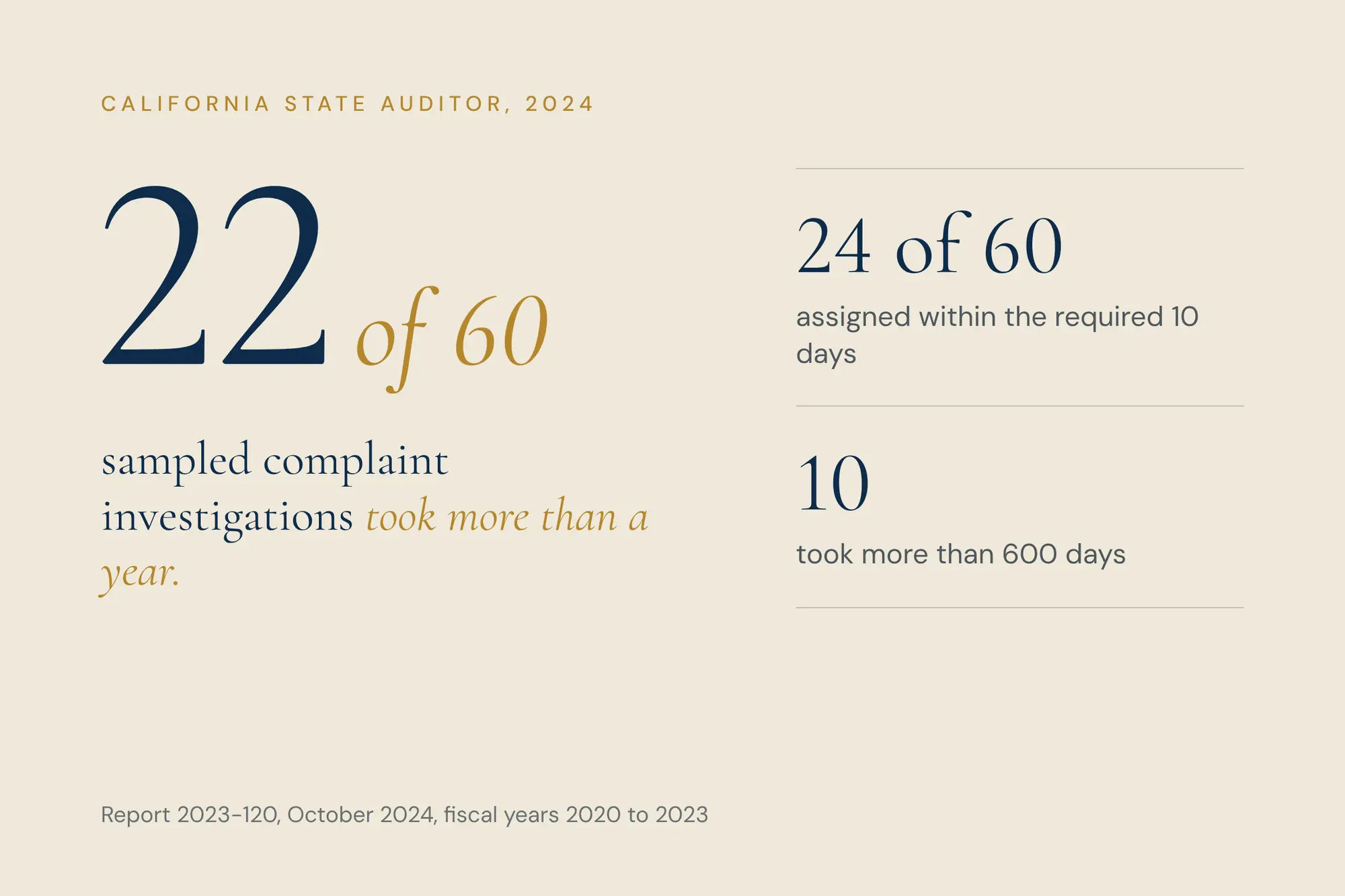
Because the state’s own auditor found the old system slow. In Report 2023-120, published October 24, 2024, the California State Auditor reviewed 60 complaint investigations at DHCS from fiscal years 2020 to 2021 through 2022 to 2023. Only 24 of the 60 were assigned within the required 10 days. Medium and low priority investigations took more than 300 days, against an internal target of 30 to 60 days, and 22 of the 60 took more than a year. Ten took more than 600 days.
The audit also found that DHCS completed only half of the 26 compliance inspections it reviewed on time, and did not always follow up after finding unlicensed facilities advertising or providing services. DHCS agreed with the findings. SB 329 turns the auditor’s timeliness concern into law, and the July 2027 report will give families, for the first time, a public annual account of how those investigations went.
Is a small, six-bed setting a sign of quality?
A small setting is a design choice, not a credential. The auditor’s fact sheet notes that Southern California has a greater concentration of treatment facilities serving six or fewer residents than other parts of the state, that state law allows such facilities to sit near one another under the same owners, and that one grouping it examined advertised several small facilities as a campus.
None of that is a problem in itself. It does mean the size of a house tells you less than the license behind it. Ask whether the home you are touring is the address on the license, how many beds that license covers and whether residents or staff are shared with other houses. Our explainer on how six beds changes anonymity covers what a small census can genuinely offer, and what it cannot.
What should Beverly Hills families ask before choosing a rehab?
Ask about the record, the night shift and the hard days. Amenities can wait until these have good answers:
- 1The license. What is the DHCS license number, which address does it cover and how many beds? Look it up yourself.
- 2The complaint history. Has the program had a substantiated complaint, and what changed afterward? From July 2027, compare the answer with the state’s annual report.
- 3The suicide prevention plan. Ask to see it, or at least to have it explained: how risk is screened at admission and reassessed, and who is on site overnight.
- 4Deaths and serious incidents. Has a resident died in the past few years, and was it reported to the state as required?
- 5Staffing. Who is awake in the house at 3 a.m., and what are their credentials?
- 6The discharge plan. Who builds it, when does that work start and what happens if coverage or the stay ends early?
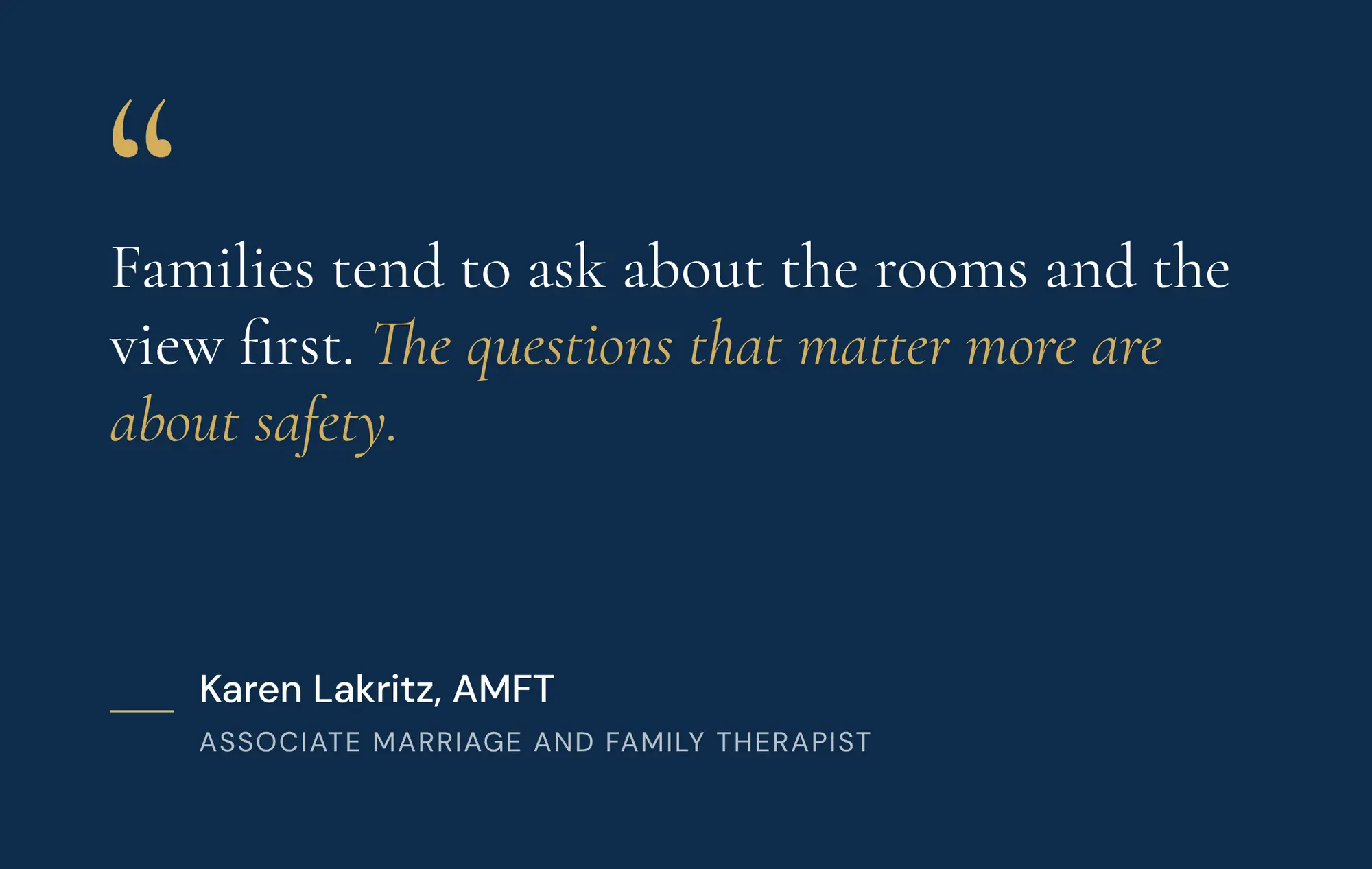
“Families tend to ask about the rooms and the view first. The questions that matter more are about safety: what happens when someone is struggling at three on a Sunday afternoon, and who notices.”
Karen Lakritz, AMFT, Associate Marriage and Family Therapist, My Limitless Journeys
“Ask any program to walk you through how a complaint is handled and who answers it. A program that runs well can do that in a few minutes, without looking anything up.”
Casey Flores, RADT, Retreat Manager, My Limitless Journeys
If an offer arrives with free travel or a promise that nothing will cost anything, slow down further. Our guide to patient brokering in California rehab explains the warning signs and how to check a program before anyone travels, and our list of questions to ask a rehab on the phone covers the rest of the first call.
How My Limitless Journeys answers those questions
We would rather be checked than trusted. My Limitless Journeys is one six-bed residence in Encino, licensed by DHCS under license 191135CP and accredited by The Joint Commission, and it is the only address where we deliver care. For rehab for Beverly Hills families, that means a drive of about twenty to thirty minutes over the Sepulveda Pass or Beverly Glen, with arrival arranged privately through admissions. There is no Beverly Hills facility, and we do not describe one.
Detox, residential treatment, PHP, IOP and alumni care are carried by one clinical team, so the people who assess risk at admission are the people who reassess it each week. If you want to see how that continuum works for clients from the area, our page on addiction treatment for Beverly Hills clients walks through each level, and our Beverly Hills rehab overview explains privacy, insurance and the first call.
Frequently asked questions
Are luxury rehabs regulated differently in California?
No. A residential addiction treatment program in California is licensed by the Department of Health Care Services whatever it charges. Price, amenities and setting do not change the license, the inspection rules or the complaint process, which is why the license number and the facility’s record matter more than the brochure.
What is a suicide prevention plan in a rehab?
Under AB 2562, a licensed alcohol and drug facility must develop a written suicide prevention plan, and certified programs must include one in their operation manual. The state will set the details through bulletins and then regulations due by 2031. Families can ask now how a program screens for risk, reassesses it and staffs overnight.
How long does California take to investigate a rehab complaint?
Under SB 329, the Department of Health Care Services must assign a complaint within its jurisdiction to an analyst within 10 days and complete an investigation within 120 days of assignment, unless it needs additional resources. A 2024 state audit found that 22 of 60 sampled investigations had taken more than a year.
Is a group of small homes the same as one program?
Not necessarily. Each licensed facility has its own license, address and bed count. The State Auditor found one grouping of small facilities in Southern California advertised as a campus. Ask which license covers the home you are touring and whether residents or staff move between houses.
Ask us for our license, our accreditation and our safety plan before you ask about anything else. We will walk you through each one, and through what a stay would involve and cost.
Begin a conversation · (866) 209-4246 (admissions, business hours)
This article is general information, not a diagnosis or a substitute for an assessment by a clinician. If someone is in immediate danger, call 911. In a mental health or substance use crisis, call or text 988.
Sources
- Digital Democracy (CalMatters), “SB 329, Alcohol and drug treatment facilities: complaints,” bill status and text, chaptered September 27, 2026, Chapter 646. calmatters.digitaldemocracy.org
- Digital Democracy (CalMatters), “AB 2562, Alcohol and drug facilities: suicide prevention plans,” bill status and text, chaptered September 27, 2026, Chapter 620. calmatters.digitaldemocracy.org
- Steinberg Institute, “Behavioral Health Bills Signed into Law by Governor Newsom in the 2025 to 2026 Legislative Year,” October 28, 2026. steinberginstitute.org
- Steinberg Institute, “Behavioral Health and Substance Use Disorder Bills Signed into Law by Governor Newsom in the 2025 to 2026 Legislative Year” (2025 bills, including AB 424 and AB 1356), October 22, 2025. steinberginstitute.org
- California State Auditor, “Drug and Alcohol Treatment Facilities,” Report 2023-120, October 24, 2024. auditor.ca.gov
- California State Auditor, Report 2023-120 fact sheet, October 2024. auditor.ca.gov
Every article on this site is written by our editorial team and reviewed by a licensed clinician. Read how we write and review content.
Keep reading: Rehab for Beverly Hills families · Patient brokering in California rehab · How to choose a rehab · What a 1:1 clinical ratio means