
Substance use in the entertainment industry: what the research actually says.
Film, television, and music workers face a particular set of occupational risks: extreme hours, unstable employment, constant access, and a culture that has treated using as part of the job for a century. This page gathers what peer-reviewed studies and industry surveys have found, names the industry's own support organizations, and describes what treatment built for this population looks like.
Authored by the MLJ Clinical Team. Reviewed under board-certified psychiatric oversight. Last updated September 2026.
Key Takeaways- Federal survey data have placed the arts, entertainment, and recreation sector above the all-industry average for heavy drinking, illicit drug use, and substance use disorder.
- A 2026 systematic review of 23 studies found substance use among musicians consistently exceeds general-population rates, driven by workplace stressors, cultural norms, coping deficits, and economic instability.
- Large surveys of screen workers and musicians report high rates of anxiety, depression, and poor mental health, the conditions most often found underneath substance use in this population.
- The industry has built its own support infrastructure, including union foundations, community funds, and music-specific charities, and treatment programs should work alongside them rather than around them.
- Treatment designed for entertainment workers accounts for schedule, exposure, identity, and privacy, not just the substance.
What the numbers show, and what they do not.
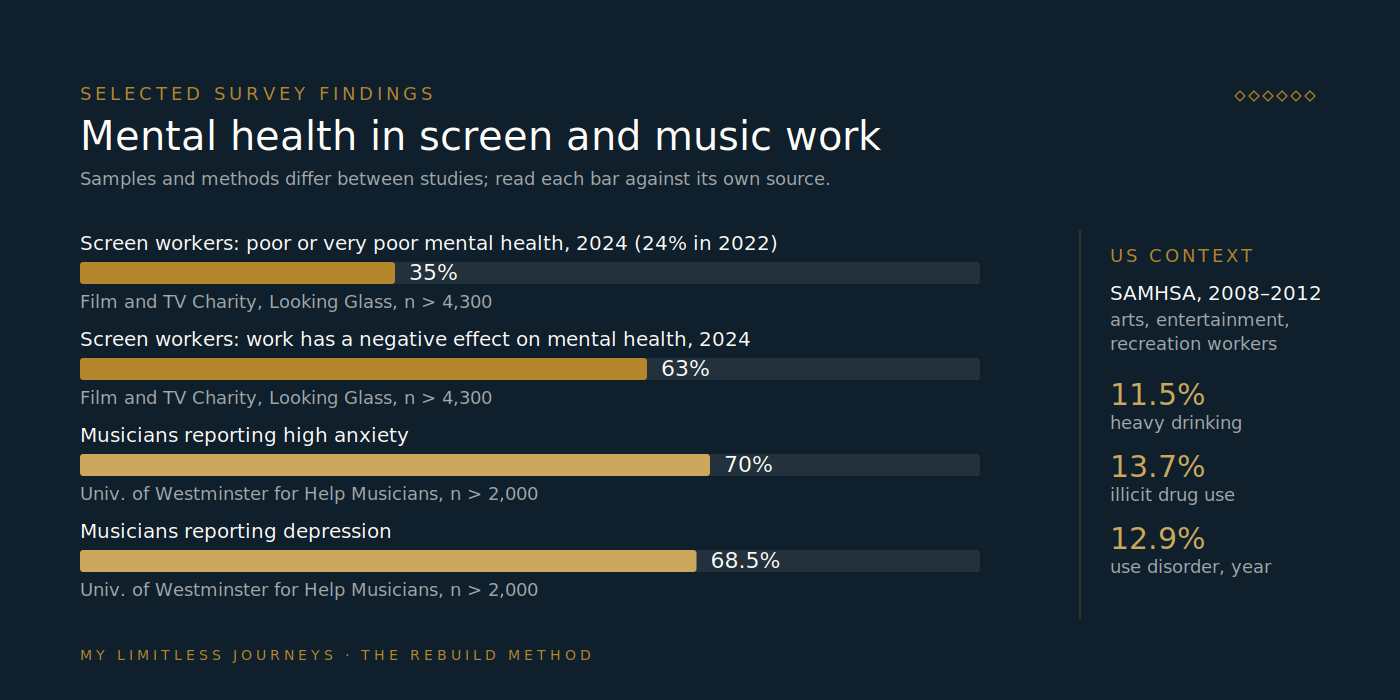
Start with the broadest source. The Substance Abuse and Mental Health Services Administration analyzed national survey data by industry and, in combined 2008 to 2012 data, found that among full-time workers in arts, entertainment, and recreation, 11.5 percent reported past-month heavy alcohol use, 13.7 percent reported past-month illicit drug use, and 12.9 percent met criteria for a past-year substance use disorder. The all-industry figures were 8.7, 8.6, and 9.5 percent respectively. The sector was not the highest in any category, but it sat clearly above the average in all three. You can read the SAMHSA report on substance use by industry directly.
Two cautions. First, the category is broad: it includes performing arts and film alongside spectator sports, museums, and amusement parks, so it approximates rather than isolates the population this page is about. Second, the data are more than a decade old, and the industry has been through a pandemic shutdown, two strikes, and a contraction in production since then. We cite them because they are the most rigorous federal numbers available, not because they describe this year.
For music the evidence is more specific. A systematic review published in 2026 in Medical Problems of Performing Artists pooled 23 studies spanning 1959 to 2024 and more than 36,000 participants and concluded that substance use among musicians is consistently elevated relative to the general population, with prevalence estimates ranging from 13 percent to over 80 percent depending on the substance, the genre, and how use was measured. The review's summary is worth reading for the range alone; it tells you that "musician" is not one risk profile but many. Comparable pooled data for film and television crews specifically are thin, which is itself a finding: this workforce has been studied far less than its size and risk would warrant.
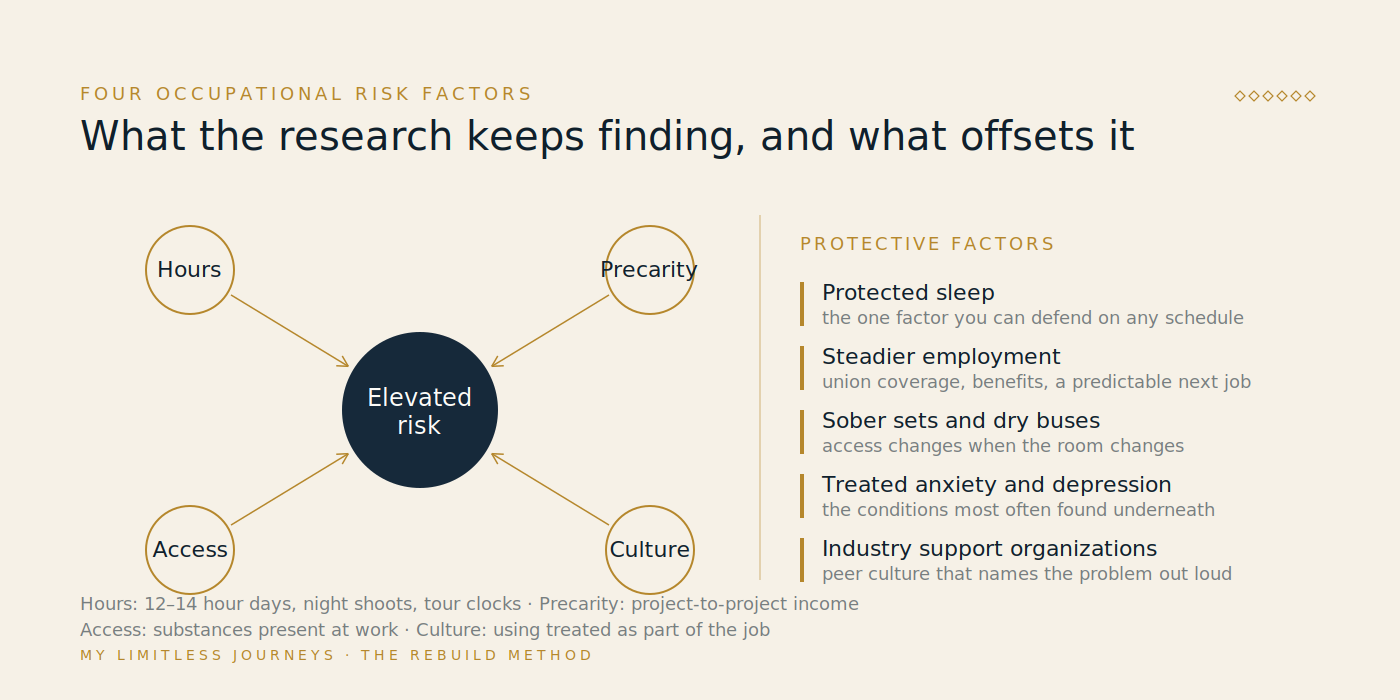
Four occupational risk factors the studies keep finding.
The research on musicians and the smaller literature on screen workers converge on the same handful of mechanisms, and they map cleanly onto how the industry actually works.
Hours. Twelve- to fourteen-hour production days, night shoots, and the "Fraturday" that turns a Friday call into a Saturday wrap are normal in film and television. Touring inverts the day entirely. Chronic sleep restriction on its own increases alcohol and stimulant use as people self-medicate for wakefulness and then for sleep, and it degrades the executive function needed to say no. The 2026 musician review names workplace-specific stressors as a primary driver; the screen-worker surveys described below make long hours a central complaint.
Precarity. Almost everyone in this industry is a freelancer between jobs, even when the job is a hit. The review identifies economic instability as a risk factor for musicians, and it is no less true for a grip, an editor, or a day-player actor. Precarity does two things: it makes people afraid to decline work or take time off, and it removes the ordinary employer structures, such as an HR department or an employee assistance program, that catch problems early elsewhere.
Access. Alcohol is on the rider, at the wrap party, at the premiere, and behind the bar the band is playing in front of. Stimulants circulate wherever people are expected to stay sharp past midnight. Access does not cause addiction, but for someone with the underlying vulnerability it removes every practical barrier.
Culture. The review names industry norms that normalize substance use, and anyone who has worked a set or a tour recognizes them. Using is read as bonding, as authenticity, as part of the craft's mythology. That culture also carries stigma about seeking help, since a reputation for being "a problem" can end a freelance career faster than the substance does. Our page on when your using network is your professional network explores this bind, and our guidance for film and television crews and musicians and touring artists addresses how treatment responds to it.
The mental-health layer underneath.
Substance use in this population rarely travels alone, and the industry surveys are strongest on this point. In the United Kingdom, the Film and TV Charity's 2024 Looking Glass survey of more than 4,300 film, television, and cinema workers found that 35 percent described their mental health as poor or very poor, up from 24 percent in 2022, that 63 percent said their work had a negative effect on their mental health, and that 64 percent had considered leaving the industry in the past year because of it. The charity's summary of the findings is public. It is a British sample, but the working conditions it describes are the same ones a Los Angeles crew would recognize.
For musicians, the University of Westminster's Can Music Make You Sick? research, commissioned by the charity Help Musicians and based on more than 2,000 music makers, found that over 70 percent of respondents reported high rates of anxiety and 68.5 percent reported depression, figures the researchers characterized as roughly three times the general-population rate. The university's summary and the later book of the same name lay out the qualitative side. A separate 2019 survey of independent musicians by a digital distributor reported that 73 percent had experienced symptoms of mental illness; it was an industry survey rather than a peer-reviewed study and should be read as such.
Clinically, this is the most important part of the page. When anxiety, depression, or trauma sit underneath the drinking or the using, treating the substance alone produces a relapse, because the reason for using is still there. This is why co-occurring disorder treatment with board-certified psychiatric oversight is the standard of care for this population rather than an upgrade, and why the first weeks of treatment are as much about accurate diagnosis as about detox.
The industry's own support organizations.
Entertainment has built a support infrastructure that most industries lack, and it is worth knowing before you call anyone else. Union-affiliated foundations, such as the SAG-AFTRA Foundation, offer emergency financial assistance and wellness resources to performers. The Entertainment Community Fund, formerly known as The Actors Fund, serves people across every craft in film, television, theater, and music with counseling, health-insurance navigation, addiction and recovery services, and emergency assistance, and it is one of the few places where a below-the-line worker and a series lead receive the same door. In music, MusiCares provides health, financial, and recovery support to music professionals, including help accessing treatment, and Backline connects music-industry workers and their families with mental-health and wellness resources through case management.
These organizations are navigators, funders, and communities rather than residential treatment providers, and the best outcomes we see involve them and a clinical program working together, each knowing the other exists. If you are already in contact with one, tell our admissions team; if you think you qualify and have not reached out, we will encourage you to. Guild and union health plans vary considerably, so have admissions verify benefits rather than assuming coverage either way.
What treatment designed for this population looks like.
If the risk factors are hours, precarity, access, and culture, treatment has to answer each of them rather than treating the substance in isolation. In the Body domain of the Rebuild Method, that means rebuilding sleep and nervous-system regulation deliberately, because a decade of production hours has usually broken both and a person cannot make good decisions on four hours of sleep, sober or not. In the Mind domain, it means psychiatric evaluation early and trauma-focused therapy where it applies, since the mental-health layer described above is where most relapses originate. In the Life domain, it means return-to-work planning that is specific to a set, a tour, or an edit bay, and relapse prevention rehearsed for the green room rather than the living room. In the Self domain, it means addressing the fear that the creative self and the substance are the same thing.
Structure matters as much as content. A six-bed residence changes the anonymity math for people whose faces or names are known; a private house without a lobby, a shuttle, or a forty-person group is a different experience from a campus. One clinical team across detox, residential care, PHP, IOP, and transitional living means the plan survives the transition back to work, which is where it is tested. And a location 20 to 30 minutes from the Burbank and Universal lots and the Ventura Boulevard post corridor allows step-down care to coexist with a production schedule. The professionals hub explains the reasoning behind each of these choices.
How to read research like this without despair.
A page of percentages can make an industry sound doomed. It is not. The same studies that find elevated risk find that most people in these professions do not develop a substance use disorder, and the conditions the research names, sleep deprivation, isolation, untreated anxiety and depression, are the treatable ones. Understanding the occupational factors is not a way of concluding that the work is the problem; it is a way of no longer concluding that you are. Recognizing that this industry has offered a specific set of chemical solutions to a specific set of pressures for a very long time is the beginning of choosing something different, at any hour, at (866) 209-4246.
- Treatment for professionals. Why a six-bed house in the Valley is built for people whose work cannot be set aside.
- Film and television crews. Below-the-line hours, stimulants and sleep, and treatment around a shooting schedule.
- Musicians and touring artists. Tour cycles, venue culture, and relapse prevention for a job inside bars.
- Timing treatment around a production calendar. How 30, 60, and 90 days map onto hiatus and post.
- Co-occurring disorder treatment. The mental-health layer underneath most substance use.
- High-functioning anxiety and silent alcoholism. The pattern that hides inside a successful career.
This guide is educational and is not a substitute for medical advice. If someone is in immediate danger, call 911.