
Timing treatment around a production calendar: what fits, and what can't be compressed.
Hiatus, the gap between projects, and post are the windows people in film, television, and music actually use to get well. This is a candid planning guide to how 30, 60, and 90 days fit inside them, which parts of treatment do not shrink to fit a schedule, and when the right answer is to go now regardless.
Authored by the MLJ Clinical Team. Reviewed under board-certified psychiatric oversight. Last updated September 2026.
Key Takeaways- A network-series hiatus, the gap between features, and the post-production stretch each offer a realistic window for residential care, but they suit different lengths of stay.
- Detox cannot be rushed, the first two weeks of psychiatric stabilization cannot be skipped, and a step-down plan cannot be improvised on the last day; everything else has some flexibility.
- Thirty days of residential care followed by PHP or IOP is a legitimate plan for many people; for alcohol with a long history, benzodiazepines, or a significant co-occurring diagnosis, it is usually too short.
- Treatment that fits a calendar is planned backward from the return date, with the clinical team and, when you want them included, your representatives.
- Some situations override the calendar entirely: withdrawal risk, an overdose, suicidal thinking, or use that has already reached the set.
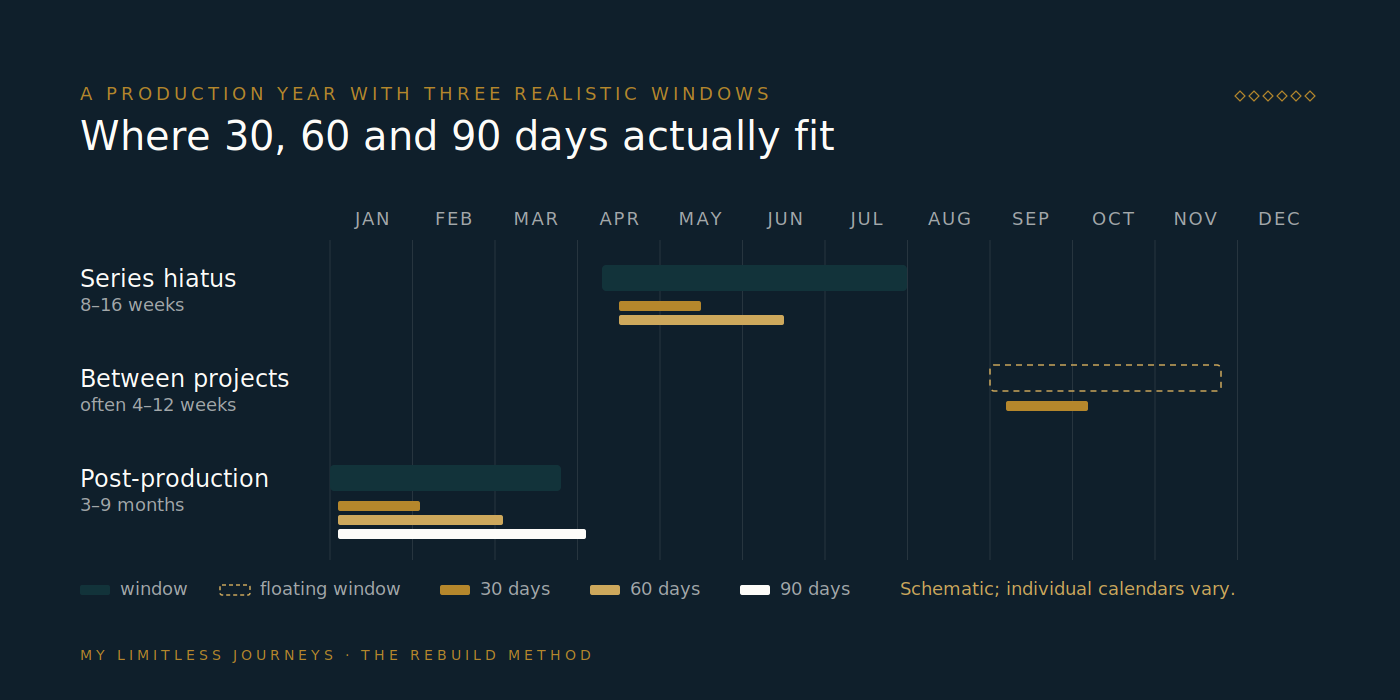
The three windows the industry actually has.
Nobody in production has a free month. What they have are predictable gaps, and the whole question of timing comes down to which gap you are looking at. The first is hiatus. A traditional broadcast season wraps principal photography in spring and resumes in summer, which historically opened a window of two to four months; streaming schedules are less regular, but a series still has a stretch between seasons when the cast and core crew are not on the clock. The second is the space between projects, which for features, commercials, and freelance crew can be weeks or months and is usually the least visible to anyone else, because being "between things" requires no explanation at all. The third is post. Once a picture is locked, an actor, a director of photography, or a line producer is largely done, while the editor, the composer, and the sound team are only beginning; whether post is a window for you depends entirely on which chair you sit in.
Music has its own version: the stretch after a tour ends and before the next record cycle begins, or the writing period before a studio is booked. Our page for musicians and touring artists covers the specifics. The principle is the same across every craft. You are not looking for time that is empty. You are looking for time that is already unaccounted for, so that a thirty- to ninety-day absence reads as ordinary.
Mapping 30, 60, and 90 days onto each window.
Here is how we think about the fit, with the caveat that length of stay is a clinical recommendation that emerges from assessment, never a package you buy. Our guide to 30, 60, and 90-day programs explains what each length is for; this section is about where each one fits in a working year.
| Window | Typical length | What fits realistically | Where it strains |
|---|---|---|---|
| Series hiatus | 8–16 weeks | Detox plus 30–60 days residential, then PHP or IOP through the rest of the break | Press, table reads, and prep often eat the last weeks |
| Between projects | Unknown; often 4–12 weeks | 30 days residential with a committed step-down; longer if the next start is genuinely open | An offer arrives mid-stay and pressure to leave early spikes |
| Post-production | 3–9 months for many on-set roles | Full 60–90 days residential, transitional living, and IOP | Reshoots, ADR, and looping can pull you back with little notice |
| Post-tour / pre-record | 6–20 weeks | 30–60 days residential, then IOP while writing resumes | One-off festival dates and promo tempt an early return |
Notice what the table does not say. It does not say thirty days is enough because that is what your hiatus allows. It says that for a given window, a particular combination of residential care and step-down is realistic. Whether that combination is clinically sufficient depends on what you are detoxing from, how long you have been using, and what else is going on psychiatrically. When the two do not line up, we tell you, and we help you decide whether to move the calendar or accept a plan with more outpatient structure than you might prefer.
What cannot be compressed.
Detox runs on physiology, not scheduling. Acute alcohol withdrawal typically peaks in the first seventy-two hours and needs medical monitoring during that time because of seizure and delirium risk; the National Institute on Alcohol Abuse and Alcoholism describes the scale of alcohol's effects in its public materials, and our own alcohol withdrawal timeline explains the days in detail. Benzodiazepines are the hard case: a safe taper is measured in weeks and sometimes months, and pushing it faster to hit a call date is dangerous. Opioids and fentanyl have their own arc, with acute withdrawal lasting roughly a week and a longer tail of sleep and mood disturbance. If your substance is any of these, the first phase has a floor that no calendar changes.
The second floor is psychiatric. When someone arrives with untreated depression, anxiety, bipolar disorder, or trauma alongside the substance use, the first two weeks are mostly about stabilization and accurate diagnosis; you cannot see what is underneath until the substance clears. Our psychiatrist needs that time, and the medication decisions that follow need a few weeks more to be evaluated. Levels of care for co-occurring disorders explains why psychiatric contact frequency drives these decisions.
The third is the step-down plan itself. Discharge into a fourteen-hour shooting day with no outpatient structure is how relapses happen in week two back. What can flex is where that structure lives. Our IOP runs in the evenings and is 20 to 30 minutes from the Burbank and Universal lots, so it is compatible with most shooting schedules, and our alumni program stays with you on location.
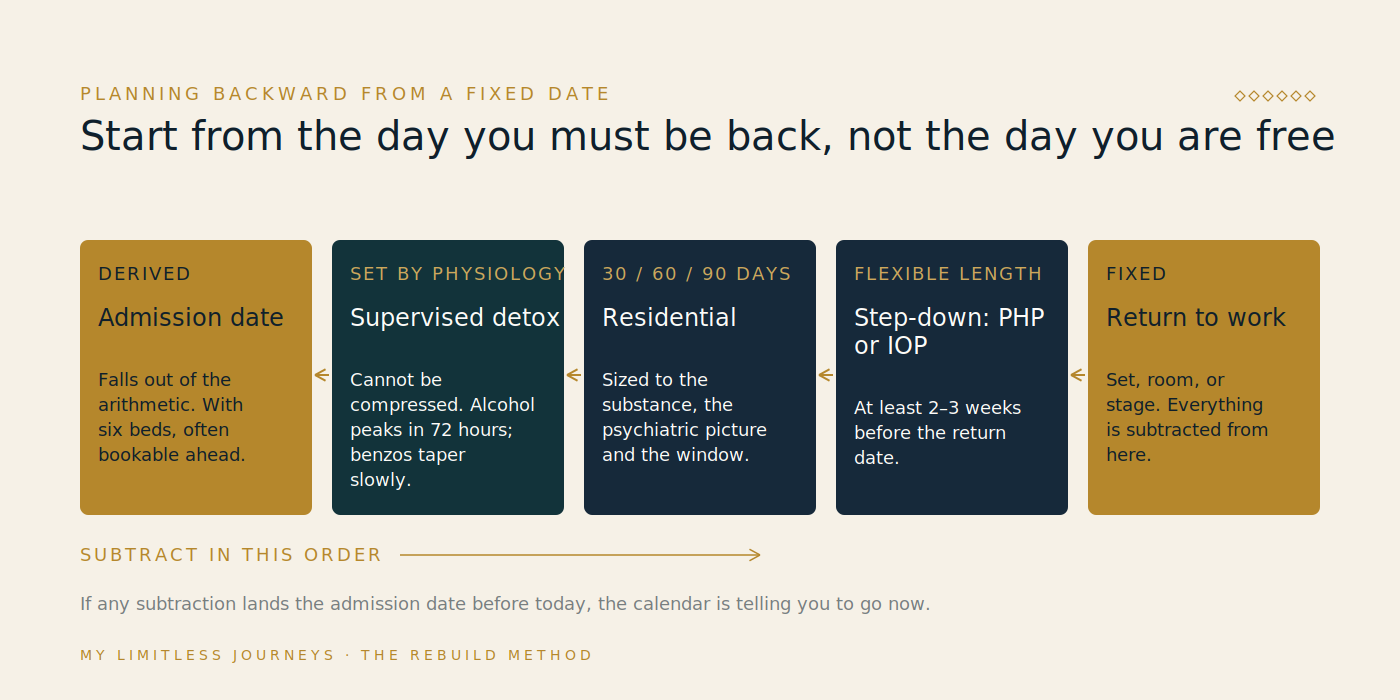
Planning backward from a return date.
The people who make treatment fit a working life plan it the way a producer builds a schedule: from the immovable date backward. Start with the day you must be on set, in the room, or on stage. Subtract the step-down phase you will need before that day, which for most people means at least two to three weeks of PHP or IOP while living either at home or in transitional living. Subtract the residential phase your assessment calls for. Subtract detox. What remains is your admission date, and it is often earlier than the day the hiatus officially begins.
That last point is where planning conversations get honest. Many professionals can leave a few days before the wrap party, skip the press junket, or hand off the final week of post to someone they trust. Those choices are uncomfortable and they are also how you buy the time the clinical plan needs. Our admissions team will build the backward schedule with you on the first call, and, if you want them involved, with your agent, manager, or attorney; our guide on what to tell your team has language for those conversations. Nothing about your professional identity is shared with anyone who is not on a release you sign.
When to go now, regardless of the calendar.
Planning is a privilege of stability, and some situations remove it. If you are drinking or using benzodiazepines heavily enough that stopping produces shaking, sweating, or confusion, you need medical detox now, not in six weeks, because unsupervised withdrawal from those substances can be fatal. If you have overdosed, or are using fentanyl or anything that could contain it, the next use is a coin flip you should not schedule around a production. If you are having thoughts of ending your life, treatment is today's problem and the show is not. If a set medic, a first AD, or a bandmate has already noticed, the disclosure you were trying to time has already happened, and staying to protect the secret protects nothing.
In these cases the calendar becomes the clinical team's problem to solve alongside you, and it usually can be solved. Productions replace people mid-shoot far more often than the public knows, insurers and completion bond companies have procedures for medical absences, and a manager who has been dreading this call often feels relief that it is finally being made. Our medical detox versus quitting at home guide explains what makes withdrawal a medical event, and (866) 209-4246 is staffed around the clock for the night you decide the schedule can wait.
After the window closes: staying well on a working schedule.
The window gets you through the intensive phase. The rest is designed for a life with 5 a.m. calls and night shoots. Because one clinical team carries you through the entire continuum, the therapist who knows your history does not hand you off when you return to work; your relapse-prevention plan is written for your actual schedule, including what happens on location and during the weeks a series is in production and you cannot make an evening group. Our page on the first ninety days back at work describes the arc most people follow, and our post on when your using network is your professional network speaks to the hardest part of returning to a set where everyone knew you a different way.
- Treatment for professionals. The hub for people whose work, reputation, and privacy cannot be set aside.
- Film and television crews. Hiatus and strike calendars as windows, and PHP/IOP around a shooting schedule.
- Actors and on-camera talent. A thirty-day stay in a hiatus, and what happens if a set needs you sooner.
- 30, 60, and 90-day programs. What each length of stay is actually for.
- Partial hospitalization program. The middle step between residential and IOP.
- Why January admissions spike. The calendar logic seen from the other side.
This guide is educational and is not a substitute for medical advice. If someone is in immediate danger, call 911.