
Published by the Clinical Team at My Limitless Journeys. Reviewed under board-certified psychiatric oversight.
The four o’clock shift
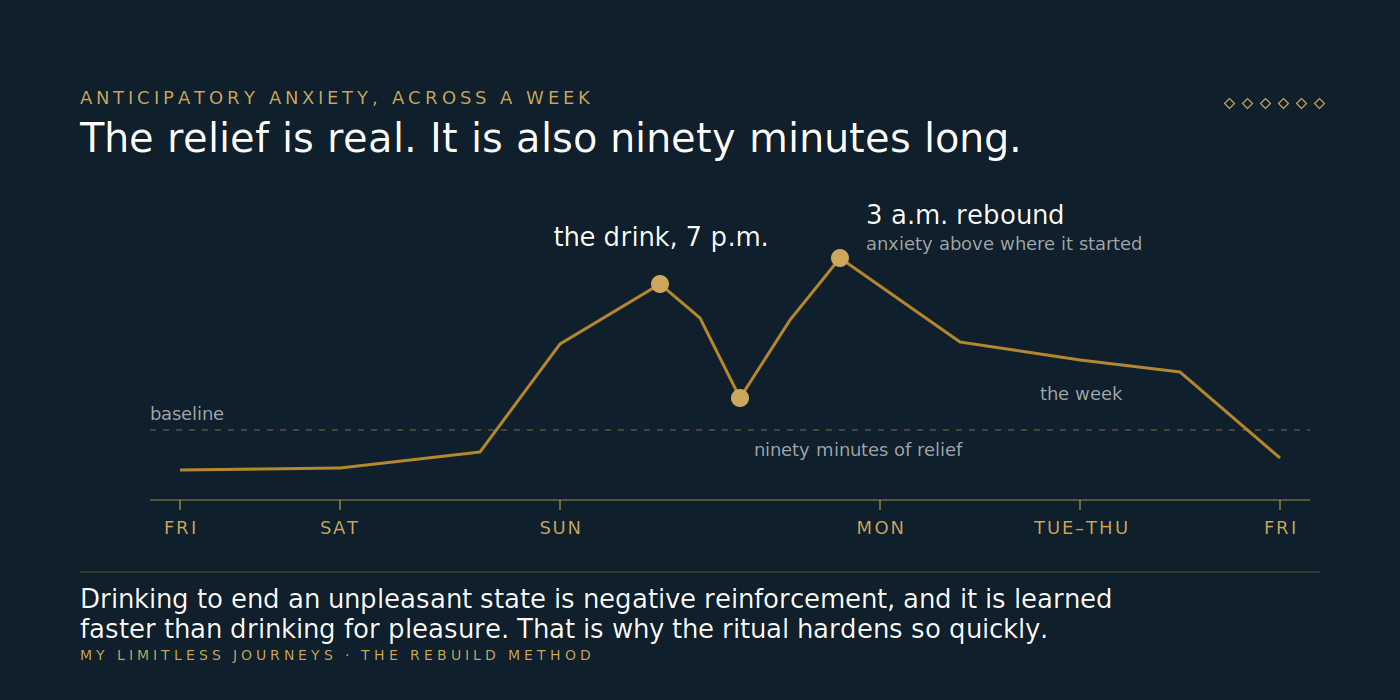
The people we see describe it with unnerving precision. The weekend is fine until a particular hour, usually mid-afternoon on Sunday, when the light changes and the week arrives. The inbox is not open yet, but you can feel it. There is a call on Monday, or a conversation you have been avoiding, or nothing in particular and the same feeling anyway. By six you are irritable with people you love. By seven there is a drink, and the drink works.
Every part of that sequence is ordinary, which is exactly why it is worth looking at closely. Nothing here involves waking up in a strange place. It involves a competent adult, in their own kitchen, solving a real feeling with a tool that is effective, legal and in the cupboard.
Anticipation is a physiological event, not a mood
The body prepares for demand before demand arrives. One useful line of evidence comes from research on the cortisol awakening response, the rise in cortisol during the first half hour after waking. Studies comparing work days with weekends have found the response differs between them, and work by Schlotz and colleagues reported that perceived work overload and chronic worrying predicted the size of that weekend-to-weekday difference. In plain terms: the people who worry most about work show the biggest physiological gap between a Sunday and a Monday, and their bodies begin the shift before their alarms go off.
Anticipatory anxiety is that machinery running ahead of schedule. You are not reacting to Monday. You are rehearsing it, repeatedly, with the full autonomic accompaniment: a faster heart, a tight chest, a mind that keeps opening the same three files. Sunday evening is unstructured enough to leave room for the rehearsal, and just close enough to the deadline to make it feel urgent.
Why alcohol fits the problem so exactly
Alcohol enhances inhibitory signaling in the brain and dampens the arousal system. Functionally, it is a short-acting anxiolytic that begins working within fifteen minutes and requires no appointment. If you had designed a molecule to interrupt anticipatory anxiety on a Sunday evening, you would have designed roughly this one.
The problem is what follows. As blood alcohol falls, the same systems overshoot in the opposite direction, and anxiety returns above where it started. That is why the second glass feels necessary rather than optional, and why three in the morning is the hour so many people describe: awake, heart going, dread now attached to something specific and unhelpfully vivid. The NIAAA journal Alcohol Research: Current Reviews devotes a full review to this territory, bridging the psychiatric, psychological and neurobiological accounts of co-occurring alcohol use disorder and anxiety, and one of its central observations is that the relationship runs in both directions. Anxiety promotes drinking; drinking promotes anxiety.
There is a second mechanism worth naming. Drinking for pleasure is positive reinforcement. Drinking to end an unpleasant state is negative reinforcement, and negative reinforcement produces more durable, more automatic habits, because escape from discomfort is learned faster than pursuit of reward. This is why the Sunday drink becomes non-negotiable long before the quantity becomes alarming. You are not choosing it any more. You are answering a cue.
What it costs the night, and therefore the week
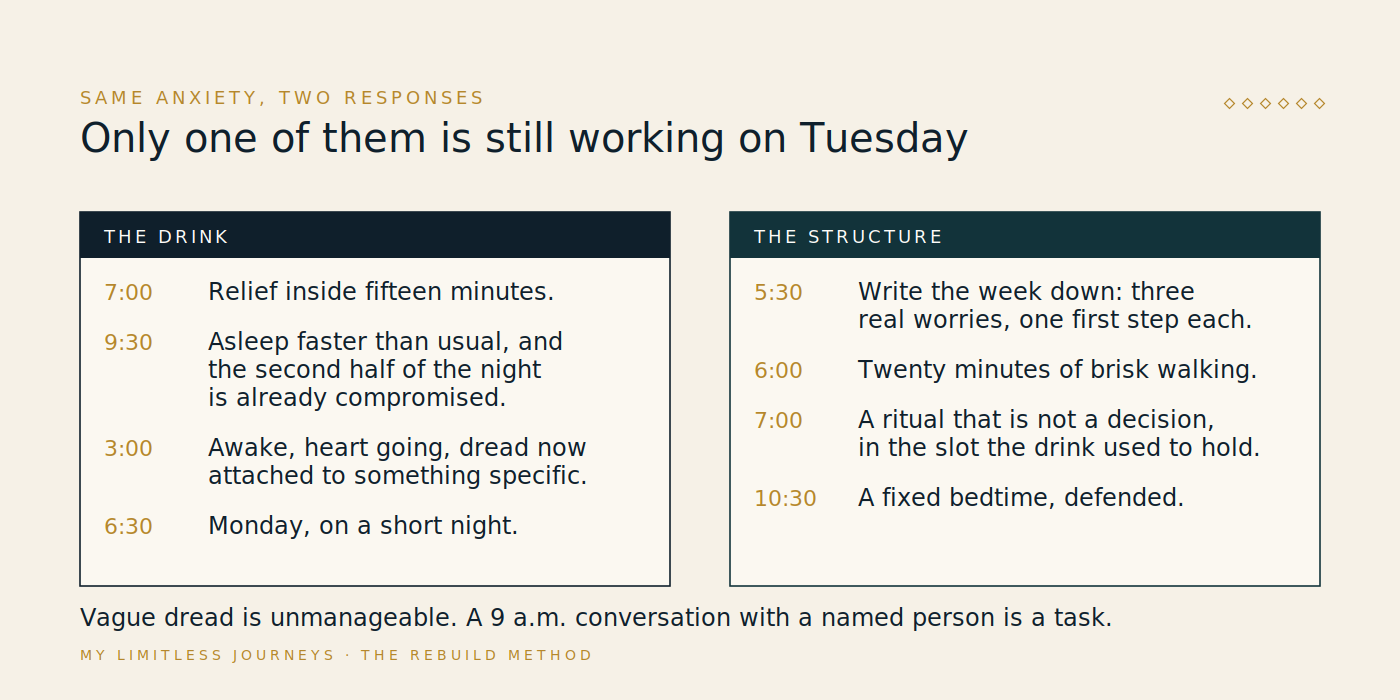
Alcohol shortens the time it takes to fall asleep and degrades the second half of the night, suppressing REM early and fragmenting sleep as it is metabolised. A person who drinks on Sunday evening to sleep better before a hard Monday reliably gets the opposite: faster sleep onset, then a 3 a.m. wake with a raised heart rate and an anxious mind, then a Monday running on a short and disorganised night. Our page on sleep in early recovery covers what happens to sleep architecture when the drinking stops, which is its own difficult arc.
Monday then costs more than it should, which makes Sunday feel more threatening the following week, which strengthens the ritual. The loop is self-reinforcing and does not require escalation to do damage.
Why this pattern goes unnoticed for years
It is small. It is private. It is scheduled, which makes it look like control rather than compulsion. It never touches Monday’s performance, because people in this pattern are usually extremely good at their jobs and have organised their whole lives around never being caught short. And it is socially invisible: nobody sees a person drink alone in their own kitchen at seven on a Sunday.
This is the profile we describe at length in high-functioning anxiety and the silent alcoholism of modern professionals, and it is why the usual diagnostic shorthand fails. There is no rock bottom in this story. There is a person who has been managing an anxiety disorder with a depressant for eleven years and calling it unwinding. If you want a blunter checklist, the signs of a high-functioning alcoholic is the place to look.
Two questions that are more useful than counting
Ask what happens to Sunday evening if you do not drink. Not whether you could, in principle, on a given week. What actually happens: does the evening remain tolerable, or does it become the thing you spend the evening managing? A person who can sit in an unmedicated Sunday and be merely uncomfortable has a habit. A person for whom the absence of the drink becomes the main event of the night has something else.
Then ask whether the drinking has begun migrating. Sunday to Sunday and Thursday. Seven o’clock to five. One large glass to one large glass plus what you had while cooking. Migration is the reliable early signal, and it usually shows up a long time before quantity does. For the numbers themselves, the NIAAA thresholds for heavy drinking are five or more drinks on any day or fifteen a week for men, four or more on any day or eight a week for women, and the U.S. Preventive Services Task Force recommends that every adult be screened for unhealthy alcohol use in primary care.
What actually helps on a Sunday
Give the anxiety its object. Vague dread is worse than a specific problem, so write the week down before six: the three things that are actually worrying you, and the first small action for each. Anxiety about an unspecified Monday is unmanageable. Anxiety about a 9 a.m. conversation with a named person is a task.
Move the body, because twenty minutes of brisk walking changes autonomic arousal in a way that talking yourself out of it does not. Put something in the seven o’clock slot that is not a decision, because a ritual is best replaced rather than resisted. Protect the sleep, since the drink’s real cost is extracted at three in the morning. And treat the anxiety as a condition in its own right rather than a personality trait: the evidence base for cognitive behavioural therapy in anxiety is substantial, and we use CBT and acceptance and commitment therapy for exactly this pairing. Where both conditions are present, treating them together is the standard of care, which is the subject of anxiety and addiction as co-occurring disorders.
When it is bigger than Sunday
Some signs mean this is no longer a scheduling problem. Drinking on weekday evenings to manage the next day. Morning anxiety that lifts with a drink, which is withdrawal rather than stress. Needing more for the same effect. Real consequences arriving quietly: a missed morning, a conversation you cannot remember, a physician’s comment about liver enzymes. And the particular loneliness of holding all of this without telling anyone.
None of that requires a residential admission by itself. It requires an honest assessment by someone who will not flinch. For people whose work and reputation make that conversation feel impossible, our work with professionals exists precisely because the fear of being seen is often the last thing keeping a treatable problem in place.
Frequently asked questions
Is one or two drinks on a Sunday actually a problem?
Not necessarily, and quantity is the wrong lens. What matters is function. If the drink is one of several ways you might spend the evening, it is a drink. If it is the mechanism by which the evening becomes survivable, then the amount is beside the point and the dependence is psychological before it is physical.
If I treat the anxiety, will the drinking take care of itself?
Sometimes, early on. More often the two have become independent, and treating only one leaves the other to reinstate it. Concurrent treatment is the standard, which is why psychiatric care and substance use care sit under one team here rather than in two buildings.
I only drink on Sundays. Do I need residential treatment?
Probably not. Most people in this pattern are better served by outpatient psychiatric care and therapy. Level of care is a clinical judgment about risk, structure and severity, and our page on whether you need residential treatment lays out how that decision gets made.
My partner has this pattern. How do I raise it?
Not on a Sunday evening. Pick a neutral morning, describe what you have observed rather than what you conclude, and lead with the anxiety rather than the alcohol, because that is usually the part they already know is true.
If the honest answer to “what happens if I do not drink tonight” made you uncomfortable, that is worth a conversation. It is confidential, it is not a commitment, and it can happen on a Sunday.
Keep reading: High-functioning anxiety and silent alcoholism · Signs of a high-functioning alcoholic · Anxiety and addiction · Sleep in early recovery · Treatment for professionals