
Sleep in early recovery: why it breaks, what returns when, and why we treat it as medicine.
Almost everyone sleeps badly in the first weeks off alcohol, opioids, sedatives, or stimulants. It is one of the most reliable predictors of relapse, and one of the most treatable. Here is what is happening, how long it lasts, and what we do about it without simply handing you another pill.
Authored by the MLJ Clinical Team. Reviewed under board-certified psychiatric oversight. Last updated September 2026.
Key Takeaways- Every major substance disrupts sleep architecture, and stopping it does not restore sleep overnight; the brain has to relearn how to fall asleep and stay asleep on its own.
- Sleep onset usually improves first, within one to three weeks. Deep sleep, dream regulation, and waking refreshed take longer, often two to three months, and sometimes more after long alcohol or benzodiazepine use.
- Persistent insomnia in early recovery is one of the strongest predictors of return to use, which is why sleep is a clinical target in the Rebuild Method's Body domain, not a comfort item.
- The most effective long-term treatment for insomnia is behavioral, and it begins in the first week. Medication has a narrow, deliberate role; some common sleep aids are avoided entirely.
- Sleep that does not improve on schedule is a signal. It may point to untreated depression, trauma-related nightmares, or sleep apnea, each of which we assess for.
- Why sleep breaks, substance by substance
- What returns when: a rough arc
- Sleep as clinical work, not a comfort item
- The behavioral protocol, and why it starts on day one
- Medications we use, and medications we avoid
- When insomnia is a sign of something else
- How sleep is handled across the MLJ continuum
Why sleep breaks, substance by substance.
Sleep is not one thing. It is a nightly sequence of light sleep, deep slow-wave sleep, and REM, cycled several times, governed by a body clock and a chemical pressure to sleep that builds through the day. Substances interfere with different parts of that machinery, and the pattern of insomnia you get in recovery depends on which part was disrupted.
Alcohol is the great impostor. It shortens the time to fall asleep, which is why so many people use it for that purpose, and then fragments the second half of the night, suppresses REM early and causes REM rebound later, and blunts deep sleep. Over years, the brain adapts to sleeping with alcohol on board; remove it and sleep onset lengthens dramatically, the night fragments, and vivid, often disturbing dreams arrive as suppressed REM comes flooding back. Research summarized in NIAAA's journal Alcohol Research & Health has documented that sleep abnormalities in people recovering from alcohol dependence can persist for months, and that those with the most persistent insomnia are the most likely to relapse.
Benzodiazepines and other sedatives act on the same braking system as alcohol and produce a similar picture, often more prolonged, because these medications were frequently prescribed for sleep in the first place. The insomnia that emerges during a taper is partly withdrawal and partly the original problem returning. Opioids suppress deep sleep and disrupt breathing during sleep; in withdrawal, the body's overdrive state makes falling asleep nearly impossible for several nights, and restless legs and sweating fragment what sleep there is. Stimulants invert the pattern: days of no sleep, then a crash of twelve to eighteen hours, then weeks in which the body clock is scrambled and sleep is long but shallow and unrefreshing. And cannabis, which many people also use for sleep, suppresses REM in a way that produces striking dream rebound and a few weeks of poor sleep when stopped.
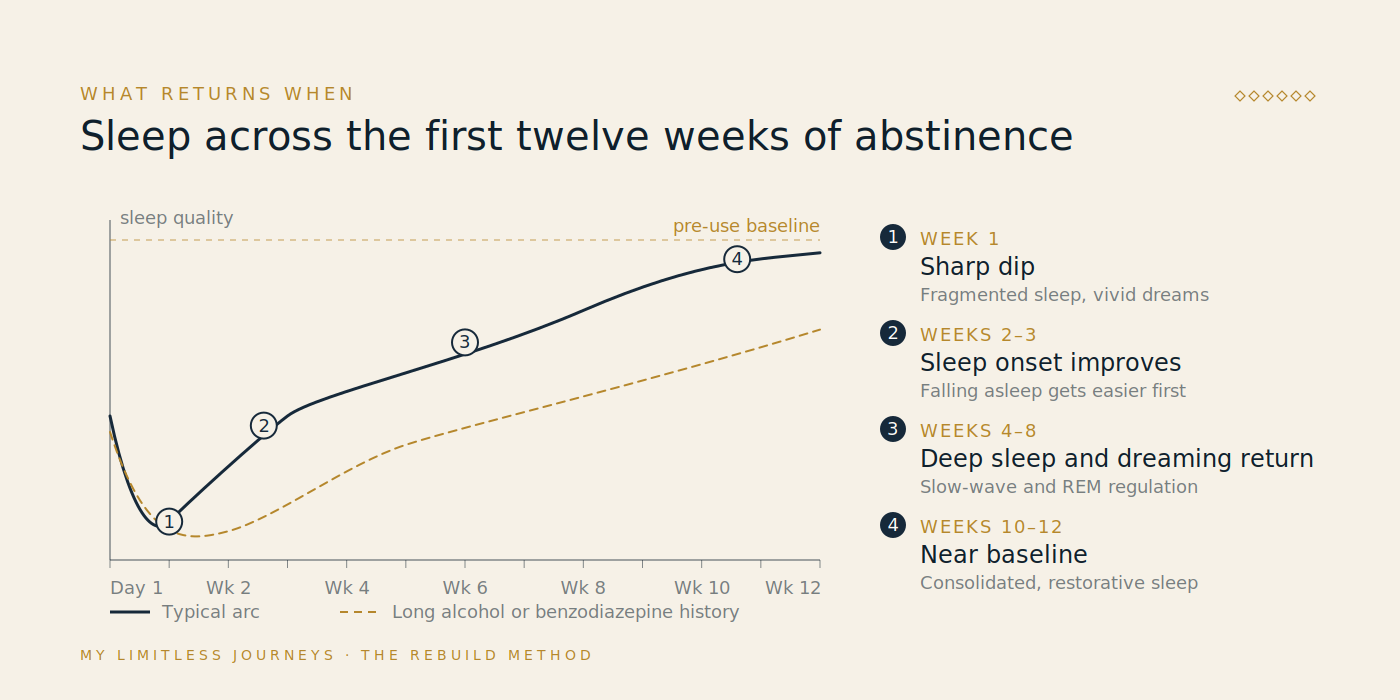
What returns when: a rough arc.
People ask, reasonably, how long this lasts. The honest answer is that different parts of sleep return on different schedules, and that the schedule stretches with the length and heaviness of use. What follows is a generalization drawn from the research on alcohol and sedative recovery, which is the best studied; it is not a promise about your own course.
| Period | What sleep typically looks like | What we do |
|---|---|---|
| Week 1 | Worst of the arc. Long time to fall asleep, frequent waking, night sweats, vivid dreams; after stimulants, the reverse, with very long crash sleep | Protect safety and medical stability; accept broken sleep; begin fixed wake time and morning light as soon as withdrawal permits |
| Weeks 2–3 | Sleep onset begins to shorten; nights still fragmented; dreams intense; daytime fatigue heavy | Full behavioral protocol: sleep window, no daytime napping past early afternoon, movement, caffeine cutoff; begin sleep log |
| Weeks 4–8 | Deep sleep begins to return; fewer awakenings; dreams settle; some nights genuinely restorative | Consolidate the schedule; address anxiety about sleep itself; reassess if no improvement |
| Weeks 9–12+ | Approaching a new baseline for most; residual light or short sleep can persist for months after long alcohol or sedative use | Maintain habits into transitional living and IOP; treat persistent insomnia as its own condition |
Two patterns deserve mention. The first is the "week three wall": people who have started to sleep a little better around day ten sometimes hit a stretch of terrible nights in the third week, often alongside the flat mood described on our anhedonia in week three post. It is expected and it passes. The second is that the subjective sense of having slept well lags behind the objective improvement; sleep studies in early recovery often show more deep sleep than the person believes they got. Feeling unrefreshed for a while after the numbers improve is normal.
Sleep as clinical work, not a comfort item.
Most treatment programs treat sleep as a background condition: lights out at eleven, breakfast at seven, and if you cannot sleep there is a nurse with something in a cup. We treat it as a target. In the Rebuild Method, sleep sits inside the Body domain alongside detox, fitness, nutrition, and medication management, which means it has a baseline, a plan, a clinician responsible for it, and a place in your treatment review. That is not a stylistic choice. Sleep is one of the few variables in early recovery that both predicts relapse and responds to treatment, so ignoring it leaves the easiest lever unpulled.
The reasoning runs in both directions. Poor sleep worsens everything else we are treating: it amplifies anxiety, flattens mood, erodes the impulse control that craving management depends on, and makes trauma work harder to tolerate. And the things we are treating worsen sleep: a client in the middle of processing a traumatic memory in individual therapy may have a rough week of nights, and that is information, not failure. When sleep, mood, and therapy are managed by one team in one house, those loops are visible. When they are split across a night nurse, a day therapist, and a psychiatrist who visits on Thursdays, they are not.
The behavioral protocol, and why it starts on day one.
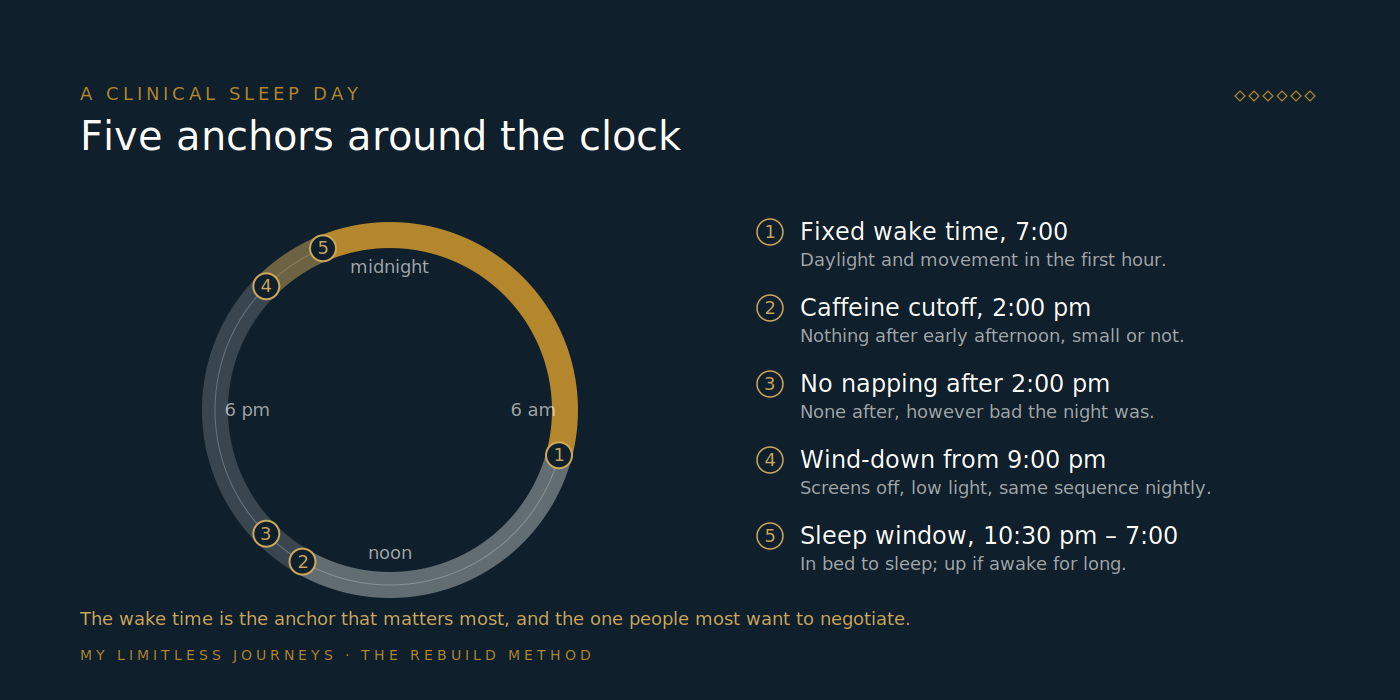
The best-evidenced treatment for persistent insomnia is not a medication. It is a structured behavioral approach, cognitive behavioral therapy for insomnia, which the American Academy of Sleep Medicine recommends as first-line care in its clinical practice guidance, with medication reserved for a supporting role. The principles are simple and the discipline is not, which is exactly why they belong inside a residential structure where someone is holding the line with you.
The anchor is a fixed wake time, seven days a week, regardless of how the night went. It is the single most powerful lever on the body clock and the one clients most want to negotiate after a bad night. We hold it, gently. Morning daylight within the first hour of waking, ideally combined with a walk on the hillside, sets the clock and builds the sleep pressure that will be needed fourteen hours later. Caffeine stops by early afternoon. Naps, tempting in the exhausted second week, are limited to short and early, because a long afternoon sleep spends the pressure the night needs. Movement happens daily, but not late. In the evening, screens go off, the room cools, and a wind-down routine that has nothing to do with productivity or the news begins.
The harder components come in weeks two and three. The bed is for sleep, not for lying awake, so a client who has been awake for a long stretch gets up, sits somewhere dim and quiet, and returns when sleepy, which feels counterintuitive and works. The sleep window may be deliberately compressed for a period to consolidate fragmented sleep, then widened as it holds. And the anxiety about sleep itself, the two a.m. arithmetic about how ruined tomorrow will be, is treated as a cognitive problem with CBT tools, because catastrophizing about sleep is one of the most reliable ways to prevent it. None of this is exotic. All of it is work, and starting it in the first week rather than after discharge is one of the quiet advantages of a residential stay.
Medications we use, and medications we avoid.
Medication has a role in early-recovery sleep, and it is narrower than most people expect. The first principle is that sleep aids with their own dependence potential are avoided in people being treated for a substance use disorder. That rules out benzodiazepines as a sleep treatment, except in the specific case where one is already being used to manage alcohol or sedative withdrawal and happens to help sleep while it is on board. It also rules out the "Z-drug" hypnotics, which act on the same receptor system and carry similar risks, and it makes us cautious with anything that produces a noticeable buzz, because the brain in early recovery is very good at learning that a pill makes the night better.
What is used, when something is needed, tends to come from three groups. Sedating antihistamines such as hydroxyzine take the edge off without dependence risk, at the cost of some morning grogginess. Certain antidepressants with sedating properties, used at low doses, can support sleep and are especially reasonable when depression or anxiety is part of the picture. And gabapentin, described on our detox medications page, has evidence for improving sleep during and after alcohol withdrawal specifically. Melatonin has a modest role in resetting a scrambled body clock after stimulant use. Each is chosen by our psychiatrist for a reason, reviewed regularly, and stopped when the behavioral work has taken over, which for most people it does.
What we will not do is treat a request for sleep medication as a problem to be managed. Sleeplessness in early recovery is miserable, and a client who asks for help at two in the morning is telling us something real. The response is a conversation, a plan, and where appropriate a medication with a clear rationale, not a reflexive no and not a reflexive pill.
When insomnia is a sign of something else.
Sleep that does not improve on roughly the schedule above is not a reason to push harder on the same plan. It is a reason to look for a different cause. Three are common enough that we assess for them in everyone.
The first is a mood or anxiety disorder that the substance was covering. Early-morning waking with a heavy mood, or a mind that will not stop at bedtime, may be withdrawal in week one and depression or an anxiety disorder in week five. The second is trauma. Nightmares that are vivid, repetitive, and tied to real events are a hallmark of post-traumatic stress, and people with PTSD very often used alcohol or sedatives precisely to suppress them. Their return in recovery is expected and treatable, and specific medications and therapies exist for trauma-related nightmares that are quite different from ordinary insomnia treatment. The third is obstructive sleep apnea, which is common, frequently undiagnosed, worsened by alcohol and opioids, and produces exactly the unrefreshing, fragmented sleep that gets blamed on recovery. Loud snoring, witnessed pauses in breathing, and morning headaches prompt a referral for a sleep study.
This is the practical argument for board-certified psychiatric oversight in a detox and residential setting. Distinguishing withdrawal insomnia from a depressive episode, a trauma syndrome, or a breathing disorder is a diagnostic act, and the right treatment differs for each.
How sleep is handled across the MLJ continuum.
In detox, the priority is safety and medical stability, and we accept that sleep will be poor. Your bedroom is a real bedroom in a private home, dark and quiet, with a nurse awake nearby through the night. In residential, the behavioral protocol is fully in place and reviewed weekly, your sleep is logged, and the psychiatrist who manages your medications is the same one hearing about your nights. Yoga and daily movement, part of the clinical program rather than an extracurricular, are scheduled with sleep in mind.
The transition home is where sleep habits most often collapse, so in transitional living and IOP we keep the wake time, the log, and the review, and we plan for the specific threats of a return to work: late emails, early calls, travel across time zones, the temptation to "catch up" on weekends. For professionals, this is often the piece of recovery that most directly determines whether the first months back at work are sustainable, and we treat it that way. Sleep is not the reward for recovery. For most people, it is one of the things recovery is made of.
- Medical detox at MLJ. The hub for the first week and who needs supervised care.
- Stimulant withdrawal. The crash, the hypersomnia, and the flat weeks after.
- Alcohol withdrawal timeline. Where insomnia and night sweats sit in the hour-by-hour picture.
- Residential treatment. Where the behavioral sleep protocol is built and held.
- PTSD treatment. When nightmares are trauma, not withdrawal.
- Exercise as pharmacology in detox. The movement side of the Body domain.
This guide is educational and is not a substitute for medical advice. If someone is in immediate danger, call 911.