
Published by the Clinical Team at My Limitless Journeys. Reviewed under board-certified psychiatric oversight.
What the pattern actually looks like
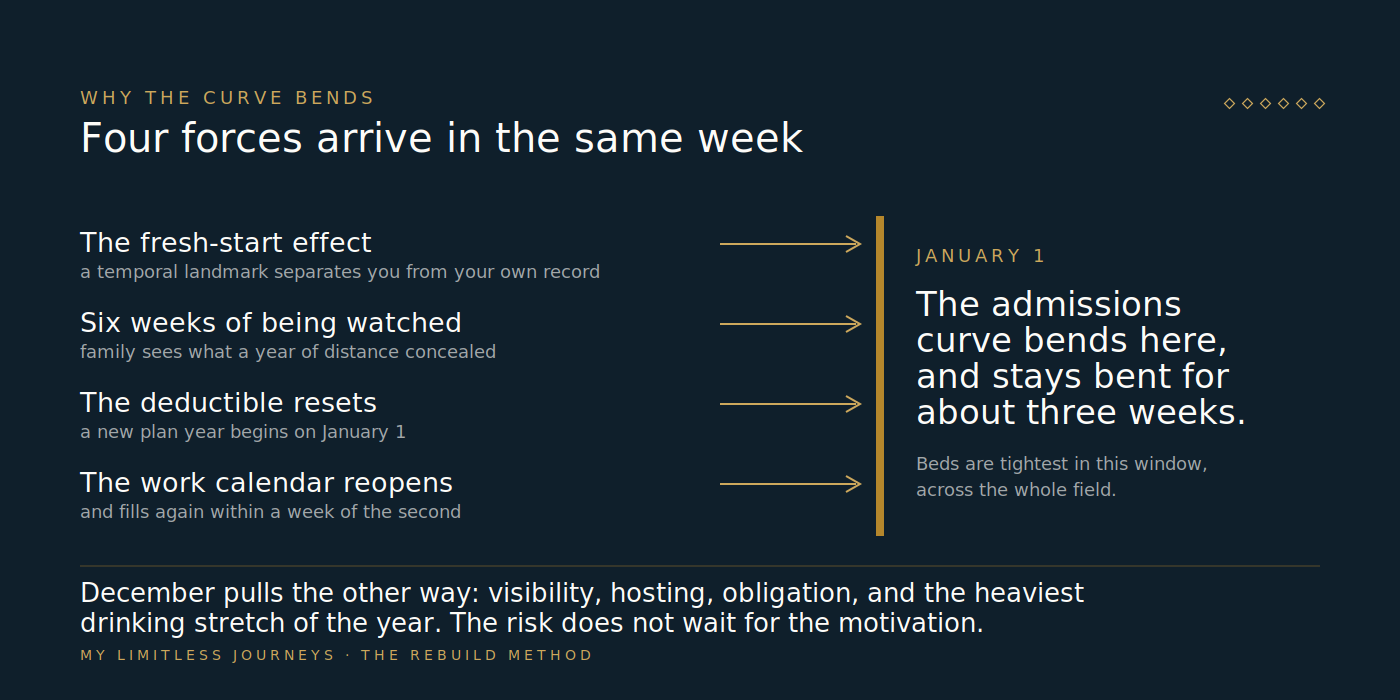
Admissions lines go quiet around December 20 and stay quiet until the second. Then the phone starts and does not stop for about three weeks. Callers in that window sound different from callers in October. They are more decisive, they have already told someone, and a striking number of them are calling with a family member in the room. Programs across the country describe the same curve, and the federal Treatment Episode Data Set collects the annual admissions totals behind it.
This is worth understanding for two opposite reasons. If you are the person considering treatment, knowing why January feels different helps you tell a real decision from a seasonal one. If you are the family member, knowing that January is the busiest month for beds is a practical fact about availability that changes when you should call.
Force one: the calendar itself does something to motivation
The behavioral science here is well established. In work published in Management Science, Dai, Milkman and Riis described what they called the fresh start effect: aspirational behavior such as gym attendance and goal setting rises after temporal landmarks including the start of a new year, month, week, semester, and even a birthday. Their explanation is that a landmark creates a psychological break with an imperfect past self, which makes the person feel less bound by their own track record.
This is genuinely useful. Someone who has failed to cut back four times can find, on January 1, that the four failures belong to a person who no longer exists. That reframing gets people through an admissions call they could not make in November. It is also, by its nature, temporary. The landmark supplies motivation, not structure, and motivation without structure decays on a predictable schedule.
The abstinence-challenge literature illustrates the limit. One study of participants in a Dry January campaign found reduced drinking six months later among those who took part, but a later prospective cohort study of general-population drinkers did not find those benefits outside the campaign group. A month off is a good experiment and a poor treatment. If you can complete a dry January easily, that is useful information. If you cannot, that is more useful information still.
Force two: six weeks of being watched
For most of the year, a functioning person with a serious drinking or drug problem is alone with it. They live alone, or their partner leaves at seven, or the work travel does the concealing for them. Then comes a stretch in which they are in the same house as their parents, siblings, adult children and spouse for days at a time, without the ordinary architecture of privacy.
Families see the tremor at breakfast. They see the wine at eleven, the bottle count in the recycling, the second phone, the pharmacy runs, the twenty-minute absences. In the first week of January our admissions team hears from a great many sons and daughters who spent Christmas quietly counting. That is not surveillance. It is the first accurate information anyone has had in a year, and it is often the thing that finally makes a family act. If that describes your household, the piece on how to talk to a loved one about getting help is the next thing to read.
Force three: the money resets
Most employer plans run on the calendar year, which means that on January 1 the deductible resets to zero and so does progress toward the out-of-pocket maximum. That cuts both ways, and it is the single most misunderstood factor in treatment timing. A January admission starts a fresh deductible from zero. A December admission may be running against a deductible you have already met, which for someone who has had a medical year can make December dramatically less expensive than January.
This deserves its own analysis rather than a paragraph, and we have written one: how deductible resets shape treatment timing walks through both scenarios with the current federal limits. The short version is that the answer depends on what you have already spent this year, and nobody should guess. You can start a confidential benefits verification at any point, including before you have decided anything.
Force four: the work calendar reopens, and closes again
People assume January is the easiest month to disappear because the year is starting fresh. In our experience the opposite is closer to true for professionals. December has hiatus weeks, dark production days, closed courts, quiet deal flow and an office where half the floor is out. January has budget cycles, new fiscal quarters, staffing-up, and a calendar that fills within a week of the second. For people in the entertainment industry, the December-to-January hiatus is often the single cleanest thirty-day window in the year, which we cover in timing treatment around a production calendar.
The problem: risk does not wait for motivation
All four forces point at January. The danger points at December. The National Highway Traffic Safety Administration recorded 1,038 drunk-driving deaths in December 2023, and more than 4,931 across the Decembers of 2019 through 2023. The NIAAA attributes roughly 178,000 deaths a year to excessive alcohol use and counted more than four million alcohol-involved emergency department visits in 2022. Those are annual figures, but they are not evenly distributed across a year in which about a quarter of distilled spirits sales fall between Thanksgiving and New Year’s Day.
There is a second, quieter risk in the decision to wait. Someone who has decided to enter treatment on January 5 often drinks or uses harder in the interval, on the logic that this is the last of it. That is the most dangerous six weeks of a bad year, undertaken deliberately, by a person who has already concluded they need help. We wrote about the seasonal version of this in holiday drinking when you have been cutting back.
When waiting is reasonable, and when it is not
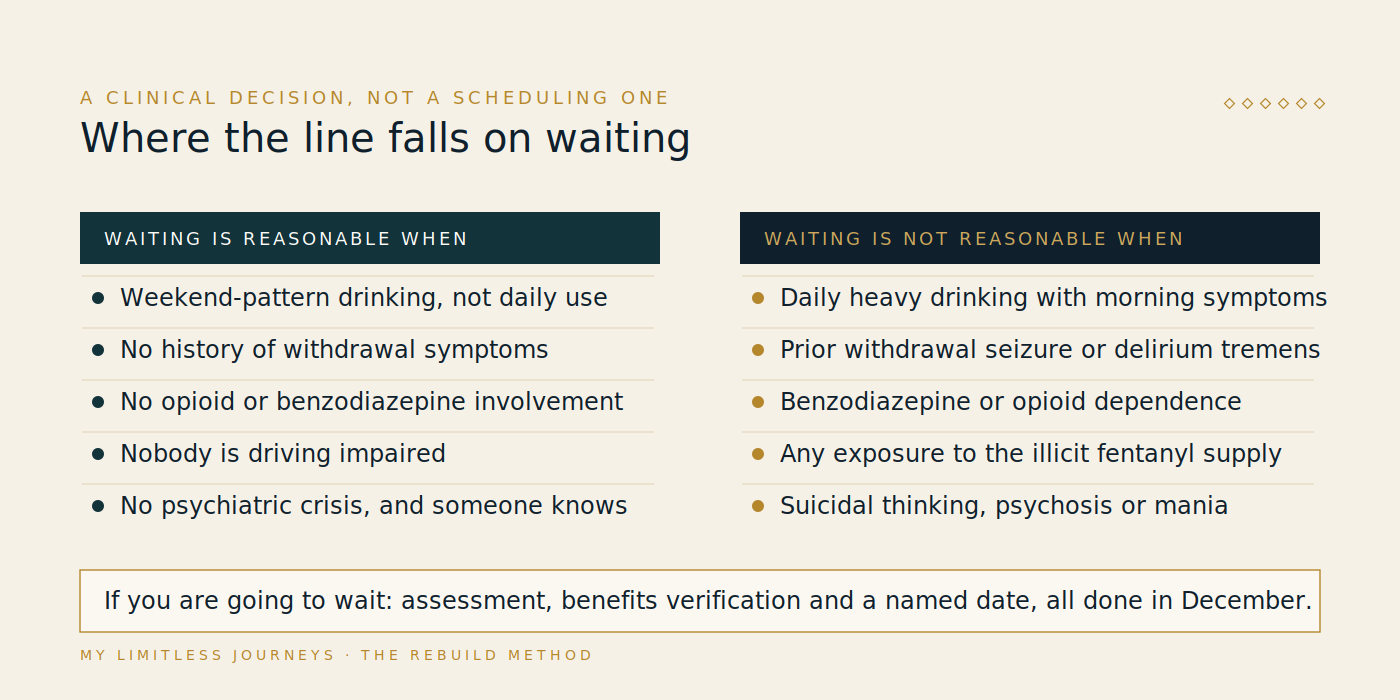
Waiting is often fine. If the pattern is heavy weekend drinking without daily use, if there is no history of withdrawal symptoms, if no one is driving impaired, if there is no opioid involvement and no psychiatric crisis, then six more weeks with a plan is a defensible clinical choice, and using December to arrange care properly is a good use of the time.
Waiting is not reasonable in several specific situations. Daily heavy drinking with morning symptoms means physiological dependence, and the clinical literature on alcohol withdrawal describes how seizures and delirium tremens arise in exactly that population. Any prior withdrawal seizure or episode of delirium tremens raises the stakes on every subsequent stop. Benzodiazepine dependence carries the same category of risk and requires a supervised taper, which we describe in benzodiazepine tapering. Opioid use in the current illicit supply, where fentanyl and adulterants are the norm, is a different risk calculation entirely. And any suicidal thinking, psychosis or manic episode is an emergency now, not a January appointment.
If you are going to wait, wait well
A January date is a plan only if the work happens in December. Do the clinical assessment now, so that the level-of-care decision is made rather than assumed; our page on how the right level of care is determined explains what that involves. Run benefits verification in December, because insurance departments slow down over the holidays and authorizations take business days that the last two weeks of the year do not have. Pick the actual date and put it in the calendar with a name attached to it. Tell one person. Arrange the work absence quietly. And know what you would do if the wait stops being safe, which is a single phone number you have already saved.
There is one more reason to make the call in December: beds. We have six, never more, which is the point of the place and also a hard constraint. The first two weeks of January are the tightest of the year across the industry. A December conversation lets us hold a realistic date rather than offer you one three weeks out. If cost is the reason for the delay, how people actually pay for treatment covers the options, including single-case agreements and private pay.
Frequently asked questions
Is a New Year’s resolution a bad reason to enter treatment?
No. It is a fine reason to start and an insufficient reason to finish. The landmark supplies the willingness to make the call, and the structure of treatment supplies everything after that. What matters is converting the resolution into an assessment, a date and a level of care within a few days, before the motivational boost fades.
Are beds actually harder to get in January?
Yes, across most of the field, and more so at small programs. With six beds, a single admission changes availability by a sixth. Calling in December does not commit you to anything, and it is the difference between choosing a date and taking one.
My family confronted me over the holidays and I agreed in the moment. Now I am not sure.
That ambivalence is normal and does not mean the agreement was false. Start with an assessment rather than an admission. Our page on what happens on the admissions call describes exactly what that conversation covers and what you are not required to decide during it.
Where else can someone get help right now?
SAMHSA operates a free, confidential National Helpline at 1-800-662-HELP, staffed around the clock in English and Spanish, which will refer to local treatment regardless of insurance status. For an immediate danger to life, call 911, and for suicidal crisis call or text 988.
If January is the plan, December is when it gets built. One confidential conversation now decides the level of care, the date and the coverage, and none of it obligates you.
Keep reading: Deductible resets and treatment timing · Holiday drinking when you have been cutting back · Do I need residential treatment? · What happens on the admissions call · Paying for treatment