How common is binge drinking in the San Fernando Valley?
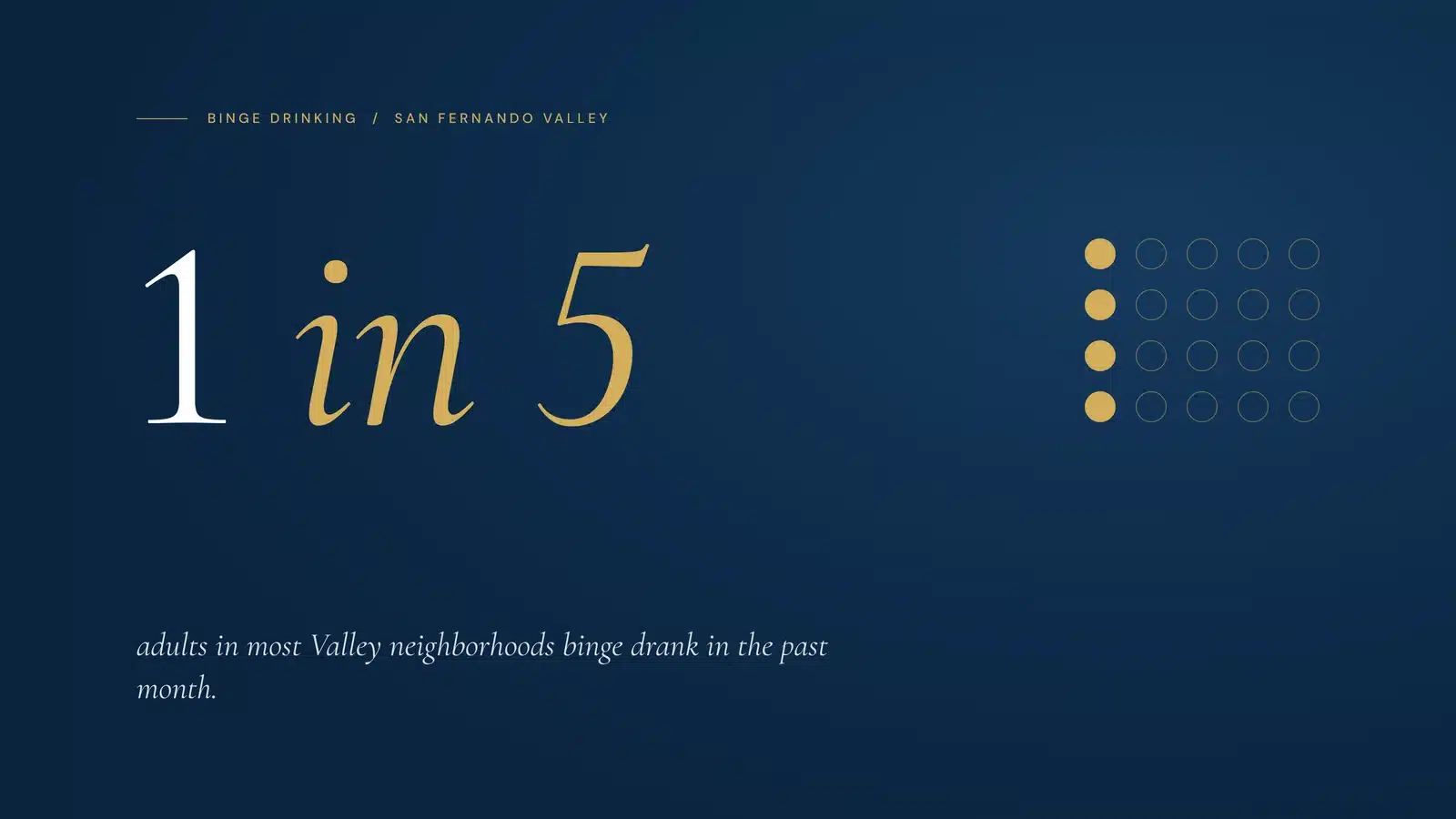
In most San Fernando Valley neighborhoods, roughly one adult in five reported binge drinking in the past month, according to Los Angeles County Public Health estimates from the 2023 county health survey. Neighborhood estimates range from about 15 percent in Glendale to about 24 percent in Studio City, with wide margins of error.
What counts as binge drinking?
The National Institute on Alcohol Abuse and Alcoholism defines binge drinking as a pattern that brings blood alcohol concentration to 0.08 percent. For a typical adult that means five or more drinks for a man, or four or more for a woman, in about two hours. Heavy drinking is a related but different measure: for men, five or more drinks on any day or 15 or more in a week; for women, four or more on any day or eight or more in a week.
Los Angeles County uses the same four and five drink thresholds, counted on a single occasion at least once in the past month. That is a low bar on purpose. A birthday dinner can meet it. What matters is how often it happens, what follows it and whether it is becoming the way someone gets through the week.
What do the Valley’s neighborhood numbers show?
The county’s Community Health Profiles estimate the share of adults who binge drank in the past month for each city and Los Angeles neighborhood, using the 2023 Los Angeles County Health Survey combined with population and census data. Across the San Fernando Valley, most estimates fall between 17 and 24 percent: roughly one adult in five.
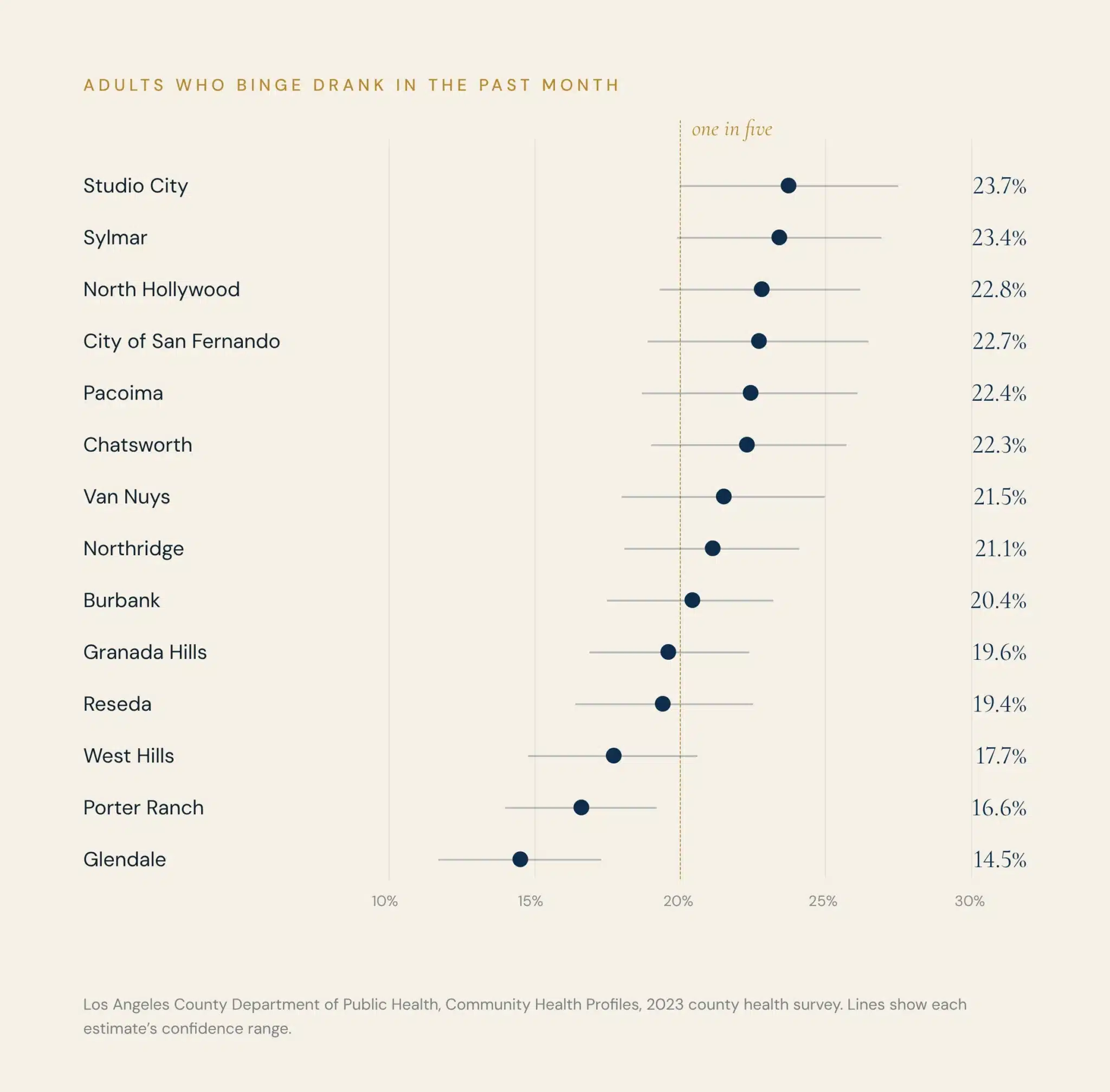
The full set of Valley estimates, highest to lowest: Studio City 23.7 percent, Sylmar 23.4, North Hollywood 22.8, the City of San Fernando 22.7, Mission Hills and Valley Village 22.5, Pacoima 22.4, Chatsworth 22.3, Arleta 22.1, Sun Valley 22.0, Lake Balboa 21.8, Van Nuys 21.5, Northridge 21.1, Canoga Park 21.0, Tarzana 20.7, Burbank 20.4, North Hills 20.1, Valley Glen 19.7, Granada Hills 19.6, Reseda 19.4, Tujunga 19.1, West Hills 17.7, Panorama City 17.6, Winnetka 17.0, Porter Ranch 16.6 and Glendale 14.5.
Read the ranking with care. These are modeled estimates, and most come with a margin of three points or more in either direction, so Studio City and Northridge are statistically closer than the order suggests. The useful finding is the floor, not the ranking. There is no part of the Valley where binge drinking is rare.
What did Valley residents say about drinking around them?
A second county source adds texture. Public Health’s 2022 Community Needs Assessment on alcohol, published in April 2024, surveyed residents 12 and older from August 2022 to February 2023 and reported results by Service Planning Area. Service Planning Area 2 covers the San Fernando Valley.

In SPA 2, 11.9 percent of respondents reported binge drinking in the past 30 days, compared with 10.3 percent countywide, and 42.7 percent reported any drinking in that period. Nearly a third, 30.2 percent, said close friends binge drink, and 26.8 percent said family members do. More than three in four, 77.1 percent, said alcohol is easy to get, and 10.2 percent had used an alcohol delivery service.
These figures are lower than the neighborhood estimates above because they measure something different: a younger age range, a convenience sample rather than a weighted survey, and a different method. They are best read for what they say about the social setting. When a third of people say their close friends binge, a binge stops looking like a warning sign to anyone in the room.
When does binge drinking become alcohol use disorder?
Binge drinking is a pattern. Alcohol use disorder is a medical condition, which NIAAA describes as an impaired ability to stop or control alcohol use despite harm to work, relationships or health. NIAAA notes that binge drinking and heavy drinking raise the risk of developing it.
Clinicians look at eleven criteria over the past year. Among them: drinking more or longer than intended, trying to cut down and failing, continuing to drink despite trouble with family, giving up activities in order to drink, needing more to feel the same effect and having withdrawal symptoms, such as trouble sleeping, as the effects of alcohol wear off. Two or three criteria indicate a mild disorder, four or five a moderate one, and six or more a severe one.
“Nobody plans a binge. The third drink usually decides the fifth, so most of our work is about the hour before that third drink, not the morning after.”
Brett Cronon, Counselor, My Limitless Journeys
Is it safe to stop drinking suddenly?
For an occasional weekend binge drinker, usually yes. For someone who drinks heavily every day, not without medical advice. NIAAA warns that people with severe alcohol use disorder may need medical care to stop safely because withdrawal can be life threatening. Our alcohol withdrawal timeline explains what the first days can bring, and medically supervised detox is how that risk is managed.
NIAAA also points out that alcohol use disorder can be treated, with behavioral therapy, mutual support and three FDA-approved medications that are not addictive. For families weighing alcohol rehab in the San Fernando Valley, the practical question is which level of care fits: detox and residential treatment for daily heavy drinking, or a structured outpatient program when withdrawal is not a concern.
What can a family do first?
Start with what you have seen, and choose a sober moment to say it. Specifics help more than labels: the missed Saturday, the drive home, the bottles in the recycling. Our piece on the high-functioning version of alcoholism describes how a binge pattern can hide behind a career that still looks fine.
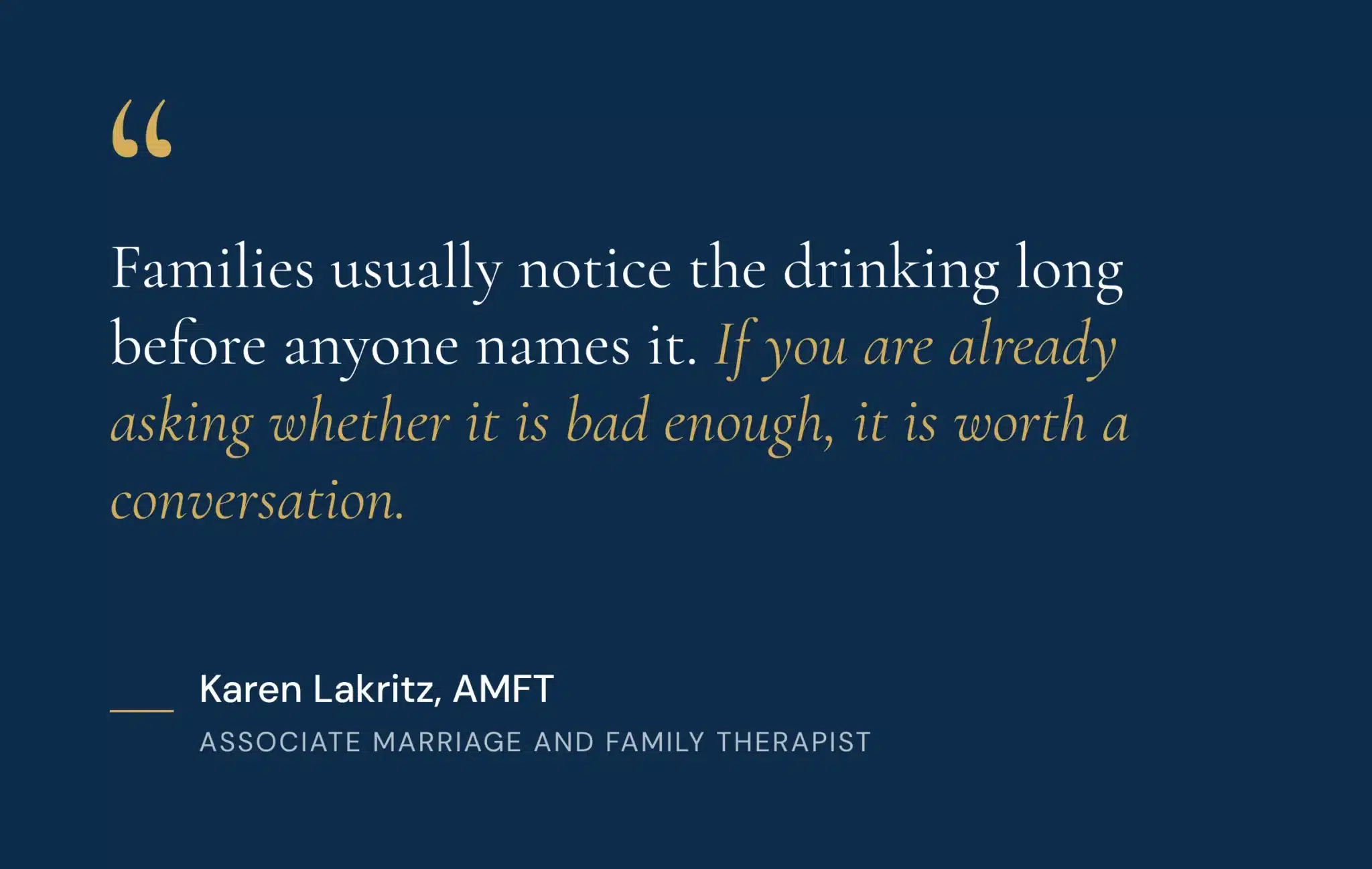
“Families usually notice the drinking long before anyone names it. The question I hear most is whether it is bad enough to do something. If you are already asking, it is worth a conversation.”
Karen Lakritz, AMFT, Associate Marriage and Family Therapist, My Limitless Journeys
If the conversation goes badly the first time, that is normal. Our guidance for families of someone who needs treatment covers what to say next and how to look after yourself while you wait.
Where can Valley families get help?
My Limitless Journeys treats adults at one six-bed residence in Encino, licensed by DHCS (license 191135CP) and accredited by The Joint Commission, with detox, residential care, PHP and IOP under one clinical team. For alcohol rehab for San Fernando Valley families, the residence is close enough that a spouse or parent can attend family sessions in person. The San Fernando Valley overview shows how families across the Valley use the same house, and admissions can run a confidential insurance check before anyone decides anything.
Frequently asked questions
Is binge drinking the same as alcoholism?
No. Binge drinking describes a pattern on a given occasion, while alcohol use disorder is a medical condition defined by an impaired ability to stop or control drinking despite harm. Many people who binge do not meet the criteria, but binge and heavy drinking raise the risk of developing the disorder over time.
Does drinking only on weekends still count?
It can. The county counts anyone who had four or more drinks (women) or five or more (men) on one occasion in the past month, whatever the day. A Friday and Saturday pattern that regularly reaches those levels is binge drinking, and federal guidance counts binge drinking on five or more days in a month as heavy alcohol use.
Why do the two county surveys give different Valley numbers?
They measure different things. The neighborhood estimates cover adults 18 and older and are modeled from the 2023 county health survey, while the Service Planning Area figures come from a 2022 to 2023 convenience sample of residents 12 and older. Each is useful, but they should not be compared directly.
Worried about someone’s drinking, or your own? Talk with our admissions team during business hours. We will ask a few questions, listen, and tell you plainly what level of care, if any, makes sense.
This article is general information, not a diagnosis or a substitute for an assessment by a clinician. If someone is in immediate danger, call 911. In a mental health or substance use crisis, call or text 988.
Sources
- National Institute on Alcohol Abuse and Alcoholism, Drinking Levels Defined (moderate and binge drinking). niaaa.nih.gov
- Los Angeles County Department of Public Health, Community Health Profiles: Adults Who Binge Drink (2023 Los Angeles County Health Survey; small-area estimates), accessed November 3, 2026. services.arcgis.com
- Los Angeles County Department of Public Health, Substance Abuse Prevention and Control, “Alcohol Use and Public Perceptions in Los Angeles County: Findings from the 2022 Community Needs Assessment,” April 2024. admin.publichealth.lacounty.gov
- National Institute on Alcohol Abuse and Alcoholism, Understanding Alcohol Use Disorder, updated January 2025. niaaa.nih.gov
Every article on this site is written by our editorial team and reviewed by a licensed clinician. Read how we write and review content.
Keep reading: Alcohol rehab in the San Fernando Valley · The high-functioning version of alcoholism · Alcohol withdrawal timeline · Finding recovery meetings in the San Fernando Valley