
What is California’s new parity law?
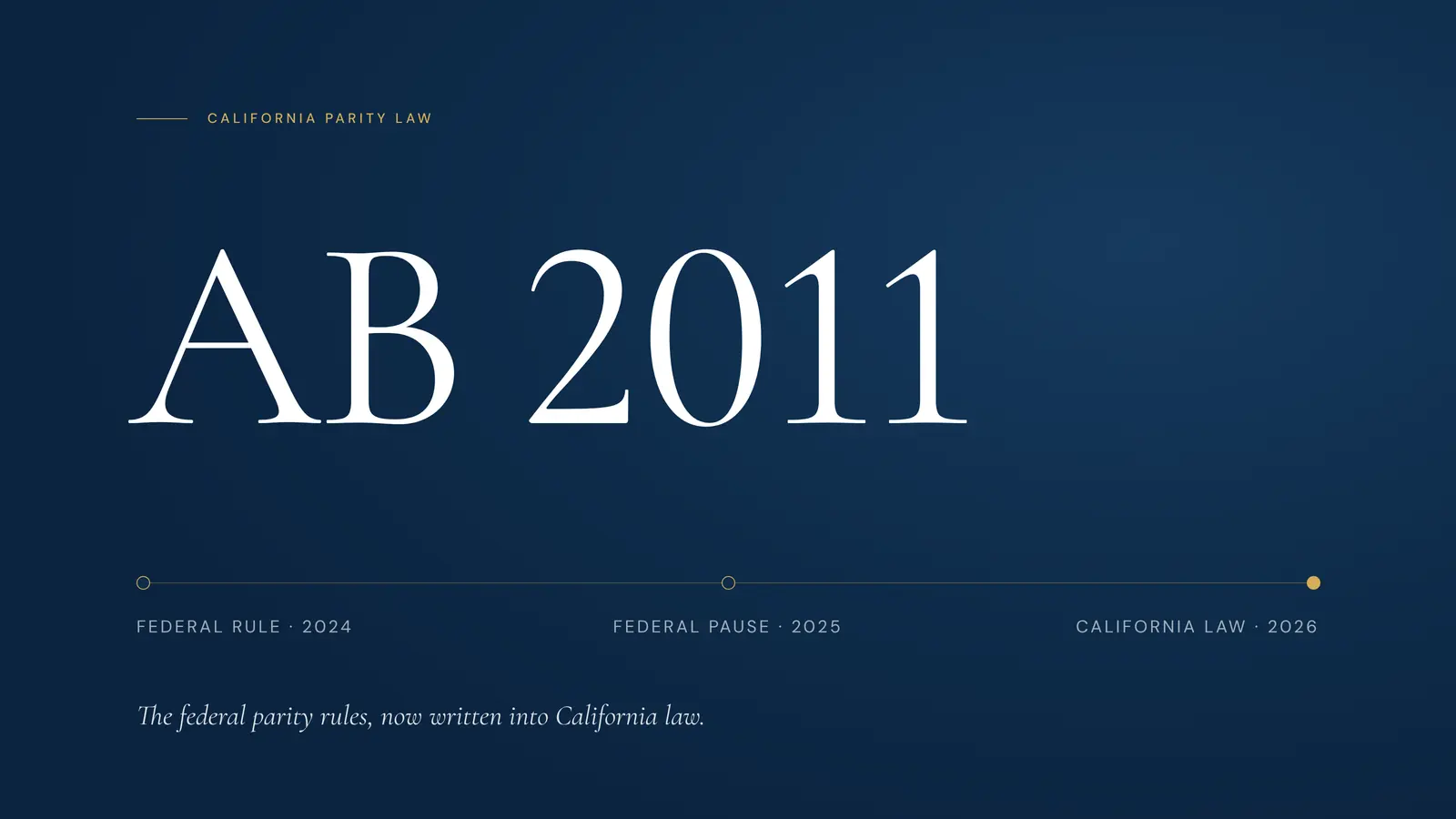
California’s new parity law, AB 2011, approved on September 30, 2026, writes the 2024 federal mental health parity rules into state law for health plans and insurers regulated in California. Those plans must cover substance use disorder treatment on terms no more restrictive than comparable medical care, even while federal enforcement of those rules is paused.
Insurance is usually the first hard conversation a family has once someone agrees to get help. For many Beverly Hills households the coverage itself is generous, and the trouble lies elsewhere: a prior authorization that never seems to clear, a residential stay approved for a few days at a time, a directory full of programs that turn out not to take the plan. Parity law is the part of the rulebook written for exactly those frictions, and California rewrote its version this fall.
Why did California pass a parity law now?
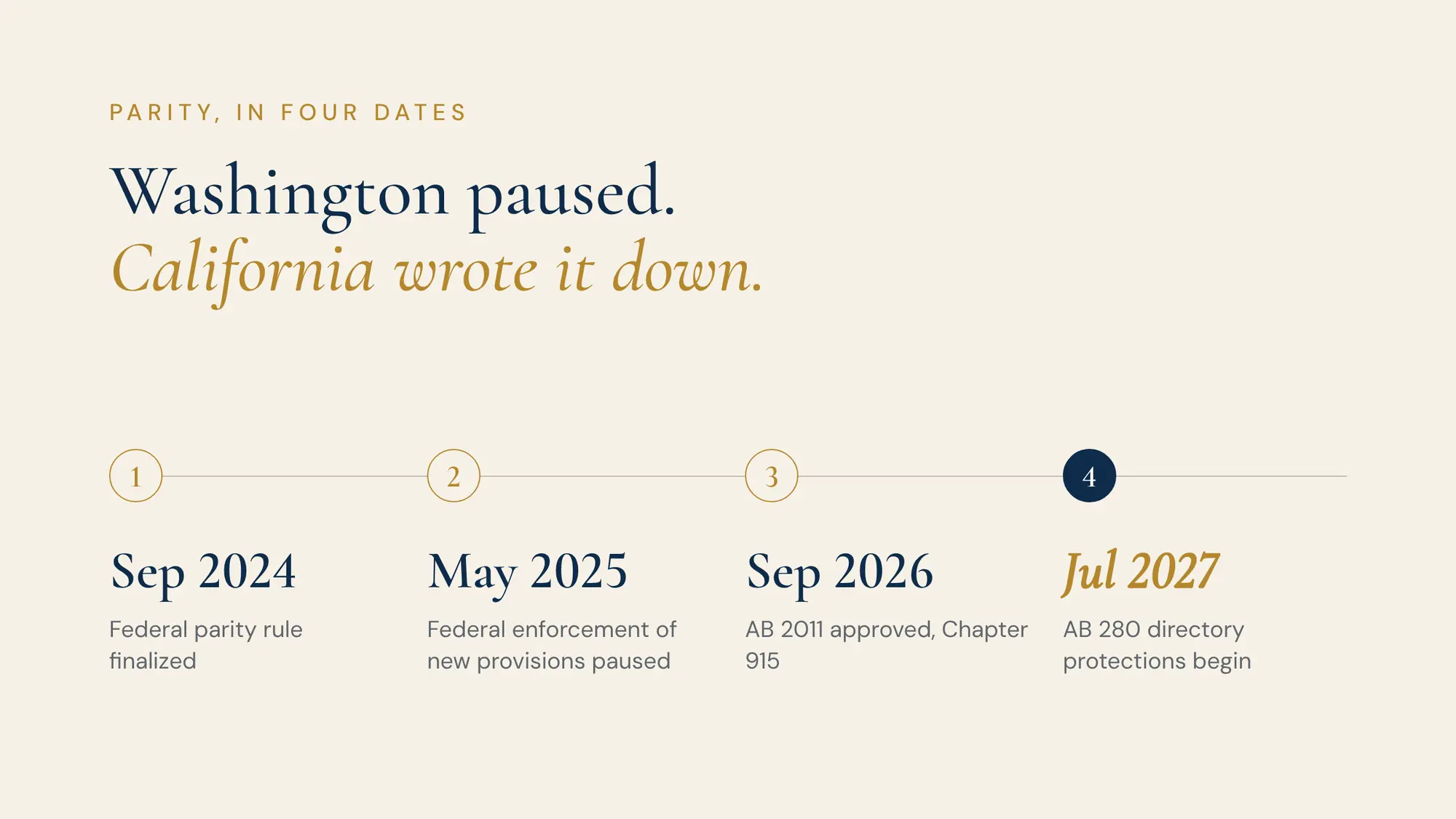
California acted because the federal rules it relied on were put on hold. In September 2024 the federal government finalized a detailed parity rule aimed at what regulators call nonquantitative treatment limitations: prior authorization, medical necessity criteria, network standards and the like. On May 15, 2025, the Departments of Labor, Health and Human Services and the Treasury announced they would not enforce the portions of that rule that were new compared with the 2013 rule, until a final decision in pending litigation plus an additional 18 months.
The federal picture has kept moving. In September 2026 the Labor Department issued a field assistance bulletin narrowing its parity enforcement to three areas it considers most harmful, and, as Morgan Lewis summarized, a new proposed federal rule is targeted for December 2026. California’s answer, AB 2011 by Assemblymember Gregg Hart, requires covered mental health and substance use disorder benefits to comply with federal parity law and the federal rules and guidance as they existed on January 1, 2025. It was approved and chaptered on September 30 as Chapter 915, Statutes of 2026, one of the behavioral health bills listed in the Steinberg Institute’s October 28 roundup.
Not everyone welcomed it. The California Association of Health Plans and the life and health insurers’ association opposed the bill, arguing that codifying federal rules the government has said it will not enforce creates legal and operational uncertainty. Supporters included the Insurance Commissioner, the California Medical Association and the National Alliance on Mental Illness.
Does the new law apply to my health plan?
It depends on who regulates the plan. AB 2011 amends the Health and Safety Code for health care service plans, overseen by the Department of Managed Health Care, and the Insurance Code for health insurance policies, overseen by the Department of Insurance. Both departments must review state provisions that conflict with the federal rules and issue joint guidance.
Many large employers pay claims themselves through a self-funded plan and hire a carrier only to administer it, even though the carrier’s name is the one on the card. Those plans are governed by federal law rather than California’s insurance codes, so a state statute like AB 2011 generally does not reach them. The federal parity statute still applies to them, and so do the comparative analysis requirements Congress added in 2021, which the Labor Department says remain in effect.

“Most families we speak with from the Westside have strong coverage and still do not know which rulebook their plan follows. That is the first thing we find out, before anyone talks about a start date.”
Garrett Braukman, Executive Director, SoCal West Region, Emend Healthcare
The fastest way to find out is to ask. Call member services and ask two questions: is this plan fully insured or self-funded, and which agency handles complaints about it? Write down the answers and the name of the person who gave them.
What does parity actually change for addiction treatment?
Parity changes the rules a plan uses to decide, not the decision itself. A plan can still require prior authorization for residential treatment or review a stay every few days. What it cannot do, under the rules California has now adopted, is apply those tools to substance use care more strictly than it applies comparable tools to medical and surgical care.
The Labor Department’s September bulletin names the three places it sees the greatest potential for harm, and they map neatly onto the frustrations families describe:
- 1Separate limits and exclusions. Blanket exclusions or caps on addiction treatment with no comparable counterpart on the medical side.
- 2Medical necessity and review. Prior authorization, concurrent and retrospective review, and whether the plan will share its clinical criteria when you ask.
- 3Network adequacy. How providers are admitted to the network and paid, which shapes whether an in-network bed actually exists when you need one.
“Parity does not mean a plan has to say yes. It means the plan has to explain its no by the same standards it uses for a knee surgery, and families are entitled to ask for that explanation in writing.”
Garrett Braukman, Executive Director, SoCal West Region, Emend Healthcare
What happens when the provider directory is wrong?
A second law signed this fall addresses a problem every admissions team knows well. AB 280, chaptered on September 27 as Chapter 499, targets so-called ghost networks: directories that list clinicians and programs who have left the network, are not accepting patients or cannot be reached. The Department of Managed Health Care will select a central utility and set uniform directory standards that plans and insurers must use.
The protection that matters most for families starts on July 1, 2027. If you reasonably relied on inaccurate, incomplete or misleading directory information, the plan must cover the care as if it were in network, and you cannot be billed more than in-network cost sharing, which then counts toward your in-network deductible and out-of-pocket maximum. Until then, the habit worth keeping is simple: screenshot the directory listing, with the date, before you call.
What should a Beverly Hills family do before choosing a program?
Start with the paperwork, then the people. A short sequence covers most of what parity can do for you:
- Identify the regulator. Fully insured or self-funded, Department of Managed Health Care, Department of Insurance or Department of Labor.
- Verify benefits in writing. In-network and out-of-network deductibles, out-of-pocket maximums and prior authorization rules for detox, residential, PHP and IOP. Our confidential benefits check does this without committing you to anything.
- Ask for the criteria. If a level of care is denied, ask which clinical guideline the reviewer used and request a copy.
- Keep a record. Dates, names, reference numbers and every explanation of benefits.
- Know the appeal path. Internal appeal first, then external review; our guide to in-network, out-of-network and single-case agreements explains how that process runs.
Some families decide the cleanest route is to leave insurance out of it altogether. That is a legitimate choice, and our page on private pay for addiction treatment sets out what it does and does not change, including what each route reveals to an employer.
How we handle coverage for Beverly Hills clients
Every admission at My Limitless Journeys begins with a benefits verification and a plain account of what the plan is likely to pay, before a start date is discussed. Our addiction treatment for Beverly Hills families is delivered in one place, a six-bed residence in Encino about twenty to thirty minutes over the Sepulveda Pass or Beverly Glen, licensed by the California Department of Health Care Services (license 191135CP) and accredited by The Joint Commission. We do not have a Beverly Hills office; families come to us.
Because one team carries a client from detox through residential treatment, PHP and IOP, the documentation a reviewer asks for at each step is written by clinicians who know the person. That does not change what a plan decides, but it removes one common reason for delay. For a broader view of how we serve the area, see our Beverly Hills overview, or read how Beverly Hills addiction treatment runs from the first call to alumni care.
Frequently asked questions
Does parity mean my insurance has to pay for a luxury rehab?
No. Parity governs how a plan makes decisions, not which program it must choose or how much it must pay. A plan can still apply medical necessity criteria, require authorization and pay out-of-network care at out-of-network rates. What it cannot do is use stricter rules for addiction treatment than for comparable medical care.
When does AB 2011 take effect?
California statutes passed without an urgency clause generally take effect on January 1 of the following year, so AB 2011 is expected to apply from January 1, 2027. The Department of Managed Health Care and the Department of Insurance must also issue joint guidance on provisions that conflict with the federal rules.
What is a ghost network?
A ghost network is a provider directory that lists clinicians or programs who are no longer in the network, are not accepting new patients or cannot be reached. Under AB 280, from July 1, 2027, a person who reasonably relied on that kind of listing pays only in-network cost sharing for covered care.
Do these laws cover my employer’s self-funded plan?
Generally not. Self-funded employer plans are governed by federal law, so California’s insurance codes usually do not apply to them. The federal parity statute and its 2021 comparative analysis requirements still do, and complaints about those plans go to the U.S. Department of Labor rather than a California regulator.
Bring us your insurance card and your questions. We will tell you what your plan is likely to cover, which rules apply and what a stay would cost, before anyone decides anything.
Begin a conversation · (866) 209-4246 (admissions, business hours)
This article is general information, not a diagnosis or a substitute for an assessment by a clinician. If someone is in immediate danger, call 911. In a mental health or substance use crisis, call or text 988.
Sources
- Digital Democracy (CalMatters), “AB 2011, Mental health and substance use disorder coverage,” bill status and text, chaptered September 30, 2026, Chapter 915. calmatters.digitaldemocracy.org
- Digital Democracy (CalMatters), “AB 280, Provider directories,” bill status and text, chaptered September 27, 2026, Chapter 499. calmatters.digitaldemocracy.org
- Steinberg Institute, “Behavioral Health Bills Signed into Law by Governor Newsom in the 2025 to 2026 Legislative Year,” October 28, 2026. steinberginstitute.org
- U.S. Department of Labor, Employee Benefits Security Administration, “Statement Regarding Enforcement of the Final Rule on Requirements Related to MHPAEA,” May 15, 2025. dol.gov
- Morgan Lewis, “US Department of Labor Clarifies Mental Health Parity Enforcement Focus,” September 16, 2026. morganlewis.com
Every article on this site is written by our editorial team and reviewed by a licensed clinician. Read how we write and review content.
Keep reading: Addiction treatment for Beverly Hills families · In-network, out-of-network and single-case agreements · Insurance vs private pay: what each reveals · Does insurance cover addiction treatment?