
Is it safe to travel for rehab?
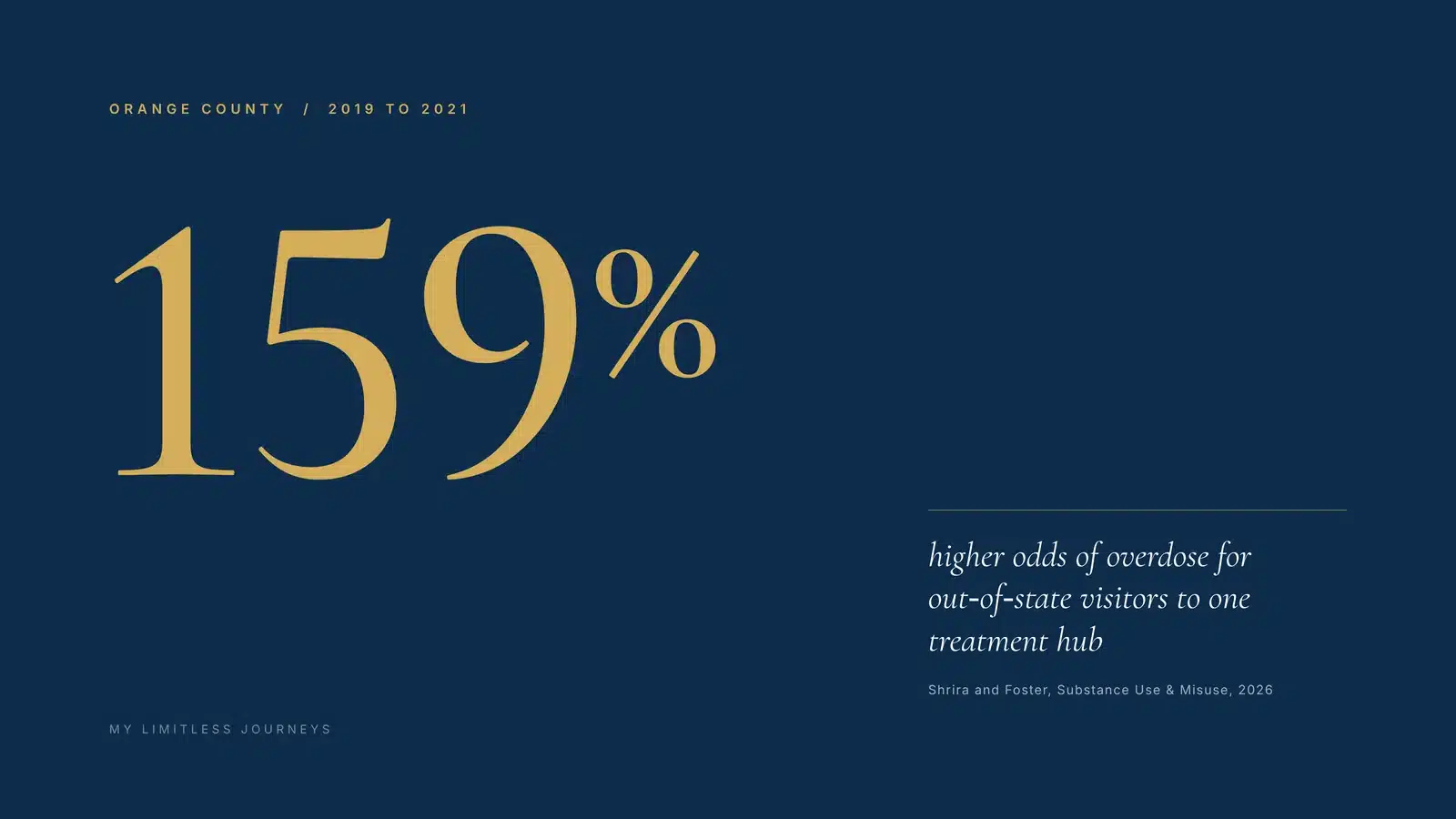
It can be, when the program is licensed, verified and planned around the day treatment ends. The risk rises when a person travels to a facility no one has seen, far from family, with no plan for housing, medication or follow-up care after discharge. A 2026 study of one Orange County treatment hub found out-of-state visitors there overdosed at far higher rates than visitors elsewhere in California.
What did the Orange County study find?
On October 13, psychologists Ilan Shrira of Penn State and Joshua Foster of the University of South Alabama described their research in The Conversation. Their peer-reviewed paper, published this year in Substance Use & Misuse, asked a simple question: if a region has unusually many treatment centers, does it have fewer overdoses, as earlier research would predict, or more?
Orange County is the obvious place to ask. Using 2019 federal data, the authors counted 14 treatment centers per 100,000 residents countywide, against 5 nationally. Inside a 10-city study area that Penn State says includes Newport Beach and Laguna Beach, the figure was 35. The team then examined more than 33 million emergency department visits to 323 California hospitals from 2019 through 2021, comparing overdoses with injuries, one of the most common reasons anyone visits an emergency room.
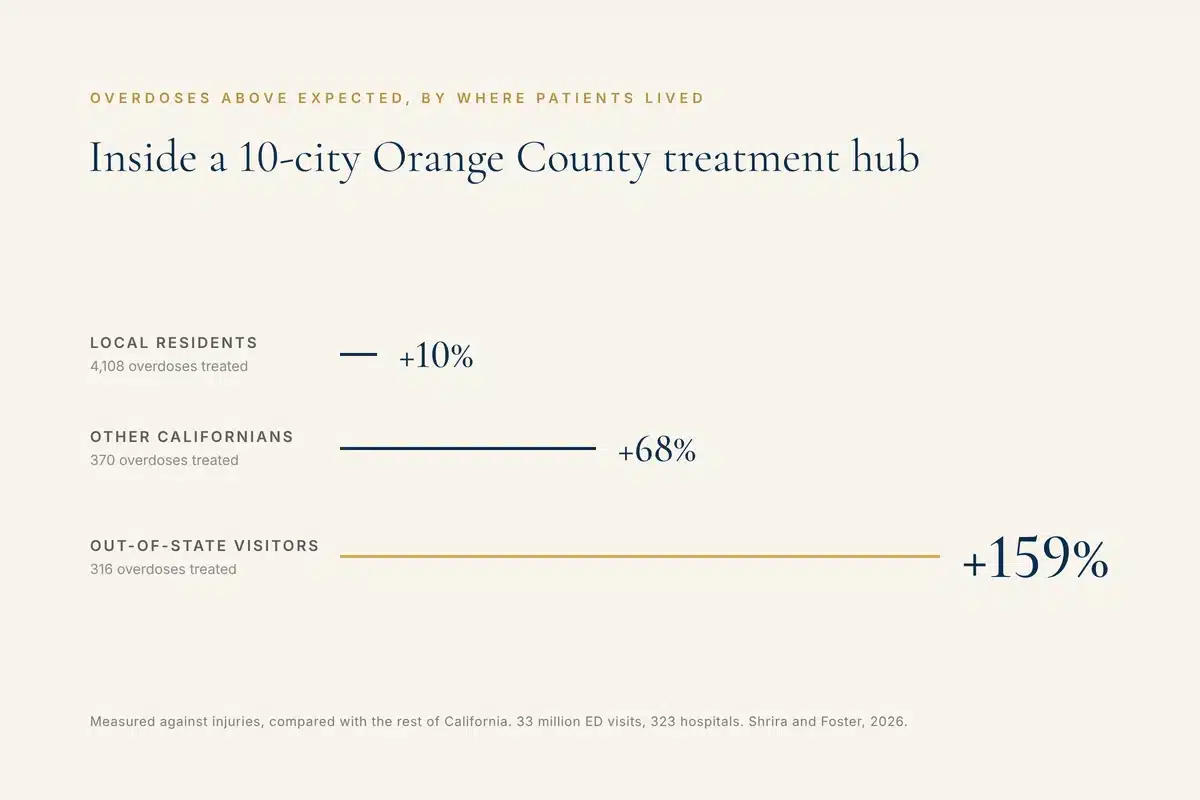
The pattern ran the wrong way. Local residents of the study area were treated for 4,108 overdoses, about 10 percent more than expected. Californians visiting from other counties were treated for 370, 68 percent more than expected. Visitors from other states were treated for 316, and their overdoses were 159 percent higher than expected compared with out-of-state visitors anywhere else in California.
Why would traveling for treatment raise overdose risk?
The authors accept part of the obvious explanation: a region full of treatment programs attracts people who are already struggling, so some excess is expected. They do not think that explains a gap more than twice as large for out-of-state visitors as for Californians. They believe predatory operators account for part of it, and they describe how the scheme works.
Insurance pays for a limited stretch of care. When it runs out, a patient who relapses can be readmitted and the billing starts again, which rewards poor care. Recruiters sometimes offer free one-way flights and housing, and may even arrange a California insurance policy on arrival. Our guide to patient brokering in California covers those red flags in detail.
What matters most for a family is the end of the story. A person far from home is cut off from the people who would notice early warning signs. When coverage ends, they can be discharged whether or not they are ready, sometimes without the money for a ticket home. The researchers note that some then face a choice between the street and staying inside a treatment system that at least houses them.
“A good program can tell a family, before admission, where their person will sleep on the night treatment ends. If no one can answer that, the distance is not the real problem. The missing plan is.”
Garrett Braukman, Executive Director, SoCal West Region, Emend Healthcare
Why are the weeks after discharge so dangerous?
Because tolerance falls faster than people expect. A widely cited follow-up study in the BMJ tracked 137 people after a 28-day inpatient opioid detox. Three died of overdose within four months, and all three were among those who had lost their tolerance during treatment. MedlinePlus notes that most opioid overdose deaths occur in people who have just detoxed, since a dose that was once routine can now stop someone breathing.
Put that next to the study above and the risk becomes concrete. The most dangerous days of recovery can fall exactly when a person is newly discharged, in an unfamiliar city, without a ride, a bed or anyone who knows them. A treatment plan that ends at the front door is not finished.
When does going away for treatment make sense?
Distance is not a warning sign by itself. Plenty of people do better away from the street, the bar or the office where their use lives, and some need privacy that a hometown program cannot offer. The difference is whether the distance was chosen, with eyes open, or arranged by someone who profits from the trip.
A good program treats distance as a clinical question. It asks how family will take part, where the person will go afterward and who will continue their care at home. Our page on going home versus transitional living walks through that decision, and many families from Orange County choose a residence a drive away in Encino precisely because it is close enough to stay involved and far enough to be private.
What should a family ask before anyone gets on a plane?

Is it licensed, and for what? In California, residential programs are licensed by the Department of Health Care Services, which publishes directories of licensed and certified programs. Accreditation can be checked through The Joint Commission’s Quality Check. Match the license to the address you were given.
Has anyone seen it? Ask for a live video walkthrough of the actual bedrooms, not a gallery. The study’s authors put it plainly: be very cautious about traveling far to a facility you have never seen in person.
Who is paying for the travel, and why? A free flight, free housing or an offer to buy insurance for your loved one are reasons to stop. California law bars paying or offering anything of value to bring in patients.
What happens on the last day? Ask for the discharge plan before admission: where the person will live, who prescribes any medication afterward, which outpatient team picks up care, and whether naloxone goes home with them. Ask who pays for the trip home if insurance stops early.
How will the family take part? Weekly family sessions, a named clinician who returns your calls and a plan for the first weeks home are signs of a program that expects your loved one to leave. Our twelve questions to ask on the phone and our guide to vetting a rehab under California’s new rules go further.
“Families often think they should step back while someone is in treatment. The weeks after discharge tend to go better when the family has been part of the plan from the first session, not invited in at the end.”
Karen Lakritz, AMFT, Associate Marriage and Family Therapist, My Limitless Journeys
Is California tightening oversight of rehab programs?
Slowly. A 2024 California State Auditor report found the Department of Health Care Services took nearly a year, on average, to finish lower-priority complaint investigations, and a little under three months for high-priority cases, including deaths. In a statement to The Conversation, the department said improvements were already underway and that it had assigned staff to Orange County to handle the region’s high volume of complaints. New state laws now put deadlines on those investigations. None of that replaces a family’s own checking before admission.
Where does My Limitless Journeys fit?
My Limitless Journeys is a six-bed residence in Encino, licensed by the California Department of Health Care Services (license 191135CP) and accredited by The Joint Commission. Care begins with on-site medically supervised detox and continues through our residential treatment program, partial hospitalization, intensive outpatient care, transitional living and alumni support, with the same clinical team throughout. Family therapy is part of the plan from the start.
If you are weighing a program out of town, or one of ours, a confidential benefits check takes a few minutes and commits you to nothing. If you are unsure where to start, SAMHSA’s free and confidential National Helpline, 1-800-662-4357, refers families to treatment in any state.
Frequently asked questions
Is out-of-state rehab a bad idea?
Not necessarily. Many people benefit from distance between treatment and the places they used. The risk lies in programs no one has verified and in discharges that leave a person far from home without housing, medication or follow-up care. Verify the license, see the facility and get the discharge plan before anyone travels.
What did the Orange County overdose study find?
Researchers from Penn State and the University of South Alabama compared emergency department visits from 2019 through 2021. In a 10-city part of Orange County dense with treatment centers, overdoses among out-of-state visitors were 159 percent higher than expected, against 68 percent for Californians from other counties and 10 percent for local residents.
Why is overdose risk higher right after rehab?
Time away from opioids lowers tolerance, so a dose a person once used routinely can be fatal. A BMJ follow-up of people leaving inpatient opioid detox found every overdose death in the first four months occurred among those who had lost tolerance. Naloxone at home and a clear aftercare plan matter most in this window.
How do I check whether a California rehab is licensed?
The California Department of Health Care Services publishes directories of licensed and certified substance use disorder programs, and The Joint Commission’s Quality Check shows accreditation. Confirm that the license matches the street address where your loved one will actually stay.
Before anyone books a flight, talk with a team that will tell you what happens on the last day of treatment as clearly as the first.
This article is general information, not a diagnosis or a substitute for an assessment by a clinician. If someone is in immediate danger, call 911. In a mental health or substance use crisis, call or text 988.
Sources
- Shrira I, Foster JD. “More rehab centers should mean fewer overdoses. In one California region, we found the opposite.” The Conversation, October 13, 2026. theconversation.com
- Shrira I, Foster JD. “Excessive Overdoses Where Treatment Centers Are Concentrated: A Case Study of Orange County, California.” Substance Use & Misuse, 2026. doi.org/10.1080/10826084.2026.2634978
- Yu, C. “Overdoses spike for visitors to California addiction treatment centers hub.” Penn State News, April 28, 2026. psu.edu
- Strang J, McCambridge J, Best D, et al. “Loss of tolerance and overdose mortality after inpatient opiate detoxification: follow up study.” BMJ, 2003;326:959. bmj.com
- MedlinePlus Medical Encyclopedia, “Opiate and opioid withdrawal,” U.S. National Library of Medicine. medlineplus.gov
- California State Auditor, “Drug and Alcohol Treatment Facilities,” Report 2023-120, October 24, 2024. auditor.ca.gov
- California Department of Health Care Services, Directories for Substance Use Disorder Services. dhcs.ca.gov
- SAMHSA, National Helpline, 1-800-662-HELP (4357). samhsa.gov
Every article on this site is written by our editorial team and reviewed by a licensed clinician. Read how we write and review content.
Keep reading: Patient brokering in California rehab · How to vet a luxury rehab · Relapse: the first 24 hours · Orange County families and Encino