
Is heavy drinking rising after 50?
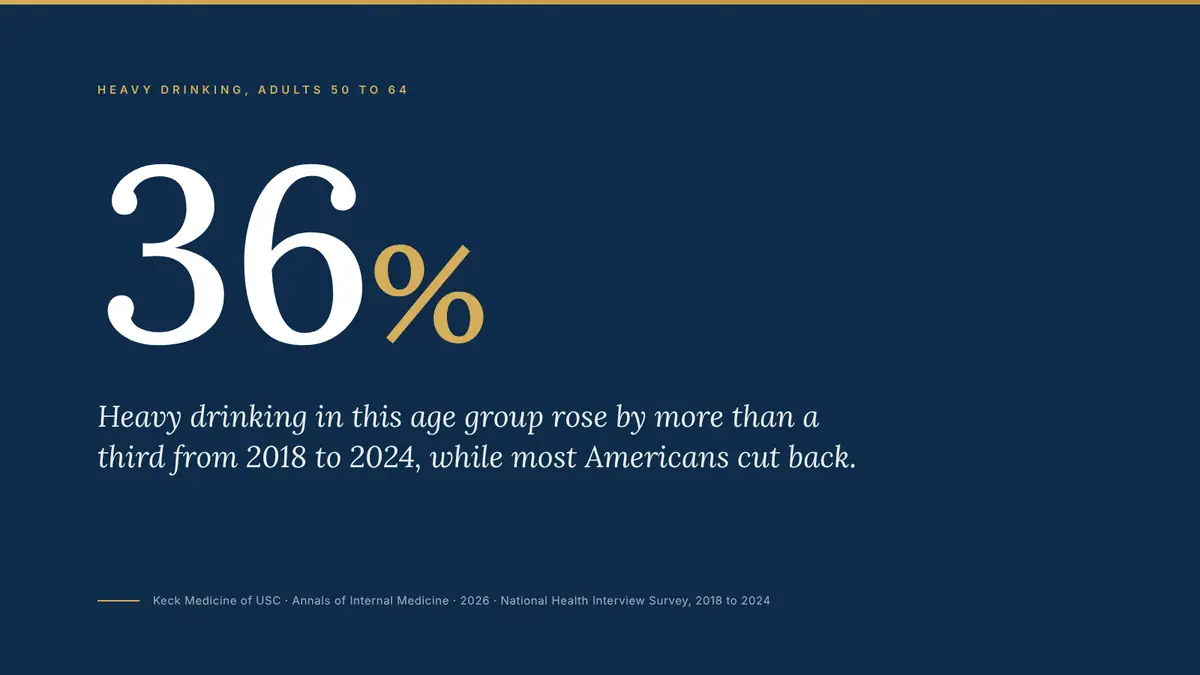
Yes, for adults in their fifties and early sixties. A Keck Medicine of USC study published in September 2026 found that heavy drinking among Americans ages 50 to 64 rose by more than 36 percent from 2018 to 2024, even as heavy drinking nationwide fell by more than 8 percent after 2022. Because the body handles alcohol less efficiently with age, the same habit carries more risk than it once did.
What did the USC study find?
On September 21, a team led by hepatologist Brian P. Lee, MD, of Los Angeles-based Keck Medicine of USC published its findings in Annals of Internal Medicine. The researchers used the National Health Interview Survey, a federal survey that asks adults about their health each year, to track how drinking changed from 2018 through 2024.
The headline was good news. Between 2022 and 2024, any alcohol use in the United States fell by nearly 2 percent and heavy drinking fell by more than 8 percent, the first confirmed decline since the pandemic began. Younger adults led the way: heavy drinking among millennials dropped 17 percent.
Adults ages 50 to 64 moved the other way. From 2018 to 2024, any drinking in this group rose by nearly 4 percent and heavy drinking rose by more than 36 percent. Despite the overall decline, Dr. Lee noted that “certain groups continue to have concerning trends,” and called for screening, prevention and treatment tailored to the people most affected.
Two directions at once
Most Americans are drinking less. One age group is not.
All U.S. adults · 2022 to 2024
−8%
Heavy drinking fell by more than 8 percent nationally.
Adults 50 to 64 · 2018 to 2024
+36%
Heavy drinking rose by more than a third in this age group.
What counts as heavy drinking?
The study used the National Institute on Alcohol Abuse and Alcoholism definition: for men, five or more drinks on any day or 15 or more in a week; for women, four or more on any day or eight or more in a week. The CDC uses the same weekly thresholds. A standard drink holds about 14 grams of alcohol, roughly a 12-ounce beer, a 5-ounce glass of wine or a 1.5-ounce pour of spirits.
Those numbers surprise people. Two generous glasses of wine with dinner most nights can reach the weekly threshold for women without anyone at the table thinking of it as heavy. A restaurant pour or a home pour is often closer to two standard drinks than one.
Why does the same drink hit harder after 50?
Body composition changes. The NIAAA explains that reduced muscle mass and body water with age means the same drink produces a higher blood alcohol level. Older people are also more sensitive to alcohol’s sedating effects, and face a higher risk of falls, car crashes and other injuries.
Metabolism slows. Aging slows the body’s ability to break alcohol down, so it stays in the bloodstream longer. The NIAAA notes that older adults can develop alcohol-related problems at lower amounts than younger people.
Medicine cabinets fill up. Midlife is when prescriptions accumulate, and the NIAAA calls older people particularly high risk for harmful alcohol and medication interactions. Alcohol with anxiety medicines such as lorazepam or alprazolam raises the risk of overdose. With common pain relievers like naproxen it raises the risk of stomach bleeding, and with the blood thinner warfarin even occasional drinking can lead to internal bleeding. Sleep aids, antidepressants and some blood pressure and diabetes medicines also interact.
Long-term risks add up. The U.S. Surgeon General’s advisory on alcohol and cancer risk links drinking to at least seven types of cancer, including breast, colorectal, liver and esophageal cancers. Dr. Lee, a liver specialist, points out that alcohol-associated cirrhosis is now the leading cause of liver transplants. Risk for these conditions rises with age at the same level of drinking.
At fifty-five, the same two glasses of wine can do more than they did at thirty-five. Nothing about willpower changed. The body did, and most people are never told that.
Maria Dahlman, MA, LCSW Regional Clinical Director
Why does midlife drinking so often go unnoticed?
Because it rarely looks like a problem from the outside. People in their fifties are often at the height of their careers, with stable homes and the means to drink well rather than visibly. Wine at dinner, a drink to mark the end of the workday and a nightcap to help with sleep can each feel reasonable on their own. Together they can add up to heavy drinking without a single dramatic night.
Midlife also brings changes that make drinking easier to slip into: children leaving home, aging parents, a career plateau, the approach of retirement, chronic pain and broken sleep. None of these causes an alcohol problem, but each can turn a habit into a coping tool. Our piece on high-functioning alcoholism describes how long that version can stay hidden, and our look at LA County overdose data among older adults covers the parallel rise in drug risk after 65.
What might families notice over the holidays?
Thanksgiving falls on November 26 this year, and for many adult children it is the longest stretch they spend with a parent all year. The NIAAA lists signs that can point to an alcohol problem in older adults, and several are easy to mistake for ordinary aging:
- Memory lapses, repeated stories or forgotten conversations
- Low mood, irritability or new anxiety
- Poor appetite or noticeable weight change
- Unexplained bruises or a recent fall
- Trouble sleeping, or napping heavily through the afternoon
One sign alone proves nothing. A cluster of them, alongside drinking that starts earlier in the day or a reluctance to talk about it, is worth a private conversation later in the visit. Our guide to holiday drinking when someone has been cutting back and our scripts for when someone says they can stop on their own can help you prepare.
“The conversation that helps is rarely about how many drinks. It is about what someone has quietly stopped doing: the walk they skip, the call they forget, the morning they lose. People can hear that.”
Brett Cronon, Counselor, My Limitless Journeys
Is it safe to stop drinking suddenly after 50?
For someone who drinks lightly, yes. For someone who has been drinking heavily every day for months or years, stopping abruptly can bring on alcohol withdrawal, which ranges from shakiness, sweating and insomnia to seizures and delirium tremens. The American Society of Addiction Medicine’s clinical guideline on alcohol withdrawal counts older age, a history of withdrawal seizures or delirium, and serious medical illness among the factors that raise the risk of complicated withdrawal.
Withdrawal can also grow more severe with each episode, a pattern called kindling. If someone in your life has tried to quit before and felt sick for days, that history matters. Our hour-by-hour alcohol withdrawal timeline shows when the risky windows fall, and what medically supervised detox actually means explains how that risk is managed. The safest first step is a conversation with a physician before the last drink, not after.
How can someone check their own drinking?
Start by counting honestly for two weeks, in standard drinks rather than glasses. The NIAAA’s free Rethinking Drinking site has drink-size calculators and a short self-assessment. Then bring the numbers to a primary care visit, along with a complete list of medicines and supplements, and ask directly whether any of them interact with alcohol.
A few questions are worth asking yourself, too. Has drinking crept earlier in the day? Do you need more to feel the same effect? Have you tried to cut back and found it harder than expected? Is anyone close to you worried? Yes to any of these does not mean something is wrong, but it does mean the question deserves a clinician’s attention.
Where does My Limitless Journeys fit?
My Limitless Journeys is a six-bed residence in Encino, licensed by the California Department of Health Care Services (license 191135CP) and accredited by The Joint Commission. Many of the people we care for are established professionals in their forties, fifties and sixties whose drinking grew slowly alongside demanding lives. Care begins with on-site medically supervised detox and continues through our residential treatment program and step-down care, with the same clinical team throughout. Our page on alcohol addiction treatment and our guide for Los Angeles professionals explain the approach.
If you are unsure whether treatment is needed, a confidential benefits check takes a few minutes and commits you to nothing. SAMHSA’s free and confidential National Helpline, 1-800-662-4357, is another place to start.
Frequently asked questions
Is drinking increasing among people over 50?
Among adults 50 to 64, yes. A 2026 Keck Medicine of USC study of 114,352 U.S. adults found heavy drinking in this age group rose by more than 36 percent from 2018 to 2024, while heavy drinking nationwide fell by more than 8 percent between 2022 and 2024.
How many drinks a week is heavy drinking?
By NIAAA and CDC definitions, heavy drinking is 15 or more drinks a week for men and 8 or more for women, or a day of five or more drinks for men and four or more for women. A standard drink is about 14 grams of alcohol, such as a 5-ounce glass of wine.
Why does alcohol affect older adults more?
With age, the body has less water and muscle and breaks alcohol down more slowly, so the same drink produces a higher blood alcohol level that lasts longer. Older adults are also more sensitive to alcohol’s sedating effects and more likely to take medicines that interact with it.
Is it dangerous to quit drinking cold turkey after 50?
It can be for someone who drinks heavily every day. Abrupt stopping can cause alcohol withdrawal, including seizures, and clinical guidelines list older age and past withdrawal problems as risk factors for complications. Talk with a physician before stopping so withdrawal can be assessed and, if needed, medically supervised.
If the numbers in this article sound familiar, for you or for someone you love, a private conversation is a reasonable next step.
This article is general information, not a diagnosis or a substitute for an assessment by a clinician. Do not stop or change any medication without medical advice. If someone is in immediate danger, call 911. In a mental health or substance use crisis, call or text 988.
Sources
- Lee BP, Dodge J, Ayyala-Somayajula D. “Alcohol Use Between 2018 and 2024: A National Cross-Sectional Study.” Annals of Internal Medicine, published September 21, 2026. doi.org/10.7326/ANNALS-26-01824
- Keck Medicine of USC. “U.S. alcohol use falls for first time since the COVID-19 pandemic, but remains above pre-pandemic levels.” September 21, 2026. news.keckmedicine.org
- National Institute on Alcohol Abuse and Alcoholism. “Aging and Alcohol.” Updated December 2025. niaaa.nih.gov
- National Institute on Alcohol Abuse and Alcoholism. “Harmful Interactions: Mixing Alcohol With Medicines.” niaaa.nih.gov
- Centers for Disease Control and Prevention. “Alcohol Use and Your Health.” January 14, 2025. cdc.gov
- U.S. Department of Health and Human Services, Office of the Surgeon General. “Alcohol and Cancer Risk.” Surgeon General’s Advisory, January 2025. hhs.gov
- American Society of Addiction Medicine. “The ASAM Clinical Practice Guideline on Alcohol Withdrawal Management.” 2020. asam.org
- National Institute on Alcohol Abuse and Alcoholism. Rethinking Drinking. rethinkingdrinking.niaaa.nih.gov
- SAMHSA, National Helpline, 1-800-662-HELP (4357). samhsa.gov
Every article on this site is written by our editorial team and reviewed by a licensed clinician. Read how we write and review content.
Keep reading: The high-functioning version of alcoholism · Why each withdrawal can hit harder · Holiday drinking when you’ve been cutting back · Drug addiction in older adults