

Does Covered California cover rehab?
Yes. Every Covered California plan must cover substance use disorder treatment, including inpatient behavioral health care, as an essential health benefit, and limits on that care generally cannot be stricter than limits on medical care. What differs between plans is the network, the deductible and the approval rules, which decide where treatment happens and what it costs.
What changed for 2027?
Covered California opened its fourteenth open enrollment period on November 1. According to the agency’s October 30 announcement, enrollment runs through January 31, 2027, and anyone who wants coverage for all of 2027 needs to choose a plan by December 31. Twelve insurers will sell plans next year, including one new company, and more than 1.7 million Californians are enrolled today.
The money has shifted. Congress let the enhanced federal premium tax credits expire, which Covered California says had brought Californians nearly $2.5 billion a year. The state is filling part of that gap: its subsidy fund rises from $190 million in 2026 to $300 million in 2027, with extra help for households earning up to 200 percent of the federal poverty level, which is $31,920 for one person or $66,000 for a family of four. Covered California says 55 percent of current enrollees will see no increase in their monthly premium.
For everyone else, prices are moving up. When rates were announced in July, Covered California put the preliminary statewide increase at 9.9 percent, with 8.5 percent in its northeast Los Angeles County region and 9.3 percent in its southwest region. Higher premiums push families toward cheaper plans, and the cheapest plan is not always the one that works when someone needs treatment.

What does a Covered California plan have to cover for addiction?
Every marketplace plan, including every Covered California plan, must cover mental health and substance use disorder services as essential health benefits under the Affordable Care Act. The federal marketplace guide to mental health and substance abuse coverage lists substance use disorder treatment, behavioral health treatment such as psychotherapy and counseling, and mental and behavioral health inpatient services among the services all plans must include.
Two more protections matter to families. Limits on mental health and substance use care generally cannot be more restrictive than limits on medical and surgical care, and a marketplace plan cannot deny coverage or charge more because of a pre-existing condition, which includes a history of addiction.
In practice, coverage usually reaches the full continuum: medically supervised detox, residential treatment, partial hospitalization and intensive outpatient care. Covered does not mean automatic. Each level still has to be medically necessary, most plans require approval before a residential admission, and the plan pays its share only after the deductible and coinsurance rules are applied.
Which plan details matter most if treatment is likely in 2027?
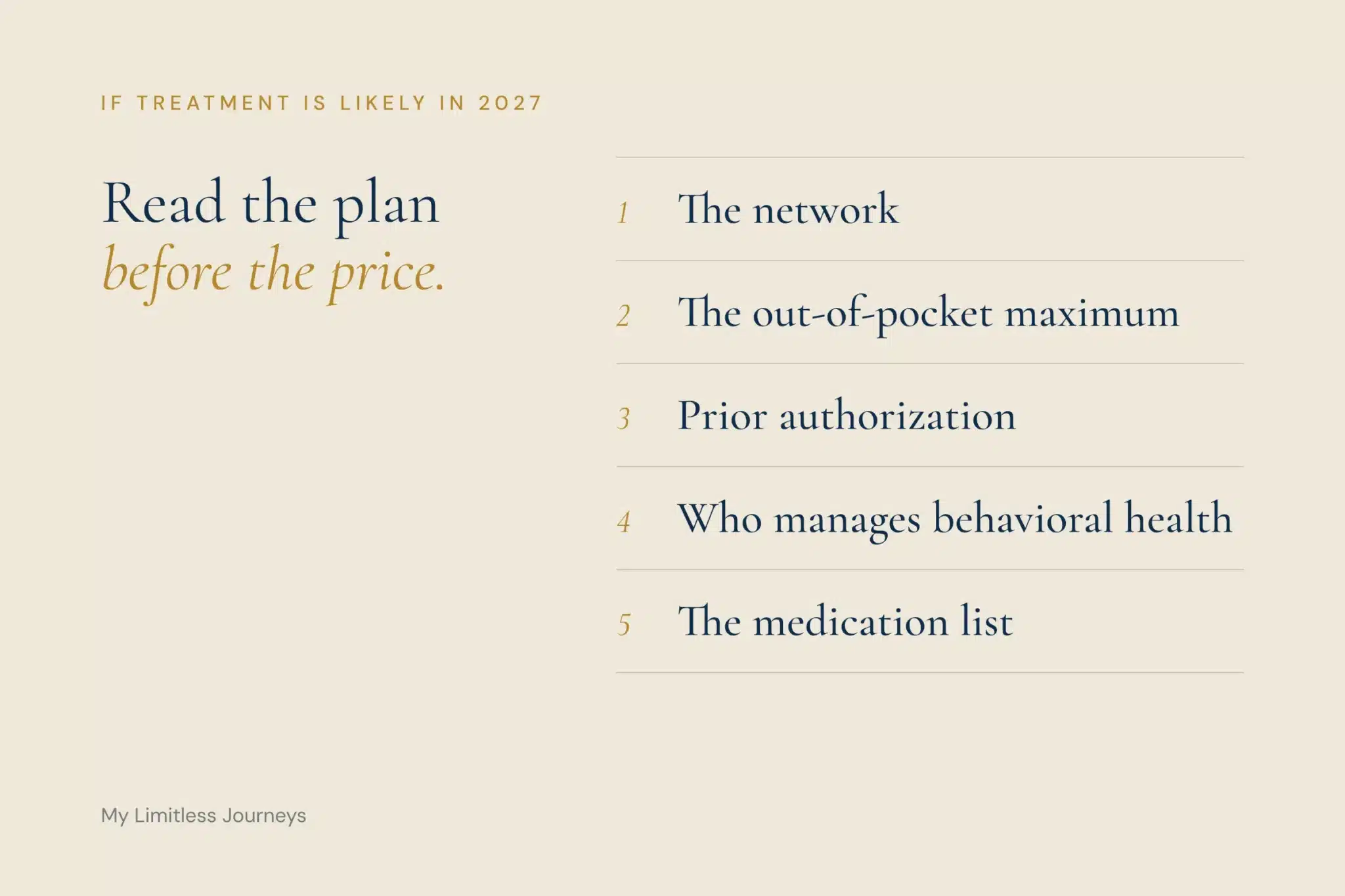
Metal tiers (Bronze, Silver, Gold, Platinum) describe how costs are shared. They say nothing about which treatment programs you can use. If a son, a spouse or you yourself may need care next year, read the plan in this order.
- 1The network. Is a licensed detox and residential program in network, and where is it? Many HMO and EPO plans pay little or nothing outside their network except in an emergency, so ask before you choose.
- 2The deductible and the out-of-pocket maximum. A residential stay can reach the annual maximum quickly. The maximum, not the premium, is the number that tells you the worst case for the year.
- 3Prior authorization. Ask how the plan approves detox and residential care, how long approvals usually take and who submits the clinical information.
- 4Who manages behavioral health. Some plans route mental health and addiction care through a separate company with its own phone number and its own network list. Get that number before you need it.
- 5Medications. Check the formulary for the medications used in addiction treatment, such as buprenorphine and naltrexone, and whether they need prior approval.

“Pick the network first and the premium second. A low monthly price does not help a family if the nearest in-network residential program is two counties away.”
Garrett Braukman, Executive Director, SoCal West Region, Emend Healthcare
How do you check whether a specific rehab is in network?
Start with the plan, not the program’s website. Call the member services number for the plan you are considering, give the program’s legal name and address, and ask whether it is in network for substance use disorder treatment at each level of care. Write down the date, the representative’s name and a reference number.
Then ask the program to run its own benefits check. Families comparing addiction treatment in the San Fernando Valley can request a confidential insurance verification from us at no cost and with no commitment. If the program you want is out of network, our plain guide to in-network, out-of-network and single-case agreements explains when a plan will make an exception and what to ask for in writing.
What can you do if the plan denies treatment?
A denial starts a process; it does not end one. First file a grievance with the plan and keep copies of everything the treatment team sends. For plans overseen by the California Department of Managed Health Care, the DMHC asks consumers to go through the plan’s grievance process for 30 days before filing a complaint, unless the situation is urgent, in which case you can ask the DMHC for help right away. If the plan denies, changes or delays a request for care, you can apply for an Independent Medical Review. The DMHC says complaints are generally decided within 30 days and reviews within 45 days. Its phone number is 1-888-466-2219.
“If you are weighing two plans, call the program you would actually use and ask how each plan has worked there. A straight answer in December is worth more than a surprise in February.”
Garrett Braukman, Executive Director, SoCal West Region, Emend Healthcare
Should you wait for January if someone needs help now?
No. A plan chosen in December shapes next year; it does nothing for this week. If someone is drinking heavily every day or using opioids or sedatives, stopping suddenly can be dangerous, and the right first step is a medical assessment, not a calendar decision. Use the coverage you have today, and if there is none, ask about private pay options while you sort out 2027.
Timing still matters at the edges. Deductibles reset on January 1, which is why some families weigh the start date of a planned admission against the plan year; our note on deductible resets and treatment timing covers that trade-off. Households with lower incomes should also ask a certified enroller whether they qualify for no-cost or low-cost Medi-Cal instead; Covered California estimates that 682,000 uninsured Californians already do. Free enrollment help is available at (800) 300-1506.
How this works for Valley families at My Limitless Journeys
Care happens in one place: a six-bed residence in Encino, licensed by DHCS (license 191135CP) and accredited by The Joint Commission, offering detox, residential care, PHP, IOP and transitional living under one clinical team. For addiction treatment for San Fernando Valley families, the short drive means a spouse or parent can join family sessions in person instead of hearing about them later. Our San Fernando Valley overview describes how families from across the Valley use the same house.
If you are choosing a plan this month with treatment in mind, call admissions during business hours with the plans you are comparing. We will tell you plainly what we can confirm and what only the insurer can answer.
Frequently asked questions
Can I change Covered California plans if someone needs rehab mid-year?
Usually not. Outside open enrollment you generally need a qualifying life event, such as losing other coverage, moving or a change in your household, to switch plans. That is why the weeks before December 31 are the time to choose a plan with treatment in mind rather than price alone.
Does a history of addiction raise my Covered California premium?
No. Marketplace plans cannot deny you coverage or charge you more because of a pre-existing condition, and a past or current substance use disorder counts as one. Your premium depends on factors such as age, income, region and the plan you choose, not on your treatment history.
Is sober living covered by Covered California plans?
Usually not. Sober living is housing rather than licensed treatment, so health plans rarely pay the rent. Clinical services delivered while someone lives there, such as intensive outpatient therapy, can be covered when they are medically necessary and provided by an in-network program.
Does Covered California cover medical detox?
Detox is part of substance use disorder treatment, which every plan must cover, but each plan applies its own medical necessity rules and usually requires approval for inpatient or residential detox. Ask the plan how detox is authorized and which licensed detox programs are in its network before you need one.
Comparing plans with treatment in mind? Send us the plans you are weighing and we will check what we can, plainly and confidentially, before anyone decides anything.
This article is general information, not a diagnosis or a substitute for an assessment by a clinician. If someone is in immediate danger, call 911. In a mental health or substance use crisis, call or text 988.
Sources
- Covered California, “Covered California’s Open Enrollment 2027: Amid Federal Changes, Covered California Continues to Connect Californians to High-Quality, Affordable Health Insurance,” October 30, 2026. coveredca.com
- Covered California, “Covered California Rates and Plans for 2027: California Continues Fight for Health Insurance Affordability and Access,” July 21, 2026. coveredca.com
- HealthCare.gov, Mental health and substance abuse health coverage options. U.S. Centers for Medicare and Medicaid Services. healthcare.gov
- California Department of Managed Health Care, File a Complaint and Independent Medical Review. dmhc.ca.gov
Every article on this site is written by our editorial team and reviewed by a licensed clinician. Read how we write and review content.
Keep reading: Addiction treatment in the San Fernando Valley · Does insurance cover addiction treatment? · In-network, out-of-network and single-case agreements · Deductible resets and treatment timing