
Benzodiazepine tapering: why coming off slowly is the only safe way off.
Benzodiazepines are the one class of drug where the word "detox" is misleading. Stopping abruptly can cause seizures. Coming off safely means a gradual, physician-managed taper measured in weeks to months, and this page explains why, how it is done, and what your days look like while it happens.
Authored by the MLJ Clinical Team. Reviewed under board-certified psychiatric oversight. Last updated September 2026.
Key Takeaways- Benzodiazepines (alprazolam, lorazepam, clonazepam, diazepam and others) act on the GABA system, and after months of daily use the brain depends on them to stay calm; removing them suddenly can trigger seizures, psychosis, and severe rebound anxiety.
- A taper reduces the dose in small steps over weeks to months so the GABA system can readjust gradually; most people are switched to a longer-acting benzodiazepine first to smooth the process.
- These principles, popularized by Professor Heather Ashton and now reflected in a 2025 ASAM guideline, favor slow, flexible, patient-paced reduction over fixed schedules.
- At MLJ, the taper begins under nursing supervision in residential care and continues, with the same psychiatrist, through PHP, IOP, and beyond; you do not have to finish it before you leave.
- During a taper, life continues: therapy, sleep work, exercise, and family sessions are not paused, and the taper is adjusted around how you are actually doing.

What benzodiazepines do to the brain.
GABA is the brain's principal calming signal. When it binds to its receptor, the neuron becomes harder to fire. Benzodiazepines attach to a separate site on the same receptor and make GABA work more strongly, which is why a single dose of alprazolam or lorazepam reliably quiets panic, stops a seizure, or induces sleep. They are effective drugs, and for short-term use in the right situation they are safe ones.
The problem arrives with time. Faced with a constantly amplified GABA signal, the brain adapts: receptors become less sensitive, fewer of them are expressed, and the excitatory glutamate system is tuned upward to compensate. After some weeks to months of daily use, the brain now needs the benzodiazepine to produce a normal level of calm. This is physical dependence, and it is distinct from addiction. It happens to people who take exactly what was prescribed, exactly as prescribed, which is why the FDA in 2020 added a boxed warning to the entire class describing the risks of dependence and withdrawal.
Many of the clients we see with benzodiazepine dependence did not come to it through misuse. They were prescribed something for anxiety or insomnia during a hard year, and the hard year lasted. Others combine a prescription with alcohol, which acts on the same system and compounds the dependence; that situation is discussed on our polysubstance detox page. Either way, the neurochemistry at the point of stopping is the same, and it dictates everything that follows.
What happens when you stop suddenly.
Remove the benzodiazepine from a dependent brain and the GABA system, already weakened, is suddenly working alone against an amplified glutamate system. The result is a nervous system with too little brake and too much accelerator, the same imbalance that drives alcohol withdrawal, and it produces the same dangers. Grand mal seizures can occur, including in people with no seizure history. Delirium and psychosis are possible. Even when withdrawal does not reach that severity, the experience is described by patients as among the worst of their lives: rebound anxiety far beyond the original complaint, panic, insomnia, tremor, sweating, muscle rigidity, sensory distortions in which light and sound become painful, depersonalization, and intrusive thoughts.
Timing depends on the drug. Short-acting benzodiazepines such as alprazolam and lorazepam leave the body quickly, so withdrawal can begin within a day of the last dose and is often more abrupt and intense. Long-acting drugs such as diazepam and clonazepam have a delayed onset, typically two to several days, and a more drawn-out course. SAMHSA's TIP 45 is explicit that abrupt discontinuation of benzodiazepines in a dependent person is medically dangerous and that gradual reduction under medical supervision is the standard of care.
There is a specific way this goes wrong that we see often enough to name. A person becomes frightened by what they read about their prescription, or a new physician declines to renew it, and they stop. Two days later they are in an emergency room with a seizure or in a state of terror they cannot describe, and they conclude that they cannot live without the drug. That conclusion is wrong. What they have learned is that they cannot stop it abruptly, which is true of everyone who is dependent. The way off exists; it is simply slow.
The principles of a safe taper.
The modern approach to benzodiazepine withdrawal owes much to Professor C. Heather Ashton, a British clinical pharmacologist who ran a withdrawal clinic for twelve years and published her observations as what is now known as the Ashton Manual. Her core insight was that the brain needs time to regrow and resensitize its GABA receptors, and that the rate of taper should be set by the patient's symptoms rather than by a calendar. In 2025 the American Society of Addiction Medicine, with several partner organizations, published a joint clinical practice guideline on benzodiazepine tapering that formalizes many of the same principles for physicians in the United States.
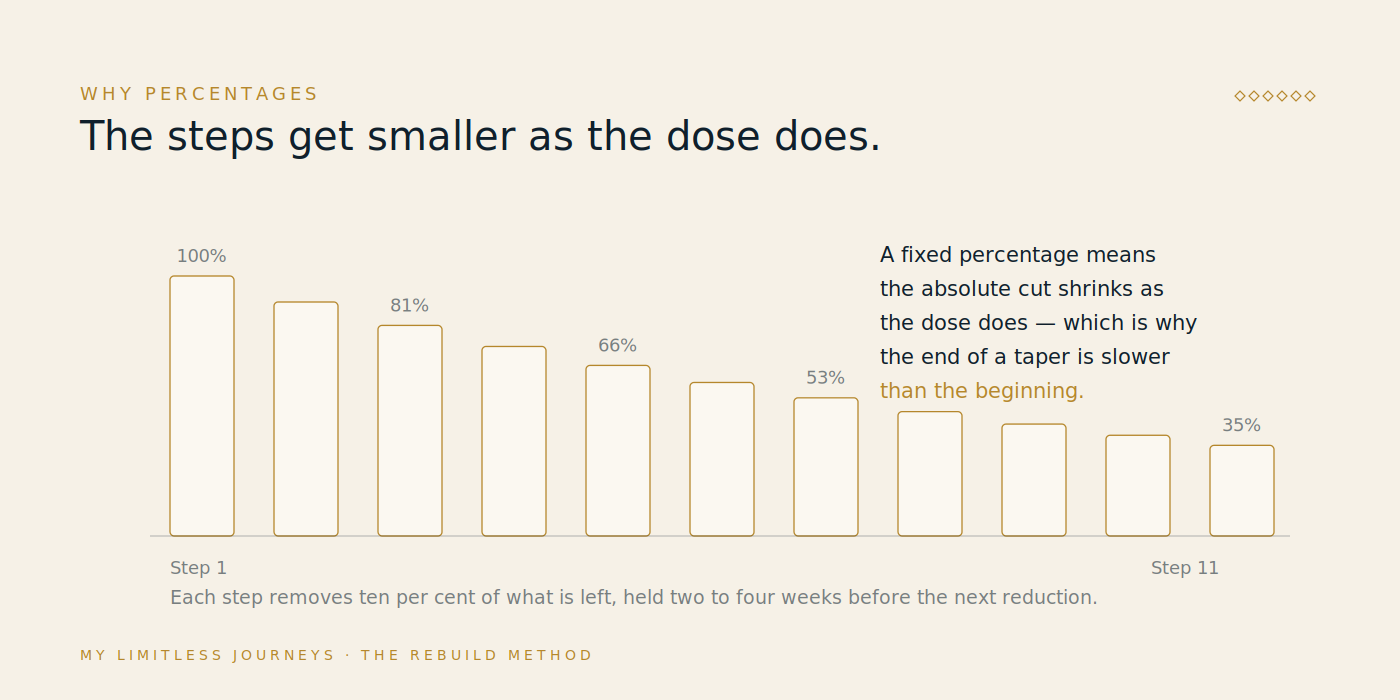
The principles are straightforward to state. Reduce the dose gradually, by a small fraction at each step, and let each step settle before taking the next. Make the steps smaller as the dose gets lower, because the last part of a taper is proportionally the largest change and often the hardest. Never go backward to a higher dose unless there is a medical reason to; if a step is too hard, hold there rather than reversing. Treat the symptoms that emerge, particularly sleep and anxiety, with non-benzodiazepine strategies. And most importantly, let the patient have a voice in the pace. A taper that a person feels is being done to them is a taper they will abandon.
What this means in practice is that there is no single correct schedule. Two people on the same drug at the same dose may finish their tapers months apart, and both may have done it right. This page deliberately does not give doses or percentages. Those numbers belong to the conversation between you and the physician who knows your history, your other medications, your sleep, and your life.
Cross-titration: switching to a longer-acting drug.
Tapering a short-acting benzodiazepine directly is difficult because the blood level rises and falls sharply between doses, so the person experiences a small withdrawal several times a day before the next dose arrives. For that reason most tapers begin with a switch to a long-acting benzodiazepine, usually diazepam, whose active forms stay in the body for days. The blood level becomes a gentle slope instead of a saw-tooth, and each reduction is felt as a gradual settling rather than a series of cliffs.
The switch is called cross-titration, and it is itself done in steps rather than all at once: part of the daily dose is converted to the long-acting drug, the person is observed for a few days, then more is converted, until the short-acting drug is gone. Equivalence between benzodiazepines is approximate, not exact, so the conversion is a clinical judgment that is checked against how the person actually feels. This is one of the reasons the first stretch of a taper is best done in a setting with nursing coverage; the early days of a cross-titration are when under- and over-conversion show themselves, and both are easily corrected when someone is watching.
Not every taper uses cross-titration. Some people are already on a long-acting drug, and some tolerate a direct taper of their own medication well. Some physicians add an anticonvulsant or other adjunct medication to reduce the risk of seizures and ease symptoms during reduction, a practice TIP 45 describes as an option in selected cases. These decisions are individual, and our detox medications guide covers the medications involved in plain language.
How long a taper takes.
Longer than you would like, and shorter than you may fear. For a person who has taken a moderate dose daily for a year or two, a taper measured in two to four months is a common outcome. For someone on high doses for many years, or someone with a history of seizures or severe withdrawal, it can take six months or longer. For a person who has been on a low dose for a few months, it may take a matter of weeks. Ashton's own clinic saw the whole range, and she was firm that the slower tapers were not failures but appropriate responses to what individual brains needed.
| Factor | Tends to shorten the taper | Tends to lengthen the taper |
|---|---|---|
| Duration of use | Months | Many years |
| Dose | Low, stable | High, or escalating |
| Drug | Already long-acting | Short-acting, high-potency |
| Other substances | None | Alcohol, opioids, other sedatives |
| Prior withdrawal | None | Prior seizure or severe episode |
| Underlying condition | Situational anxiety, now resolved | Untreated panic disorder, PTSD, or insomnia |
The last row matters most, and it is why a taper cannot be separated from treatment. Benzodiazepines were prescribed for a reason. If the anxiety, trauma, or insomnia underneath has not been treated, every reduction will reveal it, and the taper will stall. At MLJ the psychiatrist who manages your taper is the same one treating the condition beneath it, and the therapy you do in CBT, DBT, or trauma-focused work is, quite literally, what makes the next reduction possible. Some people also experience protracted symptoms that persist for months after the last dose; these are real, they do improve, and they are not a sign that stopping was a mistake.
What daily life looks like during a taper.
People imagine a taper as a long, low-grade version of acute withdrawal. That is not quite right. A well-run taper has a rhythm: a reduction, a few days in which symptoms rise noticeably, a week or two in which they settle, then the next reduction. The days after a step are the hard ones. Sleep is lighter, anxiety is closer to the surface, concentration is worse, and the body feels wrong in ways that are hard to name: tingling, tight muscles, a sense of the ground being slightly unstable. Then it eases, and there is a stretch of relative normality before the next step. Over months, the baseline between steps improves, and people often notice that they are thinking more clearly and feeling more than they have in years, because benzodiazepines blunt emotion and memory as well as anxiety.
Within that rhythm, the work of treatment continues. In residential care at MLJ, you are in individual therapy, in group, in family sessions, in movement and yoga, on a sleep schedule that is treated as a clinical intervention rather than a preference. None of that pauses for the taper. In fact, the taper is one of the reasons for it: a person who has learned to tolerate a wave of anxiety through skills practiced in DBT is a person who can hold a dose step that would otherwise have sent them back to the bottle of pills. The Body domain of the Rebuild Method, which covers sleep, nutrition, and exercise as clinical work, is doing much of the heavy lifting in a benzodiazepine taper.
Two practical honesties. First, you will have days when you want to stop tapering, and the right response to that is usually to hold the current dose for a while, not to reverse. Second, other people will not be able to see what you are going through, which is isolating. For professionals, a taper can be conducted while working, particularly in the IOP and transitional-living phases, but it is wise to plan for the days after each reduction to be lighter ones. Our guidance on working during treatment covers how that planning goes.
How a taper works at MLJ.
You are admitted on your current medication. Nobody takes it away on day one. The physician takes a full history, including exactly what you are taking and when, what else you use, and what has happened when you have tried to reduce before. Bloodwork is drawn. Over the first days in residential care, the plan is built: whether to cross-titrate, whether to add an adjunct, how large the first step should be. Nursing is present around the clock during this stabilization phase, and this is where the medically supervised structure described in the Medical Detox pillar matters most, because the first reductions are where the risk of seizures is concentrated.
The taper then continues through your residential stay, which for most benzodiazepine clients runs longer than the thirty-day minimum because the taper and the underlying treatment both benefit from it. When you step down to PHP and then IOP, the same psychiatrist continues to manage the taper, so the plan does not restart with a new prescriber who has to relearn your history. If you move to transitional living, the taper comes with you. For clients who return home mid-taper, we coordinate with an outside prescriber and share the plan with your consent. The point is continuity: a benzodiazepine taper that changes hands is a taper that tends to stall or reverse, and the six-bed, one-team structure exists in part to prevent that.
If you are reading this because you are frightened of your own prescription, or because someone you love has been trying and failing to get off one, the first thing to know is that you should not stop on your own, and the second is that getting off is entirely possible. It takes a physician who understands the pharmacology, a pace set by your brain rather than by a calendar, and treatment for whatever the drug was quieting. That is what we do.
- Medical detox at MLJ. The pillar page and the supervised setting in which a taper begins.
- Alcohol withdrawal timeline. The other GABA withdrawal, and why it runs on a faster clock.
- Sleep in early recovery. The symptom that most often stalls a taper, and how we treat it.
- Detox medications. The adjuncts and alternatives, explained without dosing.
- Benzodiazepine addiction treatment. The program that runs alongside the taper.
- Anxiety and addiction: how co-occurring disorders are treated. For the condition underneath the prescription.
This guide is educational and is not a substitute for medical advice. If someone is in immediate danger, call 911.