
Polysubstance detox: when it is alcohol and benzos, opioids and stimulants, or all of it at once.
Most people who come to us are not withdrawing from one thing. They are withdrawing from a system: a drink to sleep, a pill to settle, a line to get through the afternoon. Detoxing that system safely means understanding how the pieces interact and treating them in the right order.
Authored by the MLJ Clinical Team. Reviewed under board-certified psychiatric oversight. Last updated September 2026.
Key Takeaways- Single-substance detox is the textbook case; combined use is the real one. Planning for one drug when three are on board is where detox goes wrong.
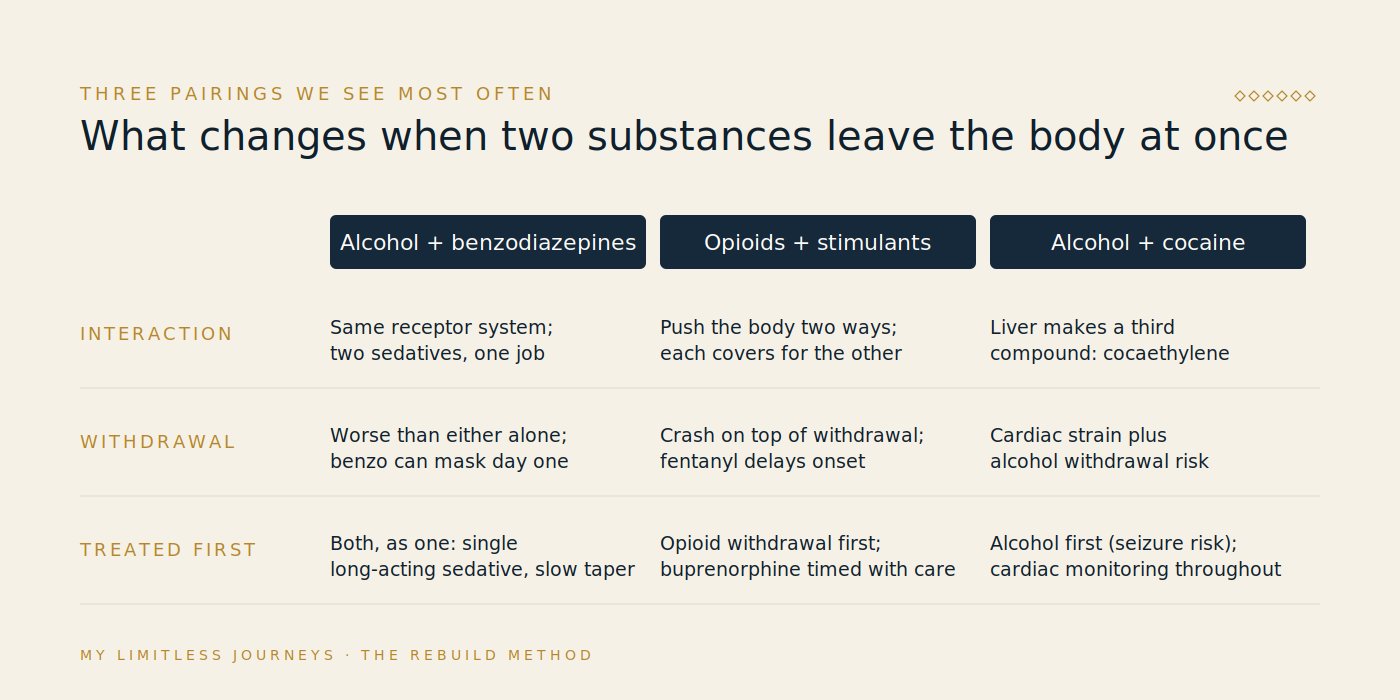
- Alcohol and benzodiazepines act on the same receptor system, so their withdrawals stack. This is the combination most likely to cause seizures or delirium if managed casually.
- Opioids and stimulants pull the body in opposite directions during use and can mask each other's withdrawal, which complicates timing, especially with fentanyl involved.
- Alcohol and cocaine together form a third compound in the liver that stresses the heart, so cardiac monitoring matters more than either drug alone would suggest.
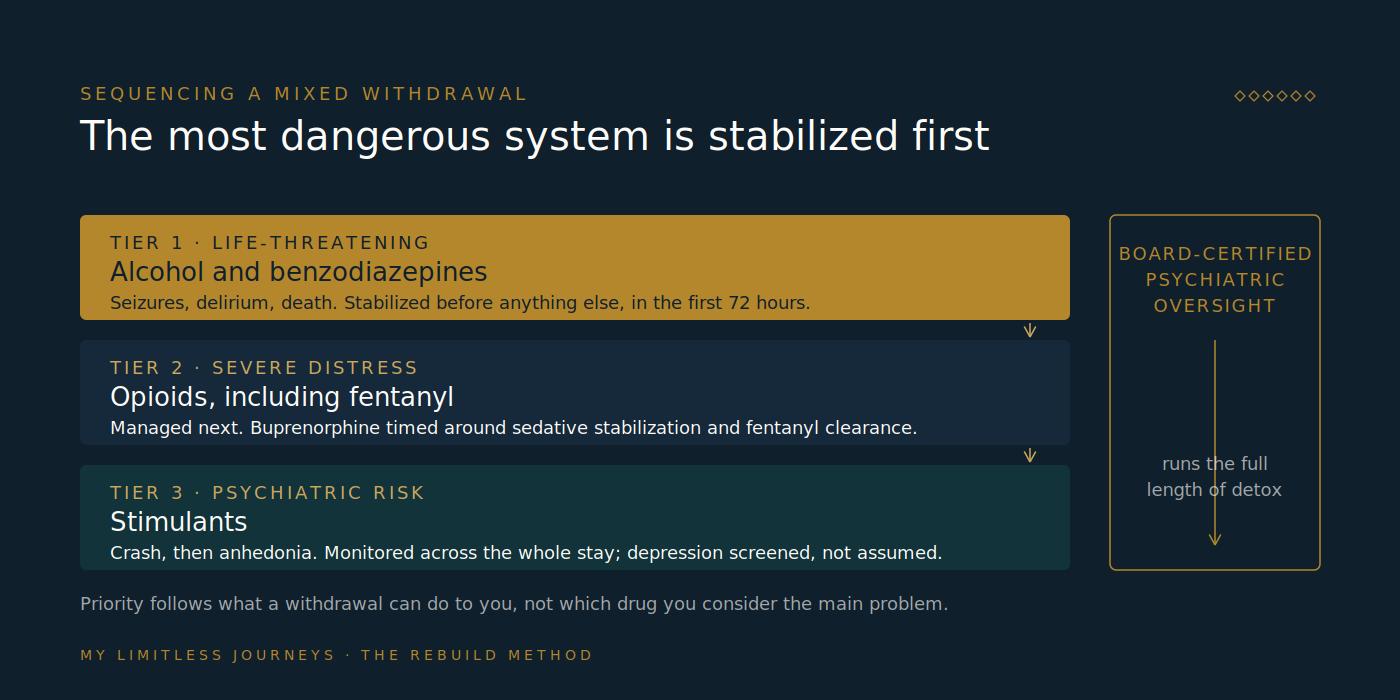
- Sequencing follows medical risk: stabilize the withdrawals that can kill first, manage the ones that cause severe distress next, and hold psychiatric oversight across the whole picture.
Why "one substance" is the exception.
Treatment literature is organized by drug. Alcohol has its chapter, opioids theirs, stimulants theirs. Real people are not organized that way. The executive who drinks heavily also takes a prescribed benzodiazepine for anxiety and, on bad weeks, both. The producer using cocaine to sustain eighteen-hour days drinks to come down. The person who started on prescription opioids after surgery now uses whatever is available, and what is available in Los Angeles is frequently fentanyl, sometimes pressed into pills that look like something else. SAMHSA's guidance on detoxification, TIP 45, devotes a dedicated discussion to polysubstance withdrawal for exactly this reason: it is not the edge case, it is the common one.
Combined use changes detox in three ways. First, the withdrawals interact. Two sedatives leaving the body at once produce a worse withdrawal than either alone, and a stimulant on board can hide the early signs of a sedative withdrawal that is about to become dangerous. Second, the timing gets complicated. Different half-lives mean different withdrawals arrive on different days, and a plan built around the first one can be caught flat by the second. Third, the history is often incomplete, not because people lie but because the pattern is genuinely hard to reconstruct, and because a pill bought outside a pharmacy may not contain what it was sold as.
The practical consequence is that polysubstance detox is a medical-planning problem before it is a medication problem. What is on board, in what amounts, for how long, and what is the sequence in which each will leave? Our detox program is built around answering those questions in the first hours, with a nurse taking the history and a board-certified psychiatrist setting the plan, because the order of operations is the whole game.
Alcohol and benzodiazepines: one receptor system, two sedatives.
Alcohol and benzodiazepines both enhance GABA, the brain's main inhibitory signal, and both suppress glutamate, its main excitatory one. Used together over time, the brain adapts to a very heavy brake and compensates by strengthening the accelerator. Remove both at once and the accelerator is unopposed. The result is the most medically dangerous withdrawal we manage: tremor, racing heart, and sweating within hours, then a real risk of seizures and of delirium, the confused, agitated, hallucinating state that in alcohol withdrawal is called delirium tremens. Our pages on the alcohol withdrawal timeline and benzodiazepine tapering cover each substance alone; together, the risks compound rather than add.
This combination has a specific trap. A person who drinks heavily and takes a daily benzodiazepine may look deceptively stable in the first day off alcohol, because the benzodiazepine is still on board doing the work alcohol used to do. If the benzodiazepine is then stopped abruptly, or simply runs out, the sedative withdrawal that was being held off arrives all at once, often on a day when everyone had begun to relax. The ASAM guideline on alcohol withdrawal management is clear that concurrent benzodiazepine use raises the risk profile and calls for a higher level of monitoring.
Clinically, the two withdrawals are managed as one. A long-acting benzodiazepine is typically used as the single sedative to cover both, dosed against symptoms in the first days and then reduced slowly, with the taper governed by the benzodiazepine history rather than the alcohol history, because benzodiazepine withdrawal runs far longer. Anticonvulsant support and thiamine repletion have their roles, described on our detox medications page. Vitals and a structured withdrawal scale are checked frequently around the clock for the first several days. Nobody with this combination detoxes at home safely, and we say so on the first phone call.
Opioids and stimulants: the masking problem.
Using an opioid and a stimulant together, whether deliberately or because the local supply is contaminated, pushes the body in two directions at once. The stimulant raises heart rate and blood pressure and suppresses the sedation and slowed breathing of the opioid; the opioid softens the stimulant's anxiety and crash. During use, each covers for the other. That is part of why the combination is so lethal in overdose: the stimulant's alertness can hide how depressed breathing has become until the stimulant wears off first. Public health surveillance in recent years has documented fentanyl involvement in a large and growing share of stimulant-related deaths, which is why we assume fentanyl exposure in anyone using non-prescribed stimulants until testing says otherwise.
In withdrawal, the masking reverses. Opioid withdrawal is a state of physiological overdrive: agitation, sweating, cramps, diarrhea, dilated pupils, a racing pulse. Stimulant withdrawal is the opposite: exhaustion, hypersomnia, heavy appetite, and a flat, low mood. When both arrive together, one can blunt the other's presentation. A person crashing from methamphetamine may sleep through the early hours of opioid withdrawal and wake into the worst of it. Someone in florid opioid withdrawal may not look like they are also in a stimulant crash until the opioid symptoms are controlled and the depression underneath becomes visible.
Fentanyl adds its own timing problem, covered in detail on our opioid and fentanyl detox page: it is stored in fat and leaves the body unpredictably, so withdrawal onset is delayed and buprenorphine induction has to be timed with care. Layer a stimulant crash on top and the clinical judgment required goes up again. The opioid withdrawal is addressed first because it is the one causing acute suffering and driving people out the door; the stimulant crash is managed with sleep, food, and psychiatric watchfulness, as described on our stimulant withdrawal page. The two plans run in parallel, under one team.
Alcohol and cocaine: the third compound.
Alcohol and cocaine are the pairing we see most often in professionals, because they are the pairing most easily hidden inside a social life. A drink softens the edge of the cocaine; the cocaine lets you keep drinking past the point where you would otherwise have stopped. What most people using them together do not know is that the liver, presented with both, produces a third active compound, cocaethylene, which lasts longer in the body than cocaine and is harder on the heart. NIDA's research report on cocaine notes that this combination carries greater cardiovascular risk than either substance alone.
For detox, that means two things. The alcohol withdrawal is the medically urgent piece and is managed as it would be alone, with sedative cover, monitoring, and thiamine. But the cardiac history gets more attention than a straightforward alcohol detox would demand: baseline heart rhythm, blood pressure trends, any history of chest pain or palpitations during use. And because the cocaine crash brings hypersomnia and low mood just as the alcohol withdrawal is producing agitation and insomnia, the person's sleep and mood can swing in ways that look alarming and are, mostly, the two withdrawals overlapping.
There is also a behavioral piece. The drinking and the cocaine are usually wired to the same settings, the same people, and the same hours, so the craving work that begins in residential treatment has to address them as a unit rather than as two habits. That is not a detox task, but the detox team hands over the whole picture, not half of it.
Sequencing: what gets treated first, and why.
The principle is simple and the execution is not. Withdrawals are prioritized by what they can do to you, not by which drug you consider your main problem. A client may be far more worried about their opioid use than about the nightly wine and the occasional pill, and still the wine and the pill are what the medical plan is built around in the first seventy-two hours, because those are what can cause a seizure.
| Withdrawal | Principal risk | Priority | Typical approach |
|---|---|---|---|
| Alcohol / benzodiazepines | Seizures, delirium, death | First; stabilize before anything else | Single long-acting sedative covering both, frequent monitoring, then a slow taper |
| Opioids / fentanyl | Severe distress, dehydration, leaving treatment, overdose after tolerance drops | Concurrent, once sedative withdrawal is controlled | Carefully timed buprenorphine induction, comfort medications, continued into residential |
| Cocaine / methamphetamine | Depression, suicidal thinking, psychosis | Throughout; psychiatric oversight from day one | Sleep, nutrition, structure, daily mood and safety assessment |
Two sequencing rules follow. Never taper two sedatives independently; consolidate to one and taper that. And never let the treatment of one withdrawal blind you to the arrival of another: the day the alcohol symptoms settle is often the day the fentanyl withdrawal begins in earnest, and the week the opioid symptoms lift is when the stimulant depression becomes visible. The plan is written for the whole arc, and it is rewritten as the arc unfolds.
What the assessment has to catch.
Polysubstance detox is only as safe as the history it is built on. On the admissions call and again at intake, we ask about every substance, including the ones that do not feel like the problem: the nightly drinks, the sleep aid, the prescribed anxiety medication, the occasional stimulant on a deadline, cannabis, nicotine. We ask when each was last used, how much, how often, and for how long, and we ask again in a day or two, because memory improves once the first hours have passed.
We also test. A urine screen on arrival confirms what is on board and frequently reveals what was not expected, including fentanyl in people who believed they were using only cocaine or a pressed benzodiazepine. Baseline blood work checks liver function, electrolytes, and blood counts, all of which shape medication choices. Where heavy alcohol use is part of the picture, thiamine repletion begins before anything else, because Wernicke's encephalopathy is preventable and catastrophic. Where cocaine and alcohol travel together, we look harder at the heart.
And we assess the mind. Polysubstance use is very often self-treatment for something: anxiety held down by alcohol and benzodiazepines, depression papered over by stimulants, trauma quieted by opioids. Our psychiatrist's first evaluation is not only about safe withdrawal. It is the beginning of the co-occurring disorder assessment that will shape the rest of your stay, because when the substances clear, whatever they were managing is still there.
How polysubstance detox runs at MLJ.
The first hours belong to the history, the tests, and the plan. A nurse takes the full substance timeline, draws baseline labs, records vitals, and begins a structured withdrawal assessment. Our board-certified psychiatrist reviews the picture the same day and writes a plan that names each withdrawal, the order in which each is addressed, and what would change the plan. Nursing coverage is continuous through the highest-risk window, with vitals and withdrawal scores checked frequently overnight in the first days, because the dangerous hours in sedative withdrawal are rarely the daytime ones.
Six beds matter here more than anywhere. A mixed withdrawal presents differently every day, and the person who noticed you were unusually confused at 2 a.m. on day two needs to be the same person, or on the same small team, as the one who sees you at breakfast. There is no shift report that captures what a single clinician who has been watching you for thirty hours knows. That continuity is what a true 1:1 ratio buys, and polysubstance detox is where we spend it.
When the acute phase passes, usually within a week for the sedative and opioid components and longer for the stimulant depression, you do not transfer anywhere. You move down the hall into residential treatment with the same psychiatrist, the same nurses, and a plan that already knows the whole story.
- Medical detox at MLJ. The hub for how the first week runs, and who needs it.
- Benzodiazepine tapering. Why the sedative taper governs the timeline when alcohol and benzos overlap.
- Opioid and fentanyl detox. Fentanyl's timing problem and how induction is handled.
- Detox medications, explained. What each medication does and what it is not.
- Detox and residential program. How the acute phase flows into the rest of the stay.
- Co-occurring disorders. What the substances were often managing, and how that is treated.
This guide is educational and is not a substitute for medical advice. If someone is in immediate danger, call 911.