
What "medically supervised" actually means.
Almost every program uses the phrase. It should mean a nurse who is awake, a physician who is accountable, vital signs on a schedule, medication given by protocol, and a clear rule for when someone goes to the hospital. Here is what to expect, and what to ask.
Authored by the MLJ Clinical Team. Reviewed under board-certified psychiatric oversight. Last updated September 2026.
Key Takeaways- "Medically supervised" is not a regulated phrase; the substance behind it is nursing coverage, physician orders, a vitals schedule, and written medication protocols.
- Withdrawal from alcohol and benzodiazepines can be life-threatening; opioid, stimulant, and polysubstance withdrawal each carry different risks that change what monitoring looks like.
- Vitals and withdrawal scales are checked most often in the first 72 hours and taper as the picture stabilizes.
- A well-run detox has explicit transfer criteria and a relationship with a nearby hospital; needing that transfer is not a failure.
- "Social detox" means observation without medical management, and it is not appropriate for alcohol or benzodiazepine dependence.
The same phrase, three different buildings.
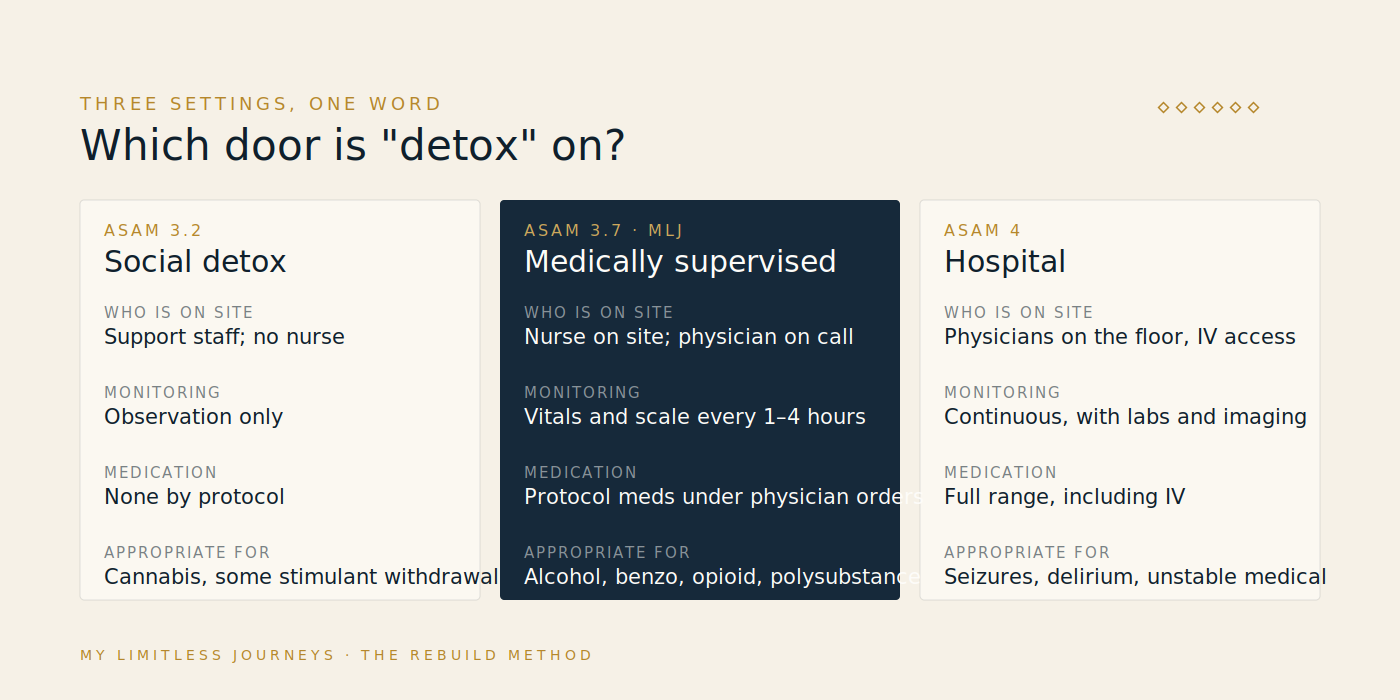
Detox happens in three kinds of settings, and marketing language blurs them. At one end is the hospital: physicians on the floor, intravenous access, and the capacity to manage seizures, cardiac events, and severe delirium. At the other end is social detox: a safe, supportive place to be uncomfortable, with staff who observe and encourage but do not prescribe or monitor on a medical schedule. In the middle is medically supervised detox in a residential setting: nurses on site, a physician directing care around the clock, medications by protocol, and a defined pathway to the hospital when the picture exceeds what the setting can safely handle.
In the ASAM framework, those three roughly correspond to Level 4, Level 3.2, and Level 3.7 withdrawal management. The Substance Abuse and Mental Health Services Administration's Treatment Improvement Protocol 45 remains the standard reference on how these settings differ and who belongs in each. MLJ provides Level 3.7 detox inside our six-bed residence. This page describes what that middle tier should contain so you can compare any program's answer, including ours, against it. Our guide to the ASAM criteria explains how the level gets chosen.
Nursing coverage: who is awake.
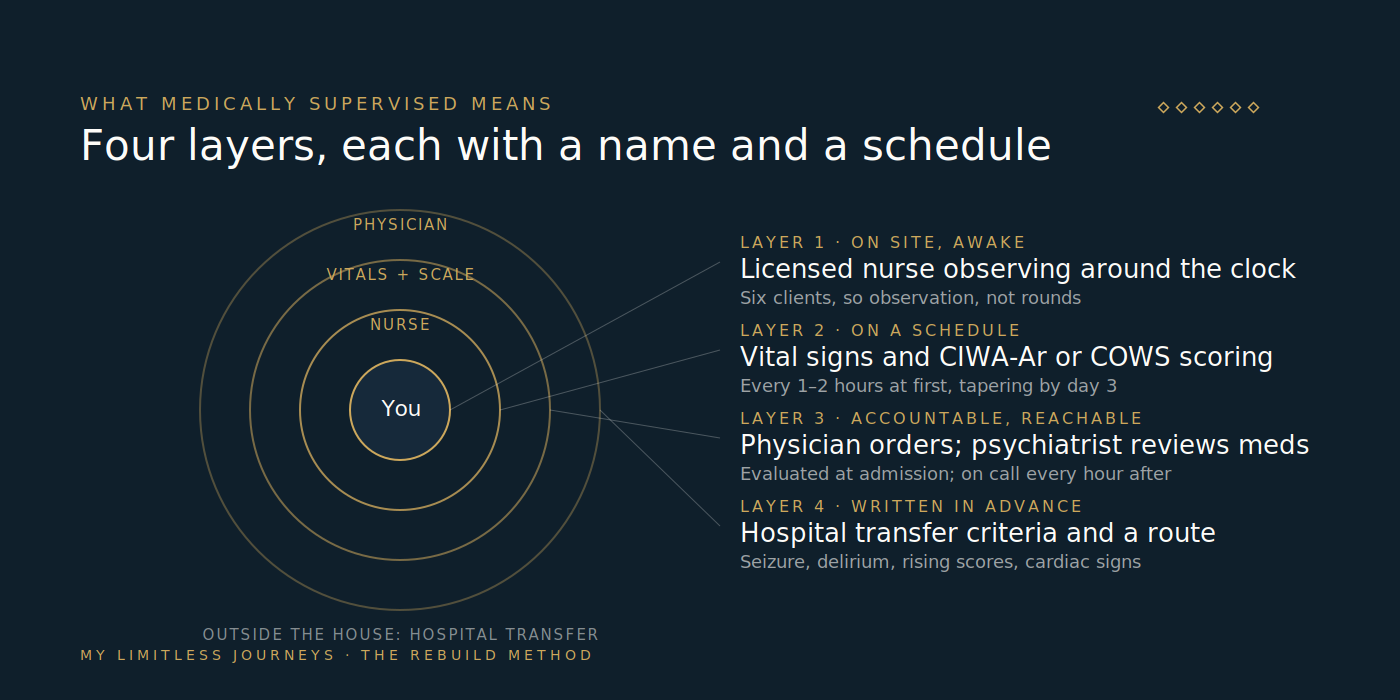
The first question to ask any detox is who is physically present at three in the morning, and what their license is. "24-hour staff" can mean a house manager with a phone number to call. Medically supervised should mean a licensed nurse on the premises during the acute phase, with the authority to assess, administer medications under physician orders, and escalate. Nurses notice that a pulse has climbed from 88 to 118 over two hours, that a tremor has become coarse, or that a client who was oriented at dinner is now confused. Those observations separate a rough night from a medical emergency caught early.
Six beds changes the arithmetic here. A nurse covering thirty clients is doing rounds; a nurse covering six is doing observation. Because our detox and residential program shares one clinical team, the nurse who sits with you on night two belongs to the same team running your individual sessions a week later; your withdrawal course is known, not summarized in a transfer note. Nursing also owns the unglamorous work the Body domain of the Rebuild Method takes seriously: fluids, electrolytes, food that stays down, and the beginning of sleep. Our page on sleep in early recovery covers why that last item matters so much.
Physician oversight and standing orders.
Nurses act on orders, and orders come from a physician. In a medically supervised detox, a physician evaluates you at or shortly after admission, either in person or through a detailed nursing assessment reviewed in real time, and writes an individualized plan: which withdrawal scale to use, how often to score it, which medications to give and at what thresholds, what laboratory work to draw, and what findings require a call. That physician remains reachable around the clock for the duration of detox. At MLJ, psychiatric oversight sits alongside medical oversight from the first day, because the medication list of a person arriving in withdrawal frequently includes antidepressants, mood stabilizers, stimulants, or sleep aids that interact with what detox requires. The psychiatrist reviews that list before your first night, and adjustments are made deliberately rather than by omission.
Standing orders are the written protocols that let nurses respond without waiting for a callback: what to give when a withdrawal score crosses a line, when to recheck, when to hold a dose, when to call. Their existence means the program has anticipated the common trajectories rather than improvising. Their limits matter too: a protocol with no "call the physician now" threshold and no transfer criterion belongs to a program that has not thought about what happens when things go badly. Asking a facility "what is your protocol for alcohol withdrawal, and who wrote it?" is entirely reasonable. Our twelve questions include it.
Vital signs and withdrawal scales, by the hour.
Two kinds of measurement run through a detox: ordinary vital signs, and a structured withdrawal scale, scored by a nurse, that turns symptoms into a number so trends are visible and medication decisions are consistent. For alcohol, the most widely used is the Clinical Institute Withdrawal Assessment for Alcohol, revised, known as CIWA-Ar. For opioids, it is the Clinical Opiate Withdrawal Scale, or COWS. ASAM's clinical practice guideline on alcohol withdrawal management describes how scale scores should drive both medication and level-of-care decisions.
The cadence is front-loaded. Risk peaks in the first three days for alcohol and the first several days for short-acting benzodiazepines, and monitoring follows that curve. The table below reflects a typical schedule for an uncomplicated alcohol detox; your own plan may be more frequent depending on history and scores.
| Phase | Vital signs | Withdrawal scale | What the team is watching for |
|---|---|---|---|
| Admission | Full set, plus history and labs as ordered | Baseline score | Time since last use, prior seizures or delirium, co-occurring medical risk |
| Hours 0–24 | Every 1–2 hours while awake; overnight checks | Every 1–2 hours, more often if rising | Rising pulse and pressure, tremor, sweating, agitation, early confusion |
| Hours 24–72 | Every 4 hours | Every 4 hours | Peak seizure and delirium window; hallucinations; sleep and intake |
| Days 3–7 | Two to three times daily | Daily or as scores warrant | Lingering anxiety and insomnia; readiness to begin full clinical programming |
Benzodiazepine detox follows a longer, slower arc because the safe approach is a gradual taper rather than abrupt cessation; our guide to benzodiazepine tapering explains why weeks, not days, is the right unit. Opioid withdrawal is monitored just as closely, but for dehydration, distress, and the temptation to leave rather than seizures. When several substances are involved, the schedule follows the most dangerous one, which is the subject of our page on polysubstance detox.
Medication protocols.
Detox medication has two aims: prevent dangerous complications, and make withdrawal tolerable enough that you stay. For alcohol, the mainstay is a benzodiazepine, given either on a fixed taper or, more commonly now, on a symptom-triggered basis where each dose is tied to a withdrawal score. Symptom-triggered dosing uses less medication over a shorter period, but depends on frequent, accurate scoring, which is why the nursing cadence above matters. Thiamine and other B vitamins are given routinely because heavy drinking depletes them and deficiency can cause lasting neurological harm. Our post on nutrition in alcohol withdrawal goes deeper on that point.
For opioids, including fentanyl, the protocol usually centers on buprenorphine, started once withdrawal is sufficiently established to avoid precipitating it, with supportive medications for nausea, cramping, and sleep. For stimulants there is no specific withdrawal medication; care is about sleep, nutrition, hydration, and watching mood closely, because the crash can include profound depression. The full picture is on our page about detox medications. What we will not do is sedate you into silence for a week and call it treatment; the goal is a person medically stable and awake enough to begin clinical work by the end of the first week.
When someone goes to the hospital.
Every residential detox has a ceiling, and an honest one tells you where it is. Transfer criteria are written down before they are needed. Ours include a seizure at any point, signs of delirium tremens such as severe confusion with autonomic instability, a withdrawal score that keeps rising despite protocol medication, chest pain or cardiac irregularity, dangerously abnormal vital signs, uncontrolled vomiting with signs of dehydration, and any acute psychiatric emergency that cannot be safely managed in a residential setting. When a criterion is met, the nurse calls the physician and, in parallel, arranges transport to a nearby emergency department. We do not wait for the callback to start moving.
Two things are worth knowing about transfers. First, they are not common in a well-screened detox, precisely because the admissions call asks about seizure history, medical conditions, and quantity of use so that people who need a hospital from the outset are routed there directly. Second, a transfer is a pause, not an ending. Your bed is held, your clinical team is the same one you left, and detox resumes where it was interrupted. People sometimes hear "we may need to send you to the hospital" as a threat; it is a sign that the program has decided in advance to put your safety ahead of its census.
What "social detox" is, by contrast.
Social detox, sometimes called social-setting or non-medical detox, provides a safe place to withdraw with peer and staff support but without on-site nursing, physician orders, or protocol medication. It has a legitimate place. For someone withdrawing from cannabis or stimulants with no medical complications or psychiatric crisis, a supportive environment and time may be all that is required. Its limits are equally clear. Alcohol and benzodiazepine withdrawal can escalate to seizures without warning, and the National Institute on Alcohol Abuse and Alcoholism is explicit in its clinical resource that severe withdrawal is a medical condition requiring medical management.
The practical problem is that some facilities describe social detox in language that sounds medical. "Around-the-clock support," "detox services," and "medical staff on call" can each be technically true of a house with no nurse in it. The questions that cut through are concrete: Is a licensed nurse physically present overnight? Who is the physician, and when will they evaluate me? What withdrawal scale do you use and how often? What are your transfer criteria? A program that provides genuine medical supervision will answer all four without hesitation, and if you are comparing the option of detoxing at home, our guide on medical detox versus quitting at home lays out that decision honestly.
- Treatment Guidance. Every level-of-care and detox question in one hub.
- Medical detox vs quitting at home. The decision this page's criteria inform.
- Detox timelines by substance. How long each phase above lasts for alcohol, opioids, benzodiazepines, and stimulants.
- Alcohol withdrawal timeline. The hour-by-hour risk curve that sets the monitoring schedule.
- Detox and residential program. How Level 3.7 detox works inside our six-bed residence.
- Exercise as pharmacology in detox. What the Body domain adds once you are medically stable.
This guide is educational and is not a substitute for medical advice. If someone is in immediate danger, call 911.