
Stimulant withdrawal: the crash, the sleep, and the flat weeks after.
Coming off cocaine, methamphetamine, or prescription amphetamines rarely puts you in physical danger the way alcohol or benzodiazepines can. The danger is quieter: exhaustion, a mind that feels switched off, and a depression that can turn serious. Here is what to expect, and why the right supervision is psychiatric.
Authored by the MLJ Clinical Team. Reviewed under board-certified psychiatric oversight. Last updated September 2026.
Key Takeaways- Stimulant withdrawal has no seizure risk and no medication that "reverses" it, so many programs treat it casually; that is a mistake.
- The first two to four days are a crash: long sleep, heavy appetite, low mood, and little else. Most people feel physically wretched but medically stable.
- From roughly day three through week two, the harder phase arrives: anhedonia, poor concentration, vivid dreams, and cravings that surface when the exhaustion lifts.
- The medical risk in this period is depression, including suicidal thinking, which is why stimulant detox at MLJ runs under board-certified psychiatric oversight rather than nursing alone.
- Sleep, food, movement, and daylight are not comfort measures here. They are the treatment, and we schedule them as clinical work.
- Why there is no "stimulant detox protocol," and why that is misleading
- The first 72 hours: the crash
- Days three to fourteen: anhedonia and the depression question
- Cocaine, methamphetamine, and prescription amphetamines: what differs
- Why psychiatric oversight is the actual medical protocol
- Sleep and nutrition as treatment, not comfort
- What the first two weeks look like at MLJ
Why there is no "stimulant detox protocol," and why that is misleading.
If you search for stimulant detox you will find a strange gap. Alcohol withdrawal has a validated scoring tool and a medication class that prevents seizures. Opioid withdrawal has a well-studied induction protocol. Stimulants have neither. The Food and Drug Administration has approved no medication for cocaine or methamphetamine use disorder, and SAMHSA's treatment guidance for stimulants, TIP 33, is candid that withdrawal management is largely supportive: rest, hydration, food, a safe environment, and treatment of whatever symptoms appear.
Some programs read that gap as permission to skip the medical part entirely. A person who has been awake for four days on methamphetamine gets a bed and a closed door and is checked on at meals. Physically, that is usually survivable. Clinically, it misses the point. What stimulant withdrawal lacks in seizure risk it makes up for in psychiatric risk, and psychiatric risk is harder to see from a hallway. The absence of a pharmacological protocol does not mean the absence of a medical one. It means the medicine is observation, assessment, and a psychiatrist who knows what a dangerous day three looks like.
That framing shapes how we run detox at MLJ. With six beds and a 1:1 clinical ratio, nobody spends the crash alone behind a door. Somebody knows how long you slept, whether you ate, and whether the flatness that follows is ordinary withdrawal or the start of something that needs treatment in its own right.
The first 72 hours: the crash.
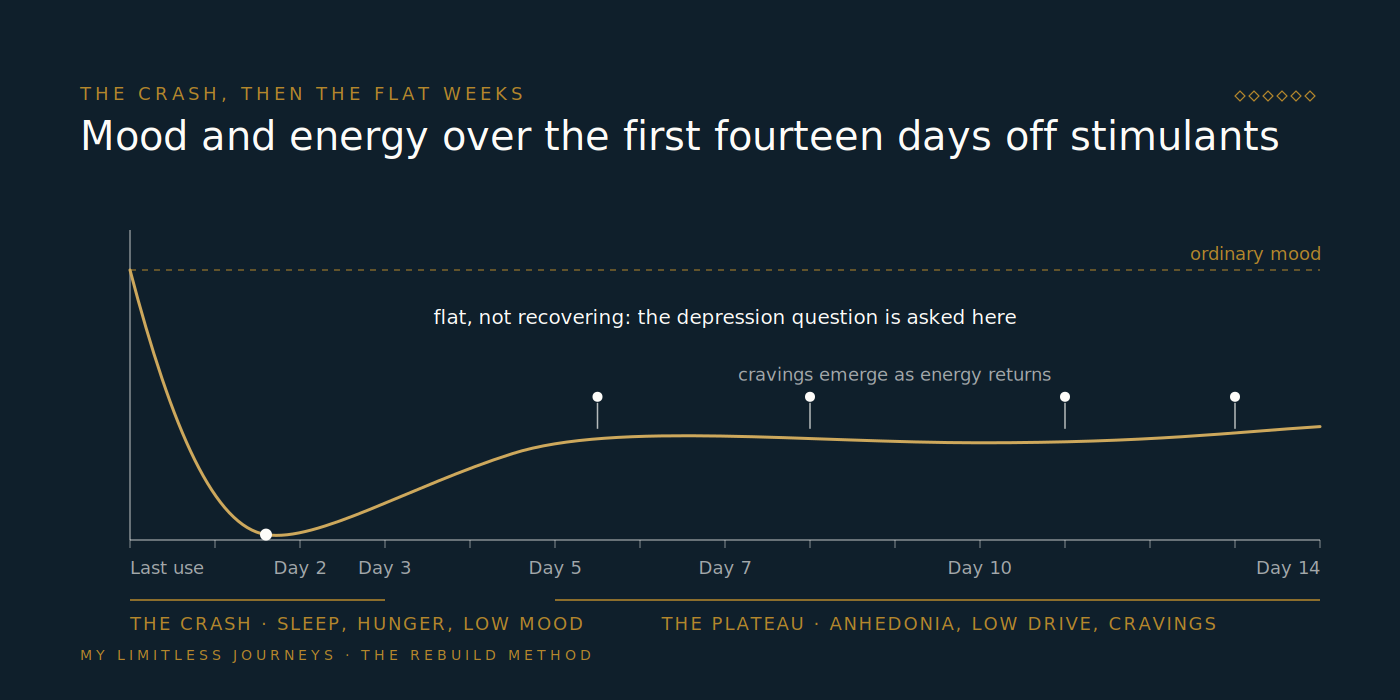
Stimulants work by flooding the brain's reward circuits with dopamine and norepinephrine and blocking their reuptake. Over days or weeks of heavy use, the brain compensates by reducing its own dopamine signaling. When the drug stops, the compensation is still there and the flood is gone. The result is the opposite of the high: profound fatigue, hunger, low mood, slowed thinking, and a need for sleep that can run twelve to eighteen hours a day. NIDA's research reports on cocaine and methamphetamine describe this early phase as the most predictable part of the picture.
For someone arriving after a multi-day binge, the crash often begins within a few hours of the last use and is deepest between about hour 12 and hour 72. People sleep, wake to eat enormous meals, and sleep again. Some are irritable and tearful; many are simply absent. Blood pressure and heart rate, elevated during use, typically settle. Headaches, muscle aches, and a slowed, heavy quality to movement are common. If methamphetamine use involved days without food or water, we also watch for dehydration and the dental and skin problems that ride along with it.
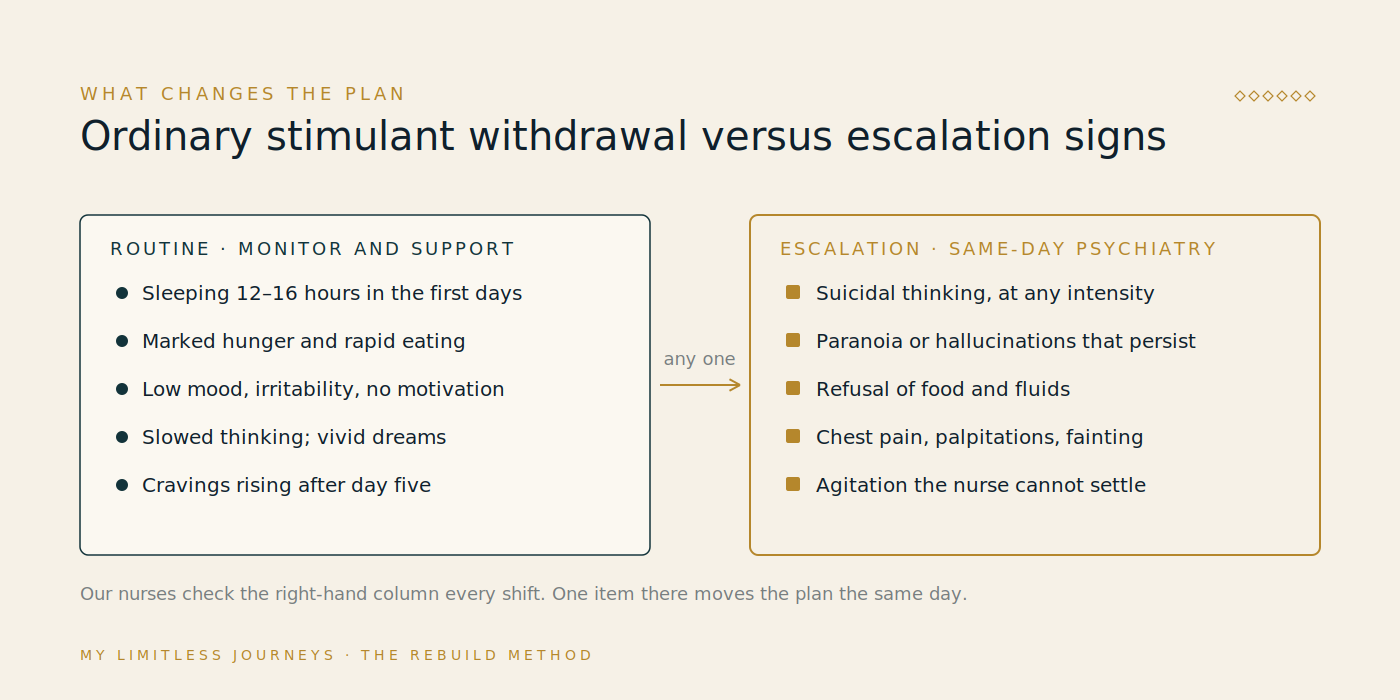
Two things matter medically here. The first is what else is on board: many people use alcohol or benzodiazepines to come down, and those withdrawals carry real physical danger, which is why our polysubstance detox page exists. The second is the mental state on waking. A person who surfaces from sixteen hours of sleep and says, flatly, that they wish they had not is telling us something a vitals check will not capture. Our nurses ask, and our psychiatrist hears about it the same day.
Days three to fourteen: anhedonia and the depression question.
Around day three or four the sleep starts to normalize and the appetite eases. This is the moment families often relax, and it is the moment clinicians lean in. Because as the exhaustion lifts, what it was covering becomes visible: a flat, grey inability to feel pleasure that the literature calls anhedonia. Food tastes like nothing. Conversation feels like effort. A person who was frenetic a week ago now sits in a chair for an hour without moving. Concentration is poor, dreams are vivid and often about using, and cravings, muted during the crash, return with a clarity that catches people off guard.
Studies that tracked people through methamphetamine withdrawal found the most intense symptoms peaked within the first day or two and eased over about a week, while lower-grade depressive symptoms and cravings persisted for several weeks in a meaningful subset. Cocaine follows a similar shape on a shorter timeline. The clinical question during this plateau is not "is this withdrawal?" but "is this only withdrawal?" Stimulant use disorders travel with high rates of major depression, bipolar disorder, ADHD, and trauma, and stimulants are remarkably good at masking all four.
The stakes are specific. The depressive dip after heavy stimulant use is a recognized period of elevated suicide risk, especially in methamphetamine withdrawal and in people with a prior history of depression. It is also the window in which many people leave treatment, not in a crisis but in a flat "this isn't working" that is itself a symptom. We say this plainly to every client and family before day three arrives, because knowing the flatness is expected and monitored changes how it feels to sit inside it. Our page on leaving treatment early covers that conversation.
Cocaine, methamphetamine, and prescription amphetamines: what differs.
The three stimulants we see most share a withdrawal shape but differ in tempo. The table is a generalization; your course depends on dose, duration, route, sleep debt, and what else you were using.
| Substance | Onset and crash | Plateau | What we watch most |
|---|---|---|---|
| Cocaine | Short half-life; crash within hours, deepest in the first one to three days | Anhedonia and cravings peak in week one; most symptoms ease by week two | Cardiac history, concurrent alcohol use, cue-driven cravings |
| Methamphetamine | Longer half-life; crash may be delayed a day, then deep, with very long sleep | Slower; depressive symptoms and cognitive fog can run two to four weeks or longer | Suicidal thinking, lingering paranoia or psychosis, dehydration, dental and skin infections |
| Prescription amphetamines | Depends on formulation; often a gentler but still real crash within a day | Fatigue, low mood, and poor focus for one to three weeks | The underlying ADHD question, and whether "focus" was actually the drug managing anxiety |
Methamphetamine deserves a specific note. Heavy use can produce paranoia and hallucinations that usually resolve within days of stopping but sometimes do not, and persistent psychosis is a medical situation, not a personality trait. Prescription amphetamines deserve a different one. Many professionals who come to us started with a legitimate prescription for ADHD and escalated. Whether to resume any stimulant treatment later is a serious question our psychiatrist takes up once the acute phase has passed, not in the first week.
Why psychiatric oversight is the actual medical protocol.
At MLJ, every stimulant detox is directed by a board-certified psychiatrist from the day of admission. Not because we expect to prescribe heavily; often we prescribe very little in the first days, because the body needs sleep and food more than medication. It is because the decisions that matter here are psychiatric: whether a depressed mood on day five is withdrawal or a depressive episode that predates the drug, whether racing thoughts on day eight are rebound or hypomania, whether a client's insistence that a colleague is monitoring them is residual paranoia or something that will need an antipsychotic, and whether the person in front of us is safe.
When medication is used, it is for specific reasons, described plainly. Short-term sleep support may be appropriate if the crash does not bring sleep on its own. Antidepressant treatment is considered when a depressive syndrome persists beyond what withdrawal explains. Antipsychotic medication is reserved for psychosis that does not resolve as the drug clears. No medication removes stimulant cravings, and anyone who says otherwise is selling something. What reduces cravings over time is sleep, nutrition, structured days, and therapy, which is why our detox flows directly into residential treatment with the same team. Six beds make that oversight practical: our psychiatrist knows what you looked like on Tuesday and can see the difference on Thursday.
Sleep and nutrition as treatment, not comfort.
In the Rebuild Method, the Body domain treats sleep, food, and movement as clinical work with goals and a schedule, not as amenities. Nowhere is that more literal than in stimulant withdrawal. Stimulants suppress appetite and sleep; the crash is the body collecting on a debt, and we let people pay it. In the first three days we do not wake clients for programming, only for food, fluids, and a brief check. The kitchen keeps dense, easy meals available at odd hours because a person who last ate properly nine days ago should not wait for a scheduled lunch.
From day three or four, permission gives way to structure. Unchecked hypersomnia slides into a reversed sleep schedule and a deeper depressive rut, so we anchor wake time, get people into morning daylight, and walk. Movement in this phase is gentle and non-negotiable: a slow walk on the hillside, not a workout. There is reasonable evidence that regular aerobic activity improves mood and reduces cravings in stimulant recovery; our post on exercise as pharmacology in detox lays out why. Meals move to a regular rhythm with protein at each one, because the flat weeks are not helped by a blood-glucose roller coaster. None of this is glamorous. It is also the most effective treatment available for the first two weeks off stimulants, and a clinician who walks with you at 8 a.m. because the walk is the medicine is doing clinical work.
What the first two weeks look like at MLJ.
You arrive at a private home in the Encino hills, not a ward. A nurse completes intake, including a careful history of everything you have used and when, and our psychiatrist sees you within the first day. If you are exhausted, the first assessment is short and you go to bed. If you are still wired from a recent binge, we keep you safe and comfortable while it passes.
Days one through three are the crash, and we let it be the crash. Days four through seven, structure enters: wake times, meals, daylight, movement, and short individual sessions while concentration is poor. From the second week you are typically in the full residential day, which for stimulant clients leans early on CBT for cue and craving work, sleep restoration, and a frank psychiatric assessment of whatever the drug was covering. The nurse who sat with you on night two is the nurse you see in week four. For a withdrawal whose main risk is being misread, that continuity is the protocol.
- Medical detox at MLJ. The hub for how we run the first week, substance by substance.
- Polysubstance detox. Most stimulant users also drink or use sedatives, which changes the medical picture.
- Sleep in early recovery. Why sleep breaks after stimulants and what returns when.
- Cocaine addiction treatment. What happens after detox, in residential and beyond.
- Anhedonia in early recovery: week three. A closer look at the flat weeks and how they lift.
This guide is educational and is not a substitute for medical advice. If someone is in immediate danger, call 911.