
Brilliant in bursts. Exhausted in between.
Adult ADHD is a regulation problem, not a character problem, and it hides comfortably inside a successful career. It also has a long, well-documented relationship with stimulants, alcohol and cannabis. This page is honest about both.
Authored by the MLJ Clinical Team. Reviewed under board-certified psychiatric oversight. Last updated September 2026.
Key Takeaways- ADHD in adults shows up as time blindness, abandoned systems, deadline heroics and emotional dysregulation more than as hyperactivity.
- Adults with ADHD are substantially more likely to develop a substance use disorder, and the substance is usually doing a job the executive system cannot.
- Prescription stimulant misuse is common, socially rewarded in high-pressure work, and rarely called a drug problem by the person doing it.
- ADHD cannot be diagnosed reliably during active stimulant use or early withdrawal. It takes a clean interval, a developmental history and collateral information.
- Untreated ADHD is itself a relapse risk. The question is not whether to treat it but how to treat it safely.
What adult ADHD actually looks like.
The childhood picture of a boy who cannot sit still has done adults a disservice. In grown-ups the disorder is mostly internal: a working memory that drops things, a sense of time with only two settings, now and not-now, and an effort system that will not engage for anything unimportant, however consequential. The National Institute of Mental Health describes inattention, hyperactivity and impulsivity as the three symptom groups; adults usually carry the first and a restless version of the others.
Diagnosis requires that several symptoms were present before age twelve, appear in more than one setting, and genuinely impair functioning. An analysis of the National Comorbidity Survey Replication put adult prevalence at roughly 4.4 percent, most of it untreated.
In the clients we see, ADHD looks like competence bought at an unsustainable price. Nothing gets done until the deadline supplies the adrenaline the brain cannot manufacture. Systems get built brilliantly and abandoned in three weeks. Email is a graveyard. Underneath sits the part clinicians used to leave out: emotional dysregulation, a short fuse in people who are otherwise thoughtful, and a sensitivity to criticism that can flatten a day. Our post on emotional dysregulation in ADHD goes further into that piece.
Why the substances arrive.
The National Institute on Drug Abuse lists ADHD among the conditions most consistently linked to substance use disorders, and the link holds across substances rather than pointing at one.
Each drug does something specific. Cocaine and methamphetamine are close cousins of the medication, and people describe their first use not as a high but as relief, the first quiet hour they can remember. Alcohol and cannabis work at the other end, braking a mind that will not stop long enough to sleep. None of this is recreational in the way the word implies. It is a person solving a real problem with the tools available.
Impulsivity does the rest. The trait that makes a person interrupt a meeting makes them accept the second line, the third drink, the pill offered at the end of a long shoot. Our pages on cocaine addiction and methamphetamine addiction cover the physical side.
Prescription stimulants, honestly.
Prescribed stimulants are effective medications and among the most misused controlled substances in the country. NIDA's summary of prescription stimulants defines misuse as taking more than prescribed, taking someone else's, or taking a medication in a way it was not intended. Almost nobody in that description would call themselves a drug user.
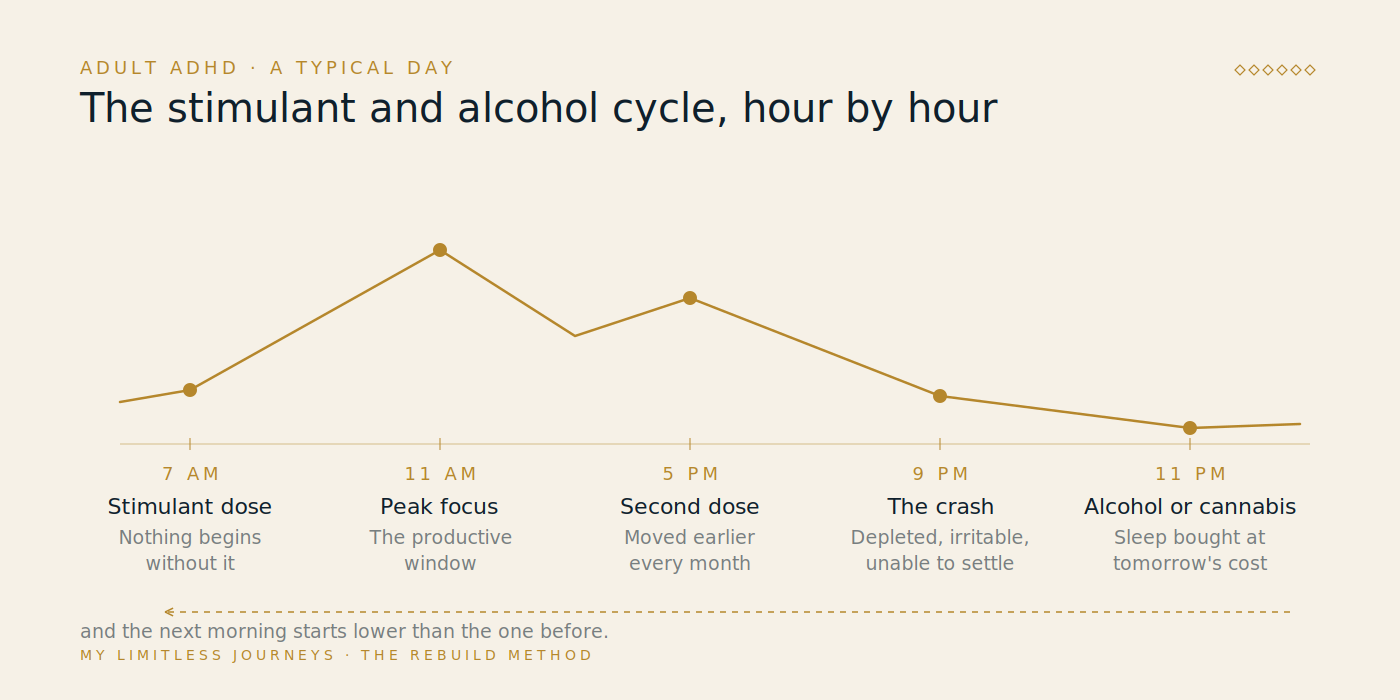
In the professionals we treat, the pattern is consistent. The prescription is real. The dose starts as written. Then a deadline arrives, the second dose moves earlier, and a month later the month's supply lasts three weeks. Because the drug improves output, everyone around it rewards the escalation, and the first evidence of trouble is sleep, then a resting heart rate a physician mentions in passing. At high or sustained doses stimulants can produce dangerous blood-pressure elevations, cardiac symptoms and, occasionally, paranoia or frank psychosis.
We say this without moralizing; moralizing has never helped anyone hand over a bottle. But we will not pretend the medication was innocent, and we will not simply re-prescribe on arrival. Our page on prescription drug misuse covers those conversations.
Why we wait to diagnose.
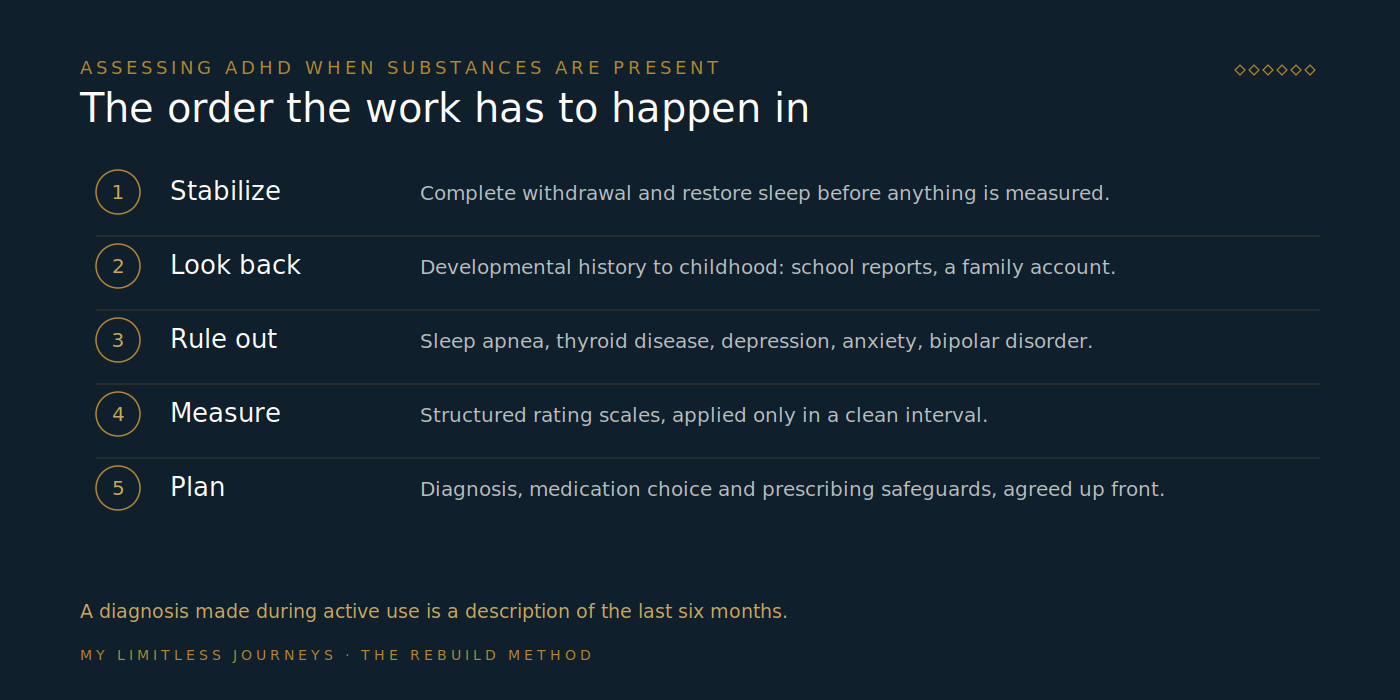
Heavy stimulant use produces inattention, irritability and disorganization. So does alcohol. So does three years of five-hour nights. Sit any of those people in front of a rating scale and they will screen positive, because the scale measures symptoms, not causes. It is the most common reason a diagnosis does not hold up.
So we sequence it. Withdrawal is completed and sleep restored first. Then our psychiatrist takes a developmental history reaching back to childhood: the report-card comments, the conversations with teachers, the pattern visible long before any substance existed. Where a client agrees, we ask a parent, sibling or partner for their account, because self-report alone is thin evidence in either direction.
Sleep apnea, thyroid dysfunction, depression, anxiety and bipolar disorder all imitate ADHD and are treated differently, so they are ruled in or out on the way through. Only then do the structured scales mean anything. Sometimes the ADHD is real and lifelong. Sometimes the attention problem was the drug. Both answers are useful, and worth the two or three weeks they cost.
Stimulant withdrawal, and what it takes.
Stopping stimulants is not usually medically dangerous the way alcohol or benzodiazepine withdrawal can be, and that fact has been used for years to argue stimulant users do not need supervised care. In practice the risk is psychiatric rather than cardiovascular. The crash brings profound fatigue, long sleep, flattened mood, and in the first week or two the kind of anhedonia that makes people say nothing will ever be interesting again. Suicidal thinking is not rare in that window, which is why it is monitored in a house with staff rather than at home.
No approved medication shortens it, so the work is supportive and unglamorous: sleep, food, gentle movement, daylight, and clinicians who keep saying the flatness lifts. Our page on stimulant withdrawal sets out the timeline; where alcohol, benzodiazepines or opioids are also present, polysubstance detox explains how competing protocols are sequenced.
Medication when there is a use history.
Two things are true at once, and holding both is the job. Stimulants are the most effective treatment for ADHD, and they are controlled substances with a real misuse profile in someone who has already misused them. The answer is not abstinence from treatment. Untreated ADHD leaves the impulsivity, boredom intolerance and sleep disruption intact, and those are relapse drivers in their own right. A large study published in the American Journal of Psychiatry found fewer substance-related problems during periods when patients were taking ADHD medication than during periods when they were not.
Where misuse risk is high we usually start with a non-stimulant. Atomoxetine and viloxazine are approved for adults and are not controlled substances; bupropion and guanfacine are used in selected cases under psychiatric supervision. They work more slowly and less dramatically than a stimulant, and we say so rather than overselling them.
Where a stimulant is genuinely indicated, it is prescribed inside a structure agreed in advance: one prescriber, long-acting formulations, staff-controlled dispensing in residential care, the state monitoring database checked, no early refills, and periodic screening framed as support rather than punishment. Clients who have misused their own medication for years often find that structure a relief.
ADHD through the four domains.
The Rebuild Method suits this diagnosis, because ADHD is treated as much by environment as by prescription.
Body. Sleep is the first medicine. Almost every adult with ADHD who reaches us has a disordered sleep schedule, and attention improves before any prescription changes. Exercise is clinical work here rather than recreation, because for this population it reliably improves focus for hours afterward.
Mind. Diagnostic clarity, medication management, and cognitive behavioral work adapted for ADHD, which is less about disputing thoughts than building external systems that do not depend on remembering. The shame carried by adults called lazy for thirty years is treated directly.
Life. This is where the treatment actually happens. Daily structure, one calendar, one capture list, planning sessions with a clinician, and life skills work rehearsed until the systems are portable enough to survive your real inbox.
Self. Many clients have built an identity around being the person who pulls it off at the last second, so removing the chaos can feel like removing the talent. Values work separates the two, so what you are good at survives the loss of what was hurting you.
A stay, and whether you need one.
A residential stay opens with withdrawal management and sleep repair, moves into assessment through weeks two and three, then spends the remainder building and testing structure, with medication adjusted as the picture clarifies. Because the house holds six, the structure is real rather than theoretical: someone notices when you skip the planning session.
If you are not physically dependent, are sleeping, and want an assessment and a medication plan, that is outpatient work and IOP may be enough. Residential is right when a stimulant or alcohol problem has its own momentum, when the crash carries suicidal thinking, when prior treatment failed because nothing was practiced, or when a prescription needs stabilizing under supervision. Our guide to levels of care for co-occurring disorders lays out the reasoning.
For families and partners.
Partners of adults with ADHD often arrive exhausted and quietly furious, having absorbed years of forgotten commitments and last-minute crises while being told they were nagging. Both experiences are real, and family sessions exist to end the argument about intent. What helps is dividing the labor honestly, agreeing which systems belong to whom, and refusing the parent-child dynamic that has crept in. Our families hub and family support program are where to start.
- Mental health treatment at MLJ. The hub for every condition.
- Co-occurring disorders. Both conditions, one plan.
- Bipolar disorder. Most often confused with ADHD.
- Stimulant withdrawal. The timeline in detail.
- Residential treatment. What a stay involves.
- Stimulant addiction treatment. The substance side.
This guide is educational and is not a substitute for medical advice. If someone is in immediate danger, call 911.