
Leaving treatment early: what AMA means and how to talk about it.
Almost everyone in residential care thinks about leaving at some point, usually between the third and fifth day. Here is why that urge arrives on schedule, what an "against medical advice" discharge actually means, and how families and clinicians can respond without threats or panic.
Authored by the MLJ Clinical Team. Reviewed under board-certified psychiatric oversight. Last updated September 2026.
Key Takeaways- The wish to leave peaks in a predictable window, roughly days three through five, when acute withdrawal is fading but sleep, mood, and clarity have not yet returned.
- "AMA" is a documentation term, not a punishment; you are an adult and can leave voluntary treatment, but leaving mid-detox carries real medical risk.
- The most useful family response is calm curiosity and a request for 24 hours, not ultimatums, guilt, or bargaining.
- At MLJ, a stated wish to leave triggers a same-day clinical conversation, a medication and safety review, and a written plan for whichever path you choose.
- Leaving early does not close the door; most people who leave and return do so within weeks, and re-admission is a normal part of our work.
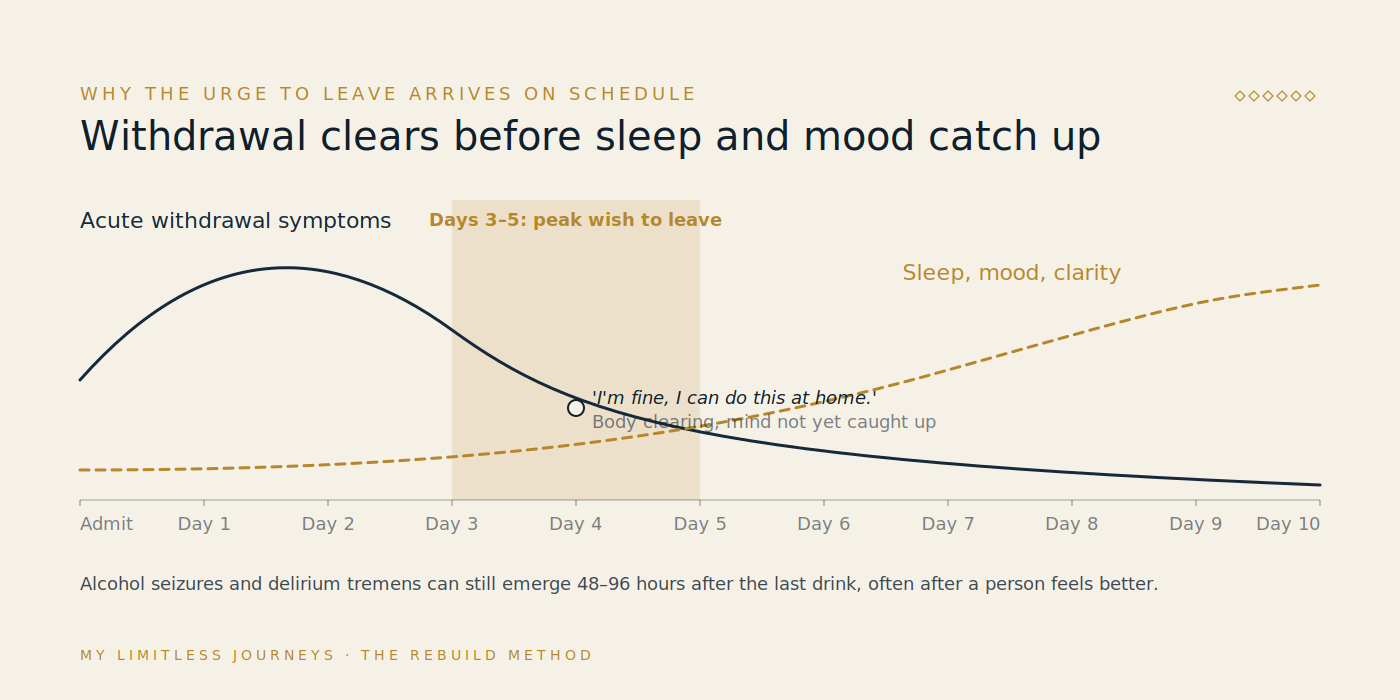
Why the urge to leave arrives on schedule.
If you have been in treatment before, or you are supporting someone who is there now, you may have noticed that the phone call announcing "I'm leaving" tends to come around the same point in every stay. That is not coincidence. It is physiology meeting psychology at a predictable intersection.
In the first forty-eight hours of a medically supervised detox, most people feel too unwell to go anywhere. The body is doing loud, obvious work. By day three or four, the acute symptoms of withdrawal from alcohol, opioids, or stimulants are usually subsiding. Tremor eases. Nausea passes. The person feels physically capable again. Knowing in advance, from the first-week orientation, that this moment is coming helps many clients recognize it as a symptom rather than a decision. What has not returned is sleep architecture, emotional regulation, or the ability to tolerate boredom. The brain is still recalibrating its reward circuitry, a process the National Institute on Drug Abuse describes as lasting weeks to months rather than days (NIDA, Drugs, Brains, and Behavior).
What an AMA discharge actually means.
"AMA" stands for "against medical advice." In a hospital, it describes a patient who leaves before the treating physician considers it safe. In addiction and mental-health treatment, the term is used the same way: a client discharges before the clinical team recommends it, and the record reflects that the discharge was the client's decision rather than a planned completion or a clinical transfer.
It helps to be clear about what AMA is not. It is not a legal finding. It is not a mark that follows you. It is not a reason a program can refuse to help you later. Residential treatment at a facility like ours is voluntary. You are an adult, and unless a court order or a psychiatric hold is in place, which is rare and governed by separate law, you retain the right to leave. Our job when you say you want to go is not to stop you. It is to make sure you are deciding with accurate information, that you are medically safe to travel, and that you have a plan for the next seventy-two hours.
There are practical consequences worth understanding. Insurance authorizations are typically tied to a documented level of care; leaving mid-authorization can complicate a later request for the same level, though it rarely prevents one. Some employers' leave paperwork references anticipated discharge dates. And medications started in detox, particularly benzodiazepine or phenobarbital tapers for alcohol withdrawal, or buprenorphine inductions for opioids, are not meant to be stopped abruptly. We will explain each of these plainly if the question comes up, and our admissions team can help sort out the paperwork side.
What is medically at stake if you leave mid-detox.
The risk of leaving depends heavily on what you were using and where you are in withdrawal. This is the part of the conversation we will not soften, because it is the part that can hurt you.
| If you were detoxing from | Leaving on day 3–5 risks | What we will ask before you go |
|---|---|---|
| Alcohol | Withdrawal seizures and delirium tremens can emerge 48–96 hours after the last drink, sometimes after a person feels better. Stopping a taper abruptly raises that risk. | To complete the taper or leave with a physician-written taper and a person who can stay with you. |
| Benzodiazepines | Seizure risk with any abrupt stop; the FDA's boxed warning specifically names rapid discontinuation as dangerous. | To leave only with a continuing taper schedule and an outpatient prescriber already identified. |
| Opioids or fentanyl | Withdrawal is rarely fatal, but tolerance drops fast. A return to a previous dose after several days off is the classic overdose scenario. | To take naloxone with you, to know your tolerance has changed, and to consider continuing buprenorphine. |
| Stimulants | Physical danger is lower; the risk is a depressive crash with intense craving and, for some, suicidal thinking in the first week. | A safety screen, a named person to check in with, and a same-week psychiatric follow-up. |
The alcohol and benzodiazepine rows deserve emphasis. Both substances act on the same GABA system, and both can produce seizures when stopped too fast. The FDA's 2020 boxed warning for benzodiazepines exists precisely because abrupt discontinuation can be life-threatening. If you are on a taper and want to leave, the single most important thing we can do is make sure the taper leaves with you. Our page on benzodiazepine tapering goes into detail.
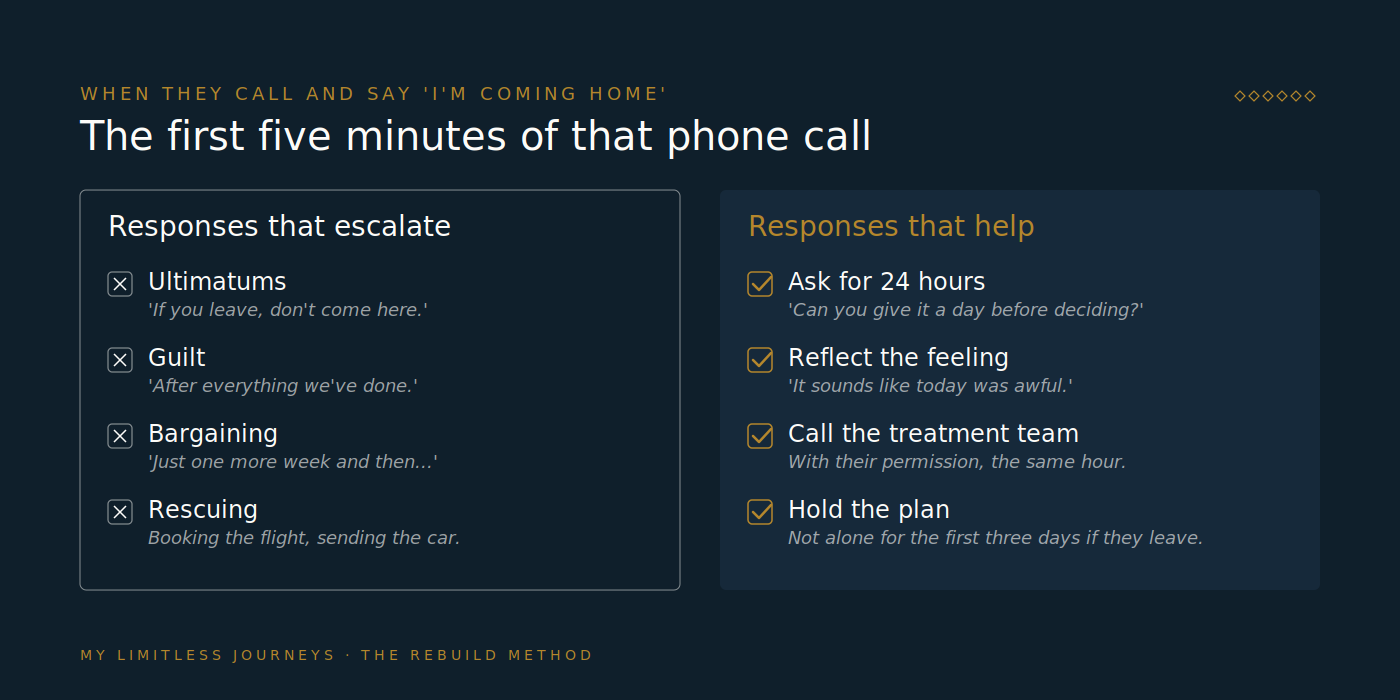
How families should respond to "I'm coming home."
The call usually comes at night. It is often angry, sometimes tearful, and it almost always contains a list of reasons that sound reasonable: the food, a roommate, a counselor who "doesn't get it," a work crisis that only they can solve. Your instinct will be to argue with the list. Resist it. The list is not the reason. The reason is that they feel terrible and want it to stop, and the list is how the mind justifies the exit.
What tends to escalate the situation: threats ("if you leave, don't come here"), guilt ("after everything we've done"), bargaining ("just finish the week and then we'll talk"), and rescuing (booking a flight, sending a car, agreeing to pick them up at midnight).
What tends to help is simpler and harder. Reflect the feeling before addressing the request: "It sounds like today was awful." Ask for time rather than compliance: "Can you give it twenty-four hours before you decide?" Most urges to leave lose their force overnight, and a request for one day is far easier to grant than a request to "stay." Then, with their permission, call the treatment team. At MLJ, families who have signed a release can reach the clinical team directly, and we would much rather hear from you at 11 p.m. than learn the next morning that a decision was made alone.
Finally, hold your own plan. If you and the family therapist agreed on boundaries during family sessions, this is when they matter. You can love someone completely and still decline to drive them home at midnight from a medical detox. Our guide for families, The Family's Role in Recovery, covers how to prepare for this moment before it arrives.
How MLJ responds when someone wants to leave.
In a six-bed home, there is no such thing as a client quietly packing a bag without anyone noticing. That is one of the quieter advantages of a small setting: the staff who see you at breakfast are the same staff who will notice that you have gone silent by lunch. When a client tells us, or shows us, that they are thinking about leaving, a specific sequence follows.
First, a same-day conversation with your primary therapist, not a shift worker or an intake coordinator. The purpose is not persuasion. It is to understand what changed, to name the day-four pattern if that is what is happening, and to address anything concrete that we can actually fix. Sometimes the problem is real and solvable: a medication that is making you feel foggy, a conflict with another resident, a work matter that genuinely needs an hour on a laptop. Our approach to work during treatment is flexible precisely so that a production deadline does not become the reason someone walks out of detox.
Second, nursing and, where indicated, our psychiatrist review your medications and safety the same day. Third, if you still want to go, we write a plan with you rather than for you. That plan includes medications and how to continue them, a scheduled follow-up with our team or an outside prescriber within the week, a list of what to watch for, naloxone if opioids were involved, and a direct line back to us. We ask for permission to call you in two days. Most people say yes.
Coming back after leaving early.
People who leave early and come back are not failures, and they are not rare. Many of the clients who complete a full stay with us did not complete their first attempt, here or elsewhere. Research on addiction treatment consistently frames it as a condition managed over time, with treatment episodes that build on one another rather than a single test passed or failed (NIDA, Principles of Drug Addiction Treatment).
If you do leave, do not go home to an empty house for the first three days, keep every medication on the schedule it was written, and attend the follow-up we scheduled even if you feel certain you do not need it. If the week goes badly, read what to do in the first 24 hours after a relapse and call us. There will be no lecture.
If you left MLJ and want to return, the process is shorter than your first admission. Your record is already here. Your clinical team already knows you. We will need to reassess where you are medically, particularly if there has been a return to use, and we may recommend a different starting point: sometimes a fresh detox, sometimes straight into residential, sometimes PHP if the medical picture allows. We will also ask what we could have done differently the first time, and we mean the question. The phone number is the same, and the person who answers will not be surprised to hear from you.
- Treatment Guidance. The full library of decisions before, during, and after treatment.
- The First Week in Residential Treatment. What the days feel like before the wish to leave shows up.
- Why Relapse Happens. The mechanics of a setback and how to think about one.
- The Family's Role in Recovery. How to prepare for the hard phone call before it comes.
- Detox and Residential at MLJ. How our medical team manages the first ten days.
- Why Willpower Doesn't Work for Addiction. A blog post on why "I can do this at home" is a brain state, not a plan.
This guide is educational and is not a substitute for medical advice. If someone is in immediate danger, call 911.