
Family therapy at MLJ: the format, the cadence, and what it asks of you.
Family therapy here is not a weekend workshop. It is a series of sessions with one therapist who knows your family, starting in the second week of a stay and continuing through every step-down. This page explains exactly what that looks like, so you can decide what you are able to commit to.
Authored by the MLJ Clinical Team. Reviewed under board-certified psychiatric oversight. Last updated September 2026.
Key Takeaways- One family therapist is assigned per client and stays with the family from residential through IOP and into the alumni period; you will not re-explain your history to a new face at each level of care.
- Sessions run weekly during residential and PHP, roughly every other week in IOP, and as needed afterward, with the first session usually in the second week once detox is behind the client.
- Formats include conjoint sessions with the client, family-only sessions without the client, and occasional multi-family groups; each has a different purpose and you will likely do all three.
- The work belongs to the Life domain of the Rebuild Method, where it connects to daily structure at home and to return-to-work planning rather than floating free of the rest of treatment.
- What it asks of you is about ninety minutes a week, honesty about your own part of the pattern, and a willingness to change the household, not only to wait for the client to change.

Why family therapy is part of addiction treatment at all.
A person does not use in a vacuum. Over years, a household organizes itself around the drinking or the pills the way a house settles around a cracked foundation: doors that no longer close, rooms nobody uses, a family that has learned to walk in particular ways. Remove the substance and the house does not spring back into shape. The arguments are still on rails. The spouse is still checking. The children still know which parent to ask for what. If treatment addresses only the person and sends them back into an unchanged system, the system tends to reassert itself, and the person is being asked to stay sober in the exact environment that accompanied their using.
The research is consistent on this point. Family involvement in treatment is associated with better engagement, longer retention, and lower relapse rates, and the National Institute on Drug Abuse has included family-based approaches among its evidence-based practices for many years; SAMHSA maintains a treatment improvement protocol devoted entirely to family therapy in substance use treatment. That is why we treat it as a clinical service rather than a courtesy, and why our family support page lists it alongside DBT and EMDR rather than under amenities.
The three formats, and what each is for.
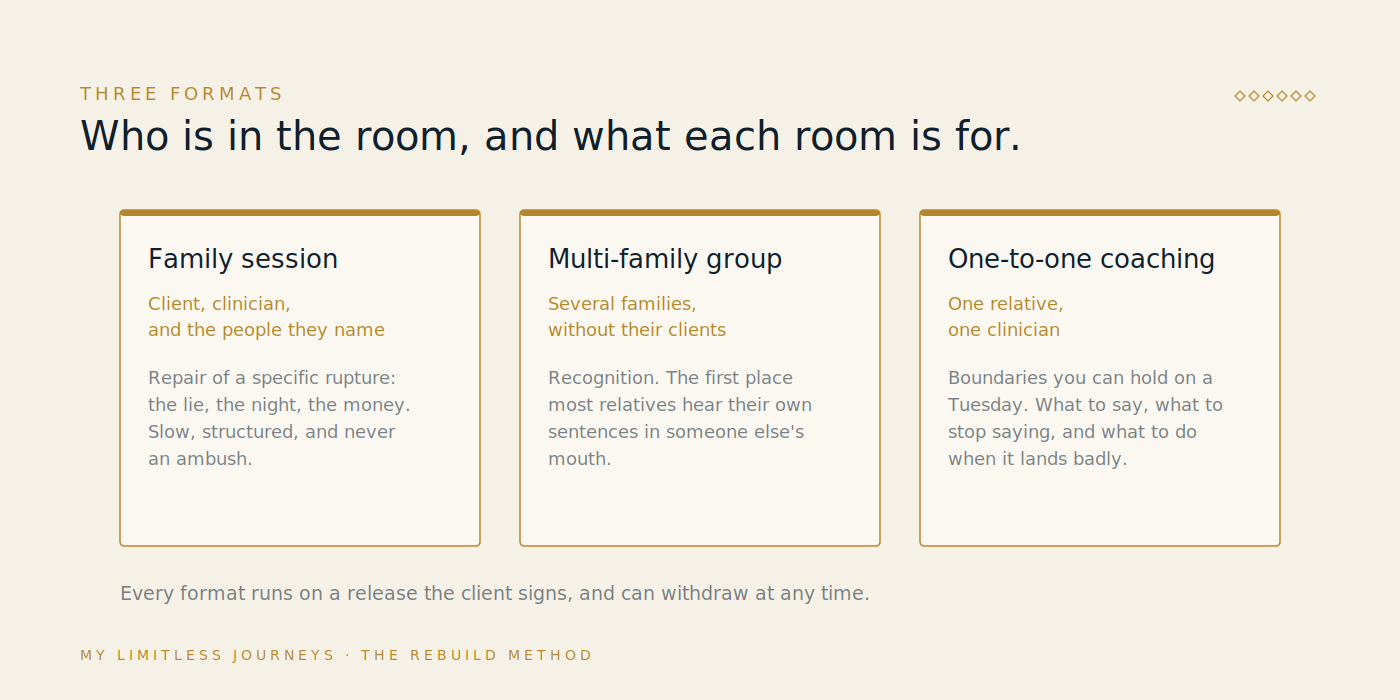
Most families will experience all three of these over the course of a stay, and it helps to know in advance what each is trying to do.
Conjoint sessions include the client and one or more family members with the therapist. These are the sessions people picture. Early on, they are structured tightly: the therapist sets the agenda, keeps the conversation from sliding into the old fight, and makes sure each person is heard. Later, they loosen, and the family practices having hard conversations with a referee present so that they can have them without one. Typical early topics are the honest account of what happened, what each person needs in order to trust again, and how communication is going to work during the stay. Later topics are about home: rules, money, the first weekend, what to do when the old argument starts.
Family-only sessions happen without the client. These exist because family members need a place to say things they are not ready to say to the client, or that would not be useful for the client to hear yet: the depth of the anger, the question of whether to stay, the fear of the next relapse. They are also where the therapist teaches: how the illness works, what the client's medications do, what to expect in the first months home, and how to respond to a slip. Partners often describe these as the most useful hour of the week.
Multi-family groups bring together the families of several current clients. At six beds, this is a small room, never more than a handful of families, and it runs less often than the other two formats. Its purpose is the thing individual sessions cannot provide: the discovery that other intelligent, capable families have had the same Tuesday, said the same things, made the same mistakes. Shame lifts faster in company. Because our clients often share professional worlds, we are careful about who is in the room, and any family may decline this format for privacy reasons without affecting the rest of the work; our privacy pillar explains how six beds shapes that decision.
The cadence across levels of care.
Because the same team follows a client from detox through alumni, the family therapist stays constant while the frequency shifts. Here is the usual shape.
| Level of care | Frequency | Primary formats | Focus |
|---|---|---|---|
| Detox (days 1–7) | Introduction and updates only | Family-only, by phone | Releases, communication plan, orienting the family |
| Residential (weeks 2–12) | Weekly | Conjoint and family-only, alternating; occasional multi-family | Honest account, trust, education, the home plan |
| PHP | Weekly | Conjoint | Rehearsing home routines while still in structure |
| IOP | Every other week | Conjoint | Troubleshooting real life: work, evenings, conflict |
| Transitional living and alumni | As needed; check-ins at 30, 90, 180 days | Conjoint; family-only on request | Maintenance, relapse response, the long view |
The first formal session almost always waits until the second week. In the first days a client is withdrawing, medicated, and sleeping, and a family session would be neither fair to them nor useful to you. What happens instead is that the family therapist calls you, introduces themselves, walks through what the coming weeks look like, and sets up the release paperwork. Our guide to supporting a partner through detox describes that first stretch from the family's side.
How it connects to the Life domain.
The Rebuild Method organizes treatment into four domains: Body, Mind, Life, and Self. Family therapy lives in Life, alongside daily structure and return-to-work planning, and the placement is deliberate. Life is the domain that asks how a person is going to live once they leave, and a person's household is the most important answer to that question. So family therapy at MLJ is not sealed off from the rest of the treatment plan. The family therapist attends the same weekly clinical team meeting as the individual therapist, the psychiatrist, and the nursing lead, and what emerges in a family session informs what happens in the client's individual work, and vice versa, within what the client has consented to share.
In practice this means the home plan is built jointly. When the client is working on daily structure, the family is working on what the household schedule will look like on the first weekend home. When the client is working on return-to-work, the family is working on what the evenings will be like when the client comes home tired from a job that used to end at a bar. When the client is doing life skills work around money, the partner who has been managing the finances alone for three years is in the room for the conversation about how that changes. The domains are a way of making sure nothing important falls between the individual and the family.
What it asks of you.
Time, first. About ninety minutes a week during residential, less later. For a family in Los Angeles, that is a drive to Encino or a video call; for a family elsewhere, it is a video call at an hour we will work out together. That is real, and we would rather you know it now than discover it in week three.
Honesty about your own part of the pattern, second. This is the hard one. Family therapy is not a venue for the family to present a list of the client's offenses to a professional witness. It will get to the offenses, and they will be taken seriously. But it will also ask what you have been doing: the covering, the checking, the drinking alongside, the silence, the way the children were recruited into alliances. Nobody in the room will be blamed for the illness. Everybody in the room will be asked to look at how they have been living with it. Partners who arrive willing to do that tend to find the process a relief; partners who arrive expecting to be exonerated tend to find the first sessions frustrating, and then find the relief a little later.
Willingness to change the household, third. Some of this is concrete: alcohol out of the house, at least for the first months, and a conversation about whether it ever comes back; a schedule that supports the sleep and structure the client has built; an agreement about how a slip will be handled before there is one. Some of it is about the family's own habits of communication, and those change more slowly. What we ask is not that you fix everything before discharge but that you begin, because a client who walks back into a house that has started to change walks into a different first year than one who walks into a house that waited.
Who counts as family.
Whoever the client's life actually runs through. For many clients that is a spouse or partner. For others it is parents, adult children, a sibling, a close friend who has been the de facto next of kin, or a long-standing business partner whose relationship with the client is more familial than most families. Our professional clients sometimes name a manager or a chief of staff as the person who most needs to be in the room for the return-to-work planning, and that can be arranged as a separate strand with clear limits on what is discussed. In every case the client decides who is invited and what each person may be told, through written releases; that is federal law, not preference, and the details are on our family confidentiality page.
Attending from a distance.
A substantial share of our clients come from outside Los Angeles, and some families are in other time zones. Family therapy works by secure video, and we schedule around the family's day rather than ours. What is lost in a video session is less than families fear; what matters is the consistency of the therapist and the regularity of the sessions, both of which survive distance intact. When a family can travel, we try to align the visit with a conjoint session and, where it fits the client's plan, with a step-down decision, so that the trip does work rather than only reassurance.
- For Families. The hub, organized by where you are today.
- Supporting a partner through detox. The stretch before family therapy begins.
- For referring clinicians. How outside therapists fit into the same team.
- Family support services. The shorter overview this page expands on.
- Residential treatment. Where the weekly cadence begins.
- The family's role in recovery. The principles behind the practice.
This guide is educational and is not a substitute for medical advice. If someone is in immediate danger, call 911.