
For referring clinicians: how we coordinate, report, and hand your client back.
If you are a therapist, psychiatrist, physician, or interventionist sending someone to us, you deserve more than a thank-you call. This page sets out what you will hear from us and when, how releases work, what our reports contain, and how the handback happens at each step-down.
Authored by the MLJ Clinical Team. Reviewed under board-certified psychiatric oversight. Last updated September 2026.
Key Takeaways- We treat the referring clinician as a member of the treatment team with a defined role, not as a source to be updated occasionally.
- Communication requires a release signed by the client that specifically names you; we ask for it on day one, and we will tell you immediately if the client declines.
- Expect an admission confirmation within 24 hours, a clinical summary by the end of week one, weekly updates during residential, and a step-down and discharge summary at each transition.
- Your treatment relationship continues during the stay where clinically appropriate; we do not replace you, and for many clients you remain the anchor of the first year.
- The handback is planned from week two, includes a warm transfer call, and comes with a written summary of medications, diagnoses, what worked, and what to watch for.

Our stance on referring clinicians.
You have known this person longer than we will. You know what they minimize, how they present when they are doing badly, what happened the last two times they tried to stop, and which family member to believe. That knowledge is clinical data, and a program that does not collect it at admission and return it enriched at discharge is wasting the most experienced clinician on the case. So we begin from the position that you are on the team. Where a release allows, we want your history at intake, your input during the stay, and your hands on the client at the end.
Releases: what the law requires, and what we do about it.
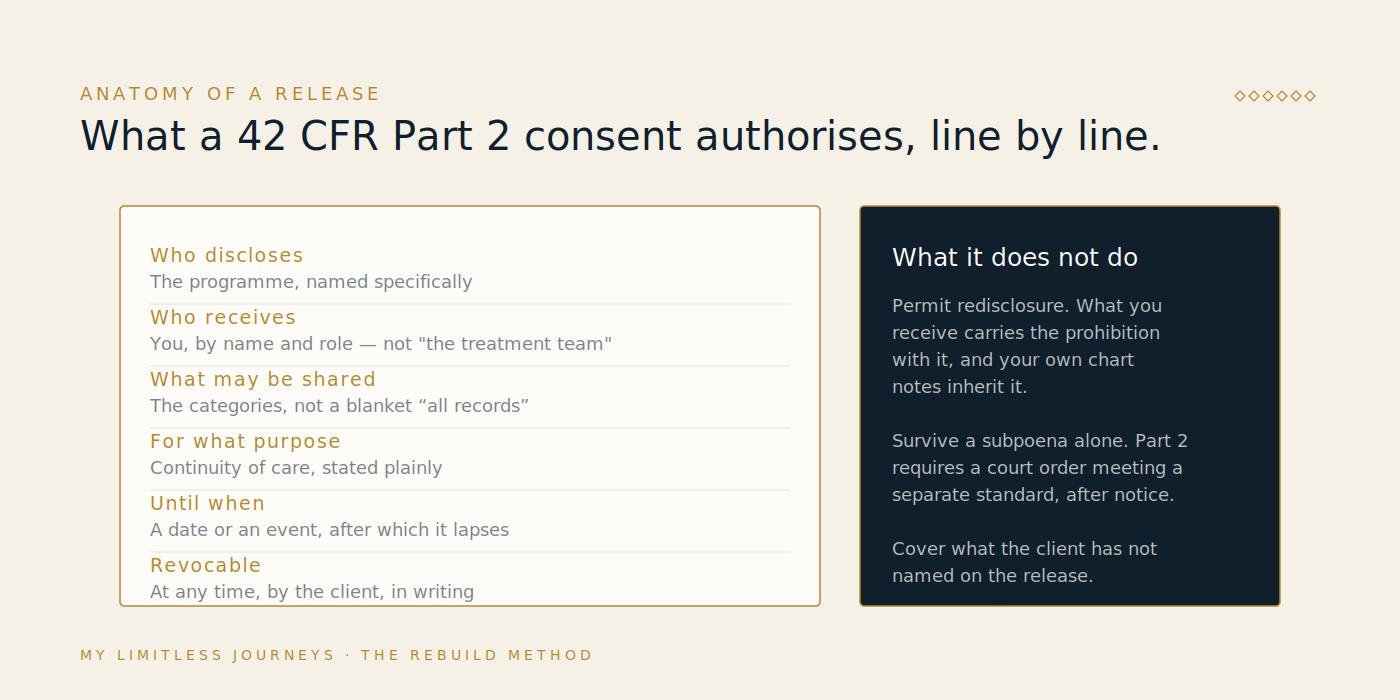
Because MLJ is a substance use disorder treatment program, records of our clients' care are protected not only by HIPAA but by 42 CFR Part 2, the federal confidentiality regulation that governs SUD treatment records specifically. Part 2 is stricter than HIPAA in ways that affect you directly. Under HIPAA alone, a treating provider can generally share information with another treating provider for treatment purposes without a specific authorization. Under Part 2, disclosure of a client's treatment record to you, even for coordination of care, requires the client's written consent naming the recipient, and the consent must meet specific content requirements. HHS's Office for Civil Rights maintains guidance on how the two frameworks interact, and our page on 42 CFR Part 2 explains it in plain language for clients and families.
In practice, this means the first thing we ask a new client on the day of admission is whether we may communicate with the clinicians who referred them, and we ask them to sign a release for each one by name. Most clients say yes; the person who sent them here is usually a person they trust. If a client declines or wants to wait, we will tell you that we have received your client and that we cannot share more at this time, and we will let you know if that changes. Please do not read a delayed release as a judgment about you. Some clients want a few days to feel settled before authorizing anything.
What to expect, week by week.
The following assumes a residential stay of roughly six weeks followed by step-down; the shape stretches or compresses with length of stay, and every touchpoint depends on a release naming you.
| When | What you receive | What we ask of you |
|---|---|---|
| Before admission | A call from our clinical director to confirm level of care and logistics | Your clinical picture: substances, psychiatric history, medications, risks, prior treatment |
| Within 24 hours | Admission confirmation and release status | Records you can send once the release is signed |
| End of week 1 | Clinical summary: detox course, working diagnoses, medication changes, initial plan | A 20-minute call with the primary therapist and, if relevant, our psychiatrist |
| Weeks 2–6 | Weekly written update; a mid-stay treatment-plan review you are invited to join | Continued sessions with your client where clinically appropriate; input on the plan |
| Step-down to PHP/IOP | Step-down summary and revised schedule | Agreement on division of roles between you and our outpatient team |
| Discharge | Warm-transfer call; discharge summary with medication reconciliation and relapse plan | A first appointment scheduled before the client leaves us |
| Alumni year | Check-in notes at 30, 90, and 180 days if the client remains engaged | A call to us if you see early warning signs; we will re-engage quickly |
The first week is medically dominated. Your client is in detox under nursing coverage and psychiatric oversight, and the priority is safety and sleep. Our guide to what medically supervised means describes vitals cadence and the criteria for hospital transfer. If something significant happens in that week, a complicated withdrawal, a medication reaction, a request to leave, you will hear about it the same day rather than in the weekly summary.
From week two, the weekly update is the backbone. It is short by design: a paragraph on engagement and mood, a line on any medication change, a note on what the individual and family work is focused on, and any concerns. Around the midpoint of the stay, we hold a treatment-plan review and invite you to join by phone or video. This is the meeting where step-down timing, length of stay, and the shape of the handback get decided, and your view of what the client's life will demand of them carries weight.
What our reports actually contain.
The week-one clinical summary covers the detox course and the medications used, including any that will continue; the working diagnostic picture, with an explicit note on what is provisional; findings from the psychiatric evaluation; a summary of the trauma and co-occurring history as the client has disclosed it to us, flagged where it differs from what you sent; and the initial treatment plan by Rebuild Method domain. If our psychiatrist has changed a medication you prescribed, the summary says so and says why, and our psychiatrist is available to discuss it directly.
The discharge summary is the document you will use most. It includes final diagnoses; a full medication reconciliation with doses, prescriber, and what remains to be tapered or continued; a narrative of the stay organized by what worked and what did not; the modalities used, whether DBT, CBT, EMDR, or others, and how the client responded to each; the family work done and the state of the home plan; the return-to-work plan for professionals; the relapse-prevention plan the client wrote with us, including their identified early-warning signs; and specific recommendations for ongoing care. We write it for a clinician, not for a utilization reviewer, and we send it before the client's first appointment with you rather than weeks later.
Notes by role: therapist, psychiatrist, physician, interventionist.
Outpatient therapists. Where the client and our team agree it is helpful, you can continue sessions during residential treatment, usually by video and usually at a reduced frequency, so that the relationship does not go cold for two months. We ask that you coordinate content with the primary therapist here so the client is not doing two competing treatments. In PHP and IOP, the balance often shifts back toward you, and by discharge you are the primary again. We will also ask for your read on the family, which is often more candid than what the family tells us.
Psychiatrists. Our board-certified psychiatrist will want to speak with you in week one, particularly about any medication that interacts with withdrawal or that we may need to adjust during detox; benzodiazepine tapers and stimulant prescriptions for ADHD are the two most common conversations. Prescribing during the stay is ours. At discharge, prescribing returns to you with a reconciled list and a bridge supply, and we schedule the handback so the client does not run out between us and you. If a diagnosis has shifted during the stay, and with clearer observation over weeks it sometimes does, we will explain the reasoning rather than simply changing the label.
Primary care physicians. We will want recent labs and a medication list before admission, and we will send you the results of any labs we run and any medical findings relevant to ongoing care, including nutritional deficits common in alcohol use, sleep findings, and anything our nursing team flags. Detox-related medical issues are handled here or, if they exceed what a residential setting can safely manage, at a nearby hospital with which we coordinate; you will be informed of any transfer.
Interventionists. Your role is most intense before and immediately after admission, and our guide on when they refuse treatment describes the handoff sequence in detail. During the first one to two weeks you will typically remain the family's bridge while releases are signed and our family therapist takes over. After that, most interventionists step back to a monitoring role by agreement with the family. We will keep you informed within the scope of your release for as long as it runs.
The handback.
Planning for discharge begins in week two, because the transition out of structured care is where the first year is won or lost, and a handback improvised in the final days is a poor one. By the mid-stay review we want to know who the client will see in the community, how often, and starting when. If that is you, we schedule the first post-discharge appointment before the client leaves and we hold a warm-transfer call: you, the client, and their primary therapist here, thirty minutes, with the discharge summary already in your hands. The client hears both clinicians agree on the plan, which matters more than it sounds. After discharge the door stays open in both directions: if you see early warning signs, call us, and we can re-engage the client through the alumni program or the relapse-prevention program without a fresh intake. Our After Treatment hub maps the first year as we see it.
How to refer, and what helps us.
Call (866) 209-4246 and identify yourself as a referring clinician; you will be connected with our clinical director or admissions lead rather than routed through the general intake script. What helps most is a clear account of substances and last use, any history of withdrawal complications, the psychiatric picture and current medications, what prior treatment has and has not worked, the client's professional and privacy constraints, and your candid read on their motivation. If you are unsure whether residential is the right level, say so; our ASAM criteria guide describes how we think about it, and we will tell you honestly if a lower level of care or a different program fits better. With six beds, we cannot take everyone, and we would rather place a client well than fill a bed.
- For Families. The hub this page belongs to; useful for the families of your clients.
- When they refuse treatment. The interventionist handoff in detail.
- Family therapy at MLJ. The family strand your client's treatment will include.
- Referring Professionals. The short overview and contact path.
- Programs. The full continuum from detox to alumni.
- 42 CFR Part 2 explained. The confidentiality rule that shapes what we can tell you.
This guide is educational and is not a substitute for medical advice. If someone is in immediate danger, call 911.