
Supporting a partner through detox: the first ten days, from your side.
Your partner is in a bedroom in Encino with a nurse down the hall. You are at home with the quiet. This is what those days are likely to feel like for you, why the phone works the way it does, when a visit helps, and how to look after yourself while someone else looks after them.
Authored by the MLJ Clinical Team. Reviewed under board-certified psychiatric oversight. Last updated September 2026.
Key Takeaways- The spouse's experience of detox has its own arc: relief, then anxiety, then a wave of anger or grief that surprises most people, then a slow settling that tracks roughly with the client's.
- Phone contact is limited in the first days for clinical reasons, not to keep you out; when calls resume, expect your partner to sound unlike themselves for a while.
- Visits at MLJ are arranged through the family therapist and usually begin after the acute withdrawal window, once your partner can be present for them.
- What you hear on the phone in week one is withdrawal talking as much as your partner; irritability, flatness, and talk of leaving are symptoms, not decisions.
- Your own sleep, meals, and support are not indulgences during this window; they are what allows you to be useful when family therapy begins.
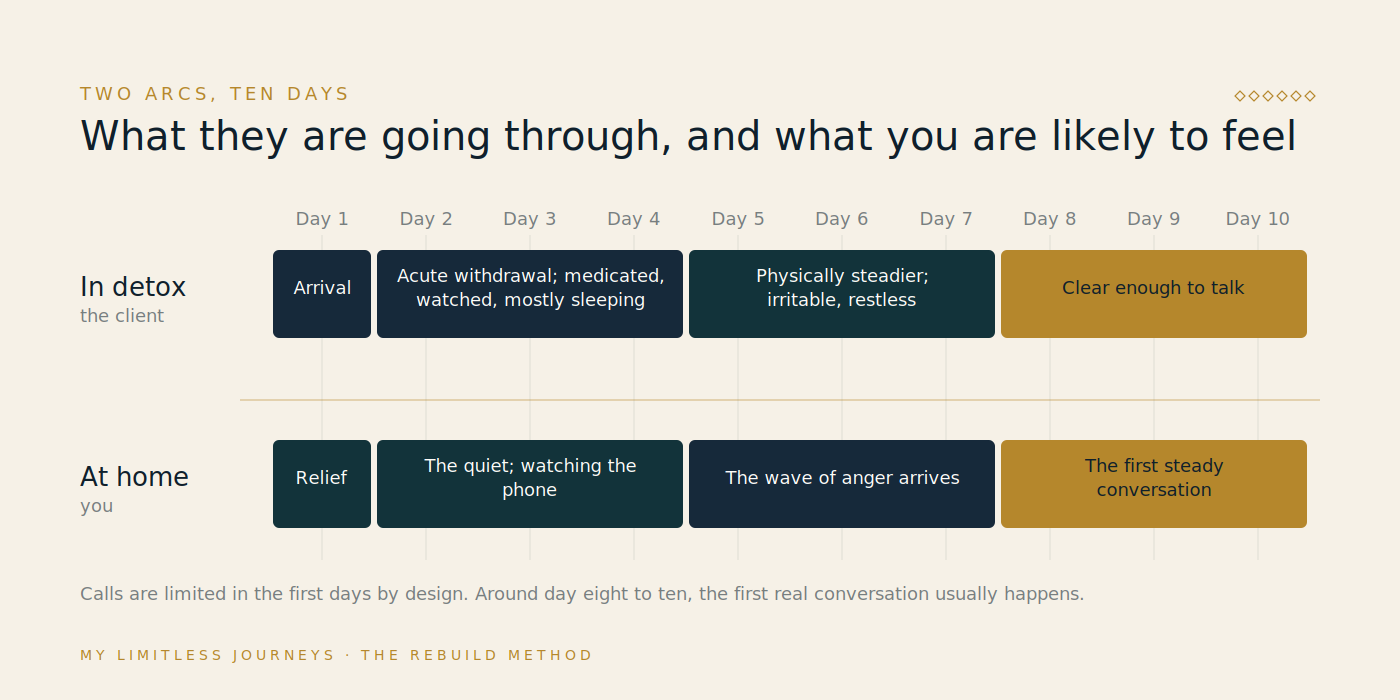
Day one: the drive home.
You drop them off, or they are driven, and there is a strange moment in the driveway where a nurse has taken your partner's bag and you are standing there with nothing to do. Most spouses describe the drive home as the first time in months they have breathed all the way out. That relief is legitimate. Someone else is watching now. Someone with a blood-pressure cuff and a psychiatrist on call, and a bed with clean sheets, and a plan.
What happens on the other side of that door in the first hours is medical. Our nursing staff take a full history and vitals, run a standardized withdrawal assessment, and consult with the psychiatrist about the protocol for whatever your partner has been using. If it is alcohol or benzodiazepines, medication to prevent seizures starts early, because that risk is real and front-loaded. If it is opioids, comfort and a decision about medication-assisted options. Our guide to what medically supervised means spells out nursing coverage and vitals cadence, and detox medications explains the pharmacology in plain terms. Your partner is not being interrogated or lectured on day one; they are being made physically safe and allowed to sleep.
Days two to four: the quiet and the phone.
This is the stretch where the house starts to feel wrong. You have spent months or years with a low hum of vigilance running in the background: listening for the garage door, checking the recycling, calculating how much was in the bottle. That system does not switch off because the person is gone. It keeps scanning for a threat that is not there, and the result is a kind of restless anxiety that many spouses mistake for worry about the treatment itself.
Meanwhile, your partner is in the hardest physical part of withdrawal. For alcohol, days two and three carry the highest risk of complications and the worst of the tremor, sweating, and sleeplessness; the alcohol withdrawal timeline explains why the team is most attentive in this window. For opioids, this is the peak of the flu-like misery. For benzodiazepines, the taper is slower and the anxiety more prominent. In all cases, your partner is medicated, monitored, and not in a state to hold a meaningful conversation, which is the reason phone access is restricted early. It is not about isolating them from you. It is that a phone call at hour forty of alcohol withdrawal tends to go badly for everyone, and a bad call can trigger the day-three impulse to leave.
What you can do in this stretch is administrative and self-protective. If a release naming you has been signed, the family therapist will reach out to introduce themselves and set up a communication rhythm; if it has not, the admissions coordinator can tell you only that your partner is safe, and that limit is federal law, described on our family confidentiality page. Use the time to handle the things your partner cannot: the employer conversation, if there is one, and our guide on what to tell your team applies to spouses fielding calls too; the pharmacy; the bills. And go to bed at a normal hour, even if you do not sleep.
Days five to seven: when the anger arrives.
Here is the part nobody warns spouses about. Somewhere around the end of the first week, when the acute danger has passed and your partner is starting to be looked after in a way that shows, a lot of partners feel a wave of anger that seems to come from nowhere. Anger at the years. Anger that they get a hillside house and a chef and a therapist while you were the one holding the family together. Anger that they are being praised for taking a step you begged them to take for a decade. Some people feel grief instead, or as well: mourning the marriage they thought they had, or the time. None of this is disloyalty. It is what surfaces when an emergency ends, and it belongs in family therapy, where it can be used rather than buried.
Your partner, in the same days, is often irritable, foggy, and exhausted. Sleep is fragmented for weeks after detox; our piece on sleep in early recovery explains why. Their emotional range is compressed and their patience is thin. If phone calls have resumed, this is the stretch in which they may sound cold, or pick a fight, or announce that the program is not for them and they are coming home. Our guide to leaving treatment early is written for that call. The short version: you do not have to win the argument, and you should not offer a ride.
Calls and visits: how we handle them and why.
Families deserve a clear account of this rather than a vague reference to "policy." During the acute withdrawal period, generally the first three to five days depending on the substance, client phone use is limited and calls are brief and scheduled. The reasons are clinical: withdrawal impairs judgment and emotional regulation, phones are the main vector for the impulse to leave, and early days need to be about sleep and medical stabilization rather than managing the outside world. This is also why phones and social media are handled the way they are throughout residential care.
Visits are arranged through the family therapist and, at a six-bed residence, are handled individually rather than by a posted schedule. Most first visits happen after the acute window, once your partner can be present for it, and are often paired with a family session so the visit has a shape. Bringing children requires a conversation first. Bringing anything from home requires a conversation too, because well-intentioned care packages are the most common way a substance gets into a treatment house. None of this is meant to make you feel supervised. It is meant to keep the visit from becoming one more thing that goes wrong in a hard week.
Days eight to ten: the first real conversation.
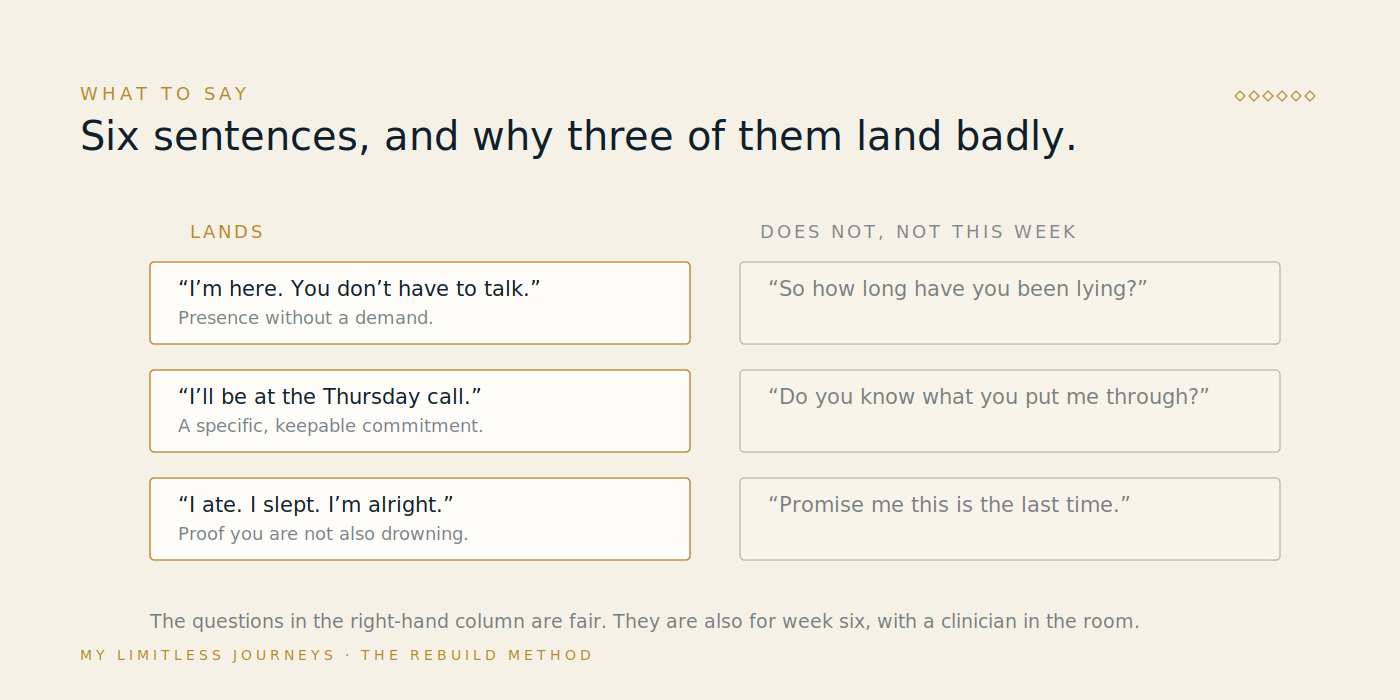
Toward the end of the second week, something shifts. Your partner's voice comes back. They have slept for a few nights in a row, the medication taper has progressed or finished, and they have started the actual therapeutic work of residential treatment, which our guide to what treatment actually looks like describes hour by hour. They may sound, for the first time in a long time, like the person you married. That can be its own kind of disorienting.
Resist the urge to have every conversation at once. The apologies, the accounting, the questions about what happens to the marriage, all of that has a place, and the place is family therapy, where it can be held rather than dropped. What the first real conversation should be is simple: you are glad they are there, you are proud of the ten days, and you are doing your own work while they do theirs. If they ask how you are, tell the truth in a sentence or two. You do not have to protect them from the fact that this has been hard on you, and you do not have to make them carry all of it yet either.
Looking after yourself, specifically.
"Take care of yourself" is advice everyone gives and nobody operationalizes, so here is the operational version. Sleep and meals first: the vigilance system that has been running in your body needs weeks to stand down, and it will not do so while you are skipping dinner and lying awake until two. Regular bedtimes, actual food, a walk in daylight. This is not wellness advice; it is the minimum biological maintenance for someone who has been living in a low-grade emergency.
Second, talk to people who understand this specifically. Friends will be kind but most will not know what to say. There are mutual-aid fellowships for the families and partners of people with alcohol or drug problems, with meetings across Los Angeles and the Valley every day of the week and online at every hour, where the other people in the room have had your exact Tuesday. There are also structured family programs and individual therapists who specialize in partners of people with addiction. SAMHSA's family resources page is a reasonable place to orient, and our roundup of Valley recovery meetings and resources lists local options. Our family therapist will also point you toward what fits.
What comes after detox, for both of you.
Detox is a beginning, and at MLJ it flows directly into residential treatment with the same team in the same house; there is no transfer, no new intake, no fresh set of strangers. Our detox and residential program page describes the whole arc. For you, the end of detox is where the real invitation begins: family therapy typically starts in the second week, once your partner can participate, and it continues at a cadence the family can sustain through residential, PHP, and IOP. What it involves is on our family therapy page.
- For Families. The hub, organized by where you are today.
- Family therapy at MLJ. What begins once detox ends.
- When they refuse treatment. If your partner is talking about leaving, the same principles apply.
- Medical detox at MLJ. What is happening on the other side of the door.
- The first week in residential treatment. The same days, from inside the house.
- Anhedonia in week three. Why the second dip comes, and passes.
This guide is educational and is not a substitute for medical advice. If someone is in immediate danger, call 911.