
When they refuse treatment: how interventions work, and what works without one.
Refusal is the normal starting point, not a verdict. Here is what a professional intervention actually involves, how the main models differ, how an interventionist hands off to a facility like ours, and what a family can do on its own when a formal intervention is not the right move.
Authored by the MLJ Clinical Team. Reviewed under board-certified psychiatric oversight. Last updated September 2026.
Key Takeaways- Most people who enter treatment were ambivalent or opposed shortly before they went; refusal today does not predict refusal next month.
- The three approaches families most often encounter differ mainly in who is in the room and how much surprise is involved: a structured confrontational meeting, an invitational family process, and a skills-based approach the family uses over weeks without a single dramatic event.
- A well-run intervention has a facility, a bed, a travel plan, and a benefits check arranged before anyone sits down; the handoff to the program happens the same day.
- Without an intervention, families still have real leverage: changing how they respond to use, making treatment easier to say yes to, and refusing to shield the person from natural consequences.
- Medical urgency changes the calculus. Daily heavy drinking, benzodiazepine dependence, or fentanyl use makes "wait until they are ready" a riskier plan than it sounds.
Why people refuse, and why it is rarely about you.
The person you love is not refusing treatment because they do not care about you. They are refusing because the substance has become the thing that regulates their nervous system, and the prospect of losing it registers, at a level below argument, as a threat. Add the ordinary human reluctance to admit a problem, a career or reputation that feels like it cannot survive a thirty-day absence, and a well-rehearsed internal story about being different from "those people," and you get someone who can be brilliant, loving, and completely immovable in the same conversation.
It helps to know that ambivalence is the normal state. Very few people arrive at a program like ours with unmixed enthusiasm. Most of the clients in our six beds were, within the previous month, saying some version of what you are hearing now. The National Institute on Drug Abuse has noted for years that treatment does not need to be voluntary to be effective; pressure from family, employers, or courts is a common and legitimate on-ramp. That is not a license to bully. It is permission to stop waiting for a moment of perfect readiness that may never come. If the phrase you keep hearing is that they can handle it alone, we wrote a separate piece about that sentence.
What a professional intervention actually is.
Television has done this word a disservice. In practice, a professional intervention is a planned process, led by a trained interventionist, whose purpose is to move a specific person into a specific treatment program on a specific date. The dramatic meeting, if there is one, is a small part of it. The larger part is preparation: assessing the person's substance use and medical risk, mapping the family system and its alliances, deciding who should be present and who should not, rehearsing what each person will say, arranging the treatment placement, and planning the logistics of getting the person from the living room to the facility without a detour.
Good interventionists spend more time with the family than with the person using. They are often licensed clinicians or certified through interventionist-specific credentialing bodies, and they will usually ask hard questions about the family's own patterns before anything else happens. They will also ask what the family is prepared to do if the answer is no, because an intervention with no follow-through teaches the person that the family's limits are negotiable.
Three models, compared honestly.
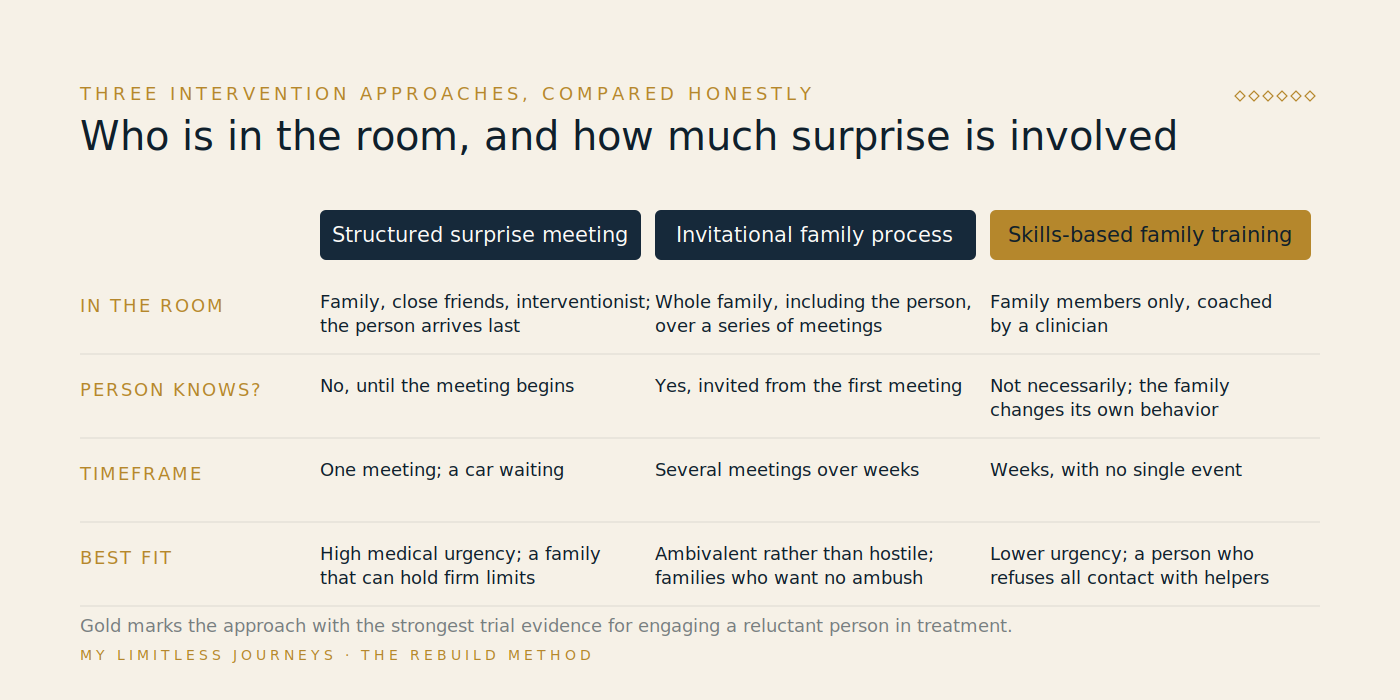
Families researching interventions will encounter several named methods. Rather than rely on trade names, here is what each approach does and where it tends to fit.
| Approach | Who is in the room | Does the person know? | Best fit |
|---|---|---|---|
| Structured surprise meeting | Family, close friends, interventionist; the person arrives last | No, until the meeting begins | High medical urgency; a family that can hold firm limits; a person who deflects every private conversation |
| Invitational family process | Whole family including the person, over a series of meetings | Yes, invited from the first meeting | Families who want to avoid ambush; a person who is ambivalent rather than hostile; moderate urgency |
| Skills-based family training | Family members only, coached by a clinician over several weeks | Not necessarily; the family changes its own behavior | Lower urgency; a person who refuses all contact with helpers; families who want a durable skill set |
The structured surprise meeting is what most people picture. Its strength is decisiveness: the person hears, in one sitting, from everyone who matters, and there is a car waiting. Its weakness is that it depends entirely on the family's willingness to follow through on stated consequences, and on the person not walking out in the first minute. It works best when the medical picture leaves little room for a slower approach.
The invitational process treats the whole family, including the person using, as the client from the start. There is no ambush. The person is invited to a series of meetings about how the family is going to change, and the first meeting proceeds whether they attend or not. Many people attend the second one. This approach tends to preserve trust and to produce family change that outlasts the admission, at the cost of taking longer.
The skills-based approach is the one with the strongest trial evidence. Family members learn to reinforce sober behavior, withdraw reinforcement from using behavior, communicate without escalation, and protect themselves, and they practice these over weeks with a coach. In randomized comparisons, families trained this way engaged treatment-refusing loved ones in care at roughly twice to three times the rate of families using traditional confrontation; one such trial is published here. It is slower, it asks the most of the family, and it is the one we most often recommend when there is time.
The handoff from interventionist to facility.
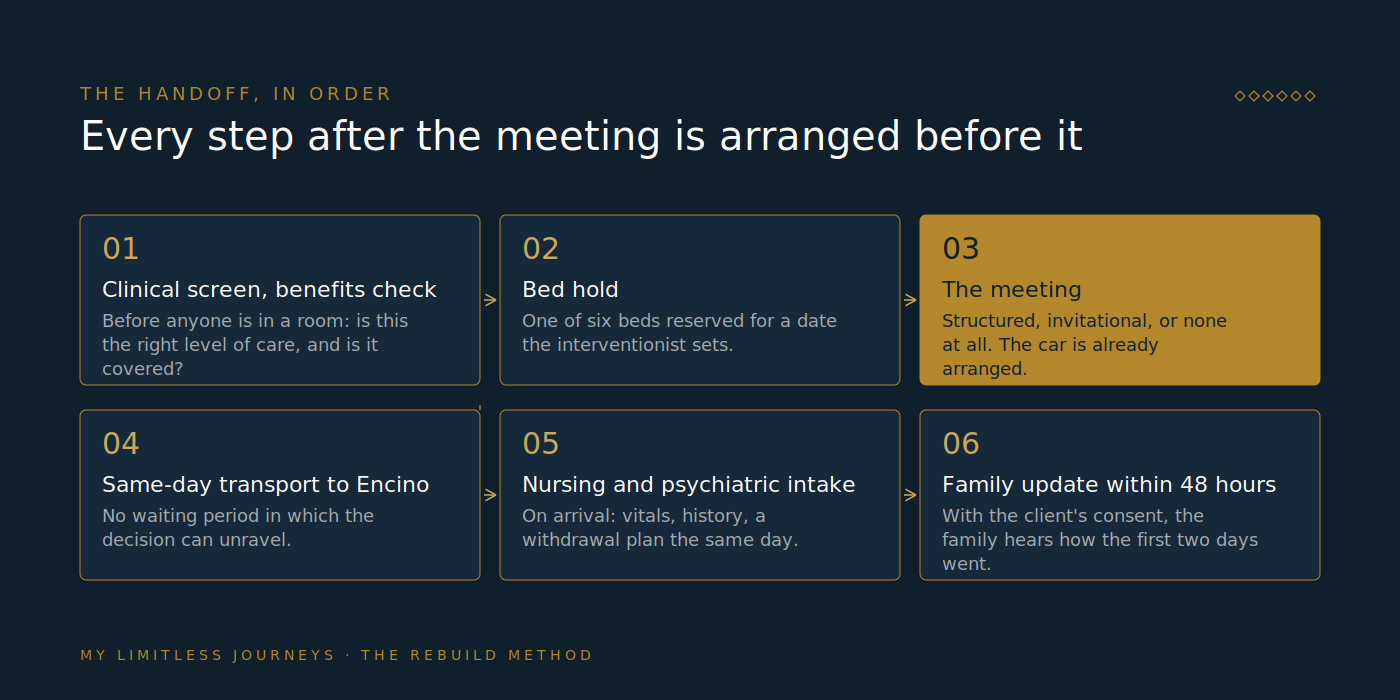
The single most common way interventions fail is a gap between the yes and the bed. A person who agrees at 10 a.m. and is told the facility can take them Thursday has three days to reconsider, and most will. So the handoff is planned backward from the meeting. Before anyone gathers, the interventionist has spoken with our admissions team, shared what they know about substances, last use, medical and psychiatric history, and any medications, and our clinical director has confirmed we are the right level of care. If insurance is involved, benefits verification has already been run. A bed is held for the day of the meeting.
When the person says yes, transport happens immediately, usually with the interventionist or a family member, sometimes with a professional transport service if distance or the person's state warrants it. Encino is reachable within the day from anywhere in Southern California, and from most of the western United States by that evening. On arrival, the sequence is medical first: our nursing staff take vitals and a withdrawal assessment, the psychiatrist is consulted about the detox protocol, and the person is settled into a bedroom rather than an intake room. Our detox pillar describes what those first hours involve, and we give the family a first update within 48 hours, within whatever the client has authorized under the rules explained on our family confidentiality page.
What families can do without an intervention.
Not every family can afford an interventionist, not every situation warrants one, and some people refuse so completely that no meeting is possible. None of that leaves you powerless. The principles behind the skills-based approach are learnable, and a family that applies them consistently changes the environment the person is using in.
Start by separating the person from the behavior in how you respond. Warmth when they are sober, and specific, non-lecturing acknowledgement of it. Quiet withdrawal, not punishment, when they are intoxicated: leave the room, decline the conversation, do not fix the consequences. Stop doing the things that make using easier, which usually means stopping the cover stories to employers, the loans, the cleaning up. This is not cruelty; it is allowing reality to do some of the persuading you have been trying to do alone. Rehearse the conversation you want to have, at a time when they are sober and not cornered, and make it about what you have observed and what you want rather than what they are. Our guide to talking to a loved one about getting help gives specific language.
Then make yes easy. Have a program identified. Know what the first phone call involves; our admissions call guide describes it minute by minute, and you can share it. Know whether insurance is likely to cover it. Know that detox can start within a day. A person who finally says "fine, maybe" and is met with "I have the number, they can see you tomorrow, and I will drive" is in a very different position from one whose family then spends a week researching. Finally, get your own support in place before you need it. Mutual-aid groups for the families of people with addiction exist in every part of Los Angeles, and SAMHSA's family resources are a good starting point for understanding what you are dealing with.
When medical urgency changes the plan.
The patient approaches above assume time. Some situations do not offer it. Someone drinking heavily every day who shakes in the morning, sweats through the night, or has ever had a withdrawal seizure is at risk each time they try to cut down on their own; alcohol withdrawal can be fatal, and it is the one form of withdrawal that a family should never attempt to manage at home. Someone taking benzodiazepines daily, especially at escalating doses or combined with alcohol, carries the same seizure risk. Someone using fentanyl or pills that may contain it is one bad batch away from an overdose, and the National Institute on Drug Abuse's overdose data make plain that this is not a remote possibility.
In these cases, the goal shifts from full treatment acceptance to medical safety, and the ask gets smaller. "Come for detox, a week, and then decide" is a request many people can accept when "go to rehab for ninety days" is not. Our detox and residential program is set up for exactly that sequence: the person arrives for medically supervised withdrawal, and the residential conversation happens once their head is clear, which is a far better moment for it. If you are in this situation, read the alcohol withdrawal timeline or opioid and fentanyl detox so you understand the risk you are looking at, keep naloxone in the house if opioids are involved, and call us. We can move quickly.
- For Families. The hub, organized by where you are today.
- Supporting a partner through detox. What the first ten days feel like from your side once they say yes.
- Family therapy at MLJ. The work the family does while they are here.
- Leaving treatment early. How to respond to the day-three phone call.
- Detox and residential. The program most interventions lead to.
- He says he can stop on his own. The most common refusal, examined.
This guide is educational and is not a substitute for medical advice. If someone is in immediate danger, call 911.