
Published by the Clinical Team at My Limitless Journeys. Reviewed under board-certified psychiatric oversight.
“Just for the holidays” is a longer sentence than it sounds
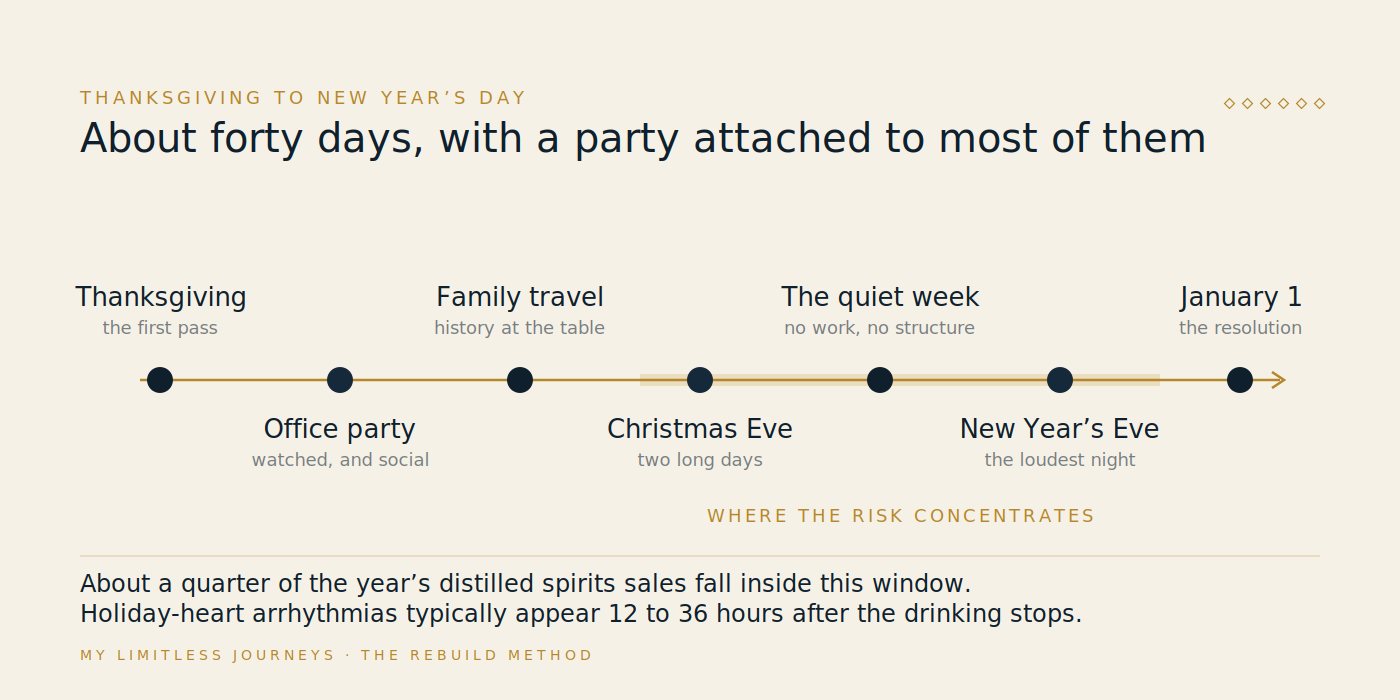
Most people who say it are picturing three events: a dinner, a party, a toast at midnight. What they are agreeing to runs from the fourth Thursday in November to the second of January: about forty days containing the office party, the client dinners, the in-laws, the flight, the unstructured week between Christmas and New Year’s when nobody is working and the bar is the living room, and then New Year’s Eve.
The commercial data reflects this. Reviewing the phenomenon clinicians call holiday heart syndrome, StatPearls notes that roughly a quarter of the year’s distilled spirits sales occur between Thanksgiving and New Year’s Day. The syndrome was first described by Ettinger and colleagues in the 1970s in patients hospitalized with atrial fibrillation after weekend binges, and it does not require a long drinking history. Otherwise healthy people who drink heavily once can present with it, typically twelve to thirty-six hours after the drinking stops, which is to say on the twenty-sixth, or on New Year’s Day.
The road data points the same direction. The National Highway Traffic Safety Administration reports that 1,038 people died in drunk-driving crashes in December 2023 alone, and more than 4,931 across the Decembers of 2019 through 2023. None of this is meant to frighten you. It is here because “just for the holidays” implies a short window, and this one is not.
You are not starting from where you think you are
Here is the part that surprises people who have been doing well. If you spent the autumn drinking meaningfully less, your tolerance came down with it. Tolerance is a physiological adaptation, and it fades. The three-drink evening that used to be unremarkable is, in real terms, a bigger dose than it was in August. People describe the same surprise: they drank what they always drank, they were far drunker than they intended, and the next day cost them two.
The second surprise is what a return to heavy drinking does after a period of reduction. In people with a history of repeated cycles of heavy drinking and abrupt stopping, withdrawal tends to get worse over time rather than better, a sensitization effect described as kindling and summarized in the StatPearls review of alcohol withdrawal syndrome. Practically: the fourth time you white-knuckle a stop is not easier than the first. It is often harder.
That is the main reason not to plan a January cold-turkey stop after a heavy December, and why our page on medical detox versus quitting at home exists. Alcohol and benzodiazepines are the two withdrawal syndromes that can kill people. The alcohol withdrawal timeline lays out the hours at which risk concentrates, and none of them are hours you want to spend in a guest room with everyone else asleep.
Know your actual numbers before you decide anything
Most people who are cutting back are estimating rather than counting, and the estimate is generous. The National Institute on Alcohol Abuse and Alcoholism defines binge drinking as the pattern bringing blood alcohol to 0.08 percent or above, typically five or more drinks for men or four or more for women in about two hours, and heavy drinking as five or more on any day or fifteen a week for men, four or more on any day or eight a week for women.
Two things distort the count at a party: a home pour is almost never five ounces of wine or a metered ounce and a half of spirits, and a topped-up glass cannot be tracked. Count in standard drinks, and count as you go.
A plan that survives contact with an actual party
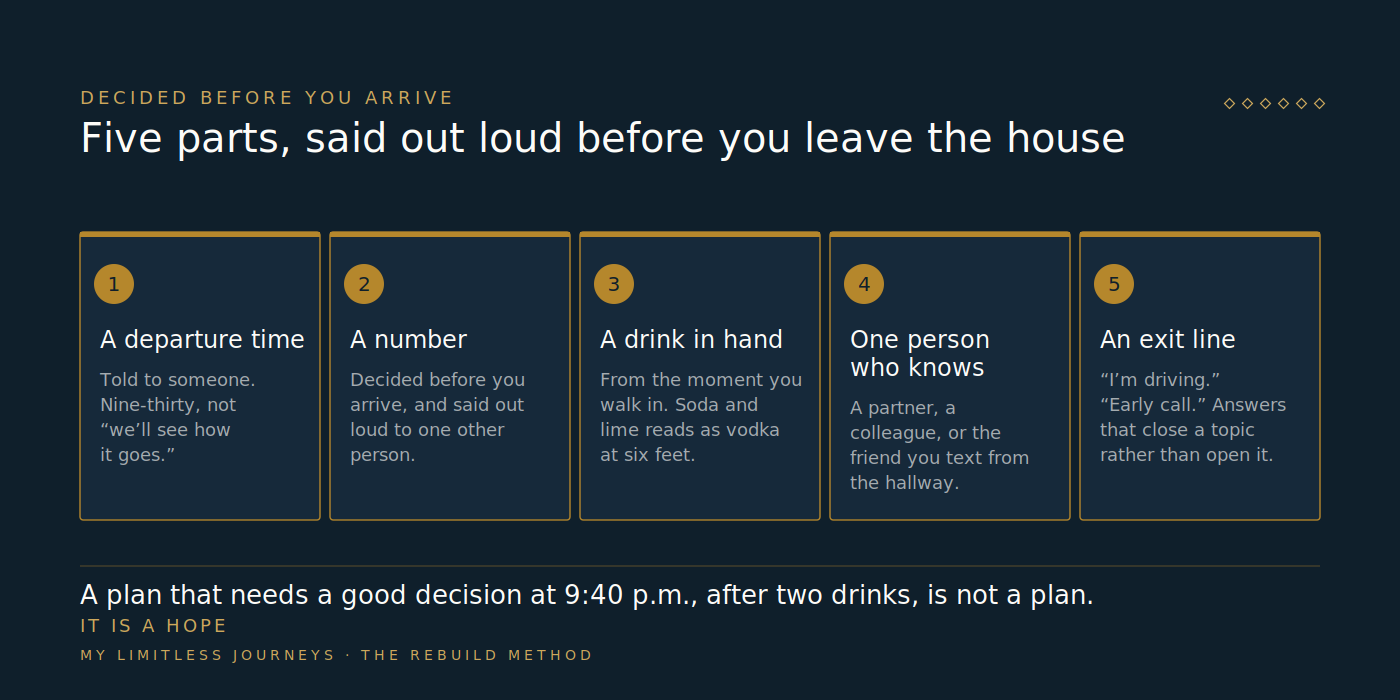
Plans that rely on deciding correctly at 9:40 p.m., after two drinks, in a room full of people you want to impress, do not work. Plans that remove the decision do. A workable one has five parts, and you should be able to say all five out loud before you leave the house.
A departure time, set in advance and told to someone. Not “I’ll see how it goes.” Nine-thirty, and the person driving knows it. A number, decided before arrival and said out loud to one other person. A drink in your hand from the moment you walk in, because the empty hand is the one a host fills, and soda water with lime is indistinguishable from a vodka soda at six feet. One person in the room who knows. And a rehearsed exit line, because “I’m not drinking tonight” invites a conversation while “I’m driving” or “I’ve got an early call” ends one.
Two additions for people whose work is social. Eat first. And decide in advance what to do about the toast, because the toast is where a season quietly turns. Holding a glass without drinking from it is a complete answer.
The family dinner is a different problem than the office party
At the office party the pressure is performance. You are watched by people who influence your career, and drinking is the local grammar of belonging. The management is logistical: arrive late, leave early, be seen, be sober, be gone.
At the family dinner the pressure is history. Everyone at the table has a version of you from twenty years ago, and someone will comment on what is or is not in your glass. That commentary is rarely about alcohol. It is about the fact that a change in you requires a change in them. Anticipating one sentence from one person, and deciding now what you will say back, is worth more than general resolve. If the family conversation is the real problem, our page for families and the post on how to talk to someone about getting help are written for the other side of that table.
When it is more than the season
A seasonal problem responds to a seasonal fix. If your plan works most nights, if the mornings are unpleasant rather than frightening, and if you can go to a party and drink two, you have a hard month and a workable strategy.
Other signs mean the thing you are managing is not the calendar. Drinking in the morning, or needing a drink to stop shaking, is physiological dependence, not habit. Tremor, sweats, nausea, racing heart, or anxiety that arrives a few hours after your last drink and lifts when you have one is withdrawal. A previous withdrawal seizure, or confusion and hallucination during a stop, changes the medical calculus entirely. Setting a limit and blowing through it repeatedly, drinking alone beforehand so you drink less at the event, or mornings you reconstruct from your phone all say the drinking has its own logic now.
None of this means you failed at cutting back. It means cutting back was the wrong intervention for what you have. The NIAAA attributes roughly 178,000 deaths a year in the United States to excessive alcohol use, and more than four million emergency department visits in 2022. If you recognize yourself above, the next step is an assessment, and our piece on the signs of high-functioning alcohol use is a fair place to check your pattern.
If December is dangerous, do not wait for January
We wrote separately about why treatment admissions spike in January. Every year, people decide in early December to get help afterward, and for many that is sound. For a smaller number it means spending the six most dangerous weeks of their year unsupervised.
There are unglamorous reasons a December admission can be the better one. Work is quiet, the calendar has holes that never appear again, and an absence explains itself. There are insurance mechanics worth understanding too, which we cover in how deductible resets affect treatment timing. But the clinical question comes first. If a stop would be medically risky, that argues for admitting sooner, and detoxing under supervision in our detox and residential program is far safer than a New Year’s Eve attempt at going dry.
Frequently asked questions
I have been cutting back successfully. Is one heavy night going to undo it?
One night does not erase three months of change, but it does two things worth watching. It gives a lower-tolerance body a larger-than-intended dose, and it tests whether the next morning ends the episode or starts a stretch. Most people can tell within forty-eight hours which happened, and that answer is more useful than the resolution that follows it.
Is it safe to stop drinking entirely on January 1 after a heavy December?
For light and moderate drinkers, generally yes. For someone drinking heavily every day, or who has had withdrawal symptoms before, an abrupt unsupervised stop is the specific scenario in which alcohol withdrawal turns dangerous. Talk to a physician or call us before you set a date.
What do I say when someone keeps pushing a drink on me?
Give a reason that closes the topic rather than opens it: you are driving, you are on a medication, you have an early call. You owe no one a disclosure at a party. If someone keeps pushing after a clear answer, the pushing is about them.
Can someone actually admit to treatment in late December?
Yes. Our admissions line is staffed around the clock every day of the year, and we admit through the end of December. With six beds, the practical question is availability on a given date, which is a few minutes on the phone.
My partner is the one I am worried about. What do I do over the holidays?
Do not stage a confrontation at a gathering; almost nothing good comes of it. Pick a sober morning, be specific about what you have seen rather than what it means, and have a concrete option ready. Our page on what to do when they refuse treatment covers the harder version.
If you are reading this in the parking lot before a party, or at two in the morning after one, the call is confidential and commits you to nothing. We answer every day of the year, including the ones on this list.
Keep reading: The alcohol withdrawal timeline · Why January admissions spike · Signs of a high-functioning alcoholic · Medical detox vs. quitting at home · Detox and residential treatment