
Published by the Clinical Team at My Limitless Journeys. Reviewed under board-certified psychiatric oversight.

Why the first meal is a clinical decision
A person arriving for alcohol detox has frequently been eating badly for months. Alcohol supplies calories with almost no nutrients, suppresses appetite, irritates the gut lining, impairs absorption in the small intestine, and damages the liver’s ability to store and activate several vitamins. The result is a body that looks fed and is not.
So when someone says the first thing they want is a proper breakfast, we are glad and we are careful. The nutritional plan in the first seventy-two hours is part of the withdrawal protocol, sitting alongside symptom-triggered medication and monitoring. The American Society of Addiction Medicine’s clinical practice guideline on alcohol withdrawal management frames the whole of withdrawal management not as a discrete service but as the beginning of treatment, and nutrition is one of the places that framing bites hardest.
Thiamine, and why it goes first
Thiamine, vitamin B1, is a cofactor for enzymes that let cells make energy from glucose. The brain is the most exposed organ when it runs short, because neurons cannot easily switch fuels. The National Institutes of Health’s Office of Dietary Supplements notes in its thiamin fact sheet that up to 80% of people with chronic alcoholism develop thiamine deficiency, through a combination of reduced intake, impaired absorption, reduced liver storage and impaired conversion to the active form.
The reason it goes first, before a glucose drip or a large carbohydrate meal, is that giving glucose to a thiamine-depleted brain increases demand for the very cofactor that is missing. In a person already on the edge, that can be the thing that pushes them over it. This is not an obscure precaution; it is standard practice in emergency medicine, and it is one of the concrete differences between supervised withdrawal and quitting at home.
Wernicke’s, and the triad that usually isn’t complete
Wernicke’s encephalopathy is the acute, treatable phase of thiamine-deficiency brain injury. Korsakoff syndrome is the chronic phase, involving lasting damage to the memory structures. MedlinePlus describes the acute presentation as confusion that can progress to coma and death, loss of coordination, and eye-movement abnormalities including double vision, and states that vitamin B1 should be given by injection into a vein or muscle as soon as possible.
The clinical trap is that the classic three-part picture is often incomplete. Someone can present with confusion alone, or with unsteadiness alone, in a setting where confusion and unsteadiness are being attributed to intoxication or to withdrawal itself. Wernicke-Korsakoff syndrome is roughly eight to ten times more common in people with chronic alcoholism than in the general population, and the acute phase can be fatal in up to 20% of untreated cases. Replacement given early can reverse the confusion and the eye signs; MedlinePlus is blunt that it often does not restore the memory loss once Korsakoff has set in. That asymmetry is the entire argument for treating suspicion, not certainty.
Magnesium, potassium, phosphate
Heavy drinking depletes magnesium through renal wasting, poor intake and gastrointestinal losses. Low magnesium matters here for two separate reasons. It lowers the seizure threshold at exactly the point in withdrawal when seizure risk is highest, and it is required for the enzyme that converts thiamine into its active coenzyme form. Replace thiamine in a magnesium-depleted person and the replacement can underperform.
Potassium and phosphate follow the same logic. They shift into cells as feeding restarts, and the serum levels that looked acceptable on admission can fall sharply over the following days. This is why bloods are repeated rather than drawn once, and why our detox protocols pair the nutritional plan with laboratory monitoring rather than with a standing multivitamin order. The specifics of medication during this window are covered separately in detox medications.
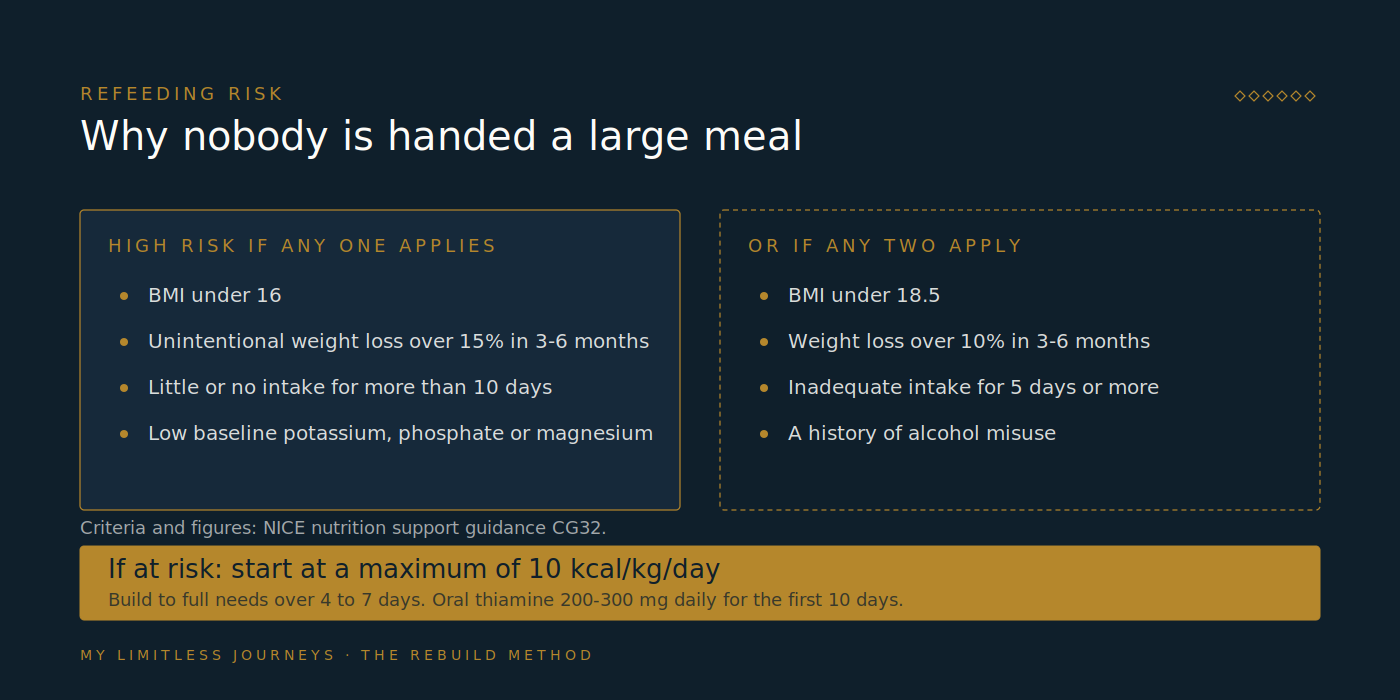
Refeeding syndrome: the reason we go slowly
When a depleted body is fed carbohydrate again, insulin rises and drives potassium, phosphate and magnesium into cells. If the reserves were already low, serum levels can crash, and the consequences reach the heart and the respiratory muscles. The UK’s National Institute for Health and Care Excellence sets out the risk criteria in its nutrition support guidance: a body mass index below 16, unintentional weight loss above 15% in three to six months, little or no nutritional intake for more than ten days, or low baseline potassium, phosphate or magnesium. Two or more lesser criteria also qualify, and one of those lesser criteria is a history of alcohol misuse.
For people who meet the threshold, NICE recommends starting nutrition support at a maximum of 10 kcal per kilogram per day and building to full requirements over four to seven days, with oral thiamine at 200 to 300 mg daily plus a B-complex preparation during the first ten days, and with electrolytes supplemented as needed. In practical terms this looks unglamorous: small, frequent, ordinary food, and a clinician watching the numbers. It is also the difference between a comfortable first week and an avoidable cardiac event.
Folate, B12, zinc, and the slower repairs
Beyond the acute window sit the deficiencies that develop quietly and correct slowly. Folate depletion is common and contributes to the anaemia and fatigue that many people assume is simply post-detox exhaustion. Vitamin B12 status can be affected by gastric and ileal changes. Zinc losses show up as altered taste, slow wound healing and poor appetite, which is a cruel loop when the goal is eating. Vitamin D is frequently low, partly through diet and partly through the indoor, night-shaped life that heavy drinking tends to produce.
None of these are emergencies. All of them affect how the first ninety days feel. We check what is worth checking, replace what is low, and then do the boring thing that actually rebuilds nutritional status: three meals, protein at each of them, real carbohydrate rather than sugar, and enough water. Our companion piece on nutrition through detox and recovery goes further into what that looks like on a plate.
Blood sugar, cravings, and the four o’clock problem
Alcohol is metabolised in a way that interferes with the liver’s production of glucose between meals, and many people arrive with an unstable glycaemic pattern on top of everything else. In the first weeks of abstinence this shows up as a mid-afternoon crash: shaky, irritable, suddenly certain that something is wrong. It is very easy to read that state as craving, because it feels almost identical.
The intervention is unimpressive and effective. Eat breakfast. Put protein in it. Do not let five hours pass without food in the first month. A meaningful minority of what people describe as afternoon cravings on the alcohol withdrawal timeline softens considerably once meals are regular, which is worth knowing before you conclude that your recovery is failing at 4 p.m. every day.
Frequently asked questions
Can I just take a high-dose B-complex from the pharmacy?
Oral supplements are useful for maintenance but absorption is unreliable in exactly the population that needs it most, which is why acute replacement is often given by injection. Supplements also do nothing about withdrawal seizure risk, electrolyte shifts or refeeding risk. Please do not treat a bottle of vitamins as a substitute for supervised withdrawal.
How long before I feel physically normal again?
Appetite and sleep usually begin to organise within two to four weeks. Energy, concentration and body composition take longer, commonly two to three months, and are strongly affected by how consistently you eat and move. This is a repair on a biological timeline, not a motivational one.
I have lost a lot of weight. Should I try to gain it back quickly?
No. Significant unintentional weight loss is one of the criteria that flags refeeding risk, so rapid refeeding is the specific thing to avoid. Weight returns as part of a monitored plan, not as a project you undertake in the first fortnight.
Why am I craving sugar constantly?
Partly unstable blood glucose, partly the reward system looking for a fast substitute. It is extremely common and usually settles. We would rather you ate the dessert in early recovery than white-knuckled it, while steadily building meals that make the spike unnecessary.
Does any of this reverse liver damage?
Abstinence plus adequate nutrition gives the liver its best chance, and early changes such as fatty infiltration often improve substantially. More advanced disease is a separate medical question for a hepatologist, and one your admissions assessment should surface early. Speak to our team about alcohol addiction treatment if you are unsure where you stand.
If you are planning to stop drinking, plan the first seventy-two hours with someone who does this for a living. That conversation is confidential and it costs nothing.
Keep reading: The alcohol withdrawal timeline · Nutrition in detox and recovery · Medically supervised detox · Detox medications · What “medically supervised” means