

How long is the wait for rehab in Orange County?
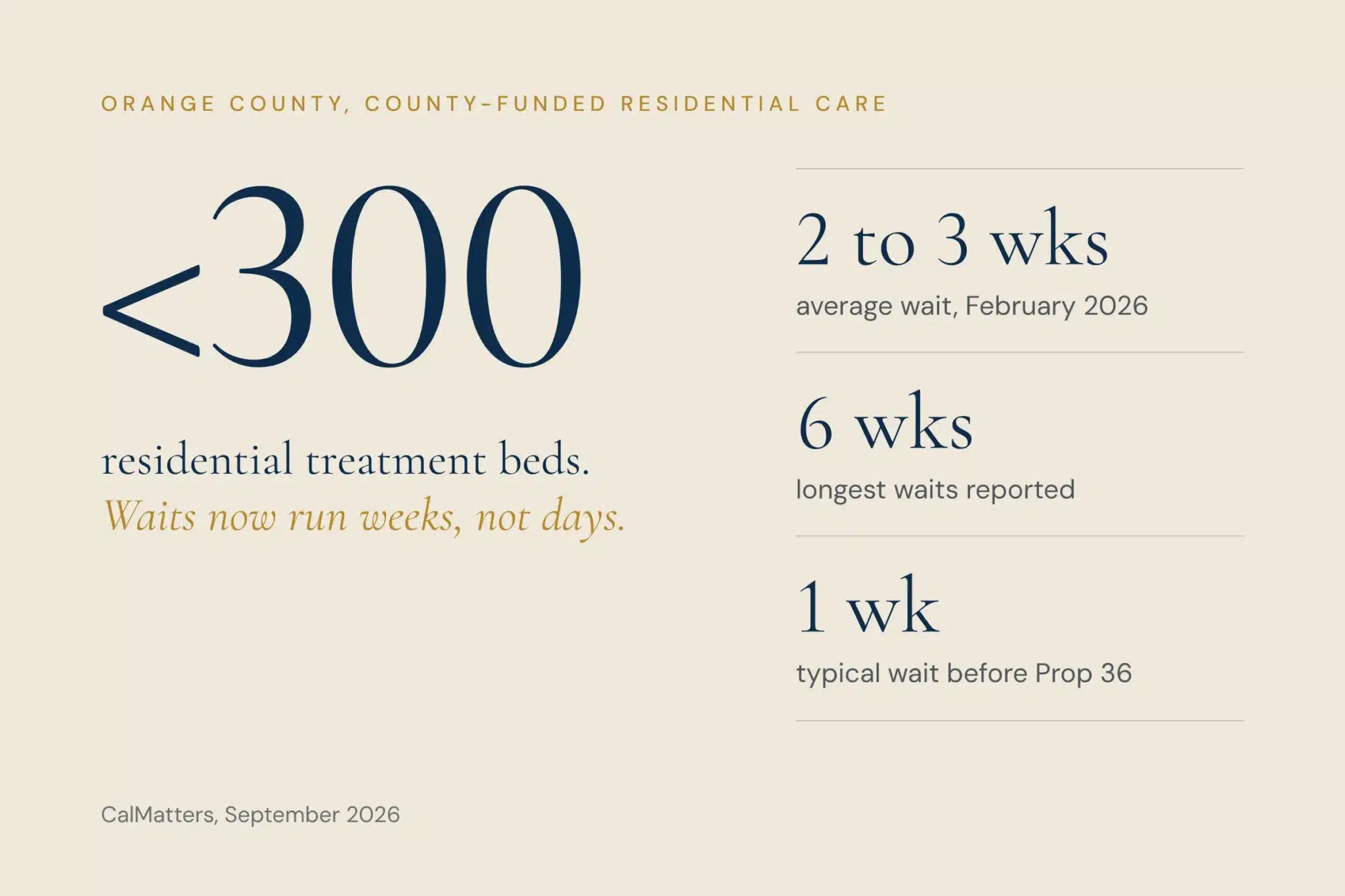
In Orange County’s publicly funded system, CalMatters reported that the average wait for a residential treatment bed had reached two to three weeks by February 2026, sometimes six. Waits at insurance-funded and private programs vary, so ask each program for a real admission date, and treat the wait itself as a risk period that needs a plan.
What CalMatters found in Orange County
In September, CalMatters examined how California counties are handling Proposition 36, the 2024 ballot measure that lets people facing certain repeat drug charges choose treatment over a jail or prison sentence. Orange County had more potential treatment cases than any other county in the analysis: 1,311 people referred on drug charges as of February 2026. Of those, 314 agreed to treatment, and fewer than half of them were actively receiving it.
The bottleneck the reporters describe is capacity. The county’s residential drug treatment system has fewer than 300 beds. Before Prop 36, people generally waited up to a week for one. By February the average wait was two to three weeks, and some people waited as long as six. Ian Kemmer, the county’s director of behavioral health services, told CalMatters he wished the program were treating more people, and said of those it does reach: “I think that these are folks that we would not have gotten into treatment any other way.”
Most families reading this are not in the court system. The numbers still describe something every family meets eventually: the gap between the day someone says yes and the day a bed opens. This article is about that gap.
Why the wait is a medical problem, not only a scheduling one
Motivation for treatment is real but rarely constant. The day someone agrees to go is often the day after something frightening, and the resolve that follows can fade as the memory does. A two-week wait asks a person in the middle of a crisis to hold a decision steady through fourteen ordinary days.
There are physical risks too. Someone who decides to get a head start by stopping alcohol or a benzodiazepine on their own can set off a withdrawal that is dangerous and sometimes life-threatening, which is why anyone in that position should talk with a physician before quitting. Our page on medical detox versus quitting at home explains the difference. Opioids carry the opposite risk. The New York City Health Department’s guidance on tolerance notes that tolerance falls when someone stops or takes a break, and that with low tolerance even a small amount raises the risk of overdose. A person who cuts back while waiting and then returns to an old amount is in danger. Keep naloxone in the house during any wait.
“A wait is not a pause in the illness. We ask families to treat those days as part of treatment: someone checks in daily, nobody stops a drug or a drink abruptly without medical advice, and naloxone is in the house.”
Maria Dahlman, MA, LCSW, Regional Clinical Director, Emend Healthcare
Is sober living a safe place to wait?
CalMatters reports that Orange County often places people in sober living homes while they wait for a residential bed, and that those homes do not provide the treatment people need. That is not a criticism of sober living, which can be a valuable step after treatment. It is a description of what sober living is: housing with rules and peer support, generally without nurses, physicians or therapy on site. Our explainer on transitional living versus sober living draws the line between the two.
If someone you love is waiting in a sober living home, ask the plain questions: who checks on them each day, what happens if they use, whether there is naloxone in the house, and who will drive them to admission when the bed opens.
Which doors are open while you wait
Wait times are not uniform. County-funded beds, insurance-funded programs and private pay each run on different calendars, and an honest program will give you its real admission date on the first call. Behavioral health benefits follow the plan rather than the county line, though networks vary, so a commercially insured Orange County resident can often look beyond the county as well. That is the reasoning behind our page on residential treatment for Orange County adults: a six-bed home in Encino, about an hour north, where the distance does part of the work.
Six beds also means we are sometimes full. When we are, we say so on the first call, give a realistic date, and help you find a safe option elsewhere if waiting is not safe. You can start a confidential benefits check at any point, and our Orange County hub explains the drive and which levels of care travel well.
A plan for the days between yes and admission
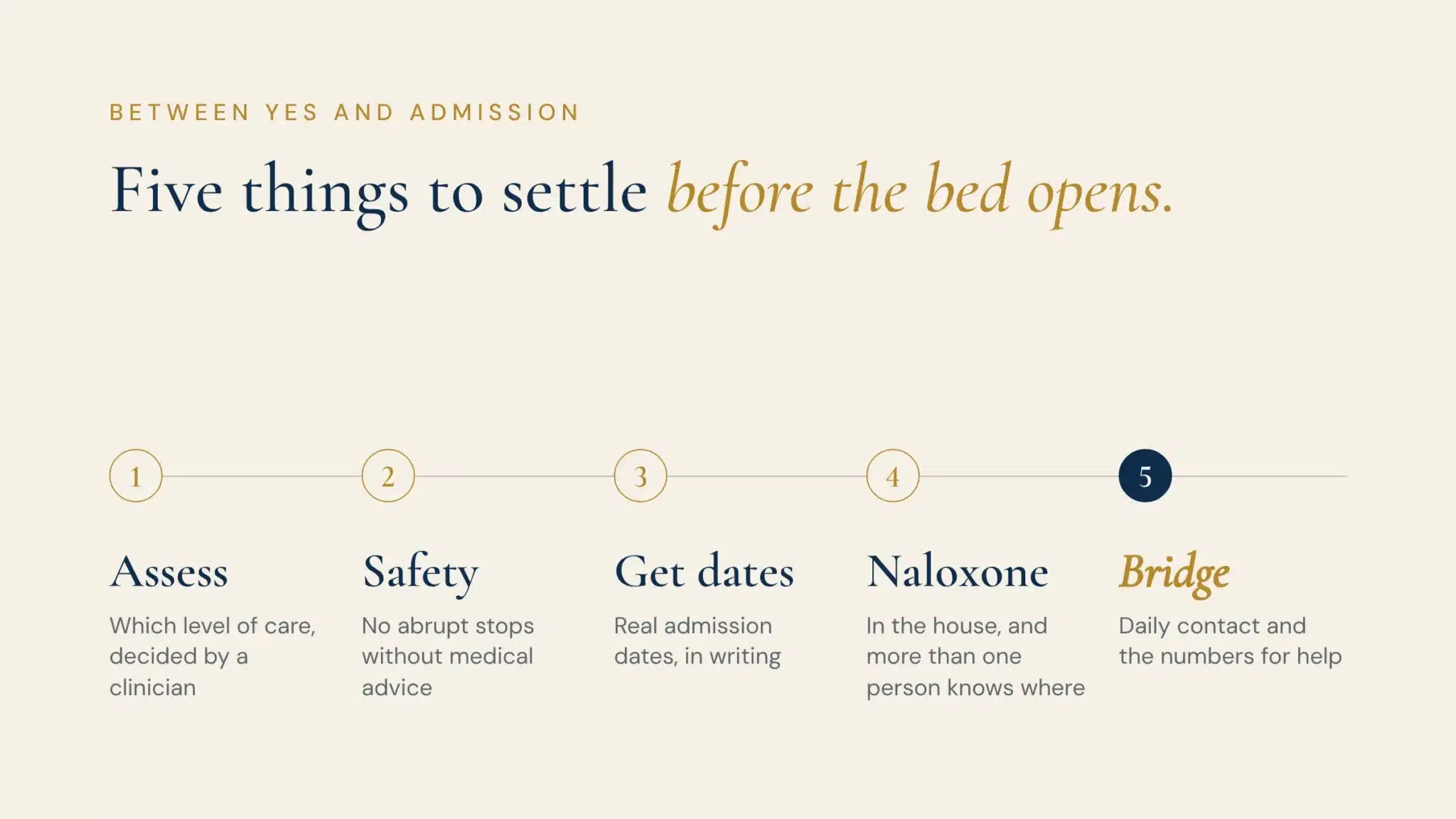
- Get a level-of-care assessment. A clinician should decide whether the person needs detox, residential, PHP or IOP. Our guide to how the right level of care is determined shows what they weigh.
- Make it medically safe. Nobody stops alcohol or benzodiazepines abruptly without medical advice. If withdrawal starts, call a physician or go to an emergency department.
- Ask for real dates, in writing. Ask every program when a bed is actually available, what it needs from you before then, and what would move the date.
- Keep naloxone at hand. Especially if opioids are part of the picture, and make sure more than one person knows where it is.
- Build a bridge. Daily contact with one steady person, outpatient sessions or meetings where available, and the numbers for help. The Orange County Health Care Agency’s OC Navigator lists local resources, and SAMHSA’s free, confidential National Helpline, 1-800-662-4357, offers referrals around the clock.
When the bed opens
Admission day should not be the first time anyone thinks about logistics. Know who is driving, what to pack, which medications to bring in their original bottles, and when the last drink or dose will be. Timing matters most for alcohol and benzodiazepines, because arriving before withdrawal peaks lets nursing staff manage it from the start. Our page on residential treatment for Orange County families and the walkthrough of what happens on the admissions call cover the details, and the residential program page describes what the weeks contain.
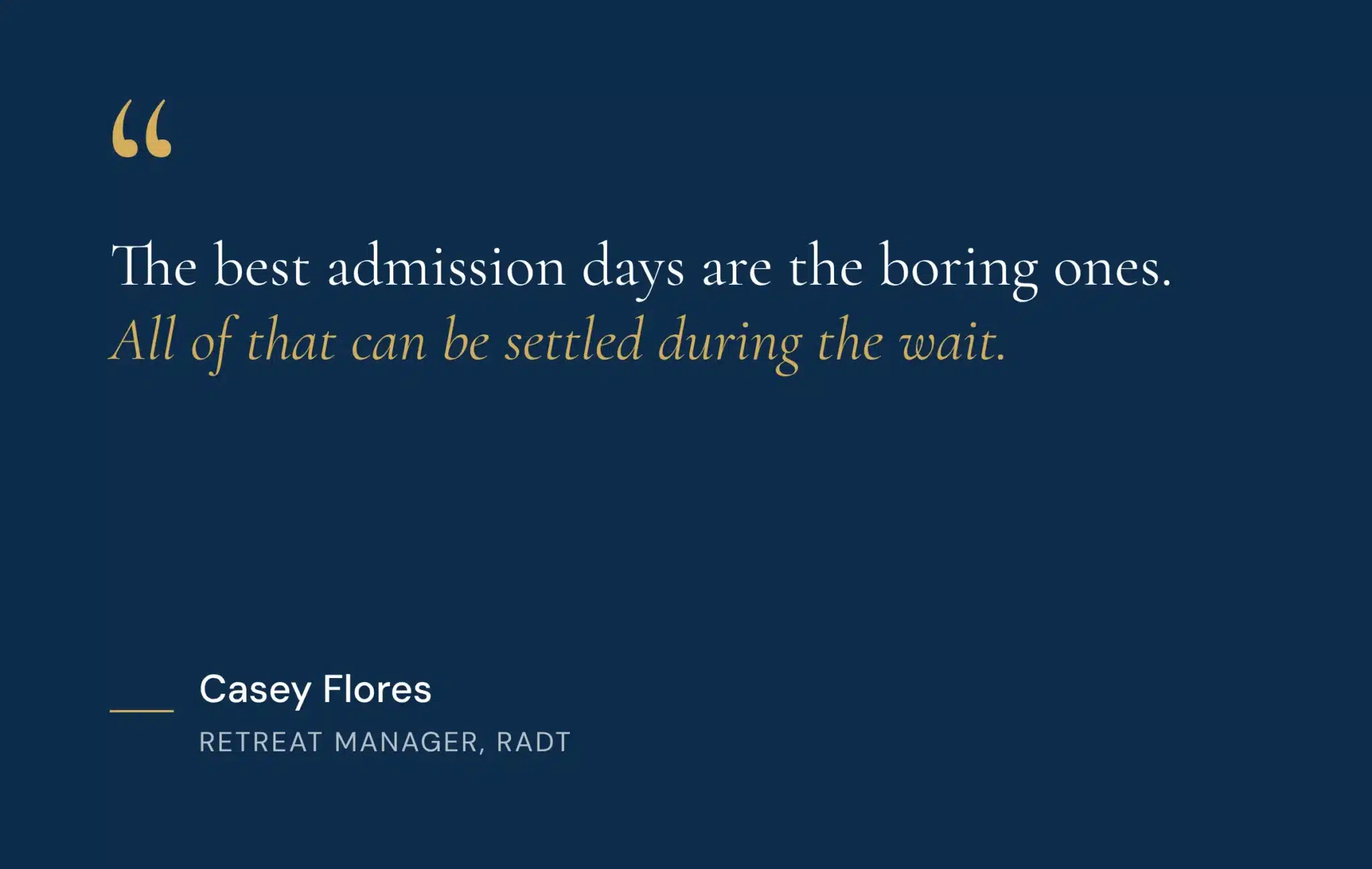
“The best admission days are the boring ones. The family knows who is driving, the medications are in their bottles, and we already know when the last drink was. All of that can be settled during the wait.”
Casey Flores, RADT, Retreat Manager, My Limitless Journeys
Frequently asked questions
How long is the wait for rehab in Orange County?
It depends on the funding source. For county-funded residential treatment, CalMatters reported average waits of two to three weeks as of February 2026, sometimes six. Programs funded by commercial insurance or private pay set their own timelines, so ask each one for a real admission date.
Can someone wait in sober living until a treatment bed opens?
They can, but sober living is housing with rules and peer support, not clinical treatment. CalMatters reported that the homes used as interim placements in Orange County do not provide the treatment people need. If sober living is the plan, add daily check-ins, naloxone and a clear route to medical care.
Is it safe to stop drinking while waiting for rehab?
Not always. After heavy daily drinking or regular benzodiazepine use, stopping suddenly can cause dangerous withdrawal, including seizures. Talk with a physician or the admitting program before cutting back, and ask whether medically supervised detox should come first.
Can Orange County insurance pay for treatment outside the county?
Often, yes. Behavioral health benefits are tied to your plan rather than your county, though networks and authorization rules vary. A benefits check before admission shows what a specific plan covers.
If the wait is the problem, ask us for a real date. We will tell you when a bed is available, what the stay would involve and what your plan covers, plainly and in confidence.
This article is general information, not a diagnosis or a substitute for an assessment by a clinician. If someone is in immediate danger, call 911. In a mental health or substance use crisis, call or text 988.
Sources
- Kendall, M., and Mihalovich, C. “California’s tough on crime law promised treatment. Here’s why people are falling through the cracks.” CalMatters, September 17, 2026, updated September 22, 2026. calmatters.org
- NYC Department of Health and Mental Hygiene, “Drug Tolerance and Risk of Overdose.” nyc.gov
- Orange County Health Care Agency, OC Navigator. ocnavigator.org
- SAMHSA National Helpline. samhsa.gov
Every article on this site is written by our editorial team and reviewed by a licensed clinician. Read how we write and review content.
Keep reading: Residential treatment for Orange County adults · Transitional living vs. sober living · Medical detox vs. quitting at home · Medical detox for Orange County residents · Do I need residential treatment?