
Withdraw where nobody's watching.
Medically supervised detox for Orange County residents, in a private bedroom in a six-bed home in Encino, roughly an hour north of the county. This page is about the first three to ten days: what "medically supervised" means at MLJ, how each substance is handled, and, because you will be unwell when you travel, exactly how arrival day is arranged so that the drive is safe.
Authored by the MLJ Clinical Team. Reviewed under board-certified psychiatric oversight. Last updated September 2026.
Key Takeaways- MLJ has no detox in Orange County; detox happens at the Encino residence, and the roughly hour-long drive is planned around your last dose or drink so a nurse is with you before withdrawal peaks.
- Detox here means nursing coverage, physician-set and score-adjusted medication protocols, daily psychiatric oversight, and a clear plan for hospital transfer in the rare case it is needed.
- Alcohol, benzodiazepines, opioids and fentanyl, stimulants, and combinations each follow a different protocol; the substance and your history, not a template, set the length.
- You do not leave when detox ends. Residential treatment begins in the same bedroom with the same team, which closes the gap where most people are lost.
- Insurance from Aetna, Anthem, Cigna, Kaiser Southern California, and UnitedHealthcare is verified before you travel; private pay accepted.
What "medically supervised" means here.
The phrase is used loosely across the treatment industry, and Orange County has programs at every point on the spectrum, from hospital units to houses where "supervision" means someone checks in twice a day. Before you drive an hour for detox, you should know precisely what you are driving toward.
At MLJ, medically supervised detox means four things. Nursing staff are present, assessing vital signs and withdrawal scores on a set cadence that is most frequent in the first seventy-two hours. A physician sets the medication protocol before you arrive, based on the substance history you gave admissions, and adjusts it to your scores rather than to a fixed schedule. A board-certified psychiatrist reviews every client, because withdrawal is when underlying anxiety, depression, and trauma surface most sharply and because psychiatric medications you already take interact with detox protocols. And there is a written plan for the uncommon situation that exceeds what a residence can safely manage, with a hospital transfer arranged rather than improvised. Our guide on what medically supervised means lays out the standard in more detail, including what "social detox" is by contrast.
What it does not mean is a hospital ward. There are six bedrooms in a private home. The monitoring is clinical; the setting is not. The Substance Abuse and Mental Health Services Administration describes detoxification as a set of interventions to manage acute intoxication and withdrawal safely, and explicitly not as treatment in itself. That framing is exactly right, and it is why the next question, what happens after, matters as much as the protocol.
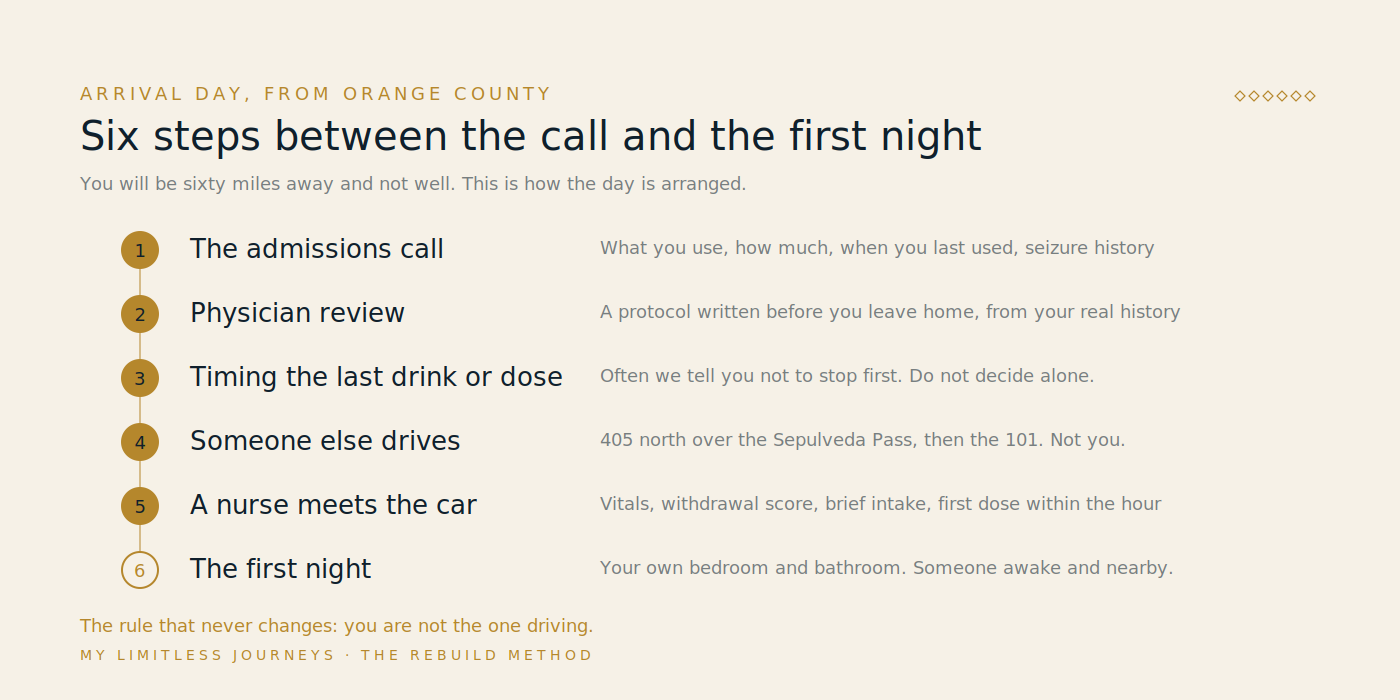
Arrival day from Orange County, step by step.
This is the section that makes an Orange County detox page different from a generic one. You will be sixty miles away and not well. Here is how we handle it.
The call. Admissions will ask what you use, how much, and when you last used it. Answer exactly, including the things you are embarrassed about; the physician builds your protocol from this and a half-truth makes it wrong. We will ask about medical conditions, current medications, seizure history, and prior withdrawals, because a previous seizure or DTs episode raises the risk this time. Benefits verification runs in parallel. The admissions call guide covers the full conversation.
Timing the last use. This is counterintuitive and important. For alcohol and benzodiazepines, we will often tell you not to stop before the drive. Withdrawal from both peaks in a window that could land you on the 405 at the worst possible moment; arriving with the substance still in your system and under nursing care is safer than arriving "clean" and forty hours into withdrawal. For opioids, timing depends on whether buprenorphine induction is planned, and we will give you a specific window. Do not decide this alone.
The driver. You do not drive. A spouse, a parent, a friend, a colleague you trust. If nobody is available, tell admissions; there are options and we will arrange them with you. The route from most of the county is the 405 north over the Sepulveda Pass to the 101 north, and we give the driver the address, which is otherwise withheld, once admission is confirmed. Off-peak the drive is an hour to an hour and a half; we schedule arrivals to avoid rush hour when we can.
Arrival. A nurse meets the car. Vitals, a withdrawal assessment, a brief medical intake, and the first dose of whatever the protocol calls for happen within the first hour. Your driver is given a short orientation about the week ahead and a family clinician's contact, and then they go home. You go to your room. The first night is usually the hardest, and someone is awake and nearby for all of it.
By substance: how long, what medicine.
Length and approach depend on what you use. These are typical ranges, not commitments; the detox timelines guide has fuller versions of each.
| Substance | Typical detox length | Main concern | Approach |
|---|---|---|---|
| Alcohol | 5–7 days | Seizures, delirium tremens | Score-guided benzodiazepine taper, thiamine, fluids |
| Benzodiazepines | 2–6 weeks (taper continues into residential) | Seizures, rebound anxiety | Slow taper, often cross-titrated to a longer-acting agent |
| Opioids and fentanyl | 5–10 days | Severe discomfort, leaving early, precipitated withdrawal | Buprenorphine induction, comfort medications |
| Stimulants | 3–7 days acute | Depression, suicidal thinking, hypersomnia | Psychiatric monitoring, sleep and nutrition |
| Polysubstance | Set by the riskiest component | Overlapping syndromes | Sequenced protocols under one physician |
Two things the table cannot show. First, a benzodiazepine taper does not end when "detox" ends; it runs quietly in the background of residential treatment for weeks, which is one reason splitting detox and residential across two programs is a mistake. Second, stimulant detox looks undramatic on paper and is dangerous in a specific way: the crash can include suicidal thinking in people who have never had it, which is why it belongs under psychiatric oversight even without an IV. The stimulant withdrawal page describes the fourteen-day mood curve.
A bedroom, not a ward.
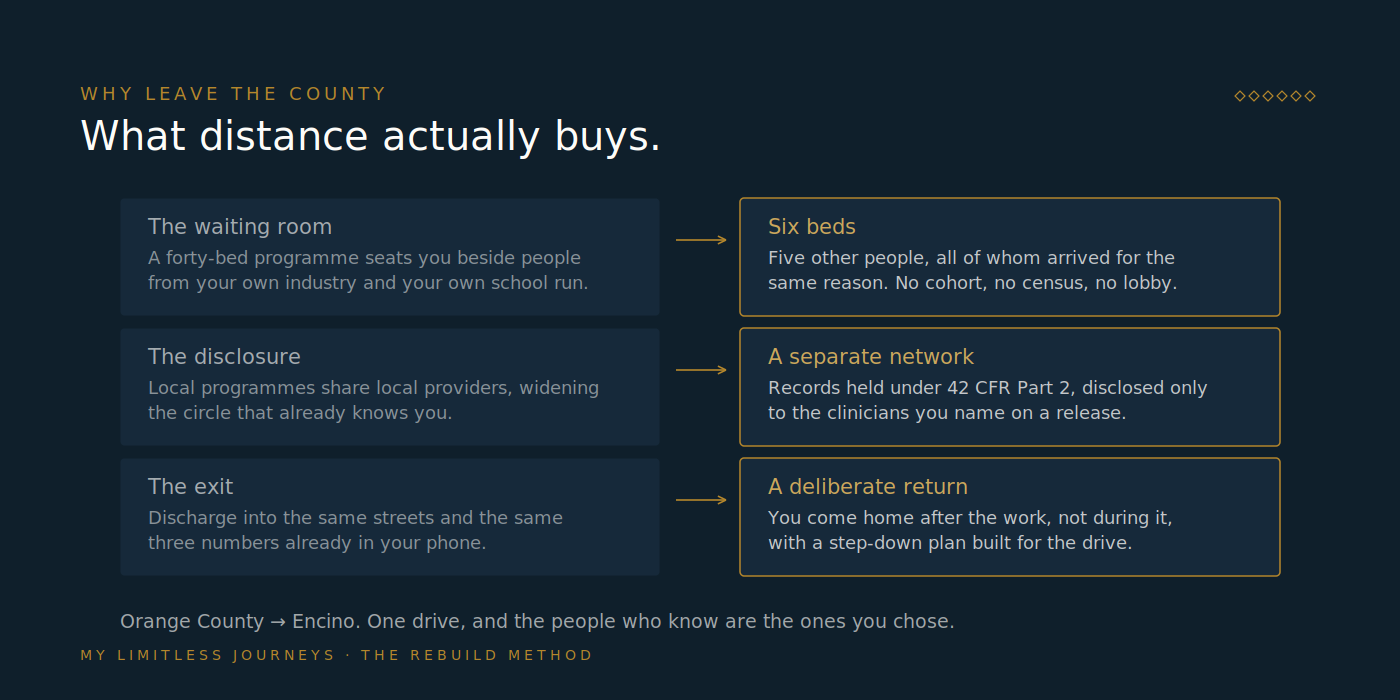
The people who leave detox early rarely leave because the medicine failed. They leave because of the setting: a shared room, a fluorescent hallway, a roommate in worse shape, a waiting room where someone from work might walk in. For an Orange County professional, that last one is not paranoia; the county's treatment corridor is small and its professional circles are smaller.
Detox at MLJ happens in your own bedroom with your own bathroom, in a hillside home whose address is not published. There are at most five other clients in the house, and staff are trained to treat your identity as sensitive by default. Nobody from your firm is in the next room. The headline of this page is not a slogan; it is a description of the floor plan. Our page on the residence shows what that looks like, and the six-beds page explains why the headcount matters as much as the address.
private bedrooms, no more
hours of most intensive monitoring
transfers between detox and residential
What happens when detox ends.
Nothing visible, and that is the point. There is no discharge from detox, no drive back down the 405 to find a residential bed, no second intake. Residential treatment begins in the same room, with the therapist who has been checking on you since the first night. The shift is in what the days hold: individual therapy several times a week, small groups, psychiatric follow-up, fitness and nutrition as clinical work, and family sessions scheduled around the drive from Orange County. The Orange County residential treatment page covers those weeks.
We say this plainly because standalone detox, followed by a drive home to Orange County, is the single most predictable way to relapse. Tolerance has dropped, nothing underneath has been treated, and the network and the calendar are waiting. If someone offers you a five-day detox and a handshake, ask what happens on day six. Our page on medical detox versus quitting at home is honest about why the medical part is only the start.
What your family should expect this week.
The person who drove you north will go home to Orange County and hear very little for several days. That is deliberate. During detox, phone contact is limited because a call about a client crisis or a family argument is not something a nervous system in withdrawal can absorb. In its place, a family clinician is in touch with your spouse or parents directly: what today looked like in general terms, what tomorrow is likely to hold, when the first call or visit will happen. Releases of information are signed on arrival so that this is possible; our page on family confidentiality explains what we can and cannot share.
For the spouse, the week is its own ordeal, and the guide on supporting a partner through detox was written for it. Visits begin after the acute phase, usually toward the end of the first week, and from then on they are clustered so that a Saturday drive from Orange County holds a family session and time together, not fifty minutes and a freeway.
- Orange County hub. The whole case for the drive north.
- Orange County residential treatment. What begins when detox ends.
- Orange County alcohol rehab. If alcohol is the substance.
- Medical detox hub. Every protocol in depth.
- Detox and residential program. The program page.
- Exercise as pharmacology in detox. Why movement is part of the protocol.
This guide is educational and is not a substitute for medical advice. If someone is in immediate danger, call 911.