
Levels of care when there is also a psychiatric diagnosis.
When depression, bipolar disorder, PTSD, or an anxiety disorder sits alongside substance use, the usual level-of-care logic changes. The deciding question becomes how often you need to be seen by a psychiatrist, and how quickly medication and mood can be adjusted when things shift.
Authored by the MLJ Clinical Team. Reviewed under board-certified psychiatric oversight. Last updated September 2026.
Key Takeaways- Roughly half of people with a substance use disorder also meet criteria for a mental-health condition, so "co-occurring" is the norm in treatment, not the exception.
- For co-occurring disorders, the level of care is driven less by how much you were using and more by how frequently a psychiatrist needs to see you and adjust treatment.
- Residential care offers daily psychiatric access and 24-hour observation; PHP offers near-daily contact; IOP assumes psychiatric stability with weekly or biweekly follow-up.
- Symptoms that appear during detox are unreliable; a diagnosis made in the first week is provisional and should be revisited once the substance has cleared.
- The safest path through the continuum keeps one psychiatrist and one clinical team from the first assessment to the last outpatient session.
Why co-occurring disorders change the calculation.
If you have read our overview of levels of care, you know the basic ladder: detox, residential, partial hospitalization, intensive outpatient, and aftercare. For a person whose only diagnosis is a substance use disorder, the choice of rung depends largely on withdrawal risk, the stability of the home environment, and how many prior attempts have not held.
Add a psychiatric diagnosis and a second axis appears. Now the team must also ask: how stable is this person's mood, thinking, and sleep once the substance is gone? How fast could that stability deteriorate? What happens if a medication needs changing on a Tuesday afternoon and the next appointment is in two weeks? These are not hypothetical concerns. The National Institute on Drug Abuse reports that about half of people who experience a substance use disorder in their lifetime will also experience a mental illness, and the reverse is true as well (NIDA, Common Comorbidities with Substance Use Disorders).
Substances and psychiatric symptoms also interact in ways that make each harder to treat alone. Alcohol deepens depression and fragments sleep. Stimulants can mimic or trigger mania and paranoia. Cannabis and benzodiazepines blunt anxiety in the short term and worsen it over time. Untreated PTSD keeps the nervous system in a state that many people medicate with whatever is at hand. This is why the field moved decades ago toward integrated treatment, in which both conditions are treated by the same team at the same time, rather than sequentially by separate providers who rarely speak to one another.
Psychiatric contact frequency: the variable that decides.
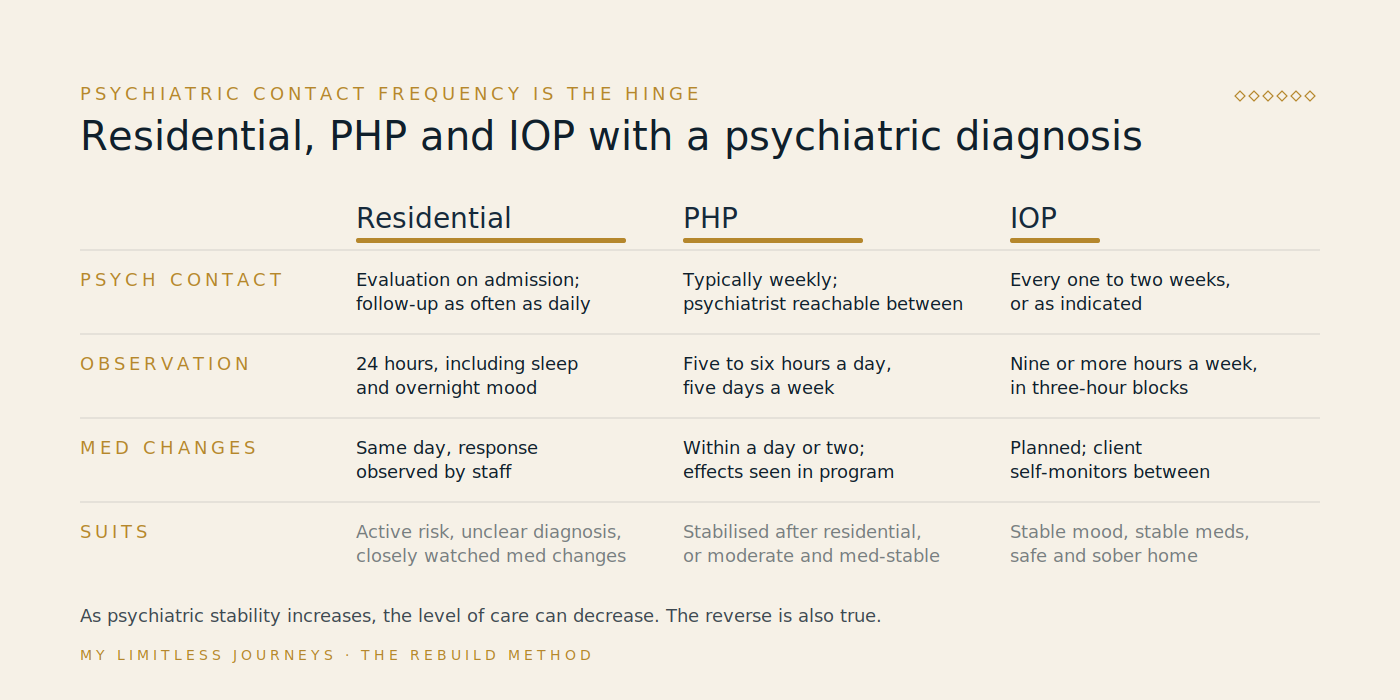
When our clinical team sits down to recommend a level of care for someone with a co-occurring diagnosis, the question we return to most often is deceptively simple: how frequently does this person need to be seen by a psychiatrist right now, and how quickly must we be able to respond if something changes?
That single variable does most of the work. A person coming off alcohol with a history of severe depression and a prior suicide attempt may be medically ready to leave detox in five days, but psychiatrically they need daily observation and the ability to adjust an antidepressant or a sleep medication the same day a problem appears. That is a residential picture. A person with well-controlled bipolar disorder on a stable mood stabilizer, who relapsed on alcohol after a stressful year but whose mood has held, may be entirely safe with psychiatric follow-up every one to two weeks. That is an IOP picture, provided the alcohol withdrawal itself has been safely managed. The ASAM criteria capture this in their third dimension, but the plain-language version is the one above: frequency of psychiatric contact is the hinge.
| Level | Psychiatric contact at MLJ | Observation | Medication changes |
|---|---|---|---|
| Residential | Psychiatric evaluation on admission; follow-up as often as daily; nursing reports reviewed each day | 24 hours, including sleep and overnight mood | Same day, with response observed by staff |
| PHP | Typically weekly, with clinician access most weekdays and psychiatrist reachable between visits | Five to six hours a day, five days a week | Within a day or two; effects reported by client and observed in program |
| IOP | Every one to two weeks, or as clinically indicated | Nine or more hours a week, in three-hour blocks | Planned; client self-monitors between sessions |
When residential is the right starting point.
Residential care makes sense for co-occurring disorders when any of the following is true: there is active suicidal thinking or a recent attempt; mood or psychotic symptoms are severe enough that a person cannot reliably take medication or keep appointments; a medication change is needed that requires close monitoring, such as starting lithium or adjusting an antipsychotic; the psychiatric diagnosis is unclear and the team needs to observe the person sober over days rather than in a fifty-minute office visit; or prior outpatient attempts have repeatedly failed at the point where substance use and psychiatric symptoms fed each other.
There is a specific advantage to residential treatment in a six-bed setting for this population. With a psychiatrist who knows every client and nursing staff who see each person at breakfast, mid-afternoon, and before bed, subtle changes are caught early. A client who is sleeping two hours a night and talking faster than usual on day eight is noticed on day eight, not at a follow-up two weeks later. In a sixty-bed program, that same person may be one line on a shift report.

When PHP fits.
A partial hospitalization program is a full clinical day without the overnight stay. For co-occurring disorders it serves two groups. The first is people stepping down from residential whose psychiatric symptoms have stabilized but who are not yet ready to manage a full evening and night alone with their thoughts. The second is people entering treatment for the first time whose psychiatric condition is moderate, whose medication has been stable for a while, and who have a safe, sober place to sleep, often our own transitional living residence.
The clinical logic of PHP for this population rests on observation hours. Five or six hours a day, five days a week, is enough for staff to notice a shift in mood, energy, or thinking within a day of its appearance, and enough for a psychiatrist to see the effect of a medication change quickly. It is not enough to catch a 3 a.m. crisis, which is why the sleeping arrangement matters so much.
PHP is often where the real diagnostic picture emerges. By the time someone has been sober for two or three weeks, the fog of withdrawal has lifted, and what remains, whether a true depressive disorder, an anxiety disorder, ADHD, or simply the exhaustion of a hard year, becomes clearer. This is the level at which we most often revisit the diagnosis made in the first week.
When IOP is enough.
An intensive outpatient program assumes psychiatric stability. The person can hold a job or care for a family during the day, attend nine or more hours of programming a week, and manage medication without supervision. Psychiatric follow-up every one to two weeks is sufficient because nothing is expected to change quickly, and the client has demonstrated that they will call if it does.
For co-occurring disorders, IOP works best as a step down rather than a starting point, though there are exceptions. Someone with mild to moderate anxiety and a drinking pattern that has not produced physical dependence, who has a stable home and a supportive partner, may reasonably begin at IOP. Someone with a history of hospitalization for mania, or with any recent suicidal thinking, generally should not, regardless of how functional they appear on the phone. High-functioning professionals are especially prone to under-estimating their needs here.
Why the diagnosis itself may change in the first weeks.
A point that surprises many clients and families: a psychiatric diagnosis made during active use or early withdrawal is provisional. Alcohol withdrawal produces anxiety, insomnia, and agitation that look exactly like a primary anxiety disorder. Stimulant withdrawal produces a depression that can be indistinguishable from a major depressive episode for a week or two. Cannabis can flatten motivation in ways that resemble depression or ADHD. SAMHSA's treatment improvement protocol on co-occurring disorders is explicit that clinicians should distinguish substance-induced symptoms from independent disorders, which often requires a period of abstinence.
This has two practical consequences. First, be cautious about a program that assigns a firm diagnosis and a new medication regimen on day two. Some medication is often needed early, especially for sleep and acute anxiety, but a complete diagnostic formulation should wait. Second, it means the level of care may shift as the diagnosis clarifies. A client admitted to residential with what looked like severe depression may, by week three, turn out to have a substance-induced mood disorder that is lifting on its own, and may be ready for PHP sooner than anyone expected. The opposite happens too.
At MLJ, our psychiatrist conducts a full evaluation on admission and revisits the formulation formally at the two-week mark and again before any step-down. The initial assessment is described in how the right level of care is determined; what we are describing here is how that assessment continues after admission.
One psychiatrist across every level.
The most common failure in co-occurring treatment is not a wrong level of care. It is a handoff. A client is stabilized in one program, referred to a different outpatient provider, and arrives with a discharge summary that the new psychiatrist reads for ten minutes before deciding to start over. Medications are changed and the story has to be told again to a stranger.
Our continuum is designed to avoid this. The psychiatrist who evaluates you in detox is the same psychiatrist who adjusts your medication in residential, who sees you weekly in PHP, and who follows you every other week in IOP. The therapist is the same. The nursing staff is the same. When a level of care changes, only the schedule changes. This is what we mean when we describe the Rebuild Method as one clinical team from the first day to the last: for co-occurring disorders, that continuity is not a convenience but the mechanism by which care actually works.
- Treatment Guidance. The full library, organized by the decisions you face.
- Levels of Care Explained. The continuum for substance use alone, compared side by side.
- IOP vs. PHP. A closer look at the two outpatient intensities.
- The ASAM Criteria in Plain Language. The six dimensions behind every level-of-care decision.
- Co-Occurring Disorder Treatment at MLJ. How integrated care works here.
- Co-Occurring Disorders: Addiction and Mental Health. A blog post on why the two conditions so often travel together.
This guide is educational and is not a substitute for medical advice. If someone is in immediate danger, call 911.