
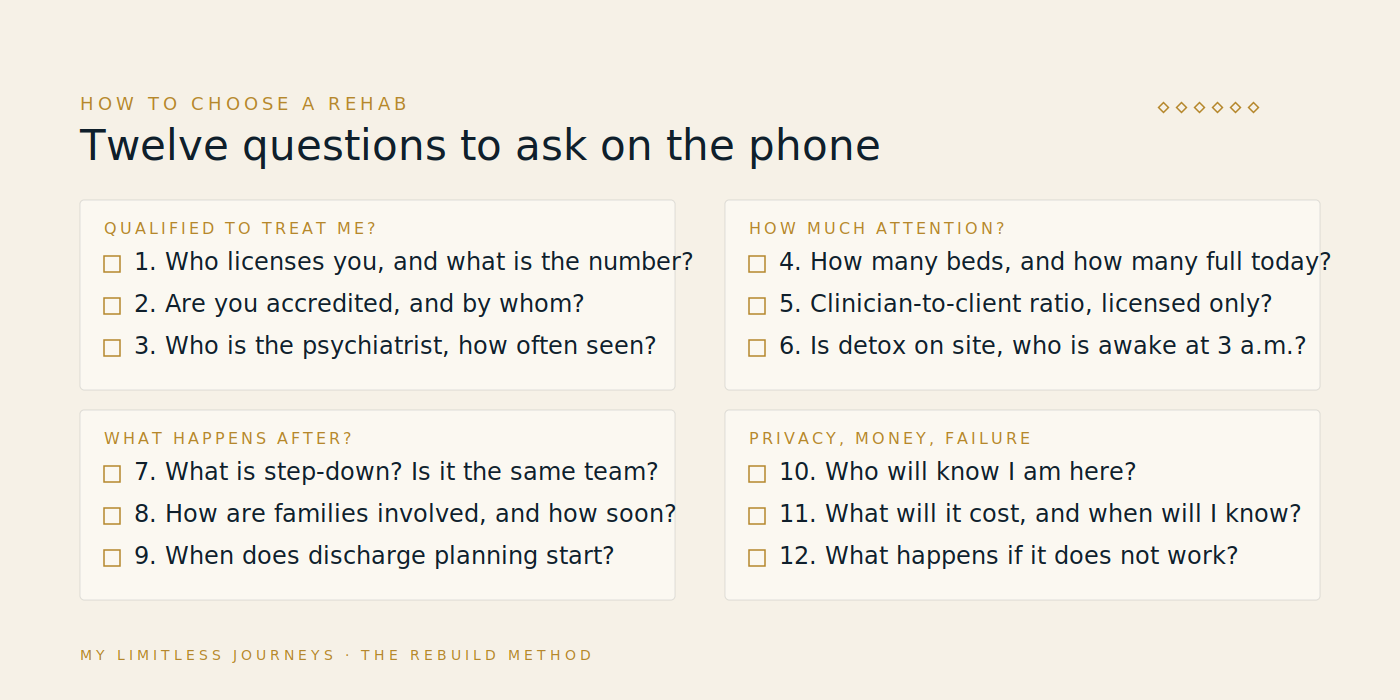
How to choose a rehab: twelve questions to ask on the phone.
Any program can sound good on a website. These twelve questions separate what a facility says from what it actually is, and we have answered each one for ourselves so you can hear what a straight answer sounds like.
Authored by the MLJ Clinical Team. Reviewed under board-certified psychiatric oversight. Last updated September 2026.
Key Takeaways- The first three questions establish whether a program is legally and clinically qualified to treat you: state licensure, independent accreditation, and a named psychiatrist.
- Bed count and clinical ratio determine how much of a clinician's attention you will actually receive; ask for numbers, not adjectives.
- A program that cannot describe detox, step-down, family involvement, and discharge planning in concrete terms has not built them.
- Privacy and cost should be answered specifically; vague reassurance on either is a warning sign.
- The most revealing question is the last one: what happens if treatment does not work the first time.
How to listen to the answers.
You are probably making this call under pressure, and the instinct is to find a place that sounds kind and say yes. That instinct is not wrong, but it is incomplete. The questions below are the ones a referring physician or a hospital discharge planner would ask before sending a patient anywhere. You are entitled to ask them too.
Two listening habits help. First, notice whether the answer contains a number, a name, or a document. "We have excellent clinical staffing" is a sentence; "one licensed clinician for every client, and I can send you the staffing sheet" is an answer. Second, notice whether the person on the phone is comfortable saying no. A program that admits everyone who calls is not screening for fit, and fit is most of what determines whether treatment holds. Our own admissions call turns people away when we are not the right level of care, and we think you should hear that from any facility you consider.
One cross-check before the list: SAMHSA's free locator at FindTreatment.gov lists licensed programs by state. If a facility does not appear there, ask why.
Questions 1–3: Is this program qualified to treat me?
1. Who licenses you, and what is the license number?
In California, residential substance use disorder treatment is licensed by the Department of Health Care Services, and detox services require a specific designation on that license. Unlicensed "sober homes" sometimes describe themselves as treatment, which they are not permitted to do. Our answer: MLJ is licensed by California DHCS for residential treatment including medically supervised detox, and we give the license number to anyone who asks. You can confirm it against the state's public database before you decide anything.
2. Are you accredited, and by whom?
Licensure is the floor; accreditation is a voluntary, independent review of clinical quality and safety by The Joint Commission or CARF. Neither guarantees good treatment, but both require a program to document what it does and submit to unannounced inspection. Our answer: we are accredited by The Joint Commission and hold LegitScript certification. We are also members of CCAPP, NAATP, IECA, and YATA, which are professional associations rather than accreditors, and we say so plainly so you do not mistake one for the other.
3. Who is the psychiatrist, and how often will I see them?
Many programs list "psychiatric services" without a psychiatrist on site or on call. What you want is a name, a board certification, and a cadence. Our answer: our clinical program operates under board-certified psychiatric oversight, our psychiatrist reviews every admission's medication list before the first night, and clients with co-occurring conditions are seen on a schedule set at intake rather than "as needed." You can read about the people involved on our team page, and about how we handle co-occurring disorders specifically.
Questions 4–6: How much attention will I actually get?
4. How many beds do you have, and how many are full right now?
Bed count is the single number that most shapes daily experience. A forty-bed facility is not worse than a six-bed one by definition, but it is a different kind of place: larger groups, more staff across shifts, less individual time, and a harder environment in which to remain anonymous. Our answer: six beds, never more, and we will tell you exactly how many are occupied today. We have written about what that number does to anonymity and to clinical ratios, because the two are linked.
5. What is your clinician-to-client ratio, and does it count non-clinical staff?
Ratios are easy to inflate by counting house managers, drivers, and administrative staff. Ask specifically about licensed clinicians: therapists, nurses, and prescribers. Then ask how many hours of individual therapy per week that ratio actually produces. Our answer: true 1:1 clinical ratios, meaning one licensed clinician per client during clinical hours, not one per shift. Individual sessions happen daily, not weekly, and group work stays small enough that everyone speaks.
6. Is detox on site, and who is awake at 3 a.m.?
Some programs send clients to a separate detox facility first, which means two admissions and a handoff at the most fragile moment. Others offer "social detox" without medical monitoring, which is dangerous for alcohol and benzodiazepine withdrawal. Ask who monitors vitals overnight. Our answer: detox happens here, in the same house, with nursing coverage around the clock and physician oversight, and the clinicians who meet you in withdrawal are the same ones who treat you in week four. Our page on what medically supervised means explains the difference in detail.

Questions 7–9: What happens after the first phase?
7. What does step-down look like, and is it the same team?
Residential treatment is a beginning. Research summarized by the National Institute on Drug Abuse consistently finds that longer engagement in care, across descending levels of intensity, predicts better outcomes than any single intensive episode; NIDA's Principles of Drug Addiction Treatment lays this out. Ask whether the program offers PHP and IOP itself or refers you elsewhere, and whether your therapist follows you. Our answer: one continuum, one clinical team. Detox, residential, PHP, IOP, transitional living, and alumni care are all ours, and your primary clinician does not change when your level of care does.
8. How are families involved, and how soon?
Some programs treat family as visitors; some treat them as clients in their own right. Ask whether there is structured family therapy, when it begins, who leads it, and what happens if you do not want your family involved at all. Our answer: family systems work is part of the Life domain of the Rebuild Method, it begins in the first two weeks when the client consents, and it is led by licensed clinicians rather than delegated to a weekend workshop. When a client prefers no family contact, we honor that and say so to the family directly.
9. When does discharge planning start?
The honest answer is "at admission." A program that begins thinking about your exit in the final week has missed the point, because the exit is where relapse risk concentrates. Ask what a discharge plan contains: housing, outpatient appointments already scheduled, medication continuity, a relapse response plan, and a named alumni contact. Our answer: your discharge plan is a working document from the first week, and it is a clinical artifact rather than a form. Our After Treatment hub shows what the first ninety days are designed to look like.
Questions 10–12: Privacy, money, and what if it fails?
10. Who will know I am here, and how do you keep it that way?
Every program is bound by HIPAA and by 42 CFR Part 2, the federal confidentiality regulation specific to substance use records, which the Department of Health and Human Services explains at HHS.gov. The question is not whether the law applies but how daily practice protects you: where the building is, who else is in it, how phones and visitors are handled. Our answer: a private hillside residence with an address disclosed only at intake, six clients at a time, and staff trained to treat identity, work, and reputation as sensitive by default. Our Privacy in Treatment hub explains exactly what it does and does not cover.
11. What will this cost me, and when will I know?
No responsible program can quote a firm number before verifying your benefits, but every responsible program can tell you how it bills, which carriers it works with, whether it is in or out of network, and when you will have a written estimate. Be wary of anyone who says "don't worry about cost" before knowing your plan. Our answer: we work with Aetna, Anthem, Cigna, Kaiser Southern California, and UnitedHealthcare, we accept private pay, and we will not admit you until you have a written picture of your expected out-of-pocket exposure. The Paying for Treatment hub explains the mechanics, including single-case agreements.
12. What happens if it doesn't work?
This is the question programs least like to hear and the one that tells you the most. Relapse after treatment is common, and a program that promises otherwise is either inexperienced or dishonest. What you want is a plan: the first twenty-four hours after a relapse, whether you can return, and what changes the second time. Our answer: we do not promise outcomes. We have a relapse-prevention program built for exactly this, alumni who relapse call the same clinician who treated them, and a return admission is planned around what the first stay taught us rather than starting from a blank chart. Our guide on why relapse happens is the long version of that answer.
Answers that should end the call.
A few responses are disqualifying on their own. If a program guarantees sobriety or quotes a "success rate" without explaining how it was measured, hang up. If it offers to cover your travel, waive your deductible, or pay you for referring friends, those are patient-brokering practices that California outlawed for good reason. If the person on the phone cannot name the medical director, or answers the bed-count question with "we're a small, intimate program" and no number, you have learned enough.
Less dramatic but equally telling: a program that pushes you to admit tonight when you are not in medical danger, or that becomes cooler once you mention you are comparing options. Fit is a two-way decision. The right place will help you make it, even if the decision goes against them; our FAQ page and your own physician are both fair places to check what you have heard.
- Treatment Guidance. Every question about levels of care, detox, and what treatment involves, in one place.
- What happens on the admissions call. The other side of this conversation: what we will ask you.
- What a 1:1 clinical ratio actually means. The number behind question five.
- Do I need residential treatment?. Deciding on level of care before choosing a program.
- Our programs. The full continuum from detox through alumni care.
- Does insurance cover addiction treatment?. Background for question eleven.
This guide is educational and is not a substitute for medical advice. If someone is in immediate danger, call 911.