What does California’s workplace naloxone law require?
California’s AB 2150, chaptered on September 20, 2026, requires any employer in the state that requires CPR certification for its employees to also require those employees to complete an online naloxone training video approved by the state Emergency Medical Services Authority. Naloxone rapidly reverses an opioid overdose, and the law aims to raise reversal rates.
The bill, by Assemblymember Matt Haney, passed quietly among dozens of behavioral health measures this fall. The Steinberg Institute’s October 28 roundup summarizes it in a single line: employers must provide naloxone training to employees who already hold CPR certification. The detail is in the bill text, chaptered as Chapter 384, Statutes of 2026. Its stated purpose is to increase the rate of opioid overdose reversals, and violating it is a crime under the bill.
Which workplaces on the Westside does it reach?
The law reaches any California employer that already requires CPR certification, which means it follows existing safety roles rather than creating new ones. On the Westside that is a long list: building security in Century City towers, hotel and hospitality staff along Wilshire, fitness and spa teams, school and childcare staff, safety personnel on productions, and many clinical roles in medical offices. The people who set those policies are often the same executives who will never take the course, which is a good reason to read the law yourself.
What AB 2150 does not do is put naloxone on the wall. Under existing law described in the same bill record, Cal/OSHA must submit a draft rulemaking proposal by December 1, 2027, to require workplace first aid kits to include naloxone or another FDA-approved opioid antagonist with instructions, and the standards board must consider adopting it by December 1, 2028. Public safety agencies that take 911 medical calls must give callers naloxone instructions by January 1, 2027. Training now, supplies later: an employer that wants the two to arrive together can simply buy the spray, which has been sold without a prescription since the FDA approved over-the-counter Narcan on March 29, 2023.
What does naloxone do, and is it safe to give?
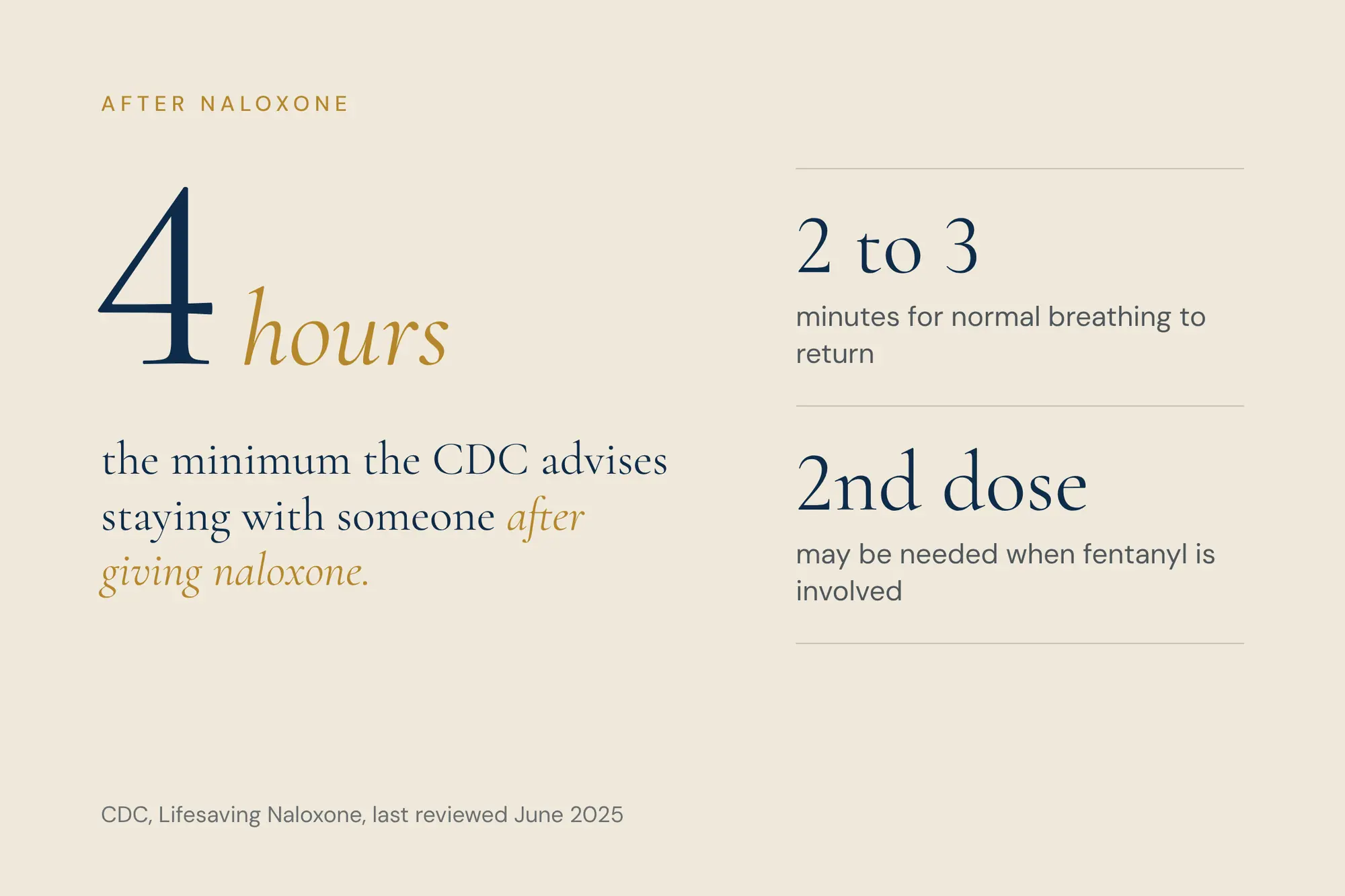
Naloxone is a medication that, in the words of the FDA, “rapidly reverses the effects of opioid overdose.” It works by blocking opioids at the receptors where they slow breathing. The CDC’s guidance on naloxone makes several points every trainee should hear plainly:
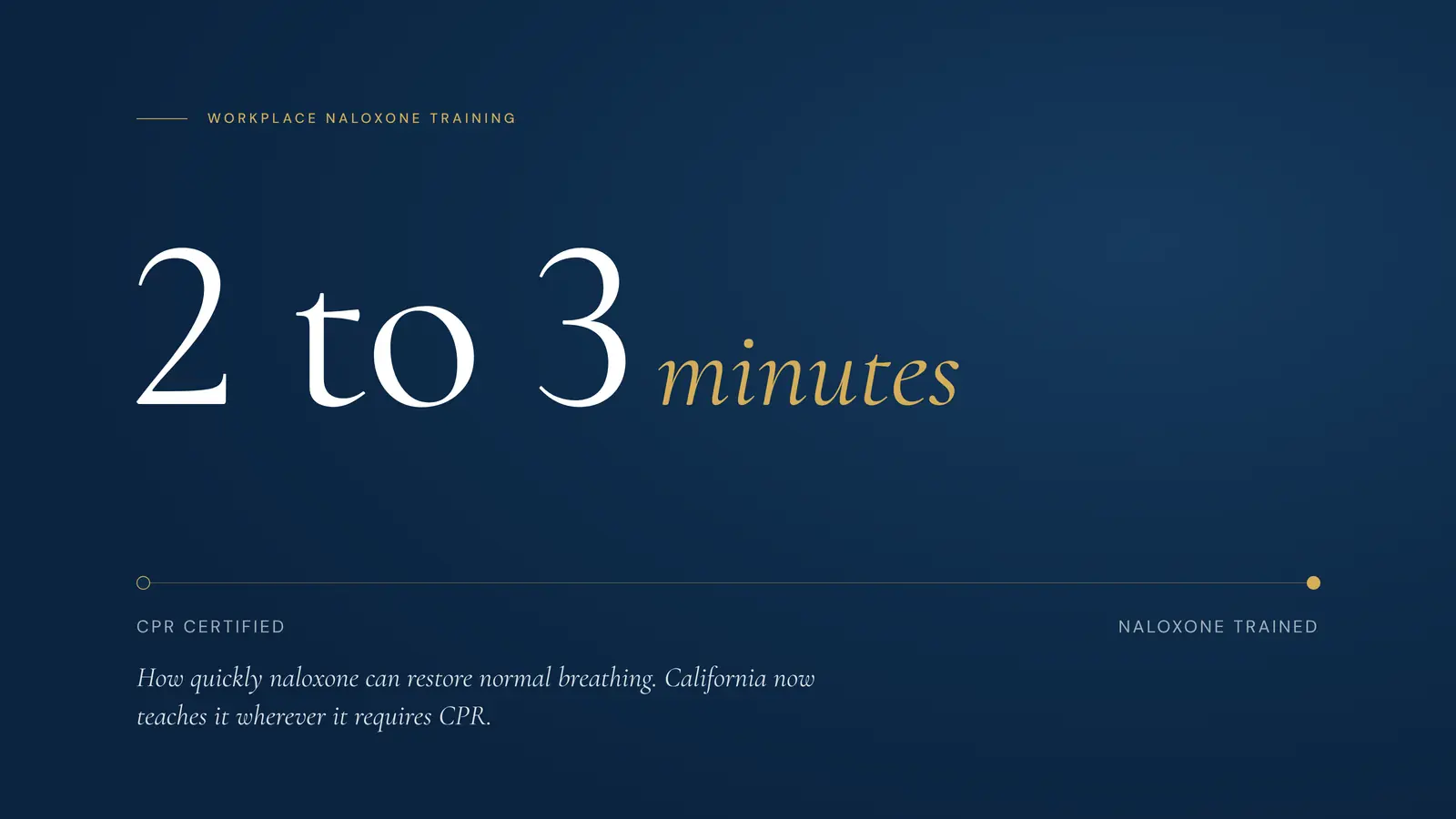
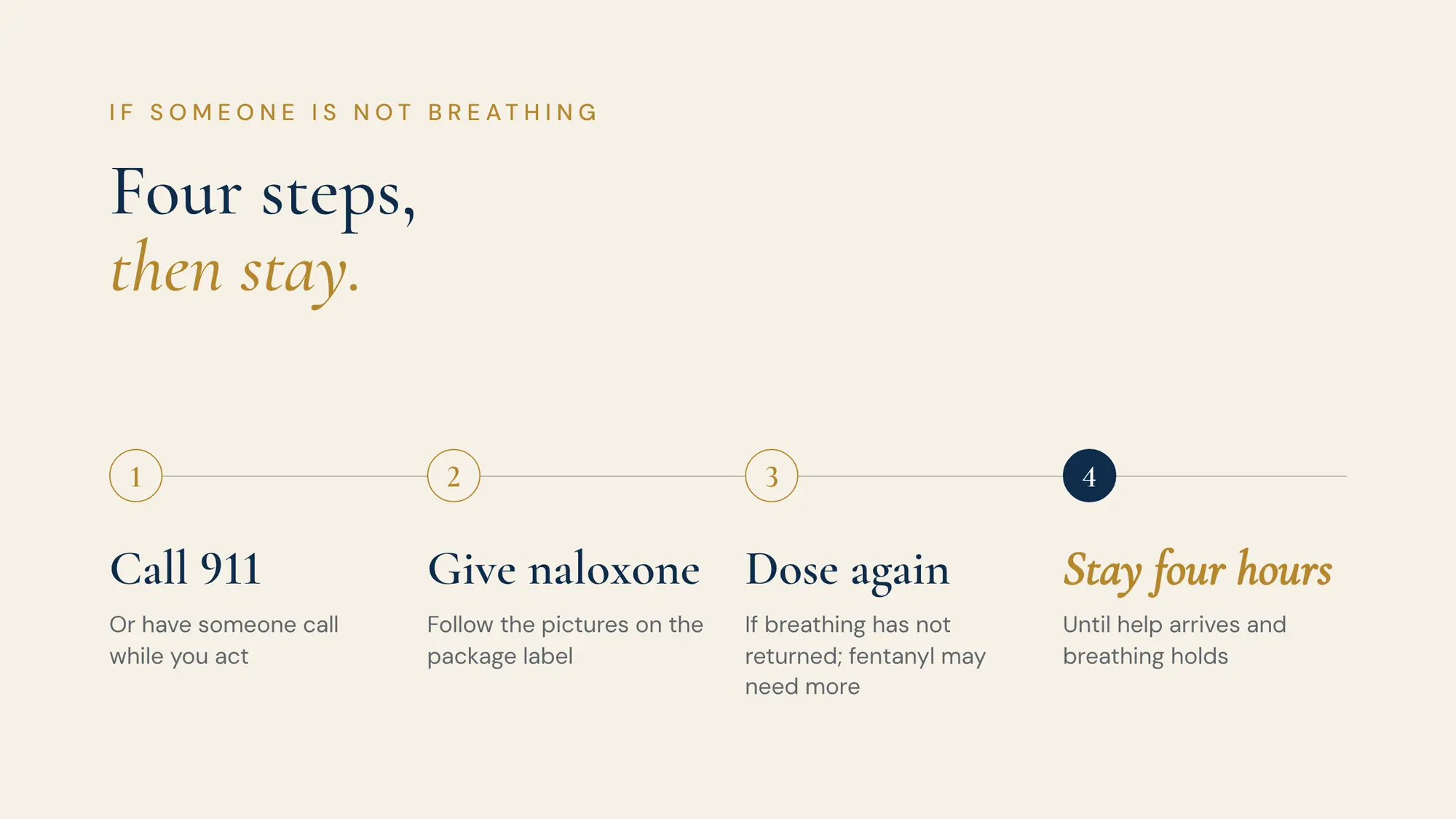
- 1It can restore normal breathing within two to three minutes.
- 2It will not harm a person who is overdosing on something other than opioids, so the CDC recommends using it whenever an overdose is suspected.
- 3More than one dose may be needed when stronger opioids such as fentanyl are involved.
- 4Someone should stay with the person for at least four hours to confirm that breathing returns to normal, and call 911 rather than wait.
The FDA notes one real caution: in a person who is physically dependent on opioids, naloxone can bring on severe withdrawal. That is uncomfortable and frightening, and it is the reason to stay, keep the person calm and let emergency responders take over. It is not a reason to hesitate.
“Naloxone is one of the first things families ask us about before discharge. We show them how to use it the way we would show them anything else that might matter on an ordinary day: calmly, and before they need it.”
Brianna Ayles, RADT, Behavioral Health Technician, My Limitless Journeys
Why should executives and professionals pay attention?
Overdose risk does not stay where people expect it to. In the twelve months ending October 2022, the FDA counted more than 101,750 reported fatal overdoses nationally, driven primarily by synthetic opioids such as illicit fentanyl. Opioid use among professionals tends to be well hidden, which is precisely why the person most likely to notice a colleague in trouble is the one at the next desk, the front desk or the security post.
For an employer, a reversal is also the beginning of a second, quieter problem: what happens on Monday. The response that helps most is private, practical and fast. That usually means a confidential conversation, paid or unpaid leave handled without public explanation, and a referral to care that can start within days. Our guide to what an employer can and cannot learn about treatment answers the questions most people ask first, and our page on care for film and television crews speaks to productions in particular.
What should happen after someone is revived?
Naloxone ends an overdose; it does not end the illness behind it. The CDC asks bystanders to stay at least four hours for a reason: breathing has to hold, and emergency care has to arrive. In the days that follow, the risk is a return to use at a dose the body no longer tolerates, and our page on the first 24 hours after a relapse walks a family through that window.
“A reversal ends an overdose. It does not end the illness behind it. The days after someone is revived are often when they are most willing to talk about help, and families should be ready to have that conversation quickly.”
Maria Dahlman, MA, LCSW, Regional Clinical Director, Emend Healthcare
For opioids, and fentanyl in particular, the next step is usually medically supervised detox followed by residential care, with medication for opioid use disorder started and continued rather than stopped at discharge. Our explainer on opioid and fentanyl detox describes why fentanyl withdrawal starts later and lasts longer than people expect.
Where Beverly Hills families and employers can turn
My Limitless Journeys offers drug rehab for Beverly Hills clients at a single six-bed residence in Encino, about twenty to thirty minutes over the Sepulveda Pass or Beverly Glen. We have no Beverly Hills facility; clients come to us, and arrival is arranged privately through admissions. Detox, residential treatment, PHP and IOP are carried by one clinical team, and every client leaving after opioid treatment, along with any family member who wants it, is offered naloxone and shown how to use it.
For an employer or family member trying to help after an overdose or a near miss, the first call is a conversation, not a commitment. Our Beverly Hills drug rehab page explains how substance-specific detox and residential care work for clients from the area, and our Beverly Hills overview covers privacy, the drive over the hill and what to expect on the first call.
Frequently asked questions
Does AB 2150 require my company to keep naloxone on site?
Not by itself. AB 2150 requires naloxone training for employees whose employer already requires CPR certification. Separately, Cal/OSHA must propose a rule by December 1, 2027, to add naloxone or another FDA-approved opioid antagonist to workplace first aid kits, and the standards board must consider adopting it by December 1, 2028.
When does the workplace naloxone training requirement start?
The bill record does not list a separate start date. California statutes passed without an urgency clause generally take effect on January 1 of the following year, so employers should plan for January 1, 2027, and watch for the Emergency Medical Services Authority’s list of approved training modules.
Can I get in trouble for giving naloxone to a coworker?
California has expanded protections for people who act in good faith. AB 1037, signed in 2025, broadened access to opioid antagonists such as naloxone and protects good-faith Good Samaritans, according to the Steinberg Institute’s summary of that year’s bills. Call 911 first or as soon as you can, give the naloxone and stay with the person.
Will naloxone hurt someone who did not take opioids?
No. The CDC states that naloxone will not harm a person overdosing on drugs other than opioids, which is why it recommends giving it whenever an overdose is suspected. In someone physically dependent on opioids it can cause sudden withdrawal, so stay with the person until emergency help arrives.
Questions about a colleague, a family member or yourself are welcome. We will explain the options, what detox and residential care involve and what coverage looks like, before anyone decides anything.
Begin a conversation · (866) 209-4246 (admissions, business hours)
This article is general information, not a diagnosis or a substitute for an assessment by a clinician. If someone is in immediate danger, call 911. In a mental health or substance use crisis, call or text 988.
Sources
- Digital Democracy (CalMatters), “AB 2150, Employer naloxone training,” bill status and text, chaptered September 20, 2026, Chapter 384. calmatters.digitaldemocracy.org
- Steinberg Institute, “Behavioral Health Bills Signed into Law by Governor Newsom in the 2025 to 2026 Legislative Year,” October 28, 2026. steinberginstitute.org
- Centers for Disease Control and Prevention, “Lifesaving Naloxone,” last reviewed June 11, 2025. cdc.gov
- U.S. Food and Drug Administration, “FDA Approves First Over-the-Counter Naloxone Nasal Spray,” March 29, 2023. fda.gov
- Steinberg Institute, “Behavioral Health and Substance Use Disorder Bills Signed into Law by Governor Newsom in the 2025 to 2026 Legislative Year” (2025 bills, including AB 1037), October 22, 2025. steinberginstitute.org
Every article on this site is written by our editorial team and reviewed by a licensed clinician. Read how we write and review content.
Keep reading: Drug rehab for Beverly Hills clients · Opioid and fentanyl detox · Relapse: the first 24 hours · Can my employer find out I went to rehab?